Hey Developers,
Enjoy watching the new video on InterSystems Developers YouTube:
InterSystems IRIS is a Complete Data Platform
InterSystems IRIS gives you everything you need to capture, share, understand, and act upon your organization’s most valuable asset – your data.
As a complete platform, InterSystems IRIS eliminates the need to integrate multiple development technologies. Applications require less code, fewer system resources, and less maintenance.
Hey Developers,
Enjoy watching the new video on InterSystems Developers YouTube:
I want to fetch value from a global without being limited by the namespace. Is there any way of referencing the values from a global to a different namespace?
   _________ ___ ____
  |__  /  _ \_ _|  _ \
    / /| |_) | || |_) |
   / /_|  __/| ||  __/
  /____|_|  |___|_|
Starting in version 2021.1, InterSystems IRIS began shipping with a python runtime in the engine's kernel. However, there was no way to install packages from within the instance. The main draw of python is its enormous package ecosystem. With that in mind, I introduce my side project zpip, a pip wrapper that is callable from the iris terminal.
Hi Community,
I'm pleased to announce DEVBOX, the code anywhere IDE for IRIS.
Please watch the video and let me know what you think. Would you use it?
All the best,
Sean.
Hi devs!
How one can understand the classnames of request and response messages of a given operation?
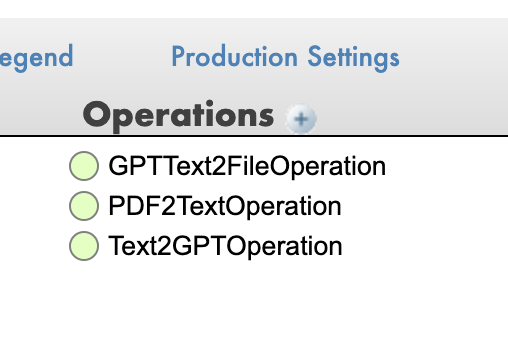
E.g. when I build the data transformation, how do I know which message will come to the operation?
Now the Classes/Rutines/DeepSee files will be automatically exported to the working directory after saving or compiling and files will be automatically deleted .
To install isc-dev , you just need to download and import the file isc-dev.xml from last release.
Some ways to import isc-dev .xml file:
NS>do $system.OBJ.Load("yourpath/isc-dev.xml","ck")
NS>zpm
zpm: NS>install isc-dev
NS>do ##class(dev.code).workdir("/path/to/your/working/directory/src/")
dev.FileManExtension class as the main one and save it.It can be obtained by using the Size query of the system-provided %SYS.GlobalQuery class.
See the sample code below for usage examples.
*Please check the class reference for specifying columns and parameters.
 set dir="C:\intersystems\iris\mgr\user" // IRIS.DAT(or CACHE.DAT) folder
 set rs = ##class(%ResultSet).%New("%SYS.GlobalQuery:Size")
 do rs.Execute(dir) // You can also specify a mask with the 3d parameter
 while (rs.Next()) {
   set gname= rs.Get("Name") // global name
   set gsize= rs.Get("Used MB") // global size (MB)
write gname," : ",gsize,!I'm trying to execute SQL on a EC2 via SSM:
import boto3

instanceid = "i-123456789"
sql = """SELECT path FROM Security.Applications WHERE ID = '/csp/sys'"""
template = """su - irisusr -c 'cat << EOF | iris sql iris -U %SYS
                """ + sql + """
                        q
                        EOF'
                       """
template = [line.strip() for line in template.splitlines()]
template = """\n""".join(template)
ssm_client = boto3.client('ssm')
response = ssm_client.send_command(
            InstanceIds=[instanceid],
            DocumentName="AWS-RunShellScript",
            Comment=AWS,
Parameters={'commands': template})With rapid evolution of Generative AI, to embrace it and help us improve productivity is a must. Let's discuss and embrace the ideas of how we can leverage Generative AI to improve our routine work.
Is it possible to hide certain properties in a class from displaying in the BPL visual editor, if you want to prevent drag and drop from accessing them or otherwise controlling or restricting their behavior?
Virtual document messages, such as EnsLib.HL7.Message, have hidden fields, such as Source, that do not show, presumably since the field list is rebuilt from the document schema. Setting the flag Internal, or XMLPROJECTION = "NONE" doesn't do it. Trying to follow the Virtual Document precedent to rebuild or edit the field list seems like a heavy list.
The extended maintenance releases of InterSystems IRIS, InterSystems IRIS for Health, and HealthShare Health Connect 2023.1.1 are now available. This release provides bug fixes for the previous 2023.1.0 releases.
You can find the detailed change lists / upgrade checklists on these pages:
The software is available as both classic installation packages and container images. For the complete list of available installers and container images, please refer to the Supported Platforms webpage.
Hey Developers,
Enjoy watching the new video on InterSystems Developers YouTube:
⏯ Projecting Data into InterSystems IRIS with Foreign Tables
I have several 1GB journals from a LIVE server that I would like to inspect (eg: check which globals have been updated over the time).
Is there a simple way to view those journals using another IRIS instance ? (eg: local installation).
I have been tempted to put those files directly into the journal folder of my local installation and restart the system, however I am concerned that the transactions they contains will be restored and will corrupt the local database.
I have checked documentation but couldn't find anything.
Hi All,
I am trying to fetch resultset using the below code -
set rs = ##class(%ResultSet).%New("Simple.Person:ValidateAge")
do rs.Execute()
it is giving me error while the same code I run it through iris terminal worked fine.
I want to understand that problem behind this. Also how can I check the possible methods that I can use on 'rs' somewhat dir() does in python.
Hi Developers, I am glad to announce Git for InterSystems IRIS, my first submission to OpenExchange and part of the current Developer Tools Contest.
Git for InterSystems IRIS is a source control package that aims to facilitate a native integration of the Git workflow with the InterSystems IRIS platform. It is designed to work as a transparent link between InterSystems IRIS and a Git-enabled code directory that, once setup, requires no user interaction. A detailed description can be found on GitHub.
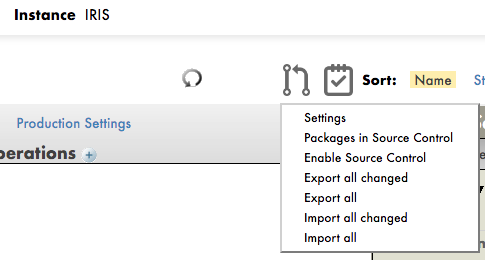
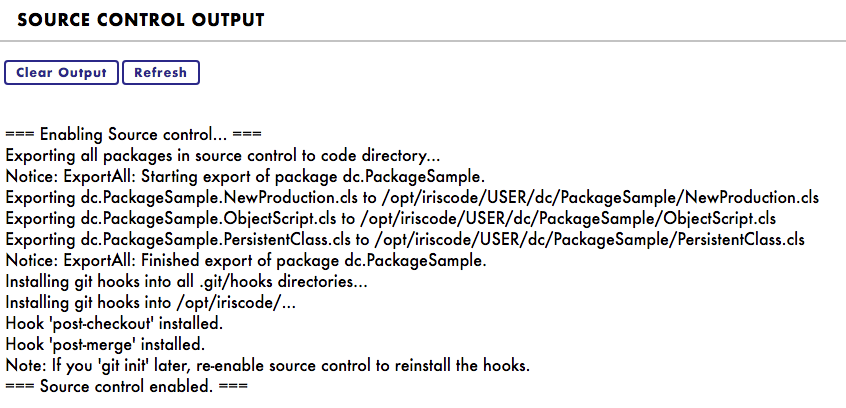
I am looking forward to learn what you think about this approach. Does it make sense?
Our next Developer Meetup will take place on July 26, 17:30 pm at the CIC Venture Café in Cambridge.
Join us to learn Generative AI Use Cases + Reference Architecture in Healthcare, witness the demo of LLMs in Healthcare and share your thoughts on the topic.
I am getting this "Studio Item 'Ens.StringResponse' is mapped from a database that you do not have write permission on. " if I am pressing any key in that class. I need to define some Property inside it. How Can I do the same
Hi everybody,
I am writing an SQL query of the following form:
SELECT
(SELECT COUNT(*) FROM DataTable WHERE Condition1 AND Condition2),
(SELECT COUNT(*) FROM DataTable WHERE Condition1 AND Condition3),
(SELECT COUNT(*) FROM DataTable WHERE Condition1 AND Condition4),
(SELECT COUNT(*) FROM DataTable WHERE Condition1 AND Condition5),
user.id
FROM UserTable user
where Condition1 depends on user and is the same for all four COUNT(*) subqueries. This query is very slow, and I believe that it can be sped up significantly if Condition1 would be checked once rather than four times.
Trying my first REST call operation to our internal EMR (Epic) server, and I am receiving "ERROR #6097: Error '<READ>Read+28^%Net.HttpRequest.1' while using TCP/IP device '9999'" when I attempt to test my operation. When I look up the General Error Messages for 6097 I am seeing...Error '%1' while using TCP/IP device $zu(189,1)='%2'. What does this mean?
I am trying to connect to the server over port 443 which is HTTPS but I am not using an SSL Configuration. Could that be the issue?
Is there a way to debug HTTP like their is with the ISCSOAP log?
Is "time" a reserved word in the %CONTAINS function?
When I run the following SQL query, I get 0 matching results
SELECT ID, text
FROM Test.Sentence
WHERE text %CONTAINS('time') OR text %CONTAINS('time ') OR text %CONTAINS(' time')
However, when I run a query where the search string contains words other than "time" alone, it returns the expected matching results
SELECT ID, text
FROM Test.Sentence
WHERE text %CONTAINS('providers time money') OR text %CONTAINS('providers time') OR text %CONTAINS('time money')
It also works if I try to search for "tim" or "ime"
SELECT ID, text
FROM Test.
Hi community,
In this article, we will learn how to set up a REST API for the IRIS Security Package. We will be able to create users, roles, add applications, etc... by simple HTTP requests as well as generate a client application in ObjectScript.
We need :
We will use a set of existing applications and libraries on OpenExchange.
InterSystems IRIS offers various ways how to profile your code, in most cases it produces enough information to find the places where the most time is spent or where the most global sets. But sometimes it's difficult to understand the execution flow and how it ended at that point.
To solve this, I've decided to implement a way to build a report in a way, so, it's possible to dive by stack down
.png)
A simple data analysis example created in IntegratedML and Dashboard
Based on InterSystems' Integrated ML technology and Dashboard, automatically generate relevant predictions and BI pages based on uploaded CSV files. The front and back ends are completed in Vue and Iris, allowing users to generate their desired data prediction and analysis pages with simple operations and make decisions based on them.
Hi folks!
How can I change the production setting programmatically?
I have a production that is a solution that uses some api-keys, which are the parameters of Business Operations but of course cannot be hard-coded into the source code.
E.g. here is the example of such a production that runs a connection of Telegram and ChatGPT.
And it can be installed as:
zpm "install telegram-gpt"
But now one needs to setup the key manually before using the production, having the following setting:
.png)
I'd like to set up it programmatically so one could install it as:
zpm "install telegram-gpt -D Token=sometoken"
How can I make it work?
I want to fetch both column name and value from resultset of sql query . I am using ExecDirect() method for SQL execution.
please help me out.
I had attempted to create a REST Operation before but did not have success. As I am going through the Tutorials and Documentation everything references REST services, but I have a case where I want to create a REST Operation that makes Epic API calls against Interconnect. I have done SOAP operations before and we currently have one in our Production Namespace, but from what I understand SOAP has the wsdl which defines al the structures and etc, where REST does not.
So how does one go about creating a REST Operation if Learning Tutorials and Documentation always talks about REST services?
I am playing around with trying to make an Epic REST API call from an operation, and from what I understood because the request has to be sent as POST, I need to send the request as JSON. However when I try taking the request and running %ToJSON against it for the payload to be created I am getting an error...
ERROR <Ens>ErrException: <METHOD NOT SUPPORTED>zgetPatientLocationByVisit+6^User.SCOTT.REST.APIOperation.1 *%ToJSON,osuwmc.Epic.Access.Request.
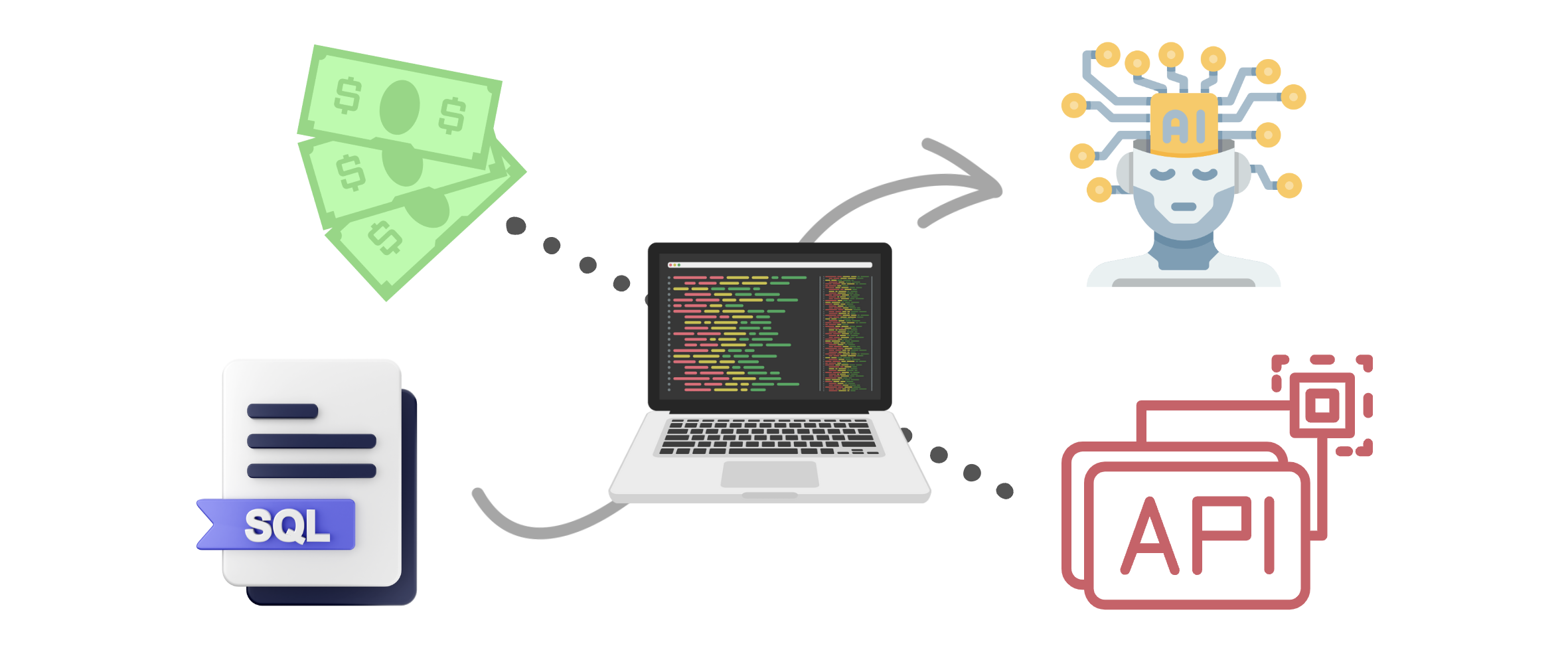
The continuing convergence of AI technologies and healthcare systems has brought forward many compelling advancements. Let's set the scene. If you have interacted with dynamic models like ChatGPT, you might have, like many of us, begun to envision its application using your unique datasets. Suppose in the healthcare sector you wish to link this technology with Electronic Health Records (EHR) or Electronic Medical Records (EMR), or perhaps you aim for heightened interoperability using FHIR's resources.
Hi all,
I am using ExecDirect() method to get SQL resultset of type %SQL.StatementResult.
now I am fetch a column something like this rs.%Get("Amount") but if amount column is empty then it is return me empty string. If There is any way to set something like this in IRIS rs.%Get("Amount",0.00) if that is possible.
Hello Everyone,
The Certification Team of InterSystems Learning Services is in the process of developing two exams focused on using SQL in InterSystems IRIS and we need input from our InterSystems IRIS SQL community. Your input will be used to evaluate and establish the contents of the exam.
How do I provide my input? We will present you with a list of job tasks, and you will rate them on their importance as well as other factors.
How much effort is involved? It takes about 20-30 minutes to fill out each survey. You can be anonymous or identify yourself and ask us to get back to you.