In my previous HttpRequests, I have used Content-Type = application/json but I have a vendor that is requesting we send application/x-www-form-urlencoded. How would I go about formatting the Payload as x-www-form-urlencoded?
Thanks
InterSystems IRIS for Health™ is the world’s first and only data platform engineered specifically for the rapid development of healthcare applications to manage the world’s most critical data. It includes powerful out-of-the-box features: transaction processing and analytics, an extensible healthcare data model, FHIR-based solution development, support for healthcare interoperability standards, and more. All enabling developers to realize value and build breakthrough applications, fast. Learn more.
In my previous HttpRequests, I have used Content-Type = application/json but I have a vendor that is requesting we send application/x-www-form-urlencoded. How would I go about formatting the Payload as x-www-form-urlencoded?
Thanks
i am install the IRISHealth on Mac,however,it met below error,can someone help on this issue:
below is the setup when do install,id/group irisusr is create during install setup.
IPM version 0.10.5 has been released on January 15, 2026. This new version contains a ton of improvements and bug fixes so be sure to check it out either directly from the GitHub page or from the Community Registry!
The big changes include the following:
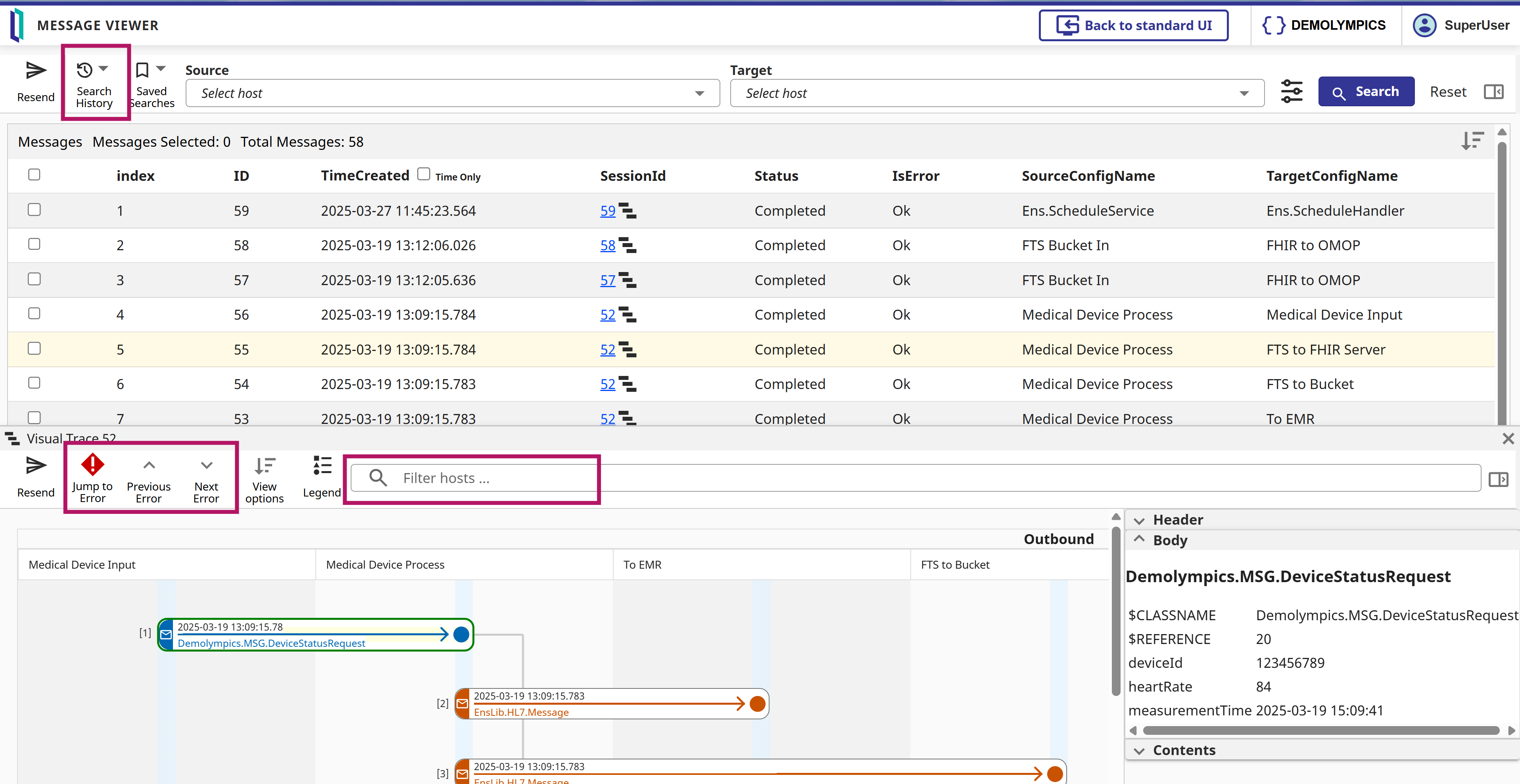
When using InterSystems IRIS as an interoperability engine, we all know and love how easy it is to use the Message Viewer to review message traces and see exactly what's going on in your production. When a system is handling millions of messages per day, you may not know exactly where to begin your investigation though.
Over my years supporting IRIS productions, I often find myself investigating things like...
Hi Community,
What is the correct syntax in a merge.cpf file to create a database with its associated resource ?
How many times have you had to receive or generate a JSON and wished you could work on it using DTLs without having to deal with DynamicObjects trying to remember the name of each field? Do you want to break down and make your giant JSON file more digestible?

In my case, never, but I thought that someone might find it useful to have a feature that captures your JSON and breaks it down into a series of ObjectScript classes that you can work with more easily and conveniently.
Well then...behold JSON2Class in all its glory!
Job Title: InterSystems Developer / Specialist (IRIS / HealthShare)
Location: New York City, NY (Hybrid / Remote)
Duration: Contract (2+ years)
Experience: Min. 8 Years
We are looking for an experienced InterSystems Developer / Specialist with expertise in InterSystems IRIS / HealthShare to support healthcare integration and interoperability initiatives. The ideal candidate should have hands-on experience in ObjectScript development, healthcare data standards, and integration protocols supporting EHR/HIE
What is a FHIR Profile?
A FHIR profile is a collection of rules and constraints used to customize and refine a base Fast Healthcare Interoperability Resources (FHIR) resource. Profiling is a vital process that adapts the base FHIR resource standard to satisfy the unique requirements of a specific use case, geographic region, medical institution, or clinical workflow.
While the base FHIR specification provides generic, flexible definitions for resources (such as Patient, Observation, or Medication), profiles transform these generic resources into more precise ones. This ensures consistent and interoperable data exchange tailored for a particular community or implementation.
FHIR is designed to cover various healthcare scenarios globally. Profiles allow implementers to adapt this general platform without losing the benefits of standardization.
Given a sting beginning with "-----BEGIN CERTIFICATE-----" and ending with "-----END CERTIFICATE-----", how do I save the string as X509 certificate in ObjectScript?
A question that quickly arises when configuring IAM (aka Kong Gateway) is how many routes should be created to reach all the business objects in an IRIS API.
A common mistake is to create one route per business object, unnecessarily multiplying the number of routes.
Let's take the example of the Supply Chain Orchestrator Data Model API:
RabbitMQ is a message broker that allows producers (those who send a data message) and consumers (those who receive a data message) to establish asynchronous, real-time, and high-performance massive data flows. RabbitMQ supports AMQP (Advanced Message Queuing Protocol), an open standard application layer protocol.
The main reasons to employ RabbitMQ include the following:
We are hiring! 100% Remote W2 Contract | 3-6+ Months (numerous extensions likely)
Two Roles:
🔹InterSystems Engineer
🔹Epic Bridges Certified/InterSystems Engineer
Having solid experience with the below:
Hi, now I would like to continuous on the topic that we talk about previously
Using Postman for testing the OAuth2.0 of the InterSystems FHIR repository - Part1
Question 1: Where is my client_id and client_secret come form?
Short answer: Authentication Server.
If you don't have an Authentication Server, you may set up one as following
Provide the hostname (the host must support Https), at least 1 grand type (we choose client credential here), and SSL/TSL configuration
What is JWT?
JWT (JSON Web Token) is an open standard (RFC 7519) that offers a lightweight, compact, and self-contained method for securely transmitting information between two parties. It is commonly used in web applications for authentication, authorization, and information exchange.
A JWT is typically composed of three parts:
1. JOSE (JSON Object Signing and Encryption) Header
2. Payload
3. Signature
These parts are encoded in Base64Url format and concatenated with dots (.) separating them.
Structure of a JWT
Header
{ "alg": "HS256", "typ": "JWT"}
Payload
I have a Postgres table which should be migrated to IRIS. The table has a computed column, like:
CREATE TABLE example_table (
id VARCHAR(10) PRIMARY KEY,
normalized_id VARCHAR(10) GENERATED ALWAYS AS (LPAD(id, 10, '0')) STORED
);
IRIS also has the LPAD function but I can't figure out how to achieve the same result using pure SQL DDL.
Tried this:
CREATE TABLE example_table (
id VARCHAR(10) PRIMARY KEY,
normalized_id VARCHAR(10) COMPUTECODE {
set {normalized_id} = LPAD({id}, 10, '0')
}
COMPUTEONCHANGE(id))
Got the following error:
I know this is not recommended but I need to investigate a bug and to modify some system classes. When I set the "Mount as read-only" flag to "off" IRIS says:
ERROR #43: the write daemon failed to set the READ/WRITE flag in IRISLIB
This database is mounted as read-only due to 'Failed to access iris.lck file'!
We are a group of interface analysts in a healthcare setting, running IRIS for Health 2024, having upgraded over time from an old ENSEMBLE environment. We have been working on a wish list of development goals, but are having trouble finding the correct, best practice method/path for getting to what we envision.
SETassigns value to the variable at RUNTIME.
#DIM declare the variable and it's Data Type at COMPILE TIME.
SET |
#DIM |
| Makes the variables Dynamic. | Improves Readability. |
| No Data Type Declaration. | Enables IDE auto-completion. |
| Runtime | Useful for Object references. |
#DIM name As%StringSet name = "Micheal Scott"#DIM age As%NumericSet age = 36#DIM employer As App.Employer ; compile timeSet employer = ##class(App.Employer).%New() ; runtime
SETor #DIM? Your design, your rules.I’m working on XML Digital Signature in InterSystems IRIS using %XML.Security.Signature
I start with an XML document that is created by parsing an input XML string, and I want to digitally sign this document using an X509 certificate.
Hey Community,
Enjoy the new video on InterSystems Developers YouTube:
⏯ Advancing Healthcare Interoperability - Strategy and Vision @ Ready 2025
Iris Health dashboard images not loading after first install, getting 404 on /csp paths, is there any setup I am missing?, found this old community post: https://community.intersystems.com/post/debugging-why-management-portal… but the links are outdated, can anyone please guide me to proper documentation. Thanks in advance.
Screenshot attached:
I have a business service that actively reads data from a remote Postgres database. OnProcessInput opens a XDBC (actually JDBC) connection, executes an SQL query, fetches several thousand rows, iterates the resultset, and closes the connection. On each iteration I also need to update each source row in the remote database using PreparedStatement.
In other words, in every OnProcessInput call I have a long running SELECT statement and several thousands small UPDATE statements.
The problems I'm facing are:
InterSystems IRIS is built on an architecture that separates the logical organization of data (namespaces) from its physical storage location (databases). Understanding this separation and the distinction between Namespaces and Databases is crucial for effective data management, security, and especially, high-performance data sharing.
In this article, I will discuss these foundational components and provide a practical guide on leveraging global mappings to share native data structures (globals) across different logical environments.
A database represents the physical reality of where the data is stored on the disk. First and foremost, it’s a file in a file system called IRIS.dat (e.g., <Install folder>\mgr\user\IRIS.DAT). The maximum size of this file is 32TB. It is the container for all the actual data and the code. Databases are managed by the IRIS kernel, which handles caching, journaling, and transaction logging at the physical file level.
When you install InterSystems IRIS DBMS, the following databases are installed automatically:

Sometimes it is more convenient, more efficient, and more secure, to limit FHIR Searches per pre-defined "Lists" of Resources.
Since v2025.1 we support several List-related features in our FHIR Server.
I will highlight these here, and provide some samples.
I have a Photo that is stored as an VARBINARY within MS SQL. I would like to Select the data into a EnsLib.SQL.Snapshot, is that possible? I would take it out of the Snapshot and send it to a %Stream so it can be written out to a file.
Hi Everyone!
We have an existing process (running in FIFO order), all business hosts having pool size=1.
Currently we are reading records from a file (one record at a time) then that record goes to business process for further processing and finally through the business operation. As of now we are using synchronous call in our existing code. Before processing the last record we are using hang of 50 seconds because we need to initiate a batch once the processing of last record is finished.
This process is taking too much time for a file having 0.1 million records (max records in a file).
Developing Custom Components for Integrations – In Person (Boston, MA) February 10-12, 2026
I was trying to see if we could connect to another Server, we use to execute external scripts using %Net.SSH.Session.