Hi Community,
How do I include the users on the Patient Index worklist to be part of the users on the arrow below?
.png)

InterSystems HealthShare is a healthcare informatics platform for hospitals, integrated delivery networks (IDNs) and regional and national health information exchanges (HIE). HealthShare includes health information exchange, data aggregation, workflow, text analysis, and analytics technology.
Hi Community,
How do I include the users on the Patient Index worklist to be part of the users on the arrow below?
HL7 (Health Level 7) is a set of technical specifications for computerized exchanges of clinical, financial and administrative data between hospital information systems (HIS). These specifications are variously integrated into the corpus of formal American (ANSI) and international (ISO) standards.
The L7 of HL7 indicates that it is a standard that operates at layer 7, in other words at the application layer, of the OSI model. This means that HL7 does not have to take into account exchange security considerations, or those of message transport (this being ensured by lower-level layers such as SSL/TLS for security or TCP for the transport of data for example). To be more precise, layer 7 supports communications for end-user processes and applications and the presentation of data for user-facing software applications. As the highest layer of the OSI model, and the closest to the end user, layer 7 provides application-specific functions such as identifying communication partners and the quality of service between them, determining resource availability, considering privacy and user authentication, and synchronizing communication, as well as connecting the application to the lower levels of the OSI model.
Returning to the HL7 standard, the HL7 version 2 standard (also known as Pipehat) was originally created in 1989 but is still being used and updated regularly, resulting in versions 2.1, 2.2, 2.3, 2.3.1, 2.4, 2.5, 2.5.1, 2.6, 2.7, 2.7.1, 2.8, 2.8.1, 2.8.2 and 2.9. The v2.x standards are backward compatible (e.g., a message based on version 2.3 will be understood by an application that supports version 2.6) and in higher versions, you will see some fields are left just for it.

Despite it being more than 30 years old, HL7v2 remains the most widely used healthcare interface standard by a large margin according to the HL7.org portal that tells that:
In the previous article, we've seen the structure of one of the most used types of HL7 message - ADT (Admit, Discharge, Transfer) and an example of ADT^A04 with the description of all its fields. Now let's look at another flow of data having to do with ordering and fulfilling the orders of tests. I'm talking about ORM (as of version 2.5 you should use specific messages to order tests, like OMG, OML, OMD, OMS, OMN, OMI, and OMP), ORL and ORU messages. In a very simplified case, the exchange of data may look like this.
.png)
Let's look at these messages in more detail.
InterSystems announces another developer preview release, as part of the developer preview program for the 2022.3. Many updates and enhancements have been added in 2022.3 and there are also brand new capabilities, such as the new FHIR SQL Builder, improvements for Columnar Storage, and support to Oracle Linux 9. Some of these features or improvements may not be available in this current developer preview.
Future preview releases are expected to be updated biweekly and we will add features as they are ready.
Cures Act USCDI/ C-CDAv21 certification. I am looking for SDA3 examples for Newman-Bates-Kid/registry settings/advices on how to learn / whatever is helpful. InterSystems xsl files are clean but I am not working very often with xsl. I am mainly looking at Provenance and Clinical Notes, the 2 last errors we have. InterSystems documentation, so far I know, is very poor: only classes and some pages. Support has a small knowledge about SDA3 -> C-CDAv21 even if they try very hard to help.
Of course I am wondering if my company is using an almost dead technology. Is everybody on fhir now?
When creating a PRA (Privileged Routine Application; which by the way is not relevant just for Routines but also for Classes/Methods), it is important to make sure you include a new $ROLES, before calling AddRoles(). For example:
 new $ROLES
 set status=$System.Security.AddRoles("MyPrivilegedRoutineApplication")
This way you ensure that indeed the added (elevated) roles "evaporate" for the User running this code, once the User is out of the scope of that routine/method.
[Thank you @Andreas Dieckow for validating this]
Look forward to the first Dutch HealthShare user group next Friday in Groningen. We have great topics to discuss with some Dutch HealthShare users:
Hi Community,
I need assistance to query ODS FHIR server to retrieve only one record.At the moment I am getting multiple records returned as seen below.
Is there a way to specify a parameter that will return a single record instead of 21 because it's the same practitioner returned 21 times.
.png)
Hi Community,
Can someone assist me to check why HealthShare Iris install disk space increased, I want to know what contributed to Disk space utilization increase as it it now running at 81%. I am running Redhat Linux machine which is hosted on AWS.
.png)
Hi all,
I'm fairly new to this engine so I was wondering what the best approach for creating a dynamic mapper to downgrade from one HL7 version to another (e.g 2.4 to 2.3) with the DTL Editor, It seems like something that would be quite commonly needed but I haven't found a method that works yet,
I would like to Map any 2.4 ADT message to the same event type in a lower version (e.g DocType 2.4:ADT_A01 to 2.3:ADT_A01), without having to create a specific map for each trigger event and without having to specify the DocType ahead of time.
This set of tools (RanRead, RanWrite, and the combined RanIO) is used to generate random read and write events within a database (or pair of databases) to test the IO speed of IRIS running on a specified hardware setup. While Read operations can be measured in the usual Input/Output operations per second (IOPS) since they're direct disk reads, write events are sent to the database and thus their physical writes are managed by IRIS's write daemon.
Results gathered from the IO tests will vary from configuration to configuration based on the IO sub-system. Before running these tests, ensure corresponding operating system and storage level monitoring are configured to capture IO performance metrics for later analysis. The suggested method is by running the System Performance tool that comes bundled within IRIS. Please note that this is an update to a previous release, which can be found here.
Good morning,
We have been investigating how to activate a Server to Generate Tokens and an associated Resource Server to Validate the Token. This step, actually we have found out with the invaluable support of @Alberto Fuentes from Intersystems.
Hello community,
on my first steps with processing FHIR requests, I tried to create a capability statement resource an returning its content JSON or XML, depending on what is requested by the client.
I create a CapabilityStatement object by parsing a JSON file with:
then, depending on the content of
InterSystems is proud to announce another developer preview release, as part of the developer preview program for the 2022.3. Many updates and enhancements have been added in 2022.3 and there are also brand new capabilities, such as the new FHIR SQL Builder, improvements for Columnar Storage, and support to Oracle Linux 9 (not in this preview yet).
Future preview releases are expected to be updated biweekly and we will add features as they are ready. Please share your feedback through the Developer Community so we can build a better product together.
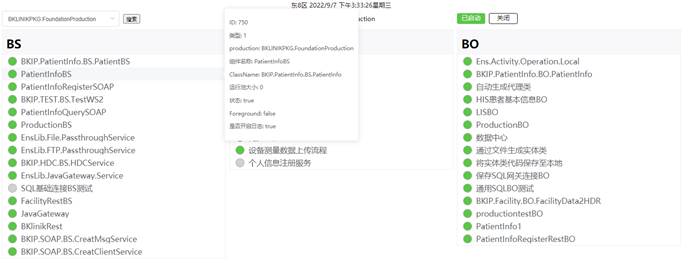
preface
Since the contact with IRIS, it has been used most in hospitals as an ESB integration engine, as a link in the hospital's integration platform+data center. However, you can also develop some restful pis to be used as the backend of front end and back end separation projects
List of articles
Introduction
List of articles
I. Development of technologies and tools
II. Development Path and Relevant Codes
1. database
2. Preparatory work
3. Steps associated with developing an interface
4.
Morning everyone,
I would appreciate some advice please- hopefully there is plenty of experts out there.
We are setting up an sFTP share between hospital trusts here in the UK and I have set the outbound operation up using a custom extension of EnsLib.HL7.Operation.FTPOperation.
We are configuring a VPN tunnel to run between the sites also so there is a bit of firewall / network routing to take place to enable the connection but to add in a complication we are on a mirrored cluster and usually present on a Virtual IP address.
Hey Community,
Enjoy watching the new video on InterSystems Developers YouTube:
Hi Community,
Watch this video to get a brief overview of the near- and long-term plans for HealthShare containerization and Kubernetes adoption, as well as a preview/demo of our current progress.
⏯ The Future of HealthShare in the Cloud: Containers/ Kubernetes @ Global Summit 2022
InterSystems is proud to announce the developer preview program for the 2022.3 releases. Many updates and enhancements have been added in 2022.3 and there are also brand new capabilities, such as the new FHIR SQL Builder, improvements for Columnar Storage, and support to Oracle Linux 9 (not in this first preview).
Future preview releases are expected to be updated biweekly and we will add features as they are ready. Please share your feedback through the Developer Community so we can build a better product together.
The build number for this developer preview release is 2022.3.0.539.0.
I would like to access discarded messages from a specfic process, is there any method that allows for this?
Alternatively what table holds this info so I can query it?
HealthShare Patient Index November 29-December 1, 2022 9:00am-5:00 US-Eastern Time (EST)
Building and Managing HL7 Integrations November 28-December 2, 2022 9:00am-5:00 US-Eastern Time (EST)
Is there a way of passing in the name of a category used in the production and returning a list of business components associated with them?
I want to be able to do this in code.
A mistake happened and records were assigned the wrong assigning authority name: PID3.4.
Everything else was correct. This resulted in duplicate records. Ex
Record 1: MRN1 has AA1 and clinical data
Record 2: MRN1 has AA2 and the same clinical data as Record 1 + more clinical data that is not in Record 1
I would like to remove Record 2 ensuring that there are no orphan records left.
Should I use a merge transaction? If so, which one? The ones that I have seen expect a different MRN in the MRG segment. These records have the same MRN. What would be the best approach?
Thank you for reading!
InterSystems is pleased to announce the 2022.2 release of InterSystems IRIS Data Platform, InterSystems IRIS for Health, HealthShare Health Connect, and InterSystems IRIS Studio are now Generally Available (GA).
2022.2 is a Continuous Delivery (CD) release. Many updates and enhancements have been added in 2022.2, in SQL management, cloud integration, Kafka and JMS adapters, the SQL Loader, and other areas. The new Columnar Storage has been released, but it stills an experimental feature.
InterSystems IRIS Data Platform 2022.
Hi
I'm thinking to deploy healthshare using kubernetes. Has any one done this before? How will the TCP listeners in healthshare work with kubernetes? Will they automatically create a service endpoint so that I can route traffic?
Please advise me on how to think about this.
Thanks
Good morning, evening, night,... 
A small reflection/question for today... it's true that new IRIS for Health (I4H) releases are more and more powerful each time regarding FHIR capabilities. Nowadays it allows us to consume FHIR resources with extrem easiness, we can connect with end-points in external FHIR servers very easily and make I4H act as passthrough or consume their resources... or, even more, we can define, configure and run a FHIR repository in, literally, less than 5 minutes.
This is the tenth in a series of releases that are part of the developer preview program for 2022.2. Future preview releases are expected to be updated biweekly and we will add features as they are ready. Please share your feedback through the Developer Community so we can build a better product together.
As usual, CD releases come with classic installation packages for all supported platforms, as well as container images in Docker container format. For a complete list, refer to the Supported Platforms document.
Hello,
We are very interested about studying DICOM in deep, both the standar itself and how it is related to HealthShare.
Could you please point us to some good references: documentation, courses, books, pdfs, explanations; to understand what is this standard about and how works.
Thanks for your replies
We have read:
https://dicom.nema.org/medical/dicom/current/output/html/part01.html
https://docs.intersystems.com/irisforhealthlatest/csp/docbook/DocBook.U…?
