22 Followers · 550 Posts

Fast Healthcare Interoperability Resources (FHIR, pronounced "fire") is a draft standard describing data formats and elements (known as "resources") and an application programming interface (API) for exchanging electronic health records

Official site

Article Tani Frankel · Apr 26 1m read

A very important feature for HL7 FHIR has been introduced with the release of v2026.1 - the support for SMART on FHIR v2 fine-grained granular Scopes.

This enables you to be much stricter and more accurate in the access you provide to the data in your FHIR repository.

Part of this new support is to refuse requests that don't match the scopes, but an even more interesting ability is to filter the results according to the provided scopes.

0
0 33
Article Fan Ji · Mar 26 1m read

Introduction

FHIR (Fast Healthcare Interoperability Resources) is the modern standard for storing and exchanging clinical data. But once your data is in a FHIR server, how do you actually explore it? FHIR data is stored as JSON — powerful, but not practical to read directly. I wanted a tool where you could click on a patient, see their conditions, medications, lab results, and more — in a clean, readable format. So I built the FHIR Patient Viewer.

How It Works

The app runs entirely in Docker and connects directly to an InterSystems IRIS for Health FHIR server.

2
2 316
Article Gabriel Ing · Jan 16 5m read

Introduction

Earlier this year, I set about creating kit to introduce young techy folk at a Health Tech hackathon to using InterSystems IRIS for health, particularly focusing on using FHIR and vector search.

I wanted to publish this to the developer community because the tutorials included in the kit make a great introduction to using FHIR and to building a basic RAG system in IRIS.

0
0 77
Article Scott Roth · Mar 11 3m read

Background

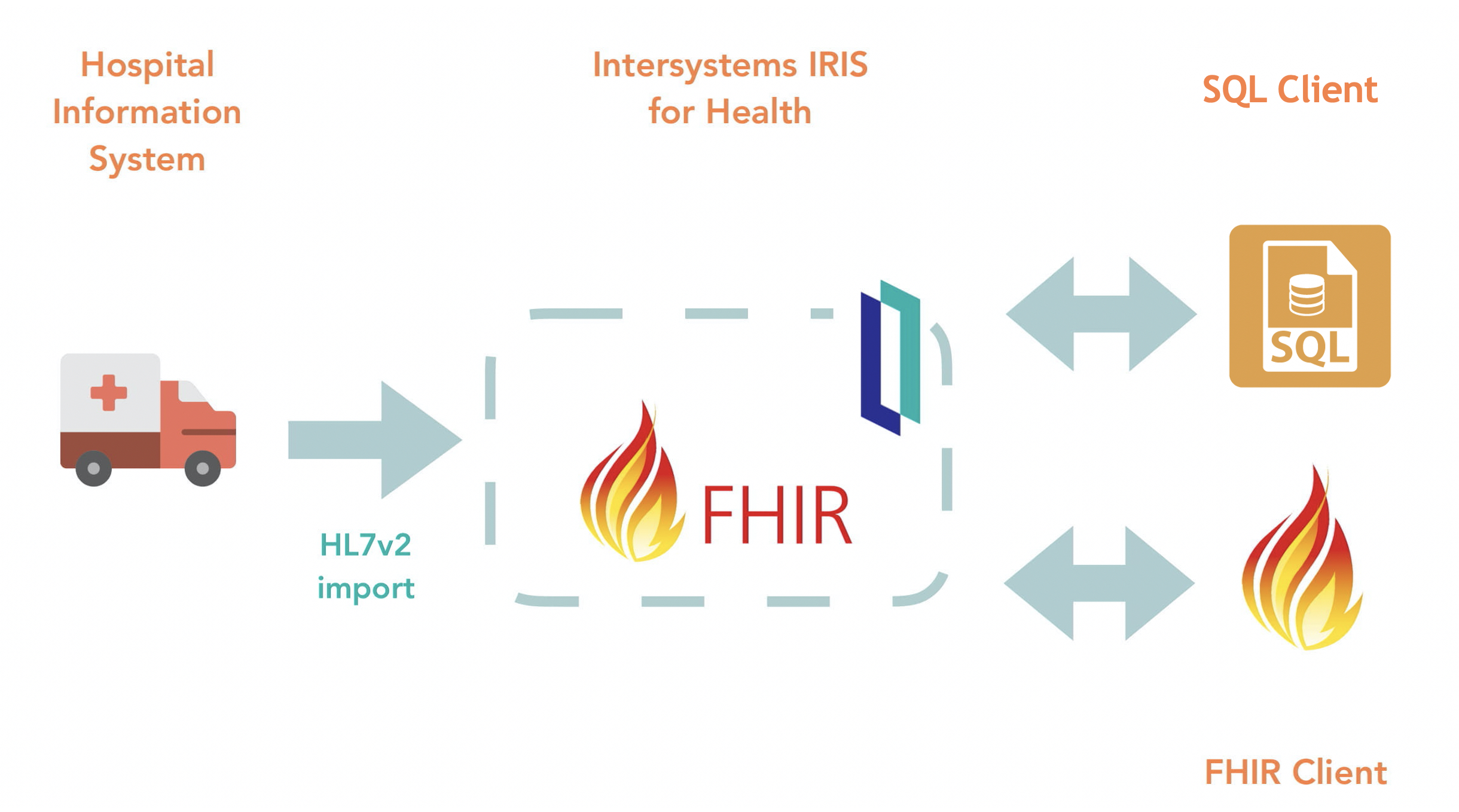
Emergency Medical Services (EMS) teams often arrive at the emergency department with patients whose demographics are incomplete or unknown—no medical record number (MRN), no confirmed name, and sometimes no date of birth. Yet EMS transportation notes still need to land in the correct chart.

To support safe and reliable documentation, EMS agencies, third-party integration services, and hospital integration teams build secure interfaces that exchange identifiers and clinical messages.

0
0 78
Article Ashok Kumar Thangavel · Feb 24 2m read

In the modern healthcare landscape, finding clinically similar patients often feels like looking for a needle in a haystack. Traditional keyword searches often fail because medical language is highly nuanced; a search for "Heart Failure" might miss a record containing "Congestive Cardiac Failure."

I am excited to share iris-medmatch, an AI-powered patient matching engine built on InterSystems IRIS for Health. By leveraging Vector Search, this tool understands clinical intent rather than just matching literal strings.

0
0 123
Article Henry Pereira · Feb 14 3m read

cover

You’ve seen how tools like Lovable are shaking up web development. People are spinning up entire apps just by talking to an AI, almost like pair‑programming on steroids.

Now imagine bringing that same “vibe coding” experience into healthcare. know, it sounds crazy. Healthcare is complex, full of regulations, and usually gives us a headache just thinking about the interoperability rules.

That’s exactly the space where withLove lives: an AI‑Native, Low‑Code platform built entirely on InterSystems IRIS for Health.

1
0 78
Article Alberto Fuentes · Feb 13 10m read

10:47 AM — Jose Garcia's creatinine test results arrive at the hospital FHIR server. 2.1 mg/dL — a 35% increase from last month.

What happens next?

  • Most systems: ❌ The result sits in a queue until a clinician reviews it manually — hours or days later.
  • This system: 👍 An AI agent evaluates the trend, consults clinical guidelines, and generates evidence-based recommendations — in seconds, automatically.

No chatbot. No manual prompts. No black-box reasoning.

This is event-driven clinical decision support with full explainability:

image

Triggered automatically by FHIR events ✅ Multi-agent reasoning (context, guidelines, recommendations) ✅ Complete audit trail in SQL (every decision, every evidence source) ✅ FHIR-native outputs (DiagnosticReport published to server)

Built with:

  • InterSystems IRIS for Health — Orchestration, FHIR, persistence, vector search
  • CrewAI — Multi-agent framework for structured reasoning

You'll learn: 🖋️ How to orchestrate agentic AI workflows within production-grade interoperability systems — and why explainability matters more than accuracy alone.

2
2 197
Article Ashok Kumar Thangavel · Jan 14 14m read

What is a FHIR Profile?

A FHIR profile is a collection of rules and constraints used to customize and refine a base Fast Healthcare Interoperability Resources (FHIR) resource. Profiling is a vital process that adapts the base FHIR resource standard to satisfy the unique requirements of a specific use case, geographic region, medical institution, or clinical workflow.

While the base FHIR specification provides generic, flexible definitions for resources (such as Patient, Observation, or Medication), profiles transform these generic resources into more precise ones. This ensures consistent and interoperable data exchange tailored for a particular community or implementation.

FHIR is designed to cover various healthcare scenarios globally. Profiles allow implementers to adapt this general platform without losing the benefits of standardization.

2
2 197
Article Kate Lau · Jan 5 3m read

Hi, now I would like to continuous on the topic that we talk about previously

Using Postman for testing the OAuth2.0 of the InterSystems FHIR repository - Part1


Question 1: Where is my client_id and client_secret come form?

Short answer: Authentication Server.

If you don't have an Authentication Server, you may set up one as following

Provide the hostname (the host must support Https), at least 1 grand type (we choose client credential here), and SSL/TSL configuration

Input the scopes (here we input user/*.read and user/*.

3
2 162
Article Tani Frankel · Dec 28, 2025 6m read

Sometimes it is more convenient, more efficient, and more secure, to limit FHIR Searches per pre-defined "Lists" of Resources.

Since v2025.1 we support several List-related features in our FHIR Server.

I will highlight these here, and provide some samples.

2
1 125
Article Kate Lau · Jan 1 3m read

Hi all, it's me again for sharing what I am studying recently.😓

Recently, I am studying how to setup OAuth2 authentication for the InterSystems FHIR repository. And I found the following articles are very good and easy to follow.😁

SMART on FHIR EHR Launch with IRIS for Health

Building an FHIR Repository + OAuth2 Authorization Server/Resource Server Configuration on IRIS for Health Part 2

For me, as a user who do not have much knowledge about OAuth2.0. I think it quite difficult to understand how to setup the whole OAuth2.0 environment before knowing how's it look like (what is it?

0
5 159
Article Piyush Adhikari · Dec 24, 2025 6m read

InterSystems API Manager (IAM) is a core component of the InterSystems IRIS Data Platform, offering centralized API management with a strong emphasis on security. IAM simplifies the entire API lifecycle, from creation to retirement, and provides a developer portal for easy API discovery and integration. Access control features allow administrators to define precise permissions, and IAM seamlessly integrates with the IRIS Data Platform, enhancing data management and integration capabilities.

Features of IAM include:

  • API Gateway: Centralized API management and security hub.
0
0 129
Article Tani Frankel · Dec 24, 2025 2m read

You send an HTTP request and get back an HTTP error but with an HTML error page which you didn't expect... what's happening?... 🤔

Specifically for example, perhaps you tried to READ a FHIR Resource (e.g. /Patient/123) and you get back a 404 error page, even though with other Patient IDs, you get back the Resource payload, so "the page" definitely does exist... why should you be getting a 404 error page? 🙄

0
0 153
Article Keren Skubach · May 5, 2025 4m read

An extension “extends” or enhances a FHIR resource or a data element in a custom way. The extension can be added to the root of a resource, such as “Patient.ethnicity” in US Core profile, and they can be added to individual elements such as HumanName, Address or Identifier.

Did you know that you can also add an extension to a primitive data type?

Primitives usually store a single item and are the most basic element in FHIR. For example: "Keren", false, 1234, 12/08/2024 etc.

2
2 425
Article Ashok Kumar Thangavel · Jun 30, 2025 23m read

Overview

Fast Healthcare Interoperability Resources (FHIR) is a standardized framework developed by HL7 International to facilitate the exchange of healthcare data in a flexible, developer-friendly, and modern way. It leverages contemporary web technologies to ensure seamless integration and communication across healthcare systems.

Key FHIR Technologies

  • RESTful APIs for resource interaction
  • JSON and XML for data representation
  • OAuth2 for secure authorization and authentication
2
10 636
Article Fan Ji · Nov 20, 2025 3m read

In today’s healthcare data landscape, FHIR has become the standard for structured clinical data exchange. However, while FHIR excels at interoperability, its JSON format makes analytics challenging—including FHIR QuestionnaireResponse.

This project demonstrates how to transform FHIR QuestionnaireResponse data from nested JSON into relational SQL tables and vector embeddings. By integrating the InterSystems IRIS FHIR SQL Builder and Vector Search, we unlock the semantic meaning behind patient answers.

Three Steps to Build It

1.

3
1 190
Article sween · Nov 20, 2025 5m read

Vibe the Module, Not the Data


While working with the FHIR to OMOP Service, I've seen good FHIR synthetic data being created using commercial LLM's etc, custom tailored for ConditionOnset with the typical amazement on return, but witnessed some questionable trust first hand on a call.  This approach also falls short generating gigantic payloads so I can go back to my interests on the backend and ensure smooth data transition.

0
0 140
Article Ariel Glikman · Jan 13, 2025 3m read

You may have noticed that to configure a mirror for InterSystems IRIS for Health and HealthShare® Health Connect there is a special requirement. I wanted to go through it step by step in this article.

This assumes you have already configured the second failover member and confirmed a successful failover member status in the mirror monitor:

Step 1: Enable HS_Services user (on backup and primary

Step 2: Switch to Namespace HSSYS and go to Interoperability > Configure > Credentials.

5
6 628
Article Ashok Kumar Thangavel · Oct 20, 2025 11m read

What is XML?

XML(eXtensible Markup Language) is a flexible, text-based, andplatform-independentformat used to store and transport data in a well-structured way that is both human- and machine-readable. XML permits users to define custom tags to describe the meaning and organization of their data. For example: <book><title>The Hitchhiker's Guide</title></book>.

An XML document is self-descriptive and structured as a hierarchical tree of elements. Every document has a single root element that encapsulates all other content.

3
6 473
Article Laura Blázquez García · Feb 23, 2025 4m read

When we create a FHIR repository in IRIS, we have an endpoint to access information, create new resources, etc. But there are some resources in FHIR that probably we wont have in our repository, for example, Binary resource (this resource returns a document, like PDF for example).

I have created an example that when a Binary resource is requested, FHIR endpoint returns a response, like it exists in the repository. 

First of all, we need a Namespace and a FHIR endpoint. After this, we need to configure an Interoperability production that will be connected to the FHIR endpoint.

7
8 601
Article Kate Lau · Oct 13, 2025 13m read

Hi all,

Let's do some more work about the testing data generation and export the result by REST API.😁

Here, I would like to reuse the datagen.restservice class which built in the pervious article Writing a REST api service for exporting the generated patient data in .csv

This time, we are planning to generate a FHIR bundle include multiple resources for testing the FHIR repository.

Here is some reference for you, if you want to know mare about FHIR The Concept of FHIR: A Healthcare Data Standard Designed for the Future

OK... Let's start😆

1. Create a new utility class datagen.utli.

6
0 191
Article sween · May 14, 2025 7m read

Real Time FHIR® to OMOP Transformation

This part of the OMOP Journey,  we reflect before attempting to challenge Scylla on how fortunate we are that InterSystems OMOP transform is built on the Bulk FHIR Export as the source payload.  This opens up hands off interoperability with the InterSystems OMOP transform across several FHIR® vendors, this time with the Google Cloud Healthcare API.

1
2 255
Article Kate Lau · Oct 13, 2025 5m read

Hi all,

It's me again 😁. In the pervious article Writing a REST api service for exporting the generated FHIR bundle in JSON, we actually generated a resource DocumentReference, with the content data encoded in Base64

Question!! Is it possible to write a REST service for decoding it? Because I am very curious what is the message data talking about🤔🤔🤔

OK, Let's start!

1. Create a new utility class datagen.utli.decodefhirjson.cls for decoding the data inside the DocumentReference
 

ClassExtends%RegisteredObject

2. Write a Python function decodebase64docref to 
a. loop through the FHIR bundle
b.

2
2 235
Article Pietro Di Leo · Oct 9, 2025 6m read

Introduction

In my previous article, I introduced the FHIR Data Explorer, a proof-of-concept application that connects InterSystems IRIS, Python, and Ollama to enable semantic search and visualization over healthcare data in FHIR format, a project currently participating in the InterSystems External Language Contest.

In this follow-up, we’ll see how I integrated Ollama for generating patient history summaries directly from structured FHIR data stored in IRIS, using lightweight local language models (LLMs) such as Llama 3.2:1B or Gemma 2:2B.

The goal was to build a completely local AI pipeline that can extract, format, and narrate patient histories while keeping data private and under full control.

All patient data used in this demo comes from FHIR bundles, which were parsed and loaded into IRIS via the IRIStool module. This approach makes it straightforward to query, transform, and vectorize healthcare data using familiar pandas operations in Python. If you’re curious about how I built this integration, check out my previous article Building a FHIR Vector Repository with InterSystems IRIS and Python through the IRIStool module.

Both IRIStool and FHIR Data Explorer are available on the InterSystems Open Exchange — and part of my contest submissions. If you find them useful, please consider voting for them!

0
2 149
Article Pietro Di Leo · Oct 9, 2025 4m read

Introduction

In a previous article, I presented the IRIStool module, which seamlessly integrates the pandas Python library with the IRIS database. Now, I'm explaining how we can use IRIStool to leverage InterSystems IRIS as a foundation for intelligent, semantic search over healthcare data in FHIR format.

This article covers what I did to create the database for another of my projects, the FHIR Data Explorer. Both projects are candidates in the current InterSystems contest, so please vote for them if you find them useful.

You can find them at the Open Exchange:

In this article we'll cover:

  • Connecting to InterSystems IRIS database through Python
  • Creating a FHIR-ready database schema
  • Importing FHIR data with vector embeddings for semantic search
0
0 144
Article Pietro Di Leo · Oct 6, 2025 4m read
2
0 203