Hello good afternoon.
It is possible to change the background string " output " of the studio?
I would like to add a line in green or red line (TDD).
InterSystems Caché is a multi-model DBMS and application server. See more details here.
Hello good afternoon.
It is possible to change the background string " output " of the studio?
I would like to add a line in green or red line (TDD).
I am pleased to announce the next 2016.2 field test kit, 2016.2.0.609.0.
This is a relatively light update with only a few dozen changes from the previous field test, spread out across all areas of the product. Also, in a break from the recent past, this update doesn’t contain any new fixes to problems found in the field.
Please download the kit and give it a try; the latest field test of 2016.2 is available HERE. And, as always, we welcome your feedback.
Steve Glassman, Director of QD
There have been a few use cases recently within InterSystems where we've needed to connect to Caché-based web services from PHP. The first of these was actually the Developer Community itself, which uses web services as part of Single Sign-On with other InterSystems sites/applications. The following example demonstrates how to connect to a Caché-based web service (particularly, the web service in the SAMPLES namespace) from PHP, using password authentication.
When developing or maintaining Caché Objects applications, or even ones written in plain COS code, it's sometimes useful to investigate dependencies. Yuzinji is a tool that analyzes the Caché class dictionary plus the COS code within methods and routines, then feeds its results into Structure101g Studio.
By doing this it becomes easy to ask questions such as "Who uses this piece of code?", getting the information in a format that is easy to explore further.
Find out what sets the InterSystems Document Data Model apart in the industry.
February 25, 2016 – Alert: Incorrect SQL Results InterSystems has corrected a defect that can cause incorrect results for certain SQL INSERT, UPDATE, and DELETE statements.
This defect is present only in Caché and Ensemble 2015.2 and HealthShare distributions based on them. The problem affects all platforms.
Incorrect results occur only when two or more of these statements are nested within each other.
The example below demonstrates one possible way for this problem to happen:
The class has an UPDATE trigger that uses embedded SQL to modify a table.
Because the SQL is embedded in the UPDATE
When my COS code is executing in a Caché process it might want to interact with the host operating system. For the purpose of this post I'm focusing on a Windows host, but much of it applies to other host OS platforms as well.
A common example of host OS interaction is when my process wants to read from or write to a file. What credentials will apply when Windows is checking whether or not to allow me access to the file?
To answer that we need to consider another question. How did our process start?
If we're in an interactive terminal session, perhaps we launched this from the Caché cube on the
Hi
In studio when I right-click a package there is no option to delete it.
Also how do I upload an image to this post without linking to an external site?
If you've got more than one developer on a project, do you each work in your own namespace? Or do you all use a common namespace?
Through my work at George James Software I have encountered many different Caché and Ensemble development setups. At risk of over-generalizing, the older and more established users of InterSystems technologies seem more likely to have all their developers working in a common namespace, whereas the newer 'converts' tend to favour giving each developer their own namespace.
I think it'd be interesting to discuss the pros and cons of these options, and to consider hybrid
Hello,
This package may be of interest...
Link: https://github.com/litesolutions/cachedb-import
I have programmed this over a hunch, in order to facilitate the retrieval of source code from a Caché installation. It makes use of the Java API provided by Caché.
Right now, I use it as a means to salvage sources in order to analyze them using the SonarQube plugin I develop for my employer. Unfortunately this plugin is not open source.
I am calling for help here, on two fronts:
RESTful API Call From Cache to Particle.io Electron
Tom Fitzgibbon | Multidata | 212-967-6700 x537 | tom@mul.com
Summary: Simple Blink Tutorial for Particle.io Electron Device from Cache
Electron device is a tiny ARM processor ($40-$60) that connects to Particle’s world wide leased 2G/3G network (about $3/mo) and runs off an included LiPo battery. Using Cache’s %Net.HttpRequest you can send/receive data, control hardware and read sensors.
Step by Step (about 1 hour)
1) Get the Electron from store.particle.io.
2) Set up the Electron from setup.particle.io.
3) Install an LED and resistor from setup
I am pleased to announce the next 2016.2 field test kit, 2016.2.0.605.0.
There are about a hundred changes from the previous field test kit, including the following fixes to problems found by those using the kits in the field:
One additional change of note: in this kit we have changed the on-disk format for DOCUMENT data.
The cdirectmgr utility will no longer be included with product distributions beginning with the Caché 2016.2 release . This was an older VB application (predating the Caché cube) which allowed users to define server connections for Visual M/Caché Direct applications. As VB 6 is no longer supported by Microsoft, we will no longer ship this component. The same functionality is already available from the cube utility.
It is also posted in Compatibility blog.
Zen Reports has offered multiple choices for direct printing including use of Adobe Reader or Foxit reader. Recent changes in Windows 10 and in the readers themselves have made it no longer possible to invoke these readers from background processes in Windows 10 and all future versions. Because of this Zen Reports will no longer support printing with these tools on Windows 10.
Windows 10 support was added for 2015.1 and 2015.2. On Windows 10, the only option for direct printing with Zen Reports will be Qoppa JPDFPrint.
Installations running on older versions of Windows with older versions of
Good morning people.
The use of TDD is currently being reference for software delivery more confiabilitade and quality.
At the company I work developing web applications , we create tests for method class in a deteminado package and running the steps that the documentation recommends:
1 export the tests classes to a predefined folder.
2- And running the test ( D ## class (% UnitTest.Manager ) .RunTest (,"/nodelete" )
It is a lot of work to do the export and run these tests would have a resource that we could only run the tests without the need for export ?
Hello!
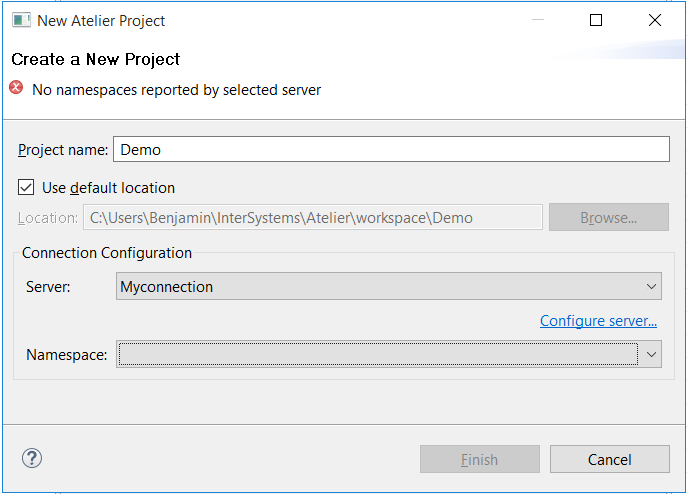
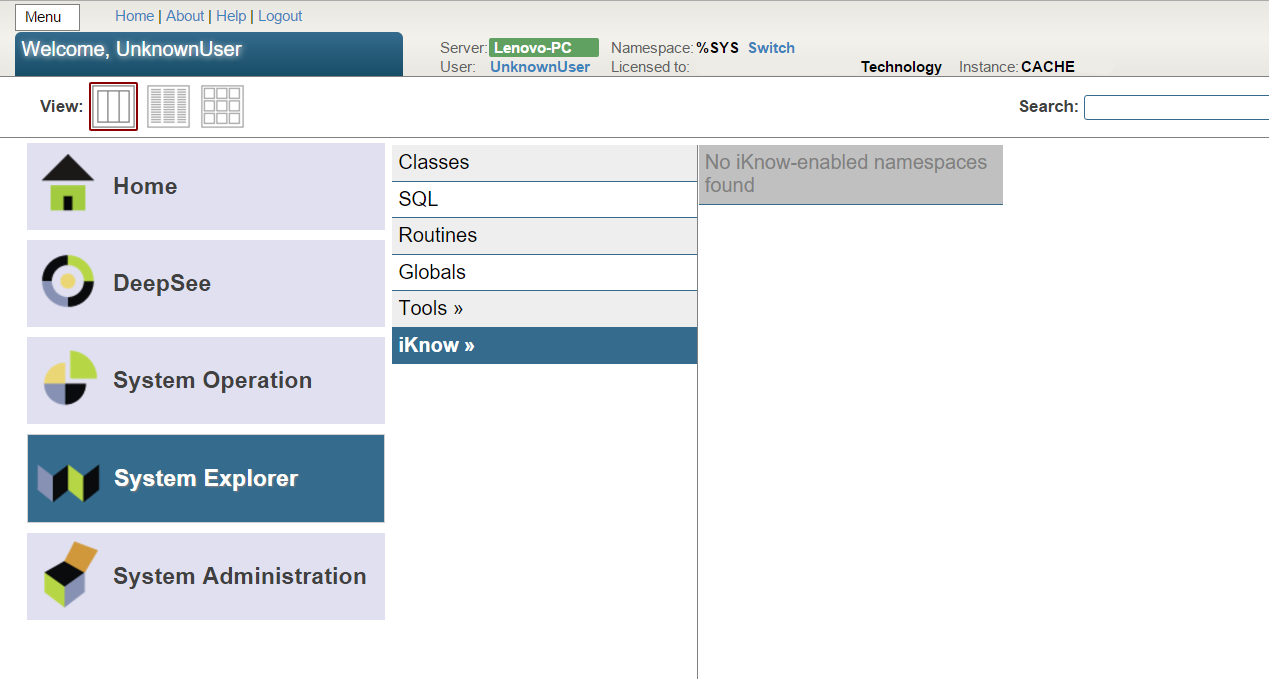
I'm trying to use iKnow but I get the following error "No iKnow-enabled namespaces found" in the Management Portal.
It was working on the 2015.2.2 version but now on 2016.2.0 it doesn't. I very new to Caché and iKnow so it's probably a simple problem.
I was able to create a iKnow domain using the terminal and I can view it in the learning portal (http://localhost:57772/csp/sys/exp/_iKnow.UI.IndexingResults.zen).
What can I do to make it work in Atelier? I've tried authenticating with SYS:SYS and USER:USER but neither seem to have any namespaces.
Very thankful for any help!


I have been meaning to make a post about this topic for a few weeks and the other day an issue came in through the WRC about it so it seems this is a conversation we should be having.I want to begin by taking a few moments to explain "Why Atelier" then we can talk about what this means in the general sense for Studio and Atelier and Caché developers.We have wrestled with what to do with Studio for years.When I moved to Product Management in 2008 this was already a "thing".At the time we could not reach a consensus.Some felt Studio was fine as is.
Is the default language (i.e., $$$DefaultLanguage, which is used as the basis for localization with $$$Text/etc. at compile time) always "en" for new Caché installations, or could it be different? How is this determined? I don't see an option to select a language during Caché installation.
Also, is there a supported/preferred API for setting the default language? Looking at %occMessages.inc, one option would be:
Set $$$DefaultLanguageNode = "en"
But I'd expect there to be a classmethod for this somewhere (and haven't managed to find it yet).
Background: My team is concerned about what might
Attached is an example of a web service client that can be used to do a lookup against the CMS NPPES database to validate and retrieve information about a given National Provider Identification (NPI).
I'm working on a proposal for a deployment tool development project and I was wondering if anyone had any experience with such a thing.
We use Healthshare and implementations for new clients are tedius and lengthy. Lots of ensemble service, registry value, lookup tables, namespaces and other things have to be created and configured.
I would like to create a Zen or CSP page based deployment tool that can do all this with a few parameters and some custom code.
Has anyone done this? What are some pitfalls you ran into? Any unique ideas you included? Other general thoughts?
InterSystems is pleased to announce that Caché and Ensemble 2015.1.4 are now available as maintenance releases.
For a complete list of the corrections in 2015.1.4, please review the release notes.
Caché and Ensemble 2015.1.4 are available today for the same platforms as 2015.1.3.
The complete set of supported platforms, including specific point releases and/or patches, is detailed in the Supported Platforms document.
Question
I am configuring IIS to work with the CSP Gateway but I'm running into this error:
"The Module DLL 'C:\Inetpub\CSPGateway\CSPms.dll' could not be loaded due to a configuration problem. The current configuration only supports loading images built for a x86 processor architecture."
Answer
Hi all,
I was wondering, what is your favourite public cloud provider?
What is your level of engagement with the cloud provider? Are you testing their infrastructure? In which case I'd expect you being progressing a parallel test with at least a second provider ;-) Or, are you already running a production environment?
--
OK, so, let me be the first one to share my experience with one specific cloud provider.
If I'm in a quick development POC project where I need to prove something very quickly, let's say I want to test a particular architecture or infrastructure with a firewalls or web servers or
Hi-
I'm curious to know what InterSystems clients are using for csp based web development methodology.
Are you doing tag based development, or class based development?
If you are using tag based development, what tools are you using to create the look and feel of your web pages? Are you using tools like Adobe Dreamweaver, or do your developers sit down and code HTML using plain editors like Notepad and Notepad++
Are you doing prototyping of web pages and then adding CSP tags, or are you just developing the finished csp page with no prototype?
Thanks
Ken
In MSSQL I think you can do something like this:
select *
from HS_IHE_ATNA_Repository.COLUMNS
where TABLE_NAME='Aggregation'
How can I do this in Cache SQL?
[%msg: < Table 'HS_IHE_ATNA_REPOSITORY.COLUMNS' not found>]
I'm planning to have a web-based management and deployment interface. For now I have started writing some .mac scripts. Will I be able to call these from a web page? Or do I just need to start with Zen?
C:\data\backup.bat :
C:\InterSystems\Ensemble\bin\cache -s"C:\InterSystems\Ensemble\Mgr" -U%%SYS ##Class(Backup.General).ExternalFreeze() <C:\data\login.scr
echo %ERRORLEVEL%
rem note that we need to check errorlevel from highest to lowest here....
if errorlevel 5 goto OK
if errorlevel 3 goto FAIL
echo errorlevel returned wrong value
goto END
:OK
echo SYSTEM IS FROZEN
xcopy c:\InterSystems\Ensemble\mgr\ z:\backup\Ensemble /s /e /y /i
echo %ERRORLEVEL%
goto END
:FAIL
echo SYSTEM FREEZE FAILED
:END
rem Now unfreeze the system
C:\InterSystems\Ensemble\bin\cache -s"C:\InterSystems\Ensemble\Mgr" -U%%SYS
Developing an idea with RuleEngine in XData, we could even refuse from editing full class and edit only valuable xml. Sometime ago I have already written an article(in russian) about such possibility, even more, in that article I wrote about compilable JavaScript to Caché.
This possible with %Studio.AbstractDocument. While extending this class, developer should add a Projection.
Projection RegisterExtension As %Projection.StudioDocument( DocumentDescription = "RuleEngine file", DocumentExtension = "RULE",
Some days ago Alberto has written a very interesting article about the usefulness of ObjectGenerators available in Caché.
In this article, Alberto shows an example RuleEngine based on XData, and how it is possible to improve the process of filling such rules. Caché Studio has a Studio Asist for XData; you may have already seen examples of it if you use ZEN or %Installer.Manifest.
We can use the %XGEN.AbstractDocument class for our task.Unfortunately, InterSystems has marked these classes (all of classes in %XGEN, in fact) as for internal use only.
Let's say the user need to execute some heavy code (build a report, or extensive calculations etc.). So, of course it needs to be asynchronous, and we possibly need to store some data about execution status. How?