Can anybody give me a correct example to kill process started by JOB command?
InterSystems Caché is a multi-model DBMS and application server. See more details here.
Can anybody give me a correct example to kill process started by JOB command?
I have inherited a web-based database application and I'm having a hard time understanding the sequence of events when CSP pages are opened. I have very limited web development experience.
Can anyone recommend a good resource for explaining this? I have already gone through the Cache Cinema tutorial and the Cache CSP documentation.
Among other things, I don't understand when the OnPreHTTP method is invoked, when it is needed, and what belongs in there.
I'm creating a new namespace by the installation manifest XML and in the "database" tag configuration I don't see attribute to configure if I what jounal globals or not to this database.
In the database wizard of the "portal administration", have this option.
Regards,
Lucas Boeing Scarduelli
Hi,
is there way when select a value in filter column and the second column filter use only value referred to the first selection??
we use to active filter to column in table, but not know how relationship the filter between columns of table.
only in the table context in zen page.
I am trying to read some binary data from a local file or through socket.
The binary data is like H.264 codec, I need to read data BYTE by BYTE (even BIT by BIT) and decide the next step based on the data read so far.
I check the documentation and it seems like most of the sample focus on human readable IO, ie: LINE by LINE.
Could I achieve my goal through COS?
Thanks.
I thought I should be able to go to the application error log or look at d ^%ER when I get the following error in the browser when troubleshooting a CSP page:
An error occurred with the CSP application and has been logged to system error log (^ERRORS)
However nothing is being generated in these logs. Where are these logs being made?
Thank you
Hello,
I need to add a new property ("Injection") to an existing database. The existing database contains, in part:
An "ImageStudy" which contains one or more "ImageFiles" defined as follows:
Class PET.ImageStudy Extends (%Persistent)
{
Relationship ImageFiles as PET.ImageFile [cardinality=children,inverse=Study]
...
}
Class PET.ImageFile Extends (%Persistent)
Relationship Study as PET.I have this local, containing a list of books of arbitrary length:
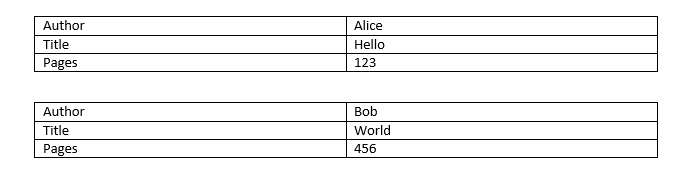
set books=2 set books(1, "author") = "Alice" set books(1, "title") = "Hello" set books(1, "pages") = "123" set books(2, "author") = "Bob" set books(2, "title") = "World" set books(2, "pages") = "456"
And I want to generate this PDF (there could be more than two tables), each book is a separate table:

The header is always the same (Author, Title, Page) but the number of tables would be different.
ZEN reports sounds relevant, but I'm not sure how to pass data from local there and how to draw a separate table for each result.
Typically, I have time to review the documentation, which I'm sure is here. However, I have a workaround (TEST1) but I was wondering if anyone could assist me in advising how I would need to adapt the curly brace snippet (TEST2) to provide the same result.
Thanks for any help you can provide.
TEST1(STATUS=1) K (STATUS) X "S MSG=$S(STATUS:""HELLO"", 1:""GOODBYE"")" W !,MSG Q TEST2(STATUS=1) PUBLIC { X "S MSG=$S(STATUS:""HELLO"", 1:""GOODBYE"")" W !,MSG }
How do I get non latin text in PDF mode for ZEN reports?
Currently cyrillic test is rendered as ####:
Class Test.Zen Extends %ZEN.Report.reportPage
{
Parameter DEFAULTMODE = "pdf";
/// ReportDefinition is a placeholder.
XData ReportDefinition [ XMLNamespace = "http://www.intersystems.com/zen/report/definition" ]
{
<report xmlns="http://www.intersystems.com/zen/report/definition"
name="MyReport" runonce="true">
</report>
}
XData ReportDisplay [ XMLNamespace = "http://www.intersystems.com/zen/report/display" ]
{
<report xmlns="http://www.intersystems.When I down load a file using a csp page, the application shows the percentage as 37 %, 74 %, and 100 %. I am trying to make changes to the application that it shows one percentage after each read. The first time it reads, it would display 37%. The next run would replace
37 % with 74 % and so on until it completes its download. I have tried adding javascript code to the application however it doesn't work. For example when I enter &js('alert');, the application displays it value on the screen. Also, I tryed putting it between two scripts tags and it doesn't work.
Hi Everybody!
We are pleased to invite you to the upcoming webinar "Optimizing Application Performance" on 29th of May at 10:00 (Moscow time)!
A unique chance to talk about application performance.
I'm facing a specific sort problem.
There are several thousands of articles sold all over.
Users expect to get a description in local language sorted by their specific collation.
Hi folks,
One of my clients want to project a null property of a cache object to an empty XML element. Say, if we have a class:
Class Diabetes.BS.Message.LabReportMessage Extends Ens.Request
{
Property Report As %String;
Property IsRisky As %Boolean;
Property RiskValue As %String ;
}
If the instance of this class has a null RiskValue, after projection, they want the XML as following:
<LabReportMessage>
<Report>Somestring</Report>
<IsRisky>1</IsRisky>
<RiskValue/>
</LabReportMessage>
Is there any way we can do it? Thanks.
I have a CACHE.DAT file that is working under CACHE version 2015.1.0.429.0
I have a second machine with CACHE version 2017.2.0.741.0
When I attempt to add/use the CACHE.DAT in the new version of CACHE, it will not mount.
How do I upgrade/convert the DAT file to make it work under the new CACHE version?
Thx. Larry...
1) I have an oref pointing to an object on disk
2) I save the object which causes an UPDATE / AFTER Trigger to fire, and updates a value in an embedded object property
3) I would like to see that new embedded property value in my in-memory object (for unit testing)
Is there a way to do this via a method call? Or do I need to close the object and re-open it to see the updated value?
Thanks!
Ben
I need to do an ordering, within another order, but it is not ordering.
I have an iKnow domain and a blacklist called Ads.
I want to get all sources that do not contain entities from Ads list.
Currently I'm doing it like this:
ClassMethod NoAds()
{
#dim domainid As %Integer = 1
set filterNot = ##class(%iKnow.Filters.GroupFilter).%New(domainid,, $$$YES)
#dim blackListId As %Integer = ##class(%iKnow.Utils.MaintenanceAPI).GetBlackListId(domainid, "Ads")
set sc = ##class(%iKnow.Utils.MaintenanceAPI).GetBlackListElements(.blackList,.#DomainId, blackListId)
set filterAds = ##class(%iKnow.Filters.ContainsEntityFilter).Let's say I have a user-generated document template with placeholders and I want to replace them with actual values.
Values could be:
So far I wrote a simple find/replace tool that works with RTF format (because it's not a binary format), here's how it works:
set template = "D:\Cache\RTF\template.rtf"
set var("%title") = "Hello"
set var("%table") = $lb("Utils.RTF", "TestFunc")
set result = "D:\Cache\RTF\out.rtf"
set sc = ##class(Utils.RTF).I have a serial object:
Class EmbedObj Extends %SerialObject
which is stored as a property of another object
Class ContainerObj Extends %Persistent
Property InnerObj As EmbedObj;
Property Foobar As %String;
Question:
From within the context of an instance of EmbedObj, how can I navigate to the containing instance of "ContainterObj" and find that value of its Foobar property?
Harder Question: Is there a way I can do this as part of SQLComputeCode? (my EmbedObj has a Calculated property which now needs to depend on the value of property Foobar of the containing object).
Hello,
If this question is in the wrong section, I apologise.
Has anyone ever used Cache Object Script to connect to any hardware such as a sensor?
What I mean is this :-
Lets assume that code has been written in Cache Object Script where it can detect breaks in electrical connections.
I've set up a Ens.Alert routing rule and would like to route alerts to different email groups based on business partner or alert group instead of relying on source config using Document.SourceConfigName. Is there a way to reference the business partner or alert group property in a routing rule?
You can compile all csp and cls by studio.
I know you can do it for the terminal, but it is slow, can you do it for the studio itself?
How to improve studio performance
We are updating from 2015.1.1 to 2017.2. I am testing the Hot JVM functionality to see if our current functionality is working in the new version of 2017.
I am having a problem trying to make it "fail".
Generally if I put in an invalid renderport then I usually get an error. Now if I put in an invalid renderport it generates the PDF anyway (FOP).
Was there a change where if it fails using the renderserver then it will create a new instance of Java to produce the PDF?
Hello All,
I hope it's not a silly question.
Here is my issue:
I have 3 simple classes:
Parent class, let's say:
Class ParentClass Extends %RegisteredObject
{
Property a As %String;
}
and two children classes
Class A.Child Extends ParentClass
{
Property b As %String;
}
Class B.Child Extends ParentClass
{
Property c As %String;
}
So no issues - all compiles and seem to work.
But, when I add %XML.Adaptor to my parent class, so:
Class ParentClass Extends (%RegisteredObject, %XML.
Is there compatibility with java language in the studio?
How to download or send images to excel
I need to embed an image in excel when exporting a report, but I can not.
Can anyone help?
Is there a way to add event listener for a zen control?
I have a custom text control and I want to add 'change' event listener for it.
Is it possible to do not using 'onchange' property?
++ Update: August 1, 2018
The use of the InterSystems Virtual IP (VIP) address built-in to Caché database mirroring has certain limitations. In particular, it can only be used when mirror members reside the same network subnet. When multiple data centers are used, network subnets are not often “stretched” beyond the physical data center due to added network complexity (more detailed discussion here). For similar reasons, Virtual IP is often not usable when the database is hosted in the cloud.
Network traffic management appliances such as load balancers (physical or virtual) can be used to achieve the same level of transparency, presenting a single address to the client applications or devices. The network traffic manager automatically redirects clients to the current mirror primary’s real IP address. The automation is intended to meet the needs of both HA failover and DR promotion following a disaster.