Hi Everyone!
New session recording from Global Summit 2018 is available on InterSystems Developers YouTube Channel:
High Availability and Disaster Recovery
Hi Everyone!
New session recording from Global Summit 2018 is available on InterSystems Developers YouTube Channel:
High Availability and Disaster Recovery
Dear Colleagues and Friends,
is there any indication that the .NET object representation of Cache objects (i.e. InterSystems.Data.CacheClient.dll) complies with .NET Standard? I'm planning to extend our existing .NET client/server solution with a mobile option by Xamarin Forms and can't find any significant hints in the internet.
I'm just fooling around a bit and made some expreiments with a REST API and a generic object-to-JSON tier:
ClassMethod ObjectFromObject(o As
i class
I hope for any instructive comment.
Thanks and regards
Markus
Hello all!
My company has been switching from $zf(-1) to $zf(-100) like many companies have been. I have been doing fine with 1 argument windows commands such as:
set errorfile = "D:\folder\error.txt"
set outputfile = "D:\folder\output.txt"
set options(1) = ""
set options(2) = "D:\ThomasTools\"
w $zf(-100,"/SHELL /STDERR="_errorfile_" /STDOUT="_outputfile, "dir", .options)
same as w $zf(-1,"dir D:\ThomasTools\ >> D:\folder\output.txt")
I get a valid response and everything works correctly. I am having troubles with commands that would take multiple arguments however.

The InterSystems DBMS has a built-in technology for working with non-structured data called iKnow and a full-text search technology called iFind. We decided to take a dive into both and make something useful. As the result, we have DocSearch — a web application for searching in InterSystems documentation using iKnow and iFind.
Hi Everyone!
 It's time again for new badges on InterSystems Global Masters Advocacy Hub!
Please welcome:
How can GM Advocates get these badges? See the details below.
Hi all,
In order to prioritize functional requirements for evolving our SQL developer experience, we have prepared a short survey to better understand how you’re currently using and, in an ideal world, would like most to interact with our SQL platform.
https://www.surveymonkey.com/r/DSY6YT2
Don’t hesitate to forward this survey informally to your peers you know are accessing our SQL engine on a regular basis. There’s a disclaimer at the top that indicates we are highly interested in feedback to drive our roadmap, but obviously cannot commit to implementing all of it.
Good afternoon - I am in the process of writing a AngularJS front-end for some CoS functions that my integration team uses for auditing, analyzing and various other purposes. I have re-tooled the functions to return JSON results that AngularJS can then interpret and display. Many kudos to the AngularJS series on this site for giving me a jump start.
One of these functions uses %SQL.Statement to prepare a class query on %Dictionary.CompiledClassQuery, Summary. This works perfectly if I give the web app making the call %All privileges but obviously I don't want to do that.
Hi! We have received a request to create a new rule on CachéQuality to identify when a developer uses double quotes (" ") within any SQL statement.
We have been asked many times about SQL validation rules, and we would like to open a debate to allow everyone discuss what would you like to be checked on a SQL statement.
Current examples are for basic situations:
Set stmt = ##CLASS(%SQL.Statement).
Hi Community!
Here is a digest of the Developer Community postings in March 2019.
Most viewed
CachéQuality for VSCode now available 364
Studio debugger since 2018.1.1 149
Job Opportunity - Relocate from Europe to UK 137
InterSystems IRIS version 2019.1 released 127
Tar compress tool in ObjectScript 125
Embedded SQL vs ObjectScript SQL. What do you prefer and why? 121
A Deep Learning Demo Kit with Python3 Binding to HealthShare (Part I) 118
Side Effects of Quit and Return Commands with $Increment, or "I.E.Repin. Unexpected..." 117
String to date 116
Behind the scene of isc-tar project 100
Using Docker with your InterSystems IRIS development repository 99
Global Data converted to CSV file 87
CSP: Dynamically Generated Table 79
Behind the scene of isc-tar project and story about Continuous Integration using Github Actions 66
Run A Deep Learning Demo with Python3 Binding to HealthShare (Part II) 62
Most voted
InterSystems Partnertag Österreich 2019 7
Adopted Bitmaps example now on Open Exchange 7
ObjectScript error handling snippets 7
Tar compress tool in ObjectScript 6
InterSystems DACH Symposium 2019 6
Synchronize Data with DSTIME 6
CachéQuality for VSCode now available 3
A Deep Learning Demo Kit with Python3 Binding to HealthShare (Part I) 3
InterSystems IRIS version 2019.1 released 3
Most commented
CachéQuality for VSCode now available 36
HL7 message import to sql server 16
Studio debugger since 2018.1.1 12
Rule to validate SQL syntaxis 12
No 'Access-Control-Allow-Origin' header issue with Cors 11
Creating multiple Record Map Records from a single HL7 message 8
Quick way to check if an SSL/TLS configuration name is valid? 7
Sending Messages on the Top of Queue 7
Ensemble to Spring Boot Java app using RabbitMQ 6
Top 10 Authors to Follow by Views
Dmitry Maslennikov, Posts, 291
Alexey Maslov, Posts, 117
Evgeny Shvarov, Posts, 99
Ponnumani Gurusamy, Posts, 87
Robert Cemper, Posts, 85
Gevorg Arutunyan, Posts, 79
Pravin Barton, Posts, 61
Stuart Byrne, Posts, 40
Top 10 Experts to Follow
Eduard Lebedyuk, Answers, +8
Aviel Klausner, Answers, +7
Alexander Koblov, Answers, +4
Kyle Baxter, Answers, +4
Vitaliy Serdtsev, Answers, +4
Jeffrey Drumm, Answers, +4
David Van De Griek, Answers, +3
Stephen Canzano, Answers, +3
Dmitry Maslennikov, Answers, +2
Robert Cemper, Answers, +2
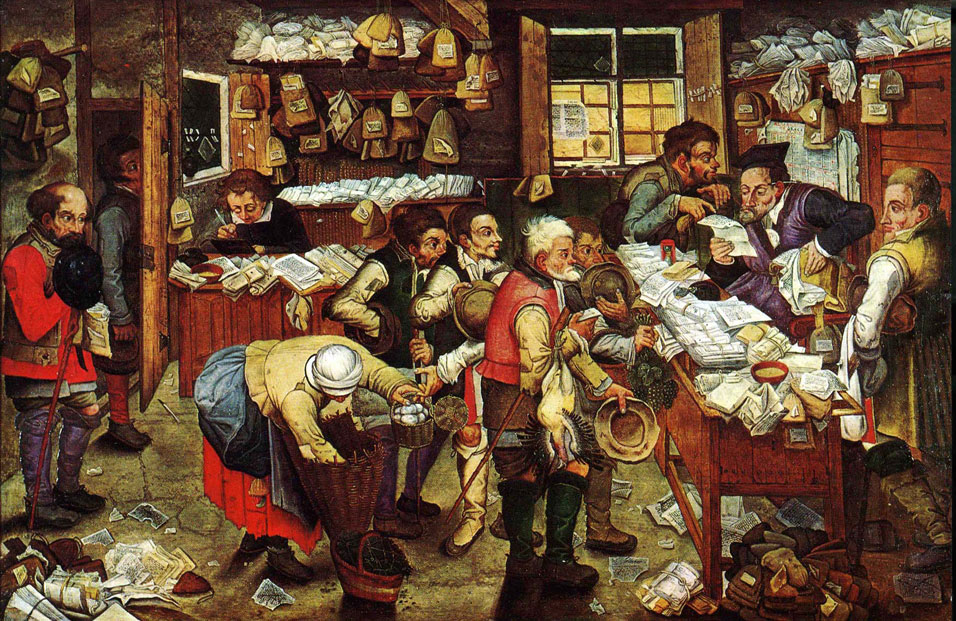
Pieter Brueghel the Younger, Paying the Tax (The Tax Collector), 1640
In my previous article, we just skimmed the surface of objects. Let's continue our reconnaissance. Today's topic is a tough one. It's not quite BIG DATA, but it's still the data not easy to work with: we're talking about fairly large amounts of data. It won't all fit into RAM at once, and some of it won't even fit on the drive (not due to lack of space, but because there's a lot of junk). The name of our subject is FIAS DB: the Federal Information Address System database - the databases of addresses in Russia. The archive is 5.5 GB. And it's a compressed XML file. After extraction, it will be a full 53 GB (set aside 110 GB for extraction). And when you start to parse and convert it, that 110 GB won't be enough. There won't be enough RAM either.
Hello,
Last weekend we've updated our Caché version to
| Versie: | Cache for Windows (x86-64) 2018.1.1 (Build 312U) |
I'm using Studio to develop. I've been using the built-in debugger and it has been working nicely. But now, since the upgrade, I'm getting this error when trying to debug any routine or class method:
Executing ##class(Blue.App.Handler.Adsolut).TestConnection()
<COMMAND>zDebugStub+30^%Debugger.System.1
This is the code for the classmethod I got the error on;
Class Blue.App.Handler.
InterSystems is delighted to announce the support of Docker container technology as a platform from the moment 2016.1 will be released.
Docker is a disruptive system technology that has many benefits and offers many advantages for those investing in infrastructure-as-code or immutable-infrastructure provisioning & deployment scenarios.
Like any new technology that appears, there is a learning curve, and many considerations need to occur when using it. However, Docker container technology has already proven to be successful by a huge follow-up with many companies already using it in production.
We have been storing raw messages in a MySQL database for DR and ad hoc purposes. We are thinking of using an Ensemble instance as our data lake instead. We could segregate the source data by namespace or by global. But either way we'll want a custom global to index the data for data retrieval performance purposes.
Anyone else taking this approach? Any feedback?
I want to upload several files using the html tag
< input multiple="multiple" name="BulkFileUpload" type="file">. The upload.csp page in the SAMPLE namespace only shows how to extract a single file from the MimeData on the %request object. I cannot fathom how to extract multiple files from the MimeData in the %request object in cache. Can some kind soul explain to me how to do that?
Hope someone can help me, so i was developing a script and during the tests I was using the csession to execute a method. Also i thought i had to stop the instance i was using, so I used the ccontrol stop [instanceName] to stop the instance, but when i restarted the instance i got this error trying to start my production, I have an idea of what's the problem but i don't know how to fix it.
ERRO <Ens>ErrException: <FILEFULL>zStartProduction+62^Ens.Director.1 ^Ens.Runtime("Name"),/hs-connect-hom/db/BPINTEGRADEV-GLB/ -- - registrado no log como '-' número - @' Set ^Ens.Runtime("Name")=pProductionName'Good morning
I'm probably overlooking something very basic, but I'm running on Win2016 with Cache 2016.2 - All the work I am doing is in INT routines, but I'm making some calls to the Host File system using $ZF(-1).
I have a few mapped Network drives that are mapped in Windows, typically these are locations where I want to back up some files.
My process is quite simple:
1. Read data
2. Zip data files using RAR
3. Create folder on Network drive
4. Move RAR files to new network share.
First time post, also a new Cache developer, hence the <Beginner> tag.
If our data has Predefined terms in a dictionary, and a user can add terms on their own, can the terms exist in different tables?
Lets call the tables "Terms" and the user data in "UserTerms".
If a third class definition has a property of "Term" can it not be either Terms or UserTerms?
I'm leaning towards using a Subclass strategy where the pseudo "Parent" (forgive me) is Dictionary.Term and the child is along the lines of Dictionary.Term.User
Dictionary.Term.User can inherit from Dictionary.
Hi Everyone!
Please meet InterSystems at hub.berlin - Europe's interactive business festival for digital movers and makers on 10 - 11 April 2019 in Berlin.
We look forward to two-day inspirational lectures and intensive technical discussions and invite you and your colleagues to our InterSystems booth for a personal conversation. In addition, we'll also present a keynote presentation and host a masterclass session.

See the details below.
InterSystems Caché globals provide very convenient features for developers. But why are globals so fast and efficient?
Basically, the Caché database is a catalog having the same name as the database and containing the CACHE.DAT file. On Unix systems, the database can also be an ordinary disk partition.
All data in Caché is stored in blocks which, in turn, are organized as a balanced B* tree. Taking into account that all globals are basically stored in a tree, global's subscripts will be represented as branches, while values of global's subscripts will be stored as leaves.
Hi,
We recently moved our cache instance from windows 2012 to windows 2016 and when i try to now import % routines i'm getting the following error "Unable to obtain a write lock on this routine because either another user has the routine open for editing or you do not have write access to the database the routine is stored in. This item will be skipped."
This is a fresh installation of cache and I've moved the cache.dat and csp pages across. It seems to work fine but can't import % routines which I need.
Has anyone experienced this and can help?
Thanks
Hi dev community,
I am currently working on a project to send documents to a RESTful based API that supports bearer
Token Authorization.
When we try to fire a JSON request from our EnsLib.Rest.Operation towards the 3rd party API with a
valid Token we keep receiving Authorization Error codes HTTP 401 back.
If we use the same request and same Token from a test utility such as Postman the request is
successful and we are able to move past the authorization stage.
We are inputting the Token in the header of the HTTP request as specified by the 3rd party API
specification.
Hello,
We have defined four BPL Business Processes. One gets occasionally errors when pool size is two. No errors happen with pool size one. The error happens on calling %Save() on a large objects with many references to other objects.
Error #5803: Failed to acquire exclusive lock on instance of 'classname'.
Error #5002: Cache error: <ROLLFAIL> %TRollBack+10^%occTransaction
The error happens on a particular large object.
Our FileService gets the same Errors #5803 and #5002 with class 'EnsLib.EDI.X12.Document'
Another BPL gets the same errors #5803 and #5002 with lock on instance of 'EDIGW.BPL.ST837.
Other Sync-Tools just work from Caché/IRIS to Caché/IRIS.
Synchronizing your data to some external DB requires some other solution.
The solution is available in Caché/IRIS since quite some time and works excellent.
^OBJ.DSTIME does the magic.
https://docs.intersystems.com/latest/csp/docbook/DocBook.UI.Page.cls?KEY=D2IMP_ch_current#D2IMP_C23869
It was built to allow data synchronization with DeepSee.
It keeps a very simple journal on Object/Table changes by signaling Modified,New,Deleted
This could be useful not only for DeepSee but for any other type of Table Synchronization.
The Global ^OBJ.
Let's say we have a class
AbcRequest extends Ens.Request, PropertiesBaseAbstractClass(has all my properties common to all request)
Prop1
Prop2 and so on
Now in my Business Operation
I want to make a json dynamically from this request.
Yes obviously I can do is
Set requestDefinition = ##class(%Library.CompiledClass).%OpenId("MyCreateRequest")
Set JsonObject = ##class(%DynamicObject).%New()
for i=1:1:requestDefinition.Properties.Count() {
Set key = requestDefinition.Properties.GetAt(i).Name
Set value = $property(pRequest,requestDefinition.
Hi Community!
We're pleased to invite you to the DMEA 2019 in Berlin – Europe's largest event for the Health IT industry.
Date: April 9 - 11, 2019
InterSystems' Location: Hall 3.2, Stand D-105
Please find all the details here: intersystems.com/de/dmea2019/

I have an application using examples from the lottery example in samples name space how do I create a dynamically link based on the data displayed to add a record id to the link
the idea is to loop over the records displays fields and link to edit the shown data at the end of the record in a table format
Hi Community!
Please welcome a new video on InterSystems Developers YouTube Channel:
Fast Provisioning in Any Cloud
The 2019.1 version of InterSystems IRIS Data Platform is now Generally Available!
Kits and container images are available via the WRC download site
The build number for these releases is 2019.1.0.510.0.
InterSystems IRIS Data Platform 2019.1 provides the following new capabilities:
We would like to know if there are any ramifications swapping out our code database while an Ensemble production is running. We are trying to minimize down time as much as possible and even though stopping and starting the production ideally would be pretty quick, is it possible that we could just restart the business hosts that had the code change?
So this is our setup: Ensemble 2016.1
global cache.dat code1 cache.dat code2 cache.dat
Namespace that we switch to point to either code1 or code2 and is mapped to the globals.
Has anyone done this?
Hi
We have just completed a migration of a test environment from Ensemble 2012 to Ensemble 2017 on a new server. This is the last in a series of migrations but the first to encounter this particular issue. All web clients making SOAP requests to a particular external web service are receiving a fault that states:
The SOAP action specified on the message, '', does not match the HTTP SOAP Action, 'http://<expected target service action follows here>'.