Occasionally I see a production item with a little 2 flag. When it has that, there is an "Item" dropdown. What does this mean?
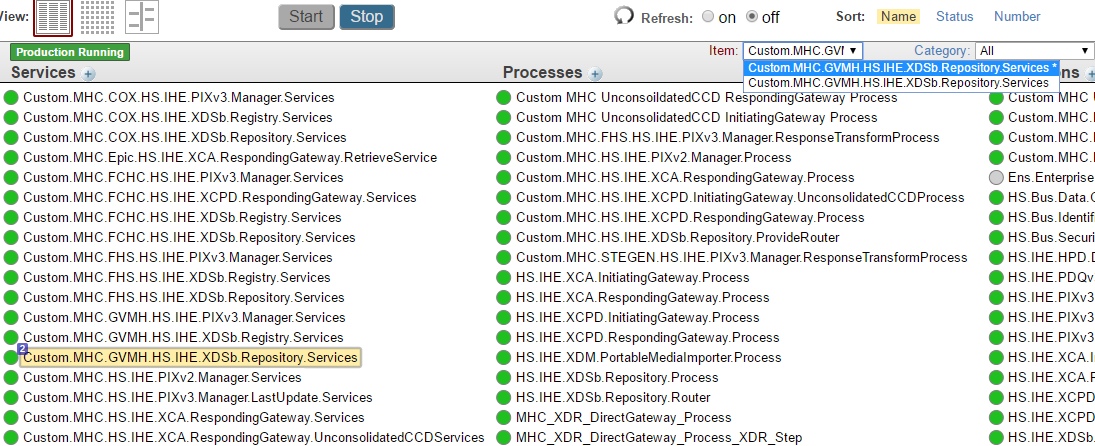
Occasionally I see a production item with a little 2 flag. When it has that, there is an "Item" dropdown. What does this mean?
Hello!
Are there any short ways of serializing COS entity to the string? I am searching for something like .$toJSON() , but I need Caché 2013.* support.
The one way I supposed to work is to use $listbuild:
set str = $LISTTOSTRING($LB(1,2,3,",",5))
set list = $LISTFROMSTRING(str,",")
zw list
list=$lb("1","2","3","","","5")
But the problem is that $listbuild does not escape delimiters, and it is not possible to deserialize serialized string. The structure I need to serialize may contain any characters.
Are there any short ways to do this in Caché to avoid writing custom parser?
I need to pass multiple values to a FILTER to a DeepSee DASHBOARD via the URL. The documentation seems to indicate this can be done, i.e.: "Where each filterspec is filter_name.filter_values" but there are no examples I can find that indicates what is used to separate multiple values. Say I want to pass the three values 5, 6, and 1395 to a filter. To pass just the 5 I know this works:
&SETTINGS=FILTER:LEAD.MYUSERID.H1.MYUSERID.5
but how do I include 6 and 1395. None of the following seem to work:
&SETTINGS=FILTER:LEAD.MYUSERID.H1.MYUSERID.5.6.1395
&SETTINGS=FILTER:LEAD.MYUSERID.H1.MYUSERID.
this is catching me all the time, again and again...
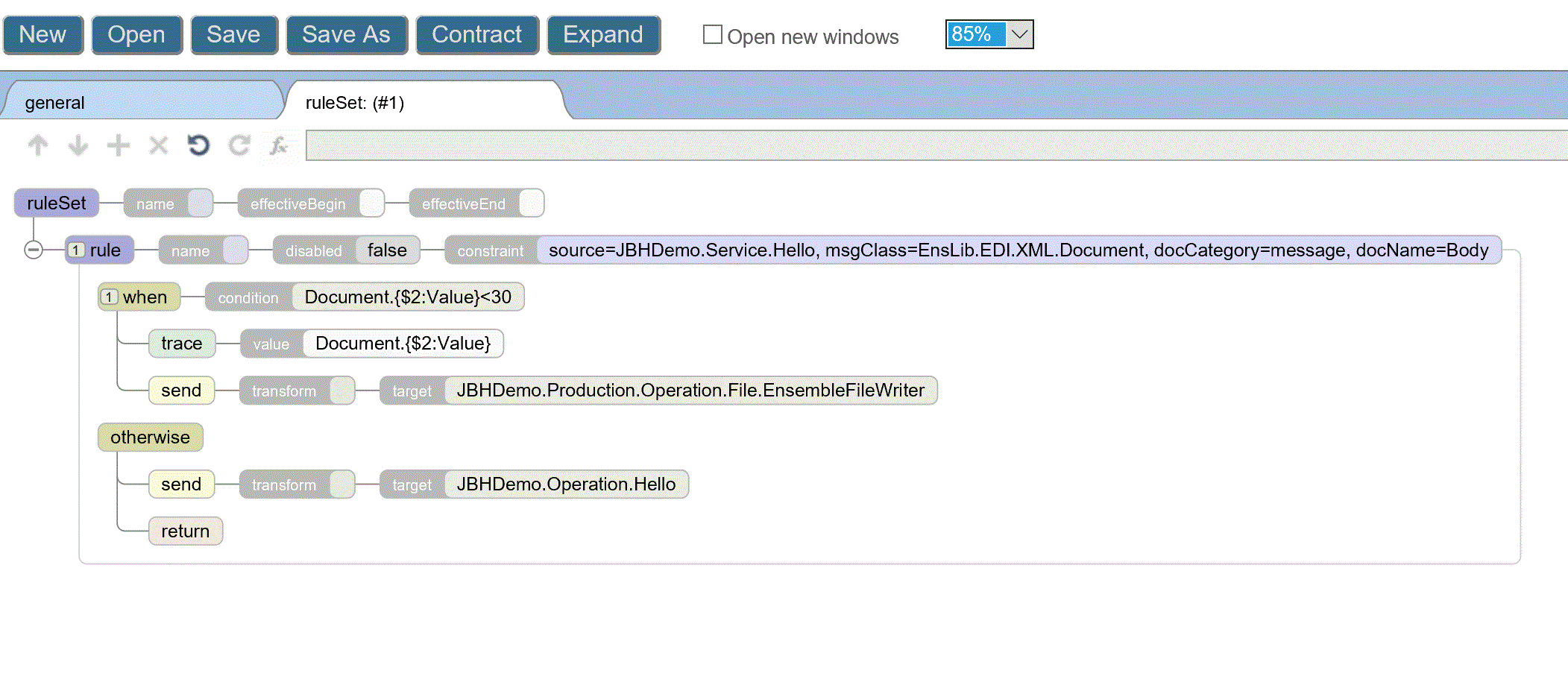
Haven't worked with XML VDOC for some time, I can't figure out, what is the correct way of using Property path. Can someone please help me to refresh my memory.
Simple example: I have a class called Body, with Value and Topic properties. I created a XML Schema for this class and imported it into Ensemble. So i have a category called message, with Body as DocType structure and Name and Topic properties of Body complex type ($2:Value and $2:Topic are element names)
My rule looks this way:
When using the "XML Cache Script" export via the Export context menu option (right clicking on a class in the Atelier Explorer View) sometimes the export dialog is empty.
Other times it is pre-filled with the project selected and the individual class chosen as expected. When it is blank you can choose the project but within the list of all classes there is no package hierarchy making it difficult to find your class.
Anyone know why sometimes you get the empty selection and sometimes you don't? I've tried to reproduce it at will but can't pick up a pattern.
NewBie's Corner Session 7 True and False
Welcome to NewBie's Corner, a weekly or biweekly post covering basic Caché Material.
Click on the Caché Cube in your system tray and select Terminal to try out these commands.
In COS, a 0 is false and any other number (positive or negative) is true.
Order is a necessity for everyone, but not everyone understands it in the same way (Fausto Cercignani)
Disclaimer: This article uses Russian language and Cyrillic alphabet as examples, but is relevant for anyone who uses Caché in a non-English locale. Please note that this article refers mostly to NLS collations, which are different than SQL collations. SQL collations (such as SQLUPPER, SQLSTRING, EXACT which means no collation, TRUNCATE, etc.) are actual functions that are explicitly applied to some values, and whose results are sometimes explicitly stored in the global subscripts. When stored in subscripts, these values would naturally follow the NLS collation in effect (“SQL and NLS Collations”).
I've been in IT since 1986.
I started with Pr1me INFORMATION and Primos on Pr1me hardware.
In the 90s and 00s, I used D3.
I'm giving Caché a try, but I'm kinda having some difficulty getting started.
I've installed Caché on a 64-bit Windows 7 workstation. It was installed under an administrator's account. From a standard users account, I'm trying to access the Management Portal at:
http://localhost:57772/csp/sys/UtilHome.csp
It is prompting me for credentials. Which ones do I use? I've tried several, but nothing is working.
Problem: Caché instance connects periodically to an Oracle database via jdbc and downloads data. Sometimes data on a remote server would change.
In DeepSee, having a customer account cube. The cube includes a time dimension AccountCreationDate.
How do you create a calculated measure to get the total number of accounts from the beginning to a certain date in abscissa ?
I tried many things including this:
AGGREGATE(%TIMERANGE([AccountCreationDate].[H1].[MonthYear].&[190001],[AccountCreationDate].[H1].[MonthYear].CURRENTMEMBER) ,[Measures].[%Count])
But I don't get the right result because the date in abscissa creates a filter on the first date.
I tried also with %MDX function, but then I loose the context for the CURRENTMEMBER.
Hi!
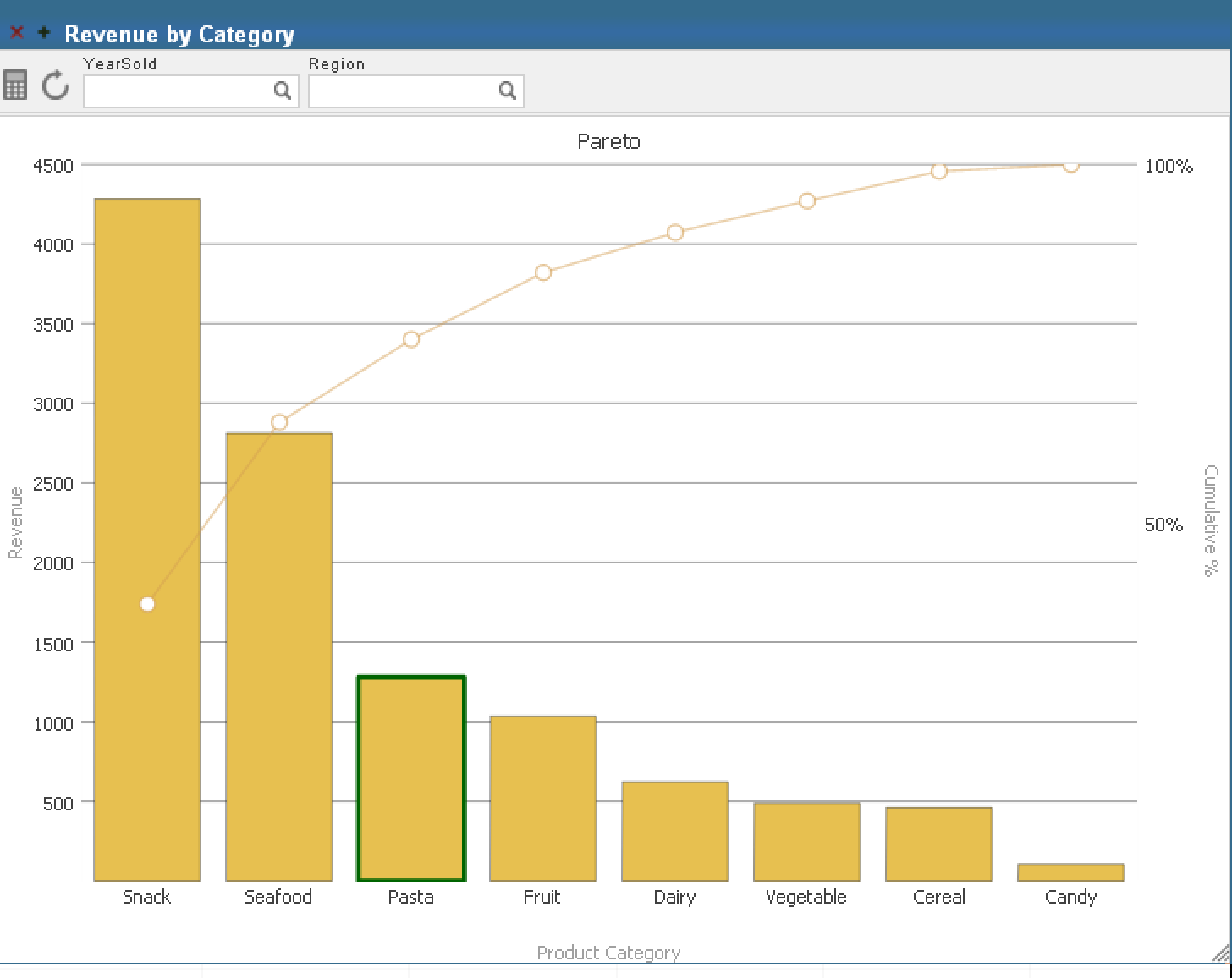
There is an example in Samples which shows how to implement 'running total' measure: "Pareto Chart for Category" dashboard.
To calculate running total this pivot uses calculated measure with %Cell expression:
I am having a problem when using atelier on my instance, which I just synched from perforce on latest and then did a built
I am getting the error ERROR #5880: Unable to create source control class: %Studio.SourceControl.ISC [zSourceControlCreate+17^%Studio.SourceControl.Interface.1:%SYS]
every time I want to open any class or routine from %SYS namespace in the Server tab.
Did someone had the same issue?
Mario
Hello, is there a way to reset all of the Sample Classes back to their "Installed State."? In other words, delete all the other classes I have put into the samples namespace and leave only those classes that were there when I installed the instance.?
-thank you
Hello,
We are sometimes asked for examples of how to do 3rd party SQL database selects/updates/inserts/stored procedures from an Ensemble SQL Business Operation.
We have noticed that when compiling with Atelier (either Atelier itself or sending the code through the REST interface) that the build will fail if all brackets '() {} []' are not closed. This includes brackets opened in comments.
For example, this will fail:
class myclass
{
//if someVar {
}
I do not know if this issue has been fixed or if this issue has been brought up, but it has been a nuisance over here.
Mirroring provides an admin capability to Stop Mirroring on this member, which causes a non-primary member to temporarily disconnect from the primary, stop dejournaling, etc. While most system administrators may never need or use this function, some employ it for certain kinds of maintenance or other special cases.
The intent is that the administrator uses the Start Mirroring function when they wish the member to reconnect. However, today mirroring also implicitly restarts (reconnects) if the Caché instance restarts.
Hello!
I have a WebSocket application which spawns new process using JOB command.
Sometimes WebSocket connection can be terminated, and in the meantime I need to hold spawned process alive until it can be associated with the new WebSocket connection. (Do not suggest serializing process state here instead please)
Technically, in Caché WebSocket connection is represented by the class, which executes in its own process. This process is terminated when the connection is lost. In this case the JOBbed process does not terminates (thanks Edward), but it rely on $ZPARENT variable.
On June 7th we'll be releasing two new views of content that will allow you to rapidly see what's new on the site as well as identify content that has gone unanswered. The next step for this (after this release) will be to add in personalization so that you can filter content based on your tag and member "following" preferences.
Sentiment Analysis is a thriving research area in the broader context of big data, with many small as well as large vendors offering solutions extracting sentiment scores from free text. As sentiment is highly dependent on the subject a piece of text is about (financial news vs tweets about the latest computer game), most of these solutions are targeted at specific markets and/or focus on a given type of source data, such as social media content.
Hello,
Why I don't see the full content of a XML file inside a Ens.StreamContainer Message?
When I look into the content I only see:
<?xml version="1.0" ?><!-- type: Ens.StreamContainer  id: 5 -->
<StreamContainer><OriginalFilename>C:\Temp\In\aa.xml</OriginalFilename><Stream></Stream><Type>FC</Type></StreamContainer>
How I can see all the content? There is any setting to modify this behavior?
I am using a EnsLib.File.PassthroughService,
Regards
Hi, Community!
Last weekend we held the Final of InterSystems Contest on Caché, DeepSee and iKnow under the aegis of IT Planet Student Championship in Ekaterinburg. BTW, this year we had more than 1,400 participants in InterSystems Contest.
One of the tasks for the final was to solve T9 Spelling problem with Caché ObjectScript and use the minimum code.
Problem description:
The Latin alphabet contains 26 characters and telephones only have ten digits on the keypad. We would like to make it easier to write a message to your friend using a sequence of keypresses to indicate the desired characters.
When I open a Business Process in Studio I am shown a BPL diagram.
I want to see a class definition directly.
Is there any way to achieve that behaviour in Studio?
I am pleased to announce the field test of Caché and Ensemble 2016.3 - with many new improvements.
The product team at InterSystems looks forward to your participation in the field test and feedback over the coming months.
Some of the more signification changes in 2016.3 are new RESTful APIs for iKnow and broader APIs for programmatic control of multiple servers (enterprise manager). As always, there are a host of scalability and performance improvements, including improvements to the core database and SQL. And hundreds of smaller improvements and corrections.
Hi -
After having seen how Atelier is working, I've decided to start learning/using Atelier for an existing project.
I've installed, and after a bit of poking around, I've managed to get a project that includes my classes, and they compile and such (these were all from an existing export), but I see that NONE of my .csp files came along despite being in the export file.
I'm trying to figure out what the planned strategy is for .
Hi!
Sometimes, especially when I work with Combined Cubes, I need to have all the dates in Date Dimension, not only members with rows in Fact table.
Is there any way to switch it on?
Hello
During some consultant activity I did at a client's I have discovered something very interesting. It seems like the current processing cycle as written in ObjectScript has trouble utilizing an SSD-based storage machine with five-digit IOPS.
Is there any official answer to this question: Does Atelier only support Unicode servers?
Thanks,
Joyce
We have put a new modern and responsive UI design on top of our existing product documentation. It is available in a public beta here: http://docs.intersystems.com/beta/csp/docbook/DocBook.UI.FramePage.cls
Please review the new design and give us your feedback.
Recently I was asked by a customer with this question. In MS SQL Server, there is a function called host_name() that will return the work station name.
Here is how I would do it in Caché :
With default SQL schema name, in my case SQLUser in SQL (which is equivalent as User in Caché class definition), I have a class called User.dummy, I added a classmethod called hostname and expose it as SQL function host_name:
Class User.Dummy Extends %Persistent [ ClassType = persistent, DdlAllowed, ProcedureBlock, SqlRowIdPrivate, SqlTableName = dummy, StorageStrategy = "" ]
{
Property f1 As %Library.