I'm trying to sign an xml but this is showing an Id attribute in the Signature tag and the xmlns attribute is not appearing.
This is the xml generated:
SET = ##class
Extensible Markup Language (XML) is a markup language that defines a set of rules for encoding documents in a format that is both human-readable and machine-readable.
I'm trying to sign an xml but this is showing an Id attribute in the Signature tag and the xmlns attribute is not appearing.
This is the xml generated:
SET = ##class
Hi:
Sorry I can't find the correct documentation for this. It's very simple I think.
I open up an XML reader class and correlate the XML to a message type.
My XML will read something like
This gets correlated into a message with the following property
Property StatusLastChecked As %String(XMLPROJECTION = "element");
I can use the following to get the other properties out
i.e. docs.RelayedDocuments.GetAt(i).
I am using studio 2015 version which does not have dynamic objects and I need to read xml and convert that to a json I have managed to come close to json string but with little difficulties .I need to be able to identify the root element and specify where to put braces between objects anyone with any idea is welcome he is my code so far
ClassMethod WriteNodes(myfile As %String = "C:\Testdata\data.xml")
{
  set status=##class(%XML.TextReader).ParseFile(myfile,.textreader)

    if $$$ISERR(status)
      {
	    do $System.Status.DisplayError(status)
	    quit
	  }

       set ptemp=##class(%Stream.FileCharacter).%New()
       set ptemp.Filename="C:\Testdata\ree.txt"
      //check status
     //iterate through document, node by node

       Do ptemp.Write( "{")
       while textreader.Read()
        {
           If (textreader.seq=462)
	         {
		       Do ptemp.Write("}")
		       Do ptemp.Write("]")
		       Do ptemp.Write("}")
		     }

		       If ((textreader.Path="/[1]/[2]/[0]")&&(textreader.NodeType'= "endelement"))
	             {
		          Do ptemp.Write("{")
		         }
		            If ((textreader.Path="/[1]/[2]/[0]")&&(textreader.NodeType= "endelement"))
	                   {
		                Do ptemp.Write("},")
		              }

                   If ((textreader.Name'="")&&(textreader.NodeType'= "endelement"))
                      {
                        Do ptemp.Write($CHAR(34)_textreader.Name_$CHAR(34)_$CHAR(58))
                      }
                      Else
                      {
	                   Do ptemp.Write("")
	                  }

                  If (textreader.Value'="")
                     {
                      Do ptemp.Write($CHAR(34)_textreader.Value_$CHAR(34)_"," )
                     }
               Do ptemp.WriteLine()
        }

       Do ptemp.%Save()

       quit
}
Hello.
I want to know how can I convert XML String intro a %SerialObject.
This is an example:
And this are the %SerialObject classes I have created:
I'm looking for any codes that match my parameter that we have received since 1/01/2020 based on the FromTime, EnteredOn or Status (if both are empty).
(Problem[Problem/Code='%1' and FromTime>"2020-01-01"]) | (Problem[Problem/Code='%1' and (count(FromTime)=0 or FromTime="") and EnteredOn>"2020-01-01"])
| (Problem[Problem/Code='%1' and (count(FromTime)=0 or FromTime="") and (count(EnteredOn)=0 or EnteredOn="") and Status/Description="Active"])
This works like a charm with standard XPATH query tools but HS does not like it.
Hello,
Recently I have been required to work with a method called ExportToStream.
The situation asks me to export a UTF-8-encoded JSON as a XML to be imported on old releases. Here's how I attempted to fulfill this request:
do $System.OBJ.ExportToStream("path/to/my/json/file.json", .stream,,,"UTF8")
The file is indeed encoded as UTF-8 and although the XML header denotes that it has been exported as UTF8:
<?xml version="1.0" encoding="UTF8"?>
I'm having trouble trying to navigate XML files USING the %XML.TextReader. I have read https://cedocs.intersystems.com/latest/csp/docbook/DocBook.UI.Page.cls?KEY=GXML_textreader#GXML_textreader_creating_method
but I still don't really understand.
I have the following block
while textreader.Read()
{
set practices= practices_textreader.Name_":"
If textreader.Value'=""
{
set practices= practices_textreader.
Hello,
We have been reasearching how could we parse a string with a JSON structure like the following:
{"code":200,"type":"Consulta","message":"Operacion correcta","result":[{"id":38802130,"paciente":null,"prestacion":{"codigo":"1.
HI,
I want to validate my XML file with a DTD file.
I found this https://community.intersystems.com/post/validating-xml but it's with the SAX parser...
Is there an easier solution?
Intersytems Ensemble version 2017.2
Regards,
Guillaume LEPRETRE
We have a data transformation where source is object collection (populated from a json file) and target is EnsLib.EDI.XML.Document.
If source file is large enough, transformation fails and we get <store> error and I quickly found this:
https://docs.intersystems.com/irislatest/csp/docbook/DocBook.UI.Page.cls?KEY=EBPLR_DTL_foreach which at the bottom in "Avoiding <STORE> Errors with Large Messages" section tells to:
"As you loop over segments in a message or object collections, they are brought into memory.
Does anyone have an anonymize script for SDA?
In my Data Transformation, the Target class needs to create a new List of objects (ListOfObj), depending on some conditions of Source class (Source/Target are completely distinct/different classes).
I experimented with Lists of 'primitive' data types (ListOfDT), and I could add new %String items (as an example) to a List of %String property, with "append" action in DT.
Does anyone have an example, or guidance, how to create new Lists of Objects in data transformation?
For example, if I have a 'container' class like this, it works:
Class Json.SalesOrderContainer Extends (%RegisteredObject,%XML.Adaptor)
{
    Property SalesOrderArray as List of %String; this works with append
when ever I pull the xml file from business services and its failed in business process and I am getting the below error.
ERROR
Hello,
We would like to get the XML which is being given by the requested system, directly to our Service output.
We have tried to just output directly the Message Response as follows:
Method findCandidatesXML(mensEntrada As %XML.GlobalCharacterStream(CONTENT="MIXED")) As Mensajes.Response.GestionPacientes.operacionResponse(XMLNAME="mensSalida") [ Final, ProcedureBlock = 1, SoapAction = "http://SCS.Servicios/GestionPacientes/findCandidatesXML", SoapBindingStyle = document, SoapBodyUse = literal, WebMethod ]
{
    set ^tipoMensaje="XML"
    $$$LOGINFO("El mensaje es de tipo: "_^tipoMensaje)


    #dim tSC as %Status
    if ('..IsServiceEnabled()){
        set tSC = $SYSTEM.Status.Error(60333,"Web Service Not Enabled")
        if $$$ISERR(tSC) do ..ReturnMethodStatusFault(tSC)
    }
    //----
    set p = ##class(%GlobalCharacterStream).%New()

    while (mensEntrada.AtEnd=0){
        //do p.Write(mensEntrada.Read())
        do p.Write($zcvt(mensEntrada.Read(),"O","UTF8"))
    }

    $$$LOGINFO("El mensaje en XML: "_p.Read())
    do p.Rewind()


    set msgER7 = ##class(EnsLib.HL7.Message).%New()
    set msgER7 = ##class(ITB.HL7.Util.Convert).XMLToER7(p,.tSC,"2.5")
    $$$LOGINFO(tSC)
    //Establece DocType
    if (msgER7.GetValueAt("1:9.3") '= "") {
        do msgER7.DocTypeSet("2.5"_":"_msgER7.GetValueAt("1:9.3"))

    } else {
        set tipo = msgER7.GetValueAt("1:9.1")
        set evento = msgER7.GetValueAt("1:9.2")
        do msgER7.DocTypeSet("2.5"_":"_tipo_"_"_evento)

    }

    set pPesponse = ##Class(Mensajes.Response.GestionPacientes.operacionResponse).%New()


    //proceso el mensaje
    set tSC = ..SendRequestSync("EnrutadorConsultaPaciente",msgER7, .pPesponse)
    //set tSC = ..SendRequestAsync("EnrutadorConsultaPaciente",p, .pPesponse)

    if $$$ISERR(tSC){ $$$TRACE("Error en la llamada al destino"_$system.Status.GetErrorText(tSC))}


    Quit pPesponse
}Hi guys,
I need help because I have no idea how to proceed further and documentation does not explaining this solution.
I have XML like this:
<Barcode>1200002101</Barcode>
<DueDate>31.12.5000 23:59:59</DueDate>
<BasicMaterial>1.
Hello.
I'm trying to export a XML stream containing some files that are supposed to have been written using UTF-8, but I'm facing some broken encoding issues.
You can see below that I'm indeed viewing a UTF-8 encoded and which is inside the CSP folder and encoded correctly (although displaying it on Studio would not display it correctly as the file is not using BOM and that's intentional).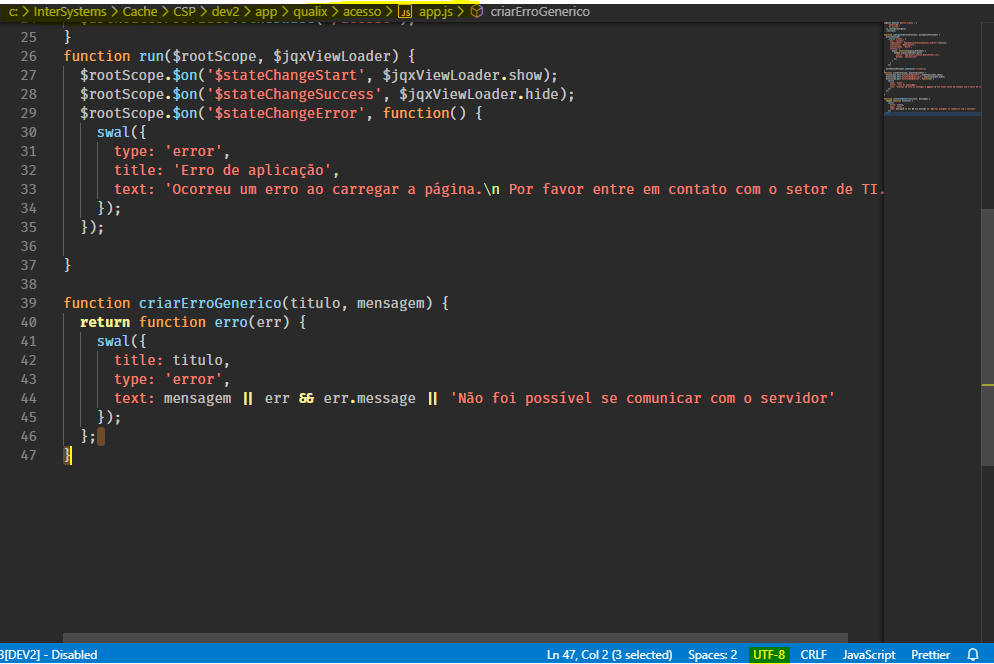
We need to export such files to XML along with many others and for that we'are using the method ExportToStream from the class %SYSTEM.OBJ.
Hello,
I am reading in an X12 document into my production that needs to be processed and returned as a CSV file. I have created a record map to support the fields I want to extract with a batch class to store headers. I have a DTL mapping the data to the appropriate fields in the record map and am sending the record map to a EnsLib.RecordMap.Operation.BatchFileOperation.
None of my components error out and in fact report that the message was processed without any errors but I am not getting an output file in my expected output folder.
Is this an appropriate use of this operation class?
Hi,
I have a large XML zen report file that I want to convert to a CSV, what is the most efficient way to do it.
XML file:
<Details>
<Col1> aa1 </Col1>
<Col2> bb1</Col2>
<Col3> cc1 </Col3>
</Details>
<Details>
<Col1> aa2 </Col1>
<Col2> bb2</Col2>
<Col3> cc3 </Col3>
</Details>
Expected Output:
Col1,Col2,col3
aa1,bb1,bb1
aa2,bb2,bb2
Thank you.
I have a large amount of classes in several XML namespaces.
Is there a way to generate all XSDs automatically?
I've read the docs but it seems like it's a manual class-by-class process.
I use the 2012 version of the caché, and I need to export data in an Excel file, the point that seems to complicate is to use the dropdown list in the cell and then trigger a validation if I exceed an interval of two values.
Help me, by your seggestions, solutions Thank you
Hi All,
I have a ZEN report, which gives a PDF output, i want to generate this report programmatically, save to a location in the disk. Here is my method so far
ClassMethod GenerateReport(,
This method generates a .xsl and .xml file which has my output, how can i get a pdf?
Thanks in Advance.
Rizmaan
Hi everyone,
I have just started to use JavaGateway and I didn''t encountered so much difficulties since I've got the output of the Java class I have called.
This is the class I have implemented:
Method OnRequest(As
Basically, I want want to translate an HL7 message into an XML message through the java class called by the JavaGateway in this way:
;
Everithing seems to work fine, indeed, when I log the output with the $$$LOGINFO i get the xml message that I was expecting.
Hi all,
is it possible to omit the typical XML header line
when writing an the contents of a EnsLib.EDI.XML.Document using the above mentioned operation. I´ve already digged into the config value Format. It only states that:
C(e) : output an XML header line declaring character encoding e. If e is empty use the encoding defined by the Adapter. If e begins with ! force the output stream's encoding.
Hi Everyone!
New video, recorded by @Stefan Wittmann, is already on InterSystems Developers YouTube:
JSON and XML persistent data serialization in InterSystems IRIS
Hi Community!
Enjoy watching the new video on InterSystems Developers YouTube, recorded by @Joel Solon, InterSystems Senior Technical Trainer:
Hello Everyone
I'm trying to open an XML that I get inside a GZIP file.
However, I can only open the contents when I save the file to a folder.
I would like to know if there is a way to get the contents of XML without saving the GZIP in a folder.
The code below is functional, however, you are saving GZIP before you can get the contents of the XML.
SET tGZIP = $System.Encryption.Base64Decode("############")
SET tFile= ##class(%File).%New("####")
SET tSC = tFile.Open("WSN")
SET tSC = tFile.Write(tGZIP)
DO tFile.%Save()
DO tFile.Close()
SET tSC = tFile.Open("RUK:::/GZIP=1:/NOXY=1")
WHILE 'tFile.AtEnd
 {
   SET tXML = tFile.ReadLine()
 }
I have one persistent, xml-enabled class.
I need to convert objects of this class to XML.
However I need to project each object in different ways (depending on
where I send it), for example:
Is there a way to do that with XML Adaptor?
Hello everyone, I'm new to COS development. I'm trying to generate a simple XML file based on a query and save into my server. I'm looking for stuff to get it done, if anyone has a tutorial or a step-by-step post on how to do it. My difficulty is just in generating the XML file.
I have an xml that has non standard characters and I would like to transform it with xslt so that those characters render in the format &#nnn here is what I have so far any help appreciated
xslt
<!--?xml version="1.0"?-->
<xsl:transform version="1.0" xmlns:xsl="http://www.w3.org/1999/XSL/Transform">
<xsl:output encoding="Windows-1252" indent="yes" omit-xml-declaration="yes" method="xml">
>  <xsl:template match="/Recordset">
    <recordset><xsl:apply-templates></xsl:apply-templates></recordset>
  </xsl:template>
  <xsl:template match="*|@*">
    <xsl:copy>
      <xsl:apply-templates select="@*">
      <xsl:apply-templates>
    </xsl:apply-templates></xsl:apply-templates></xsl:copy>
  </xsl:template>
</xsl:output></xsl:transform>
Hello everyone!
I need to have a ResultSet of type % SQL.Statement show its contents when it is trafficked in a message property by Business Process.
I tried to use the % XML.DataSet type that inherits properties of type % XML.Adaptor, but did not work.
Is there any other way to traffic as an object, other than within a Stream?
Note: I can not traffic Streams and I will not be able to use Correlate in this case.