image

Hi Community,
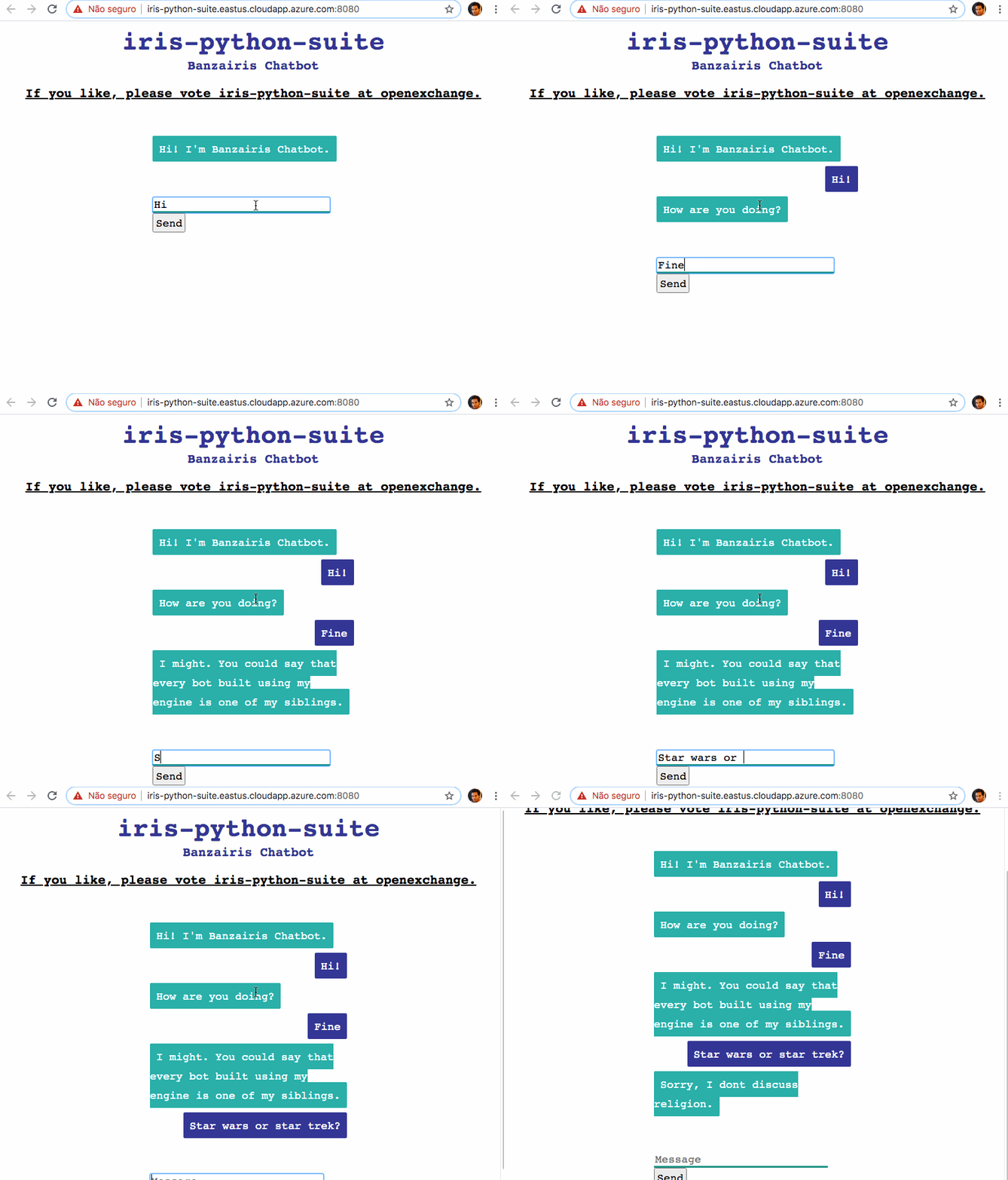
In this article, I will demonstrate below steps to create your own chatbot by using spaCy (spaCy is an open-source software library for advanced natural language processing, written in the programming languages Python and Cython):

  • Step1: Install required libraries

  • Step2: Create patterns and responses file

  • Step3: Train the Model

  • Step4: Create ChatBot Application based on the trained model

So Let us start.

6 1
1 3.7K

Hi Community,

In this article, I will introduce my application iris-AgenticAI .

The rise of agentic AI marks a transformative leap in how artificial intelligence interacts with the world—moving beyond static responses to dynamic, goal-driven problem-solving. Powered by OpenAI’s Agentic SDK , The OpenAI Agents SDK enables you to build agentic AI apps in a lightweight, easy-to-use package with very few abstractions. It's a production-ready upgrade of our previous experimentation for agents, Swarm.
This application showcases the next generation of autonomous AI systems capable of reasoning, collaborating, and executing complex tasks with human-like adaptability.

Application Features

  • Agent Loop 🔄 A built-in loop that autonomously manages tool execution, sends results back to the LLM, and iterates until task completion.
  • Python-First 🐍 Leverage native Python syntax (decorators, generators, etc.) to orchestrate and chain agents without external DSLs.
  • Handoffs 🤝 Seamlessly coordinate multi-agent workflows by delegating tasks between specialized agents.
  • Function Tools ⚒️ Decorate any Python function with @tool to instantly integrate it into the agent’s toolkit.
  • Vector Search (RAG) 🧠 Native integration of vector store (IRIS) for RAG retrieval.
  • Tracing 🔍 Built-in tracing to visualize, debug, and monitor agent workflows in real time (think LangSmith alternatives).
  • MCP Servers 🌐 Support for Model Context Protocol (MCP) via stdio and HTTP, enabling cross-process agent communication.
  • Chainlit UI 🖥️ Integrated Chainlit framework for building interactive chat interfaces with minimal code.
  • Stateful Memory 🧠 Preserve chat history, context, and agent state across sessions for continuity and long-running tasks.

6 0
0 340

This article presents a potential solution for semantic code search in TrakCare using IRIS Vector Search.

Here's a brief overview of results from the TrakCare Semantic code search for the query: "Validation before database object save".

  • Code Embedding model

There are numerous embedding models designed for sentences and paragraphs, but they are not ideal for code specific embeddings.

6 0
1 291
Article
· Apr 5, 2022 4m read
Serializing Python objects in globals

Motivation

This project was thought of when I was thinking of how to let Python code deal naturally with the scalable storage and efficient retrieving mechanism given by IRIS globals, through Embedded Python.

My initial idea was to create a kind of Python dictionary implementation using globals, but soon I realized that I should deal with object abstraction first.

So, I started creating some Python classes that could wrap Python objects, storing and retrieving their data in globals, i.e., serializing and deserializing Python objects in IRIS globals.

6 1
1 2.4K
Article
· Mar 29, 2023 1m read
Named Parameter In SQL with Python

Quick Tips: Total Productive Maintenance

Named parameters can be achieved with SQLAlchemy :

from sqlalchemy import create_engine, text,types,engine

_engine = create_engine('iris+emb:///')

with _engine.connect() as conn:
    rs = conn.execute(text("select :some_private_name"), {"some_private_name": 1})
    print(rs.all())

or with native api

from sqlalchemy import create_engine, text,types,engine

# set URL for SQLAlchemy
url = engine.url.URL.create('iris', username='SuperUser', password='SYS', host='localhost', port=33782, database='FHIRSERVER')

_engine = create_engine(url)

with _engine.connect() as conn:
    rs = conn.execute(text("select :some_private_name"), {"some_private_name": 1})
    print(rs.all())

6 0
0 578

While starting the development with IRIS we have a distribution kit or in case of Docker we are pulling the docker image and then often we need to initialize it and setup the development environment. We might need to create databases, namespaces, turn on/off some services, create resources. We often need to import code and data into IRIS instance and run some custom code to init the solution.

And there plenty of templates on Open Exchange where we suggest how to init REST, Interoperability, Analytics, Fullstack and many other templates with ObjectScript. What if we want to use only Python to setup the development environment for Embedded Python project with IRIS?

So, the recent release of Embedded Python template is the pure python boilerplate that could be a starting point for developers that build python projects with no need to use and learn ObjectScript. This article expresses how this template could be used to initialize IRIS. Here we go!

6 1
2 778

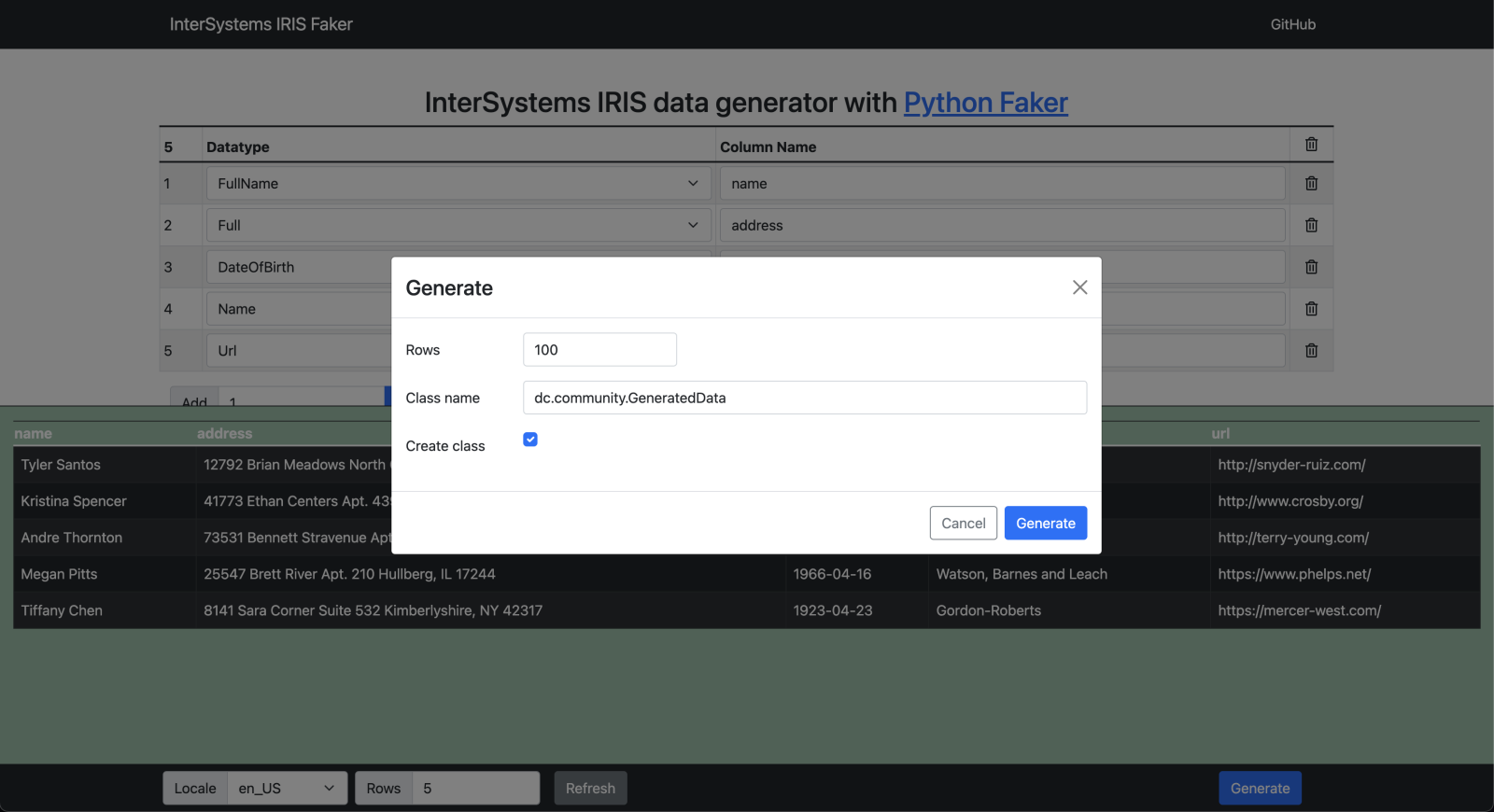
I think it's a known fact that Populate Utility has very limited functionality. It supports only one language and one country. The list of possible values does not have so many options.

There is a kind of tool that now can help with it, named Faker. It has implementations in different languages, including Python. Since IRIS has now had the Embedded Python feature, Python faker can be implemented in IRIS.

5 3
0 342
Article
· Feb 27, 2022 2m read
Dash-Python-IRIS

We are happy to share interesting information with you, as well as tell you why Python is good, where it is used.

Among the most used libraries are NumPy and Pandas. NumPy (Numerical Python) is used to sort large datasets. It simplifies mathematical operations and their vectorization on arrays. Pandas offers two data structures: Series (a list of elements) and Data Frames (a table with multiple columns). This library converts data into a Data Frame, allowing you to remove and add new columns, as well as perform various operations.

5 1
2 783

Introduction

To achieve optimized AI performance, robust explainability, adaptability, and efficiency in healthcare solutions, InterSystems IRIS serves as the core foundation for a project within the x-rAI multi-agentic framework. This article provides an in-depth look at how InterSystems IRIS empowers the development of a real-time health data analytics platform, enabling advanced analytics and actionable insights. The solution leverages the strengths of InterSystems IRIS, including dynamic SQL, native vector search capabilities, distributed caching (ECP), and FHIR interoperability. This innovative approach directly aligns with the contest themes of "Using Dynamic SQL & Embedded SQL," "GenAI, Vector Search," and "FHIR, EHR," showcasing a practical application of InterSystems IRIS in a critical healthcare context.

5 1
3 236

Why should you connect Flask to InterSystems IRIS?

The first thing that comes to mind when we think about combining Flask with IRIS is a portal to interact with your clients and partners. A good example would be a website for patients to access their clinical exams. Of course, this case would require a whole new layer of security, which we did not cover in our last article. However, we can effortlessly add it with Werkzeug, for instance.

5 0
0 463

Introduction

In my previous article, I introduced the FHIR Data Explorer, a proof-of-concept application that connects InterSystems IRIS, Python, and Ollama to enable semantic search and visualization over healthcare data in FHIR format, a project currently participating in the InterSystems External Language Contest.

In this follow-up, we’ll see how I integrated Ollama for generating patient history summaries directly from structured FHIR data stored in IRIS, using lightweight local language models (LLMs) such as Llama 3.2:1B or Gemma 2:2B.

The goal was to build a completely local AI pipeline that can extract, format, and narrate patient histories while keeping data private and under full control.

All patient data used in this demo comes from FHIR bundles, which were parsed and loaded into IRIS via the IRIStool module. This approach makes it straightforward to query, transform, and vectorize healthcare data using familiar pandas operations in Python. If you’re curious about how I built this integration, check out my previous article Building a FHIR Vector Repository with InterSystems IRIS and Python through the IRIStool module.

Both IRIStool and FHIR Data Explorer are available on the InterSystems Open Exchange — and part of my contest submissions. If you find them useful, please consider voting for them!

5 0
2 103

InterSystems IRIS currently limits classes to 999 properties.

But what to do if you need to store more data per object?

This article would answer this question (with the additional cameo of Community Python Gateway and how you can transfer wide datasets into Python).

The answer is very simple actually - InterSystems IRIS currently limits classes to 999 properties, but not to 999 primitives. The property in InterSystems IRIS can be an object with 999 properties and so on - the limit can be easily disregarded.

5 13
1 869

FHIR has revolutionized the healthcare industry by providing a standardized data model for building healthcare applications and promoting data exchange between different healthcare systems. As the FHIR standard is based on modern API-driven approaches, making it more accessible to mobile and web developers. However, interacting with FHIR APIs can still be challenging especially when it comes to querying data using natural language.

5 4
2 1.4K

Customer support questions span structured data (orders, products 🗃️), unstructured knowledge (docs/FAQs 📚), and live systems (shipping updates 🚚). In this post we’ll ship a compact AI agent that handles all three—using:

  • 🧠 Python + smolagents to orchestrate the agent’s “brain”
  • 🧰 InterSystems IRIS for SQL, Vector Search (RAG), and Interoperability (a mock shipping status API)

5 0
2 182

In the ever-evolving landscape of data science and machine learning, having the right tools at your disposal can make all the difference. In this article, we want to shine a spotlight on two essential Python libraries that have become indispensable for data scientists and machine learning practitioners alike: Matplotlib and scikit-learn.

5 2
2 286

In last week's discussion we created a simple graph based on the data input from one file. Now, as we all know, sometimes we have multiple different datafiles to parse and correlate. So this week we are going to load additional perfmon data and learn how to plot that into the same graph.
Since we might want to use our generated graphs in reports or on a webpage, we'll also look into ways to export the generated graphs.

5 0
0 1.1K

In this GitHub we fine tune a bert model from HuggingFace on review data like Yelp reviews.

The objective of this GitHub is to simulate a simple use case of Machine Learning in IRIS :
We have an IRIS Operation that, on command, can fetch data from the IRIS DataBase to train an existing model in local, then if the new model is better, the user can override the old one with the new one.
That way, every x days, if the DataBase has been extended by the users for example, you can train the model on the new data or on all the data and choose to keep or let go this new model.

5 2
1 514
Article
· May 14, 2024 11m read
Q&A Chatbot with IRIS and langchain

TL;DR

This article introduces using the langchain framework supported by IRIS for implementing a Q&A chatbot, focusing on Retrieval Augmented Generation (RAG). It explores how IRIS Vector Search within langchain-iris facilitates storage, retrieval, and semantic search of data, enabling precise and up-to-date responses to user queries. Through seamless integration and processes like indexing and retrieval/generation, RAG applications powered by IRIS enable the capabilities of GenAI systems for InterSystems developers.

5 3
3 547

In the previous article, we saw how to build a customer service AI agent with smolagents and InterSystems IRIS, combining SQL, RAG with vector search, and interoperability.

In that case, we used cloud models (OpenAI) for the LLM and embeddings.

This time, we’ll take it one step further: running the same agent, but with local models thanks to Ollama.

5 0
5 179