New
Hi Community,
Enjoy the new video on InterSystems Developers YouTube:
⏯ Deploying Solutions Using Intersystems Package Manager @ Ready 2025
InterSystems IRIS is a Complete Data Platform
InterSystems IRIS gives you everything you need to capture, share, understand, and act upon your organization’s most valuable asset – your data.
As a complete platform, InterSystems IRIS eliminates the need to integrate multiple development technologies. Applications require less code, fewer system resources, and less maintenance.
Hi Community,
Enjoy the new video on InterSystems Developers YouTube:
⏯ Deploying Solutions Using Intersystems Package Manager @ Ready 2025
Hi everyone! 👋
I’m excited to share the project I’ve submitted to the current InterSystems .Net, Java, Python, and JavaScript Contest — it’s called IRIStool and Data Manager, and you can find it on the InterSystems Open Exchange and on my GitHub page.
In a previous article, I presented the IRIStool module, which seamlessly integrates the pandas Python library with the IRIS database. Now, I'm explaining how we can use IRIStool to leverage InterSystems IRIS as a foundation for intelligent, semantic search over healthcare data in FHIR format.
This article covers what I did to create the database for another of my projects, the FHIR Data Explorer. Both projects are candidates in the current InterSystems contest, so please vote for them if you find them useful.
You can find them at the Open Exchange:
In this article we'll cover:
Are you signed up to take the InterSystems IRIS SQL Specialist or Professional exam?
Get ready with these in-person and self-paced learning resources!

InterSystems IRIS globals are one of the platform's core strengths: they store hierarchical data in a direct, ordered, and efficient structure. But when working from Python, manipulating globals can sometimes feel closer to a low-level API than to the natural habits of the language.
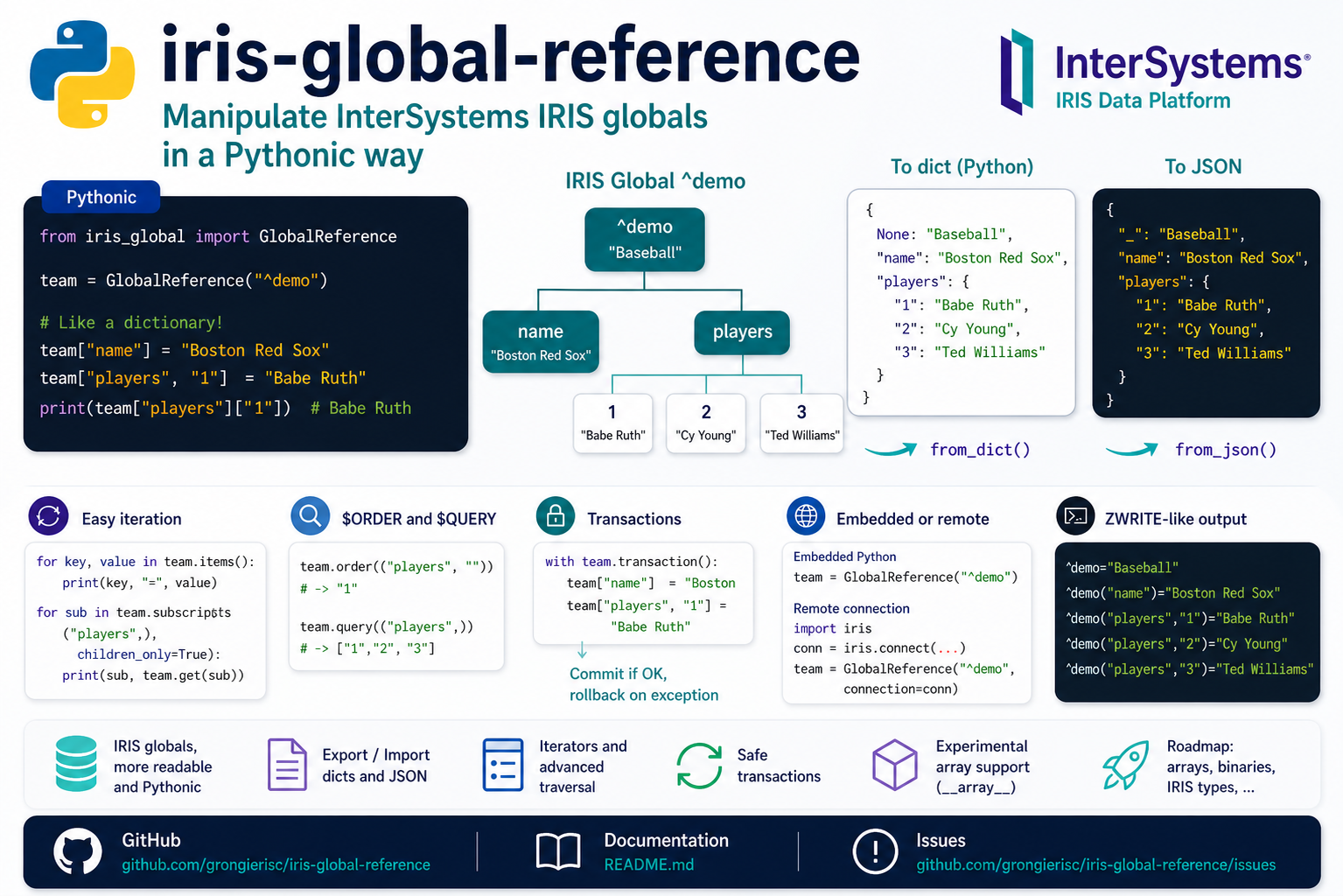
The iris-global-reference project provides a Python layer on top of IRIS globals. Its goal is simple: make access to globals more readable, more idiomatic, and easier to integrate into modern Python code, without hiding the underlying hierarchical model.
InterSystems is pleased to announce the general availability of:
This release adds support for the Ubuntu 26.04 operating system. Ubuntu 26.04 includes Linux kernel 7.0, security improvements, along with installer and user interface improvements.
We are only releasing IRIS for Intel/AMD (x86_64) processors at this time. We've seen occasional network problems on ARM servers.
UPDATE: since version 0.0.4 of the extension was published on 2025-11-23 it is now possible to use gj :: configExplorer directly in VS Code on Windows.
In my previous article introducing gj :: configExplorer I flagged up how an apparent bug in the Windows elements of the Native API for Node.js means it's not currently available to run in VS Code on a Windows desktop. In a comment on that article I offered a workaround, but this requires a Docker-equipped Linux host you can SSH to.
If you don't have a suitable target it's now possible to leverage your local Windows Docker Desktop.
While working with external languages for IRIS (such as Python and Node.js), one of the first things you must accomplish is making a connection to an IRIS instance.
For instance, to make a connection in python (from https://pypi.org/project/intersystems-irispython/):
import iris

# Open a connection to the server
args = {
	'hostname':'127.0.0.1',
	'port': 1972,
	'namespace':'USER',
	'username':'username',
	'password':'password'
}
conn = iris.connect(**args)

# Create an iris object
irispy = iris.createIRIS(conn)

# Create a global array in the USER namespace on the server
irispy.set("myGlobal", "hello world!")
Hi Community,
Do you build and manage applications with InterSystems IRIS SQL?
🎓Two tiers of certifications—specialist and professional (new!)—are now available!
I’m exploring deployment options for InterSystems IRIS in cloud environments such as AWS or Azure.
What deployment architectures, scaling strategies, or infrastructure best practices are commonly recommended by the community? I’d also appreciate guidance regarding high availability, backups, and monitoring in cloud-based deployments.
What logging and auditing strategies are commonly recommended for InterSystems IRIS environments?
I’m interested in learning about best practices for tracking user activity, troubleshooting issues, monitoring integrations, and maintaining compliance in enterprise or healthcare systems.
Are there built-in tools or external integrations that work especially well for this purpose?
I’m currently working with REST APIs in InterSystems IRIS and would like to better understand the recommended security practices for production environments.
I’m especially interested in:
I would also appreciate learning about common mistakes to avoid when deploying APIs publicly or integrating with external systems.
What approaches or tools have worked best in your environments?
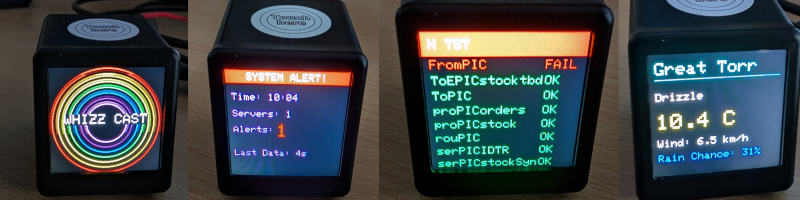
When managing critical healthcare data through an integration engine you want to know the moment a queue starts backing up or a service drops.
Unfortunately, this usually leads to an email inbox stuffed full of notifications that can sometimes seem impossible to maintain.
Well, I’ve not solved that problem.
But I have created something that could help...
I’m looking for practical recommendations to monitor InterSystems IRIS performance in a production environment. What are the most useful built-in tools, metrics, or best practices to track system health, database performance, and possible bottlenecks?
I would also like to know if there are recommended dashboards, logs, or monitoring integrations commonly used by the community.
Hi Community,
Stay ahead with content relevant to your role and goals with the InterSystems Learning Services newsletter!
See how to customize your journey! 👇

What's the most straight-forward way to install this on an offline server? I'm trying to set this up on an Azure DevOps server to support our CI/CD pipelines. I've tried using zpm installing the tgz from the local filesystem. I note zpm seems to need a repo configured to install but I can't work out how to setup a bare-bones Filesystem repo (please point me to some documentation on this). I have no idea what I'm doing...
Common Table Expressions (CTEs) provide a structured framework for defining reusable intermediate result sets within SQL statements. InterSystems IRIS implements CTEs via the WITH clause, enabling clearer query composition and modular analytical processing while remaining fully integrated with the IRIS cost-based optimizer.
This article explores the semantics of CTEs in InterSystems IRIS, explains their interaction with query optimization, discusses appropriate deployment scenarios, and presents executable examples illustrating practical patterns for production environments.
I’m excited to share the project I’ve submitted to the current InterSystems .Net, Java, Python, and JavaScript Contest — it’s called FHIR Data Explorer with Hybrid Search and AI Summaries, and you can find it on the InterSystems Open Exchange and on my GitHub page.
When building a Production, should I create separate message classes for each integration flow, or is it acceptable to reuse generic request/response classes across different Business Operations? I'm trying to understand how to keep things organized as the number of integrations grows.
What is the recommended way to handle errors inside a Business Process in IRIS? Should I use Try/Catch within the BPL, return error responses to the caller, or rely on the built-in retry mechanism of the Production? Looking for guidance on what's considered good practice.
What is the recommended approach for handling upgrades in an InterSystems IRIS Kubernetes environment?
For example, if we deploy version 1.0.0 of our product and subsequently need to upgrade to 1.0.1, and this upgrade requires changes to SQL tables containing customer data.
The quickest solution that comes to mind is creating an 'upgrade method' that runs on startup to check if any data migration actions are required. However, I'm wondering if there are better solutions or established best practices for this.
Thanks in advance!
Hello Community,
What is the most efficient, memory-safe way to get the names of the corrupted indexes on very large tables for a rebuild. However, if an index has millions of corrupted rows, the .errors array in %ValidateIndices grows too large and throws a errorerror.
IRIS Audio Query is a full-stack application that transforms audio into a searchable knowledge base.
community/
├── app/                   # FastAPI backend application
├── baml_client/           # Generated BAML client code
├── baml_src/              # BAML configuration files
├── interop/               # IRIS interoperability components
├── iris/                  # IRIS class definitions
├── models/                # Data models and schemas
├── twelvelabs_client/     # TwelveLabs API client
├── ui/                    # React frontend application
├── main.py                # FastAPI application entry point
└── settings.py            # IRIS interoperability entry point
Hi!
We are deploying the iris image in a Kubernetes environment and the cluster state is "Hung" , looking the alerts endpoint we get 2 alerts:
[
{
"time":"2026-03-24T13:45:44.548Z",
"severity":"2",
"message":"System appears to have failed over from node a69a9f137593"
},
{
"time":"2026-03-24T13:46:30.274Z",
"severity":"2",
"message":"Error: <PROTECT>KillAlive+1^%SYS.CDIRECT in SERVERS"
}
]
Any idea / help where those are comming from and how to address them?
I recently started using Cursor/VSCode with an IRIS container for development rather than Studio/Terminal.
I've noticed that whenever I use %G (so basically all the time), when I exit %G, the terminal window simply closes, rather than returning me to my usual namespace prompt.
%G also does not retain the command stack like it does in old school terminal, so I'm forced to constantly retype every global reference.
Anyone figured out a solution to this? It's a relatively minor problem in the grand scheme of things, but a time consuming and irritating one.

When developing Python applications with InterSystems IRIS, you can quickly end up with several execution contexts:
python3 process that loads the Embedded Python libraries from a local IRIS installation;These three cases are useful, but they do not behave exactly the same way for imports, system configuration, object APIs, and SQL access.
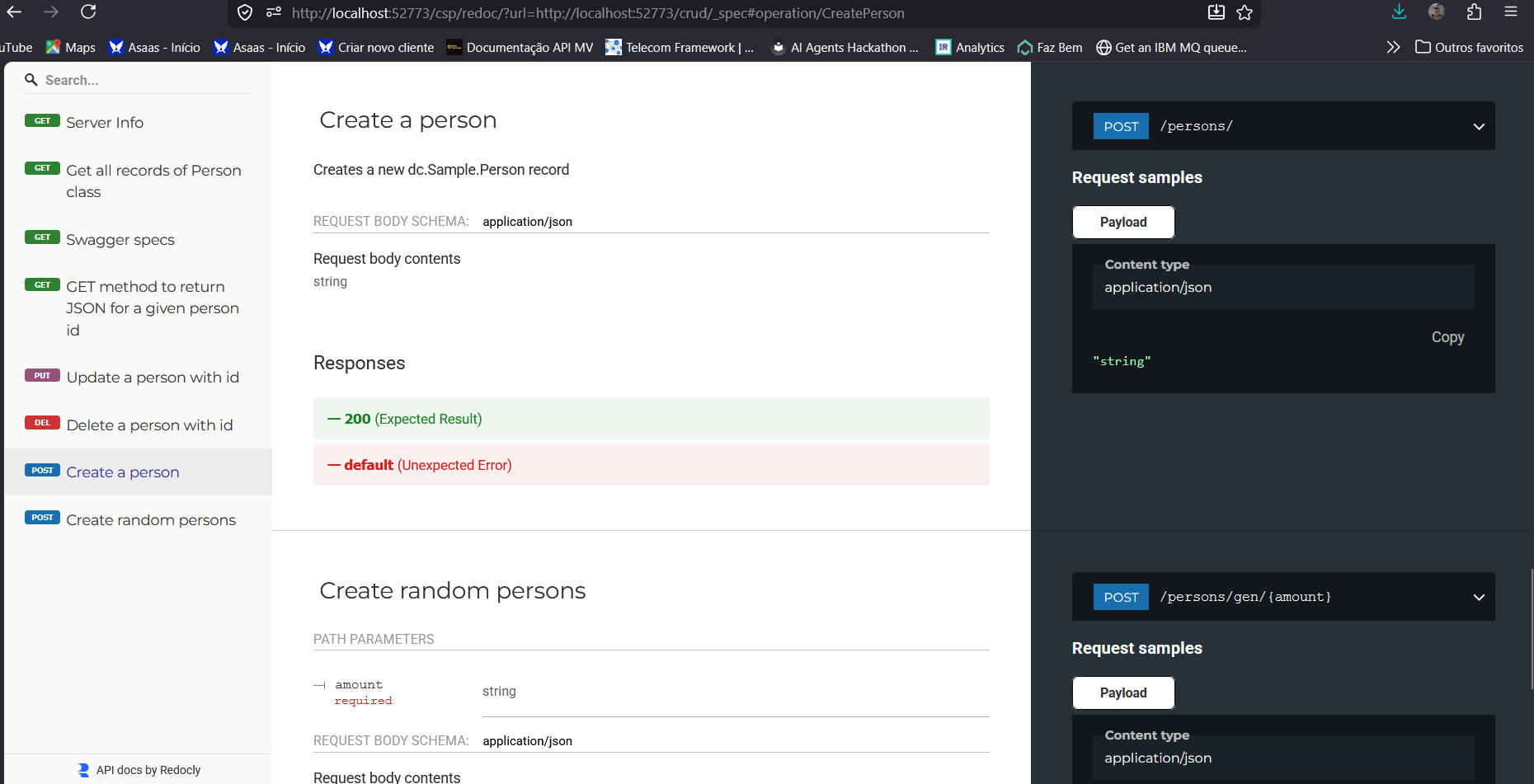
Redoc is an Open Source solution capable of rendering API specifications in OpenAPI 2.0 or 3.0+ as very beautiful and functional web portals. Currently, to have something similar, we need the ZPM SwaggerUI extension or we need to install IAM - InterSystems API Manager and then configure the IAM Developer Portal. Well, now the community has one more option, iris-redoc. This solution installs a web application on your IRIS instance that uses Redoc to present a beautiful web portal for your REST APIs:
For those who learned Caché ObjectScript from scratch: what kind of personal or practice projects did you build to get comfortable with the language? I come from a C# background and I'm looking for project ideas that are small enough to be feasible but meaningful enough to actually teach the core COS concepts.
Hello Community!
We’re excited to invite you to our upcoming Hebrew webinar, presented by @Keren Skubach, an InterSystems Senior Sales Engineer:
👉A Practical Guide to Leveraging AWS Adapters and APIs 👈
📅 Date & time: June 2nd, 3:00 PM IDT
Discover how to accelerate cloud-based integration with InterSystems' native AWS adapters for S3, SQS, SNS, and CloudWatch.
This session provides a practical look at building modern interoperability workflows — from secure file ingestion and asynchronous messaging to automated notifications and centralized monitoring.