We are glad to announce that DBeaver has supported InterSystems IRIS out-of-the-box since version 7.2.4. You don't need to configure it manually anymore, just find the IRIS icon in the Connections list.
.png)

InterSystems IRIS is a Complete Data Platform
InterSystems IRIS gives you everything you need to capture, share, understand, and act upon your organization’s most valuable asset – your data.
As a complete platform, InterSystems IRIS eliminates the need to integrate multiple development technologies. Applications require less code, fewer system resources, and less maintenance.
We are glad to announce that DBeaver has supported InterSystems IRIS out-of-the-box since version 7.2.4. You don't need to configure it manually anymore, just find the IRIS icon in the Connections list.
Hey everyone,
I'm diving deeper into Caché ObjectScript and would love to open a discussion around the most useful tips, tricks, and best practices you’ve learned or discovered while working with it.
Whether you're an experienced developer or just getting started, ObjectScript has its own set of quirks and powerful features—some well-documented, others hidden gems. I’m looking to compile a helpful set of ideas from the community.
If you're migrating from Oracle to InterSystems IRIS—like many of my customers—you may run into Oracle-specific SQL patterns that need translation.
Take this example:
SELECT (TO_DATE('2023-05-12','YYYY-MM-DD') - LEVEL + 1) AS gap_date
FROM dual
CONNECT BY LEVEL <= (TO_DATE('2023-05-12','YYYY-MM-DD') - TO_DATE('2023-05-02','YYYY-MM-DD') + 1);
In Oracle:
LEVEL is a pseudo-column used in hierarchical queries (CONNECT BY). It starts at 1 and increments by 1.
CONNECT BY LEVEL <= (...) determines how many rows toHello Community
I have previously experimented with embedded Python in IRIS; however, I have not yet had the opportunity to implement IRIS using native Python. In this article, I aim to outline the steps I took to begin learning and implementing IRIS within the Python source. I would also like thank to @Guillaume Rongier and @LuisAngel.PérezRamos for their help in resolving the issues I encountered during my recent PIP installation of IRIS in Python, which ultimately enabled it to function properly.
Let's begin to write IRIS in python.
InterSystems has released new point updates to resolve a defect affecting the most recent prior versions of 2025.1.0, 2024.1.4, 2023.1.6, and 2022.1.
Hello everyone, let me introduce, one of my latest projects. It is a DataSource plugin for Grafana, which can connect directly to InterSystems IRIS and gather any data (in the future).
.png)
Hello,
I have created this script that does lot of writes to a single global. DB write performance is much slower than expected (compared to another similar systems).
set rec = "..." //fill it with something
set time = $piece($horolog,",",2)
while(($piece($horolog,",",2)-time) < 30) //30 seconds
    set ^A($System.Util.CreateGUID()) = rec
}
I have notified the following :
I am having a hard time trying to figure out the following...
Within a DTC, I was able to take the a EnsLib.HL7.Message source and using
set a= $System.Encryption.Base64Encode(source.RawContent)
set encodedMessage=$Get(a)
to take the HL7 message encode it and add it to the Data Class as a string to be sent to an Operation to be sent out as a SOAP Request.
However to make it more universal I tried doing this within a copy of EnsLib.HL7.SOAPOperation
Method SendMessage(pMsgOut As EnsLib.HL7.Message, Output pMsgIn As EnsLib.Hi Guys,
I'm looking for a Zen component that allow me to populate a list of items and the ability to multiselect, similar to checklist?
I've thought of using MultiSelectSet component but don't know how can I populate it like to a query or resultset?
a short sample code would be helpful.
Thanks
IRIS and Ensemble are designed to act as an ESB/EAI. This mean they are build to process lots of small messages.
But some times, in real life we have to use them as ETL. The down side is not that they can't do so, but it can take a long time to process millions of row at once.
To improve performance, I have created a new SQLOutboundAdaptor who only works with JDBC.
Extend EnsLib.SQL.OutboundAdapter to add batch batch and fetch support on JDBC connection.
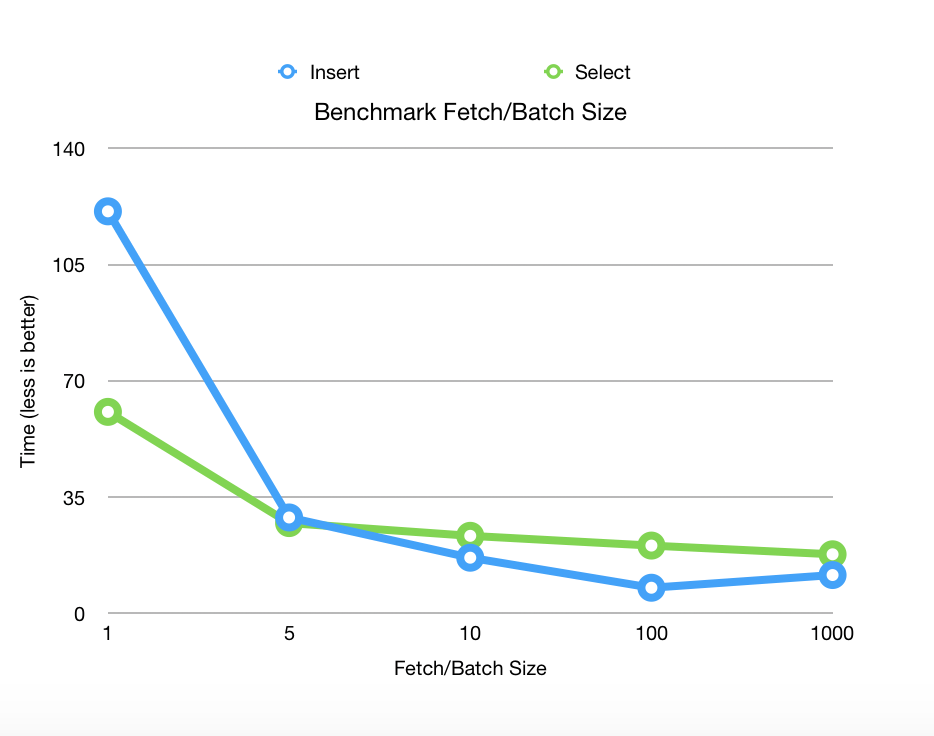
Benchmarks released on Postgres 11.2 with 1 000 000 rows fetched and 100 000 rows inserted on 2 columns.
Does anyone have a copy of the Class EnsLib.File.CSVService, which can import a CSV file in a Business Service?
I have created a New Database/Namespace within our TEST environment on both the Primary and Backup of the mirror. When I go to create the database/namespace on the DR node I am getting "Cannot open file '/ensemble/TEST/iris.cpf_...." while the cpf file that it references does not exist. Anyone have any clue to why this might be happening?
Hello All,
No matter what I try in Business Process Logic (BPL), I am unable to calculate the patient's age in days or years.
Has anyone ever built logic in a Business Process (BPL) to calculate a person's age in days?
Thank you!
In my last article I've talked about returning values with Python. But returning them is simple, what can make it harder is what I'm going to talk about today: where the value is treated.
Following the example of the last aricle, we have the method:
Class python.returnTest [ Abstract ]
{

ClassMethod returnSomething(pValue... As %String) As %Integer [ Language = python ]
{
	return pValue
}

}
Then, we'll have as a return a Python object, that IRIS interprets as the class %SYS.
Hi,
Can anyone please tell me how to append a string using a update query.
For eg : "Hello" is the string . I need to append the string world and it needs to be "Hello world".
Thanks
Jude
During the realization of some required functionality, I discovered that I need to use Deflate compression, and found, that IRIS does not offer any options, $system.Util.Compress, works one way open (GZIP/COMPRESS) totally different, even for the same algorithms, I see that what I would expect as a result for Deflate somewhere there, but Compress returns something more. Is there any way to get a correct result using just ObjectScript without a need to use external tools? Was it really so difficult to have Deflate implemented in the first place?
Hi,
We're getting a string sent to us by a client that was compressed using a java deflater (the zlib algorithm) and when trying to use $System.Util.Decompress() I get an "illegal value" error. I gather from other community posts that this is because the raw compressed string is missing the customized wrapper Iris automatically adds. I know this has been a longstanding issue for a while...just wanted to check if there'd been any updates to this functionality, or successful workarounds for decompressing raw zlib compressed data. Thanks in advance!
Hi Community,
Our Project Managers created a series of videos to highlight some of the interesting features of the new 2025.1 release. Please welcome the first one of them:
MonLBL is a tool for analyzing the performance of ObjectScript code execution line by line. codemonitor.MonLBL is a wrapper based on the %Monitor.System.LineByLine package from InterSystems IRIS, designed to collect precise metrics on the execution of routines, classes, or CSP pages.
The wrapper and all examples presented in this article are available in the following GitHub repository: iris-monlbl-example
|
Advisory ID
|
Product & Versions Affected
|
Risk Category & Score
|
Explicit Requirements
|
|
DP-439649
|
Products:
Versions:
|
Operational:
System Stability:
This issue does not constitute a security vulnerability. It does not allow users to bypass permissions checks or access data outside their authorized namespace. |
I have a Task that I am trying to write the output to a file. How do I check for if the Output File has been included in the Task Schedule, so I can direct my output of my class to that output file?
Thanks
Scott
Hi Guys,
How can I create Python pages instead of CSP or Zen pages, not familiar with Python and the only way I know is using embedded Python as methods as attached below?
.png)
Thanks
Let's suppose two different routines use one and the same chunk of code. From the object-oriented POV, a good decision is to have this chunk of code in a separate class and have both routines call it. However, whenever you call code outside of the routine as opposed to calling code in the same routine, some execution speed is lost. For reports churning through millions of transactions this lost speed might be noticeable. Any advice how to optimize specifically speed?
P.S. Whenever someone is talking about the best choice for whatever, I am always tempted to ask: "What are we optimizing?".
To enable Interoperability functionality after creating a namespace, use the EnableNamespace method of the %EnsembleMgr class:
do ##class(%EnsembleMgr).EnableNamespace()
Hi Community,
Enjoy the new video on InterSystems Developers YouTube:
⏯ Migrating 20TB to InterSystems IRIS with Near 0 Downtime @ Global Summit 2024
How would you go about creating an SQL Stored Procedure that would result in the same output as "IN LIKE"?
For example...
CustomersTable
| RecordId | CustomerName |
| 123 | Mark Stevens |
| 456 | Betty Johnson |
| 789 | John Stevens |
| 321 | Brian Smith |
| 654 | John Markson |
| 987 | Tom Obrian |
select *
from CustomersTable
where inLike('%Mark%', '%John%')
Would return:
| 123 | Mark Stevens |
| 456 | Betty Johnson |
| 789 | John Stevens |
| 654 | John Markson |
Hi Developers!
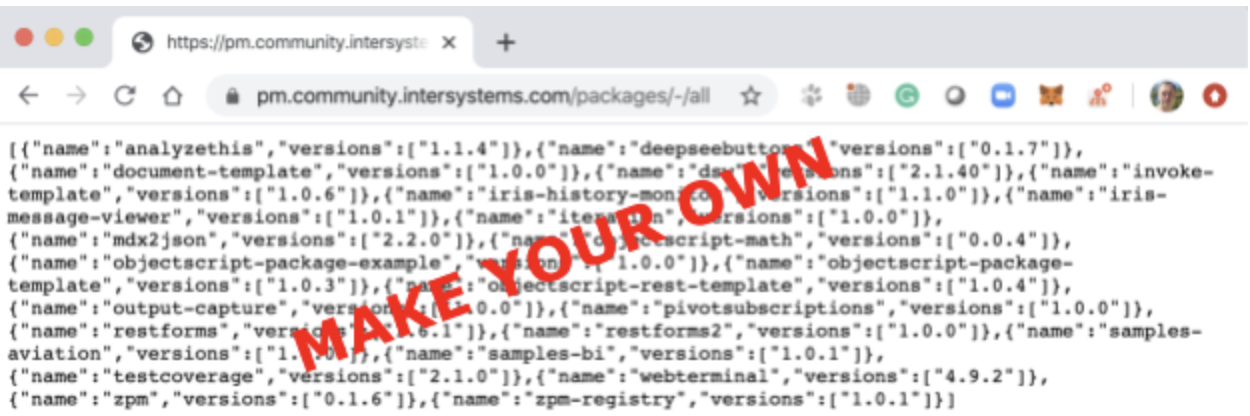
As you know the concept of ObjectScript Package Manager consists of ZPM client - client application for IRIS which helps you to install packages from the registry. And the code which works "on the other side" is ZPM Registry - server which hosts packages and exposes API to submit, list and install it. Now when you install the ZPM client it installs packages from community package registry, which si hosted on pm.community.intersystems.com
But what if you want your own registry? E.g. you produce different software packages for your clients and you want to distribute it via private registry? Also, you may want to use your own registry to deploy solutions with different combinations of packages.
Is it possible? The answer is YES! You can have it if you deploy ZPM registry on your server with InterSystems IRIS.
To make it happen you would need to set up your own registry server.
How to do that?
Hi IRIS experts!
I have a parameter in a class that stores a global name:
Parameter GlobalName = "^AGlobal";
then I'm trying to call it as:
set gn=$name(..#GlobalName)
to use it later as:
set @gn@("index")="value"
But! I'm having syntax at set gn=$name(..#GlobalName)
What am I doing wrong?
Hello,
I have a class with a "Unique" index (pxfactidIndex) on a %Numeric property (pxfactid) (partially-edit code snippet below):
Property pxfactid As %Library.Numeric(MAXVAL = 9223372036854775807, MINVAL = -9223372036854775808, SCALE = 0) [ SqlColumnNumber = 7 ];
Index pxfactidIndex On pxfactid [ Unique ];
Storage Default
{
<Data name="FactDefaultData">
<Value name="1">
<Value>pysubjectid</Value>
</Value>
...
<Value name="6">
<Value>pxfactid</Value>
</Value>
...
</Data>
<DataLocation>^CRMBI.FactD</DataLocation>
<DefaultData>FactDefaultData</DefaultData>
<ExtentLocation>^CRI want to add a database to a mirror.
Is this the correct way to do so:
set status=##Class(SYS.Mirror).AddDatabase("/db/iknow")
Is the status=0 if it worked and anything else means it failed?
Thanks for any help