#Best Practices

37 Followers · 307 Posts

Best Practices recommendations on how to develop, test, deploy and manage solutions on InterSystems Data Platforms better. 

InterSystems staff + admins Hide everywhere
Hidden post for admin
Article Richard Rael · Jan 22, 2024 7m read

IRIS can use a KMS (Key Managment Service) as of release 2023.3.  Intersystems documentation is a good resource on KMS implementation but does not go into details of the KMS set up on the system, nor provide an easily followable example of how one might set this up for basic testing.

The purpose of this article is to supplement the docs with a brief explanation of KMS, an example of its use in IRIS, and notes for setup of a testing system on AWS EC2 RedHat Linux system using the AWS KMS.  It is assumed in this document that the reader/implementor already has access/knowledge to set up an AWS EC2 Linux system running IRIS (2023.3 or later), and that they have proper authority to access the AWS KMS and AWS IAM (for creating roles and polices), or that they will be able to get this access either on their own or via their organizations Security contact in charge of their AWS access.

2
1 375
Article Luis Angel Pérez Ramos · Apr 18, 2025 3m read

Who hasn't been developing a beautiful example using a Docker IRIS image and had the image generation process fail in the Dockerfile because the license under which the image was created doesn't contain certain privileges?

In my case, what I was deploying in Docker is a small application that uses the Vector data type. With the Community version, this isn't a problem because it already includes Vector Search and vector storage. However, when I changed the IRIS image to a conventional IRIS (the latest-cd), I found that when I built the image, including the classes it had generated, it returned this error:

6
1 345
Article Ben Schlanger · Mar 15, 2024 4m read

When using InterSystems IRIS as an interoperability engine, we all know and love how easy it is to use the Message Viewer to review message traces and see exactly what's going on in your production. When a system is handling millions of messages per day, you may not know exactly where to begin your investigation though.

Over my years supporting IRIS productions, I often find myself investigating things like...

  • What sort of throughput does this workflow have?
  • Where is the bottleneck?
  • What are my most common errors?
4
6 504
Article Ben Schlanger · May 7, 2025 4m read

Here at InterSystems, we often deal with massive datasets of structured data. It’s not uncommon to see customers with tables spanning >100 fields and >1 billion rows, each table totaling hundred of GB of data. Now imagine joining two or three of these tables together, with a schema that wasn’t optimized for this specific use case. Just for fun, let’s say you have 10 years worth of EMR data from 20 different hospitals across your state, and you’ve been tasked with finding….   every clinician within your network      who has administered a specific drug         between the years of 2017-2019

3
6 377
Article Jose Ruperez · Apr 28, 2025 2m read

Sometimes customers need a small IRIS instance to do something in the cloud and shut it down, or they need hundreds of containers (i.e. one per end user or one per interface) with small workloads. This exercise came about to see how small an IRIS instance could be. For this exercise we focused on what is the smallest amount of memory we can configure for an IRIS instance.Do you know all the parameters that affect the memory allocated by IRIS ?

Memory Settings

These are the different buckets that affect memory allocation by IRIS and its corresponding parameters:

4
5 360
Article Stav Bendarsky · Feb 3, 2025 6m read

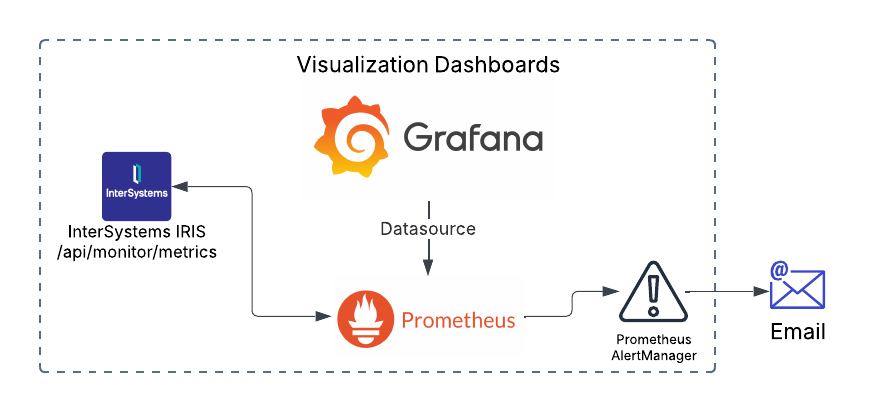
Monitoring your IRIS deployment is crucial. With the deprecation of System Alert and Monitoring (SAM), a modern, scalable solution is necessary for real-time insights, early issue detection, and operational efficiency. This guide covers setting up Prometheus and Grafana in Kubernetes to monitor InterSystems IRIS effectively. 

This guide assumes you already have an IRIS cluster deployed using the InterSystems Kubernetes Operator (IKO), which simplifies deployment, integration and mangement.


Why Prometheus and Grafana?

11
15 868
Article Roy Leonov · Mar 1, 2025 22m read

Introduction

In today's rapidly evolving threat landscape, organizations deploying mission-critical applications must implement robust security architectures that protect sensitive data while maintaining high availability and performance. This is especially crucial for enterprises utilizing advanced database management systems like InterSystems IRIS, which often powers applications handling highly sensitive healthcare, financial, or personal data.

4
1 373
Article Timothy Leavitt · Jan 15, 2020 9m read

Introduction and Motivation

A unit of ObjectScript code (a ClassMethod, say) may produce a variety of unexpected side effects by interacting with parts of the system outside of its own scope and not properly cleaning up. As a non-exhaustive list, these include:

  • Transactions
  • Locks
  • I/O devices
  • SQL cursors
  • System flags and settings
  • $Namespace
  • Temporary files
8
6 1659
Article Andreas Schneider · Apr 22, 2025 4m read

When using standard SQL or the object layer in InterSystems IRIS, metadata consistency is usually maintained through built-in validation and type enforcement. However, legacy systems that bypass these layers—directly accessing globals—can introduce subtle and serious inconsistencies.

3
0 230
Article Tani Frankel · Jan 14, 2025 6m read

Using embedded Python while building your InterSystems-based solution can add very powerful and deep capabilities to your toolbox.

I'd like to share one sample use-case I encountered - enabling a CDC (Change Data Capture) for a mongoDB Collection - capturing those changes, digesting them through an Interoperability flow, and eventually updating an EMR via a REST API.

2
2 634
Article Tani Frankel · Feb 13, 2024 3m read

Following 2 local Webinars we had focused on VS Code ["Intro" and "Beyond Basics"; in Hebrew], I prepared for the participants some related links of relevant resources which we sent as a follow-up. Sharing them here as well for the benefit of the Community.
You are all of course welcome to add more useful resources.

2
5 659
Article Thomas Dyar · Mar 25, 2025 2m read

Introduction

In InterSystems IRIS 2024.3 and subsequent IRIS versions, the AutoML component is now delivered as a separate Python package that is installed after installation. Unfortunately, some recent versions of Python packages that AutoML relies on have introduced incompatibilities, and can cause failures when training models (TRAIN MODEL statement). If you see an error mentioning "TypeError" and the keyword argument "fit_params" or "sklearn_tags", read on for a quick fix.

Root Cause

1
0 305
Article sween · May 14, 2025 7m read

Real Time FHIR® to OMOP Transformation

This part of the OMOP Journey,  we reflect before attempting to challenge Scylla on how fortunate we are that InterSystems OMOP transform is built on the Bulk FHIR Export as the source payload.  This opens up hands off interoperability with the InterSystems OMOP transform across several FHIR® vendors, this time with the Google Cloud Healthcare API.

Google Cloud Healthcare API FHIR® Export

1
2 221
Article sween · Apr 23, 2025 6m read

Nearline FHIR® Ingestion to InterSystems OMOP from AWS HealthLake

This part of the OMOP Journey we reflect before attempting to challenge Scylla on how fortunate we are that InterSystems OMOP transform is built on the Bulk FHIR Export as the source payload.  This opens up hands off interoperability with the InterSystems OMOP transform across several FHIR® vendors, including Amazon Web Services HealthLake.

HealthLake Bulk FHIR Export
 

1
0 215
Article Raj Singh · Mar 27, 2024 2m read

In recent versions of IRIS, a powerful new data loading command has been introduced to SQL: LOAD DATA. This feature has been highly optimized to import data into IRIS extremely fast, allowing hundreds of gigabytes of data to be inserted in seconds instead of hours or days. 

This is a very exciting improvement. However, a big problem in the data loading experience still exists. Namely, the time and hassle it takes to:

  1. Define the schema for the table in which you want to load data.
  2. Figure out the syntax for the LOAD DATA command.
7
1 1055
Article Timothy Leavitt · Apr 16, 2025 5m read

Thirteen years ago, I attained dual undergraduate degrees in electrical engineering and math, then promptly started full-time at InterSystems using neither. One of my most memorable and stomach-churning academic experiences was in Stats II. On an exam, I was solving a moderately difficult confidence interval problem. I was running out of time, so (being an engineer) I wrote out the definite integral on the exam paper, punched it into my graphing calculator, wrote an arrow with “calculator” over it, then wrote the result. My professor, affectionately known as “Dean, Dean, the Failing Machine,”

13
2 537
Article Iryna Mykhailova · Mar 16, 2023 6m read

InterSystems IRIS has quite a few different kinds properties. Let’s put them in order so that they make better sense.

First of all, I would divide them into categories:

  • Atomic or simple properties (all those %String, %Integer, %Data and other system or user datatypes)
  • References to stored objects
  • Built-in objects
  • Streams (both binary and character)
  • Collections (which are divided into arrays and lists)
  • Relationships (one-many and parent-children)

Some of these kinds of properties are quite straightforward. For example, atomic properties:

Property Name As %Name;Property DoB As %DateProperty Age As %Integer
4
3 682
Article Benjamin De Boe · Nov 9, 2023 3m read

With the release of InterSystems IRIS Cloud SQL, we're getting more frequent questions about how to establish secure connections over JDBC and other driver technologies. While we have nice summary and detailed documentation on the driver technologies themselves, our documentation does not go as far to describe individual client tools, such as our personal favourite DBeaver. In this article, we'll describe the steps to create a secure connection from DBeaver to your Cloud SQL deployment.

21
2 2212
Article Kurro Lopez · Mar 3, 2024 5m read

Hi community,

The aim of this article is to explain how to create messaging between IRIS and Microsoft Teams.

In my company, we wanted to monitor error messages, and we used the Ens.Alert class to redirect those error messages through a Business Operation that sent an email.
The problem was that we sent those error messages to a support account where there were many emails. We wanted something specific for a specific team.

So we investigated how to make these messages reach the development team directly and they could have, in real time, a notification of an error in our production.
In our company we use Microsoft Teams as a corporate tool, so we asked ourselves: How could we make these messages reach the IRIS development team?

15
8 965
Article sween · Mar 4, 2024 8m read

If you are a customer of the new InterSystems IRIS® Cloud SQL and InterSystems IRIS® Cloud IntegratedML® cloud offerings and want access to the metrics of your deployments and send them to your own Observability platform, here is a quick and dirty way to get it done by sending the metrics to Google Cloud Platform Monitoring (formerly StackDriver).

1
2 380