Hey Developers,
See how the InterSystems IRIS FHIR Server allows you to develop and deploy your FHIR applications on AWS without manual configuration and deployment:
⏯ Getting Started with the InterSystems IRIS FHIR Server on AWS
Hey Developers,
See how the InterSystems IRIS FHIR Server allows you to develop and deploy your FHIR applications on AWS without manual configuration and deployment:
⏯ Getting Started with the InterSystems IRIS FHIR Server on AWS
This is the first InterStstems programming contest that we participated in! Come check out and vote for us!
The overbooking management system combines the unique conditions of the hotel, such as room prices, order channels, customer needs (etc...). System uses machine learning algorithms (such as: KNN/ES-RNN...) to accurately predict the daily no-show and occupancy rate of the hotel, and further combines with the revenue equation to find the best largest room sales volume, which can significantly increase the hotel marginal revenue.
Hey Developers,
This week is a voting week for the InterSystems Multi-Model Contest! So, it's time to give your vote to the best solutions built with InterSystems IRIS.
🔥 You decide: VOTING IS HERE 🔥

How to vote?
Getting this error when starting up Caché:
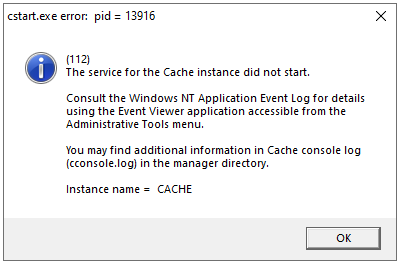
I've recently deleted several Caché namespaces to clear up space, turned Caché off, and then this started happening. Caché cube is grey, but only the start Caché option is unavailable.
Caché is still running, but just not completely:
The Windows Event Viewer application has the following error:
There are also the following logs in the mgr/cconsole.log file. I can provide more if necessary.
03/03/21-14:18:23:206 (13360) 0 START: C:\InterSystems\Cache\mgr\journal\20210303.005
03/03/21-14:18:23:206 (13360) 1 Warning: Alternate and primary journal directories are the same
03/03/21-14:18:23:222 (13360) 0 CACHE JOURNALING SYSTEM MESSAGE
Journaling started to: c:\intersystems\cache\mgr\journal\20210303.005
03/03/21-14:18:23:222 (13360) 0 Journaling to C:\InterSystems\Cache\mgr\journal\20210303.005 started.
//
...some lines later...
//
03/03/21-14:18:25:659 (15652) 0 (ZUTSTART): ^ZUTSTART Version 1.10: Configurable Cache Startup Utility
03/03/21-14:18:25:659 (15652) 0 (ZUTSTART): ZUTSTART is un-tested in this version of Cache.
03/03/21-14:18:25:659 (15652) 0 (ZUTSTART): Running ZUTSTART....
03/03/21-14:18:25:659 (15652) 0 (ZUTSTART): ZUTSTART not configured. Run SETUP^ZUTSTART
03/03/21-14:18:25:659 (15652) 0 (ZUTSTART): To configure, use this command:      DO SETUP^ZUTSTART
03/03/21-14:18:25:659 (15652) 0 (ZUTSTART): For help, use the following command: DO HELP^ZUTSTART
03/03/21-14:18:25:859 (12916) 0 Private webserver started on 57772
03/03/21-14:18:26:214 (12916) 0 Processing Shadows section (this system as shadow)
03/03/21-14:18:26:214 (12916) 0 Processing Monitor section
03/03/21-14:18:27:031 (14768) 0 LMF Info:  License server started on port 4001
03/03/21-14:18:27:447 (148) 0 [System Monitor] System Monitor started in %SYS
03/03/21-14:18:29:036 (14768) 0 LMF Info:  Connected to license server 127.0.0.1,4001
03/03/21-14:19:27:504 (148) 2 1 SSL/TLS Certificate(s) expiring within 30 days. See cconsole.log for details.
03/03/21-14:19:27:505 (148) 1 Certificate 13298795840390663119752826058995181320 Issuer CN=DST Root CA X3,O=Digital Signature Trust Co. (Subject CN=Let's Encrypt Authority X3,O=Let's Encrypt,C=US)  expires in 14 days (2021-03-17).
03/03/21-14:19:27:505 (148) 0 Certificate 13298795840390663119752826058995181320 Issuer CN=DST Root CA X3,O=Digital Signature Trust Co. in file c:\intersystems\cache\mgr\groundca.pem used by SSL/TLS configuration(s) "groundca"
03/03/21-14:49:29:062 (148) 0 [SYSTEM MONITOR] Alert state cleared.
03/03/21-15:31:36:247 (15060) 1 Operating System shutdown! Cache performing fast shutdown.I have 2 instances of Cache, one of 2010 and the other 2016. On both I have created a SSL Configuration with same name.
When I connect to a SOAP Service Client from Cache 2010, I get the above error.
If I connect from Cache 2016, the connection get through.
How can get more details of the error in the Cache 2010 instance to be able to fix this issue.
I have enabled the SOAP Log and it does not give much of details.
Regards
Anil
There's been quite a bit of discussion lately in this forum on the tools available in IRIS for using both XML and JSON, and debate on cross-conversion between the two formats.
A week or so ago I posted details of a set of tutorials I'd put together on integrating the Node.js-based QEWD technology with IRIS, working over a network. As part of that set of tutorials, I've been detailing how to use the various multi-model capabilities of the build-in QEWD-JSdb abstraction of IRIS.
Just curious if anyone tried to use HTTP/2 in their Caché projects?
And InterSystems thoughts about adding support for this new version.
Hi Community,
Enjoy watching the new session recording from the InterSystems AI+ML Summit 2021:
Hi ,
I have a requirement to programmatically fetch and update a Business Process Setting . It's a custom property , added in extended class .
I am trying find a sample, but no luck.
Could any one help me ?
Hey Developers,
Here is a digest of the Developer Community videos on InterSystems Developers YouTube Channel in February 2021:
I was having trouble with some dimension based calculated members defined in Analyzer. They would work and then not work. At one point I had two identical calculated measures, same code, same specification and one would work and one would not. I was trying to set them up in "shared storage", that checkbox in the calculated member dialog that should allow the measures to be used across multiple pivots.
Please see PerfTools IO Test Suite for a later version of the Random Read IO tool.
This tool is used to generate random read Input/Output (IO) from within the database. The goal of this tool is to drive as many jobs as possible to achieve target IOPS and ensure acceptable disk response times are sustained. Results gathered from the IO tests will vary from configuration to configuration based on the IO sub-system. Before running these tests ensure corresponding operating system and storage level monitoring are configured to capture IO performance metrics for later analysis.
Hi Developers!
We had a set of technology bonuses for the InterSystems Grand Prix contest.
Good day, developers!
The "apptools-admin" project is not only a set of tools for the administrator, but a platform for the rapid creation of a prototype of any solution. For example, Photo Album, Music Player, and Personal Library all come together in a user-friendly treasure chest design.
Load http:// your-host:your-port/apptoolsrest/a/infochest
Change the path to your treasure files and start viewing, listening or reading from any convenient device: desktop, tablet or smartphone.

Hi folks!
Sometimes when we develop a mockup or PoC there is a need for a simple interface that will provide data in IRIS in JSON against SQL queries.
And recently I contributed a simple module that does exactly that:
accepts SQL string and returns the JSON.
How to install? Just call:
zpm "install sql-rest"If you install it in a namespace X it will setup a /sql endpoint to your system that will accept POST requests with SQL string and will return the result for you for the data available in the namespace X.
Hello all,
Is there any command or way to update the versionid on windows similar to the "iris update <instance> versionid=<version>" on linux?
I have one block of code that not working as it was supposed to in in SQL. I am using it in a routine
&sql(update X_X.X set LocalEnvironment=1 where %ConfigName IN('X_X_X', 'Y_Y_Y'))
using the above SQL query I am trying to set a property(LocalEnvironment) which is defined as boolean. But the query is not enabling the property. FYI- We have extended businessprocess class to create a new property.
This is the first InterStstems programming contestthat we participated in! Come check out and vote for us!
The overbooking management system combines the unique conditions of the hotel, such as room prices, order channels, customer needs (etc.). System uses machine learning algorithms (such as: KNN/ES-RNN.
If you want to start IRIS as a service on CentOS7 you can use systemd.
Login as root and create a new file iris.service in /etc/systemd/system.
# vi /etc/systemd/system/iris.service
[Unit]
Description=Intersystem IRIS Service
After=network.target
[Service]
Type=forking
WorkingDirectory=<iris-install-dir>
User=root
ExecStart=<iris-inst-dir>/bin/iris start "<instance>"
ExecStop=<iris-inst-dir>/bin/iris stop "<instance>" quietly
Restart=on-abort
[Install]
WantedBy=default.target
<iris-install-dir> = Directory where you installed IRIS on Centos7 i.e.
I'm participating in the Developing with InterSystems Objects and SQL with Joel Solon. The course is very nice and I will share with you some tips I got during the training. Tips presented in the day 3:
I'm participating in the Developing with InterSystems Objects and SQL with Joel Solon. The course is very nice and I will share with you some tips I got during the training. Tips presented in the day 2:
Today we had an issue where a couple of our IRIS "processes" had a status of "Dead".
How do I configure IRIS so that, when that happens, IRIS will log an event to messages.log or alerts.log?
We are forwarding the contents of both of those logs to Splunk for analysis, and I'd like to be able to see those events in there as well.
hello, I had build a DocDB referring the code from here: https://community.intersystems.com/post/how-can-i-create-properties-doc…
Here are the structure of the json Documents I have added in my database called 'Orders'.
InterSystems API Management (IAM) - a new feature of the InterSystems IRIS Data Platform, enables you to monitor, control and govern traffic to and from web-based APIs within your IT infrastructure. In case you missed it, here is the link to the announcement. And here's an article explaining how to start working with IAM.
In this article, we would use InterSystems API Management to Load Balance an API.
In our case, we have 2 InterSystems IRIS instances with /api/atelier REST API that we want to publish for our clients.
There are many different reasons why we might want to do that, such as:
When I use vscode, Some classes cannot be compiled, while others can .it will report the following error:
.png)
What should I do?
Hi Community,
is there a possibility to implement a "remember password" feature in a ZEN Application?
In the management portal I added a web-application for a ZEN application with password authentification. I created an own login page, and now I want to implement a "remember password" feature (User should not have to login again after the session times out or when the browser window is closed).
Hi Developers,
A new exciting challenge introduced for Global Masters members of "Advocate" level and above: we invite you to record a 30-60 sec video with an answer to our question:
🎁 Reward of your choice for doing the interview: $50 Gift Card (VISA/Amazon) or 12,000 points!
Follow this direct link to the challenge for more information. Please note that the link will work for GM members of "Advocate" level and above. More about GM levels you can read here.

 189
189