Hello everyone. I'm currently working on how to implement a solution that makes it possible to include within the response of a BusinessOperation the "RetryCount" for each message. For Example, we have this message that was retried twice:
You’ve asked for easier ways to connect with other Global Masters and we heard you! Random Coffee Chat is an easy way for Global Masters to connect and have an informal 1:1 conversation. ☕
Hello, I am trying to get some fields from HL7 message and create a file using BPL. The values I need are in a repeating segment (AIG). Even in the repeating segment, I just want the iteration that has a certain field (AIG:3 populated). With the help of documentation and community posts, I was able to create the BPL to loop through all of AIG and create the file. But when I try to narrow the results even further (AIG:3 present), the process gets stuck. I am not sure I am missing anything or have anything incorrectly set up. Also, since the process gets stuck, it doesn't even seem to h
You’ve asked for easier ways to connect with other Global Masters and we heard you! Random Coffee Chat is an easy way for Global Masters to connect and have an informal 1:1 conversation. ☕
Welcome to the monthly recap of updates and releases to VS Code and InterSystems-related extensions relevant to IRIS developers. We'll break down the updates that are relevant to InterSystems developers with tips on how they can be applied to your day-to-day projects.
https://www.youtube.com/embed/K47GEnabO-k [This is an embedded link, but you cannot view embedded content directly on the site because you have declined the cookies necessary to access it. To view embedded content, you would need to accept all cookies in your Cookies Settings]
IRIS can use a KMS (Key Managment Service) as of release 2023.3. Intersystems documentation is a good resource on KMS implementation but does not go into details of the KMS set up on the system, nor provide an easily followable example of how one might set this up for basic testing.
The purpose of this article is to supplement the docs with a brief explanation of KMS, an example of its use in IRIS, and notes for setup of a testing system on AWS EC2 RedHat Linux system using the AWS KMS. It is assumed in this document that the reader/implementor already has access/knowledge to set up an AWS EC2 Linux system running IRIS (2023.3 or later), and that they have proper authority to access the AWS KMS and AWS IAM (for creating roles and polices), or that they will be able to get this access either on their own or via their organizations Security contact in charge of their AWS access.
I want to consume an API that provides HL7 messages. To achieve this, I have thought of the following workflow:
I have created a business service that periodically triggers a business process. The trigger request is forwarded to a business operation. There, a %Net.HttpRequest is assembled from scratch and then sent to the API endpoint. The corresponding HttpResponse then contains several HL7 messages encoded in UTF-8 in the message body. To further process the HL7 messages, the operation sends the HttpResponse back to the business process as EnsLib.HTTP.GenericMessage.
The 2025.1.3 maintenance releases of InterSystems IRIS® data platform,InterSystems IRIS® for HealthTM, and HealthShare® Health Connect are now Generally Available (GA). These releases include the fixes for a number of recently issued alerts and advisories, including the following:
It’s no secret that the InterSystems Global Masters program is integrated with Developer Community, Open Exchange, and Ideas Portal. Whenever you contribute to any of these platforms, you automatically earn points and badges on Global Masters.
We’ve created a short guide to help you discover the best ways to earn points on Global Masters:
I have always struggled with Iterating through a JSON response to pull out certain fields into a Data Class Structure to use to populate fields in a DTL. So I defined the whole structure for the following JSON, with the base structure extending Ens.Response, %XML.Adaptor, and %JSON.Adaptor.
https://www.youtube.com/embed/ZcrsyBvKFsw [This is an embedded link, but you cannot view embedded content directly on the site because you have declined the cookies necessary to access it. To view embedded content, you would need to accept all cookies in your Cookies Settings]
We’re excited to invite you to take part in shaping the next generation of ObjectScript development tools. We’re working on an AI-powered ObjectScript coding assistant designed specifically for IRIS developers. Not a generic AI adapted for ObjectScript, but a solution built from the ground up to understand ObjectScript idioms, IRIS APIs, interoperability productions, and real-world developer workflows.
To make sure we build something truly useful, we need your input.
The third developer previews of InterSystems IRIS® data platform,InterSystems IRIS® for Health, and HealthShare® Health Connect 2026.1 have been posted to the WRC developer preview site. Containers can be found on our
TL;DR This article explains how to deploy InterSystems IRIS Community Edition on Azure using the Azure Marketplace and a Virtual Machine. It covers prerequisites, instance selection, authentication, SSH access, first verification steps, and how to delete resources to avoid charges. The deployment can typically be done using Azure free credits and is suitable for developers who want to quickly start working with IRIS in the cloud.
Who this guide is for. This guide is intended for developers, solution architects, and DevOps engineers who want to deploy InterSystems IRIS Community Edition on Microsoft Azure. No prior Azure automation experience is required, but basic familiarity with the Azure Portal and SSH is helpful.
After following this guide, you will be able to:
Launch InterSystems IRIS Community Edition from the Azure Marketplace
Configure a small, secure Azure VM
Connect to IRIS using SSH and the Management Portal
Reset the default IRIS password and verify that IRIS is running
Prerequisites
An active Azure subscription (new accounts may have free credits)
Permissions to create resource groups, VMs, and networking resources
An SSH client and a private key (.pem) you can store securely
Basic knowledge of Linux command line
Deployment overview
Open the IRIS Community Edition listing in Azure Marketplace and click Get it now
In Azure Portal, choose Start with a pre-set configuration (or Create)
Configure Basics: subscription, resource group, VM name, region, image, and size (a small VM is usually sufficient)
Choose SSH key authentication and generate/download the key if needed
Review + Create, accept terms, and deploy; then Go to resource → Connect → SSH
First SSH login: run iris password to change _SYSTEM/SYS; start a session with iris session iris
If you work with Productions, highlighting connections between Business Hosts is a very convenient feature, allowing developers to get a visual representation of a data flow.
This feature works by default with all system Business Hosts. If a user writes their own Business Services, Processes, or Operations, they must implement the OnGetConnections method for this functionality to work with their custom Business Hosts (or use Ens.DataType.ConfigName properties for connections). That said, the SMP shows only the first layer of connections of the selected Business Host. Sometimes, we need to get connections of connections recursively to build a complete data flow graph. Or we might need this connection information to check which downstream systems might be affected by a change upstream.
You’ve asked for easier ways to connect with other Global Masters and we heard you! Random Coffee Chat is an easy way for Global Masters to connect and have an informal 1:1 conversation. ☕
For those of us building InterSystems workloads on Kubernetes, we are definitely spoiled with the InterSystems Kubernetes Operator (IKO) doing the heavy lifting and mirroring on day one. Where us spoiled brats jump up and down is when we try to add additional databases/namespaces when we provision from HealthConnect containers on day two, while others get to utilize HealthShare Mirroring for this task, the prerequisite of mirroring HSSYS out of the gate has been somewhat elusive. Here is example on how you can this powerful feature up and running with the employment of IKO and IrisClusters.
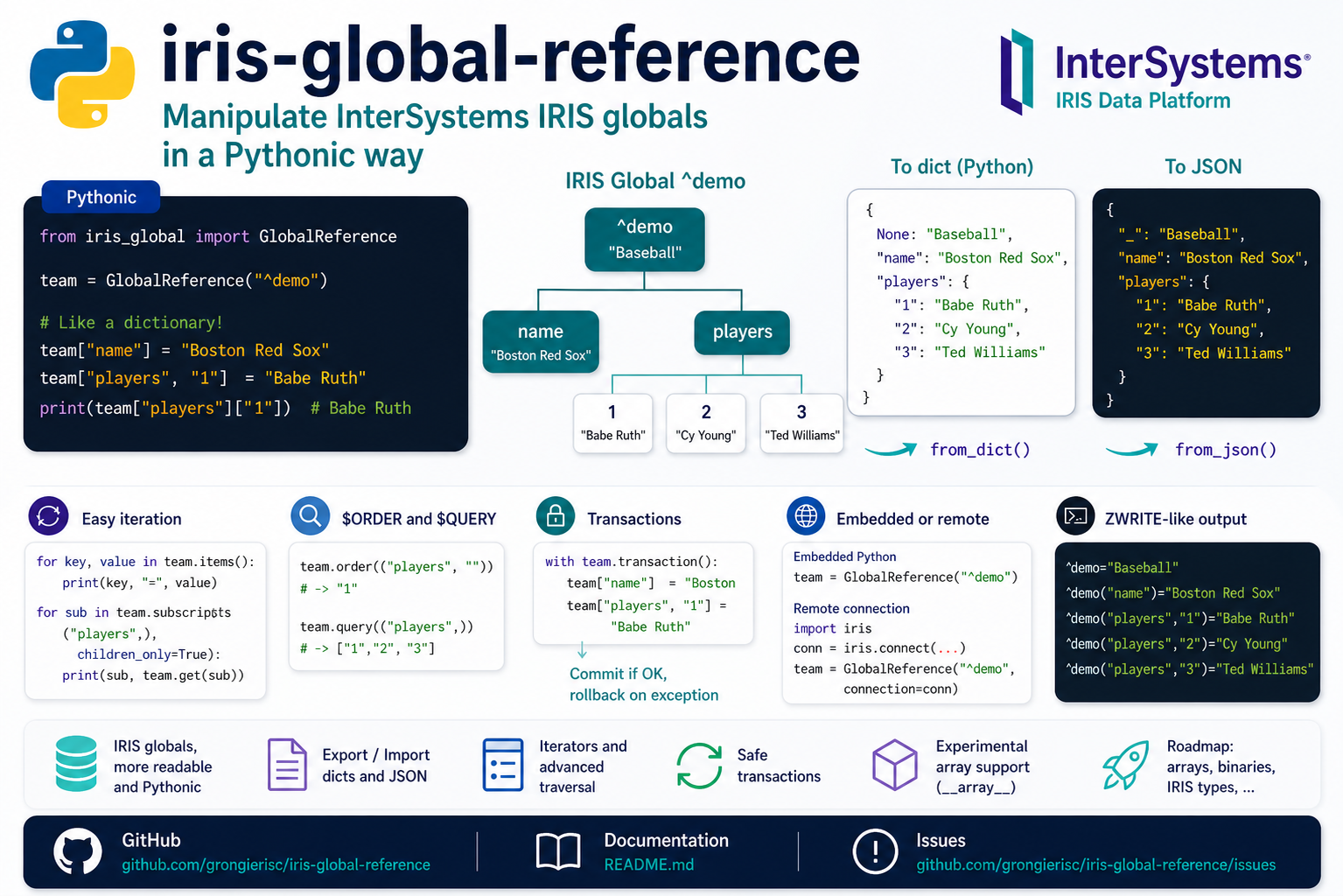
My team lead mentioned that users can sometimes create globals directly without associating them with tables or classes. In this case, these globals would not be accessible via SQL.
Is this correct? Can a global exist independently in this way, and if so, is there a specific approach to access or manage them without SQL?