I want to disable / turn off the visible cursor and then re-enable from with a Cache MUMPS (COS) routine.
Can anyone advise please ?
I am using the free Intersystems Cache installation (CachePCkit V2017.1) on Windows 10 for my own use & personal development.
I am trying to use the automated unittest class for a %CSP.Rest service.
So my Unittest code set's %request and %response from %CSP.Req/resp respectively
I build a tProxy with the fields I need for the post and set it %ToJson... I have tried seting %request.Content = tProxy (and not)
I call the method for the post url directly...
When that method calls %fromJson to set an object with the info. I passed...
- when I don't set %request.content.. I get a error '5035 - premature end of data code 12'
- when I set %request.
Let's say I want to execute this cache script (saved as test.txt) from OS terminal:
zn "USER"
write 1
zn "%SYS"
write 2
halt
Executing the following command in a terminal:
csession cache < test.txt
Would yield this output:
$ csession cache < script.txt

Node: gitlab-test, Instance: CACHE

USER>

USER>
1
USER>

%SYS>
2
%SYS>
Job succeeded
Is there a better way to run these scripts?
Currently I have two problems:
- I have several variables defined in my bash script, what's the best approach to pass them into Caché?
Hi Guys,
I want to take out the words -"Ensemble alert from" from the subject line of ensemble alerts. Does anyone have done something similar.
I have a dataListBox in ZEN which has an OnDrawItem method associated with it. The DrawItem method never seems to be called and I cannot see why. I am using IE11. Can anyone suggest a reason? The attached code runs in a namespace called CODE and can be run using view webpage on the TheLabsApp.BioAnal class. Please note that the data is in a global called ^%ANAL that resides in %SYS.
Hi,
I am afraid I am stuck again. I have ensemble connected with a MsSQL database and I have a service that calls a store procedure. All is working, and I can get strings from the database in the service. The problem is that the data the store procedure returns is suppose to be an HL7 message so I need to convert the string into HL7 format. I have been using the
How can get the data stored in the JSON object? I try StringObject but doesn't work.
Is the Feb 15 Atelier webinar going to be posted? It would help me and others stay up to date on Atelier. Thanks.
Does anyone have a function they built to change a name from all lower case, or all upper case to mix case?
Thanks
Scott Roth
Problem:
Caché prints to printers in a manner somewhat different from other Windows applications. Caché sends the data directly to the GDI Printer, without the usual interface. This is because the GUI interface can only be shown on a system desktop session and not in web browser and terminal sessions. Some printer drivers have problems with this method of printing.
Is this the problem you are having?
- If you are opening the printer as a Windows printer as described in the documentation (found here).
Hi.. I have an issue where we are using OAuth2.0 with the ZAUTHENTICATE routine. Once our token is validated we are using a users lan id (passed on the ID token) to find a software defined username in a Cache Global.
That is all working fine in ZAUTHENTICATE.. I am setting the software defined username in the Properties("Comment") array and wanting to reference it in the Rest Service Dispatch class.
What are the best steps for troubleshooting printing to a Windows printer from Cache. The printer has been configured in the Windows Printer Manager and has been able to print a test page (from the windows print manager).
The device has been configured in Cache -> Sys Admin -> Config -> Device Settings -> Devices with properly formatted |PRN|printer device name and "W" for open parameters and 101 for Alias.
From a command prompt, O 101 U 101 write something U 0 C 101 doesnt output anything to the printer, but does create a document in the Windows print spooler.
Hi everybody,
I love the integration of HL7 v2.x in Ensemble, it's really easy to use.
I would love to see the same about using CDA on Ensemble. I know it's a complicated standard, but it would be more easy for developers in Europe if we could use it like any other type of message instead of using at XML level and xsl transformations.
Any experiences dealing with CDA on Ensemble?
The base class Bmap.Person defines persons within an organization distributed
by various countries. All records are indexed by (Country, PersonalId).
this structure doesn't allow use of bitmaps.
So a wrapper class Bmap.PersonQ around the data eliminates the top level of
the index (Country) and isolates the PersonalId (%Integer, MINVAL=1).
We are ready to use a Bitmap index.
A few performance figures on 300010 generated records.
You see that Relative Cost are sometimes quite misleading.
base
select count(*) from Bmap.To be able to replace current Cache Studio user functionality in our source control system, I need to access the current project name that the atelier file belongs to when being checked out and in within the UserAction method of the source control class.
In addition to this, there also appears to be a problem in that when UserAction code is executed by the Atelier callbacks, the process is running as UnKnownUser instead of utilising the authentication values assigned in the Connection settings for the server.
Does anyone know if these properties are currently exposed?
I used ^||%Studio.
I noticed that the subscript of the index map is actually the collated field (%SQLUPPER).
Is String the only data type going through this transformation? Any other data type would also go through this transformation?
Thanks.
I'm sending data via ajax to my REST service, and while retrieving any information sent in the url parameter is easy when they're defined in the route, I can't get anything if I store information in the data parameter. For example:
$.ajax({
               url: "ServerURL",
               data: { "some": "json" } //How do I get this information?

...
I've looked at many common solutions such as here:
https://community.intersystems.com/post/lets-write-angular-1x-app-cach%C3%A9-rest-backend-part-9
Hi,
I need list all available Windows AD groups .
How I do it?
I need to change the attributes of Windows Users of AD, adding and remove groups.
Note: I was able to make the connection to LDAP, and I listed the groups that a user.
Please make these dialogs easier to use, for example by treating a double-click on a list item as a signal to select the item and effectively click the "Next" or "Finish" button. Using Tools\Add-Ins as my example, on the first page:

I want to double-click on a project and get to the next page. At the moment I have to click it, then click the "Next" button. And on the next page:

it's not as easy as it could be to select and run my chosen add-in.
My comments here relate to Atelier 1.0.137 on Windows connecting to Ensemble 2016.2 FT build 627.
I've been looking at what the Atelier Explorer view (hereafter AE), whose root elements are projects, lets us do with the contents of the namespace that the project is connected to:

versus what the Server Explorer view (here after SE) gives us:

Here are my observations so far.
1. CSP files are only accessible in SE. I'm guessing this is because Atelier's support for CSP files is so new as not to have propagated yet to everywhere that it's planned to cover.
2.
Hi, Community!
Check a new session recording from Global Summit 2017:
Mirror, Mirror, Which Should I Choose?
Hello,
We are currently in the process of migrating from Ensemble to Healthshare and I have been advised Healthshare works with the IDE Atelier.
Does anyone know if you can change the views for transforms like you can in Studio? IE to see the .dtl, .cls and the .INT?
It would be nice to be able to visually view the transforms like you can with Studio.
Cheers
Hi, Community!
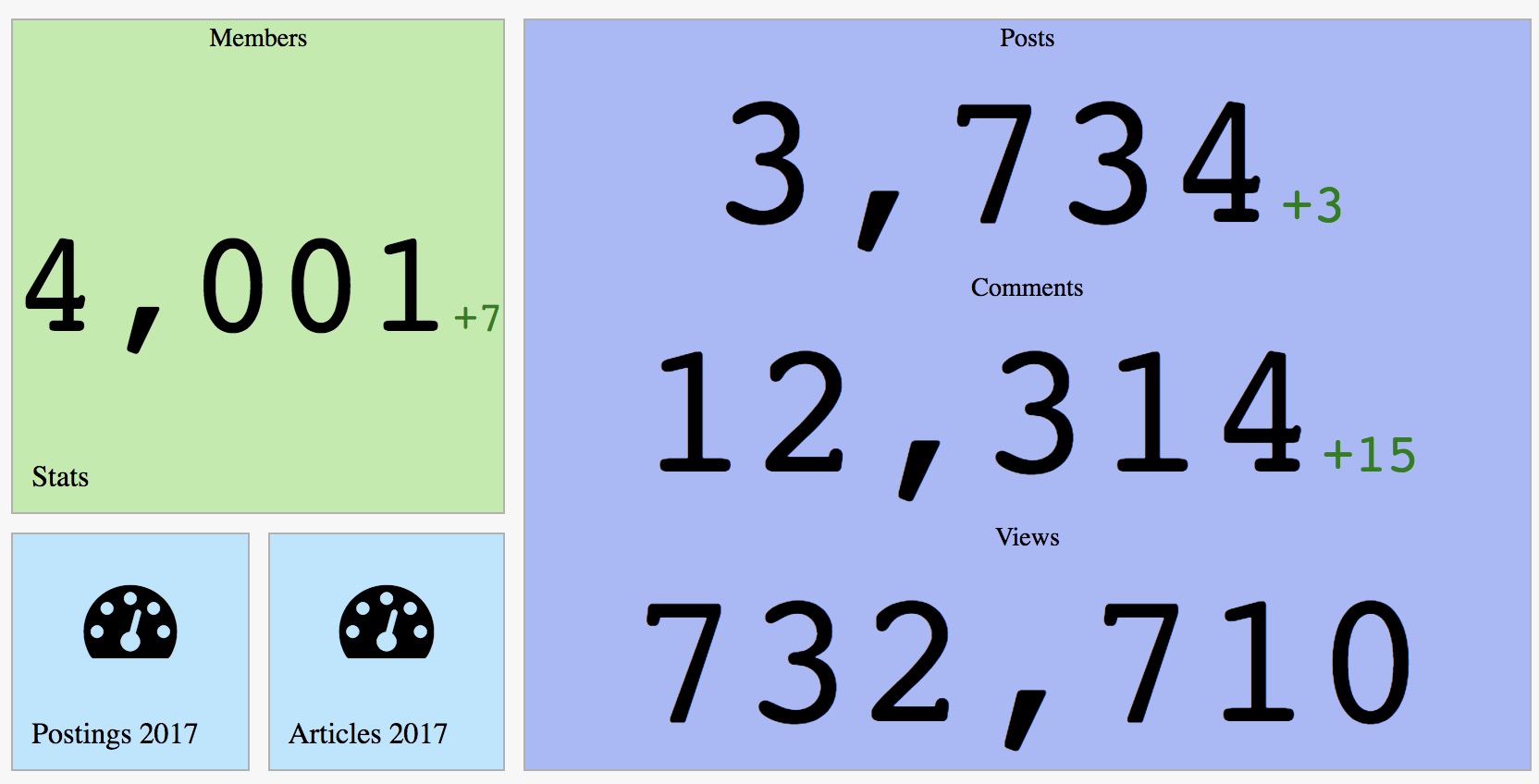
It is just a small announcement that Community is growing and we just reached 4,000 registered members!
You can track the public DC analytics in this DeepSee dashboards in Community->Analytics menu:
Intersytems documentation says not to hold entire SDA as object in In-memory.
Set object = ##class(User.NewClass1).%New()
s object.Property1="one"
s object.Property2="two"
s object.Property3="three"
s object.Property4="four"
Set w=##class(%XML.Writer).%New()
set w.Charset="UTF-8"
Set w.Indent=1
set status=w.OutputToString()
set status=w.StartDocument()
Set status=w.
I was curious if application partners were developing their own task managers for scheduling background tasks, or using the built in task schedule that is part of the Cache platform.
For those that are using the Cache task manager, what has been your method for distributing default tasks that your application needs during initial install as well as upgrades? Are you distributing an export of the %SYS.Task object, or perhaps you are distributing an installation script that adds a task to the task scheduler when it is first run?
I'm trying to learn how To use SQL in CACHE, so I hope I don't bore you with "Dumb" questions....
I'm getting "ERROR #6022: Gateway failed" message following this line of code.
s sc=gc.Prepare(hstmt,pQuery)
This line of code comes from an example I found in the documentation. pQuery is the "Select" statement setting up the variables and tables I'm trying to pull information from.
What does that error indicate?
Thank you.
Hi, Community!
We have a new release of Developer Community here!
What's new?
Better subscriptions, new notifications on answers, better performance, better member mentioning and public task tracker for DC.
See the details inside!
Hi-
Does anyone have an example of manipulating Zen tablePane columns programmatically?
Specifically, clearing out the columns and adding a new set of columns.
It would be helpful if you had both a server side and client side example.
Thanks
Documentation here lists the kinds of members a class definition may contain. In summary:
- Parameters
- Methods
- Properties
- Class queries
- XData blocks
- Projections
- (and some that are relevant only for persistent classes):
- Storage definitions
- Indices
- Foreign keys
- SQL triggers
Later in the same document, a section headed "Class Member Names" contains this warning:

So I'm interested to hear how other DC members handle this.
- Do you comply (or at least attempt to comply) with this?
- If so, do you use any tools or naming conventions to assist you?
Can you make the "Link with Editor" option work on the Atelier Explorer view? (It works fine on the Project Explorer view.) It seems a minor fix but it would mean a lot to us developers! Thank you