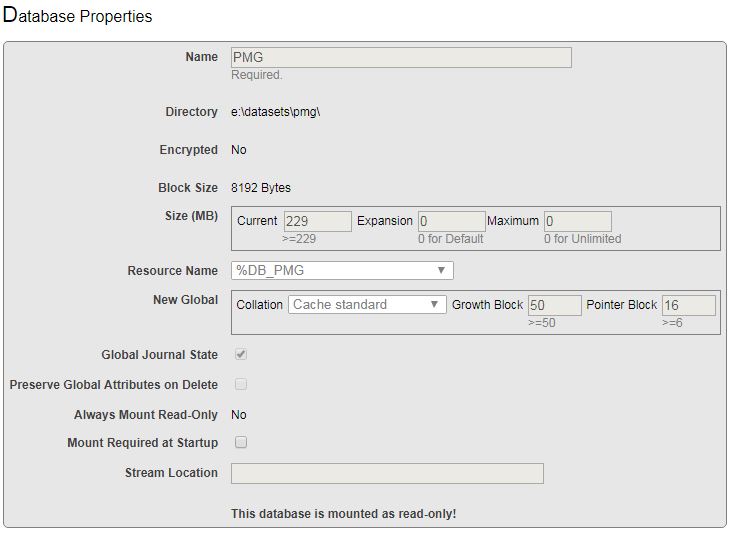
Hi Community,
What is the correct syntax in a merge.cpf file to create a database with its associated resource ?
System administration refers to the management of one or more hardware and software systems.
Hi Community,
What is the correct syntax in a merge.cpf file to create a database with its associated resource ?
I was trying to see if we could connect to another Server, we use to execute external scripts using %Net.SSH.Session.
TESTCLIN>set sshSession = ##class(%Net.SSH.Session).%New()
TESTCLIN>set user = <omitted>
TESTCLIN>set host = <omitted>
TESTCLIN>set privateKey = "/nfs/data/ssh/<omitted>"
TESTCLIN>set publicKey = "/nfs/data/ssh/<omitted>.pub"
TESTCLIN>Set statusConnection = sshSession.Connect(host)
TESTCLIN>set statusAuth = sshSession.According to the Documentation EnsLib.Workflow.TaskRequest has the following fields...
I want to be able to capture the Source, Session ID, and any other Identifiers outside of the Error so it will show up on the Task List.
I am struggling how to build a csp template for me to be able to capture additional fields to send to the Workflow
Could someone explain how and why a HL7 ACK be showing up as a Orphaned message when I run the following SQL...
SELECT HL7.ID,HL7.DocType,HL7.Envelope,HL7.Identifier,HL7.MessageTypeCategory,HL7.Name,HL7.OriginalDocId,HL7.ParentId, HL7.TimeCreated
FROM EnsLib_HL7.Message HL7
LEFT JOIN Ens.MessageHeader hdr
ON HL7.Id=hdr.MessageBodyId
WHERE hdr.MessageBodyId IS NULLI am trying to find the problem code that is causing the Orphaned messages, and an ACK showing up seems kind of Odd. While we do have Archive IO/Trace on, and Index NOT OK's set why would they show up as Orphaned messages?
I am working on building out a Workflow task that captures errors in mapping to specific tables. Within the Workflow task, I would like to give the owner of the task the ability to resubmit message once the mapping has been corrected. Is there a way to do it in a similar fashion to pulling up the Trace ie...
EnsPortal.VisualTrace.zen?SESSIONID=#(%task.%FormValues.GetAt("MsgHdrID"))#" target="_blank">View Message TraceIs there a one liner that could be called to resubmit the MsgHdrID (Session ID) from its source to post it again?
Can someone give me an explanation of how Local.PD.Linkage.Definition.Individual works? This was setup by another company as part of our implementation.
Below is my configuration..
.png)
We are getting a lot of matches on Given Name, but then the Family Name does not match at all, so I am wondering if these need to be adjusted. I just don't understand if they need to be positive or negative.
if I use the MLE CALIBRATION MONITOR, it seems that none of the values should be negative.
.png)
At the moment, we have 10 HealthShare instance servers (5 x mirrored pairs), where we implement an External Backup approach, using the freeze/thaw commands against whichever server of the pair is the backup mirror member, to complete a VM level backup. These backups are stored to a disk within our control, to purge as required. This approach allows us to deliver a zero downtime backup approach.
Hi everyone,
I’m working with an existing InterSystems IRIS server that hosts several web applications and namespace-specific code and data. I’d like to reverse-engineer the current environment into a %Installer.Manifest file so I can store it in Git and manage its changes.
My goal is to:
I understand that %Installer is declarative and wasn’t necessarily designed to reflect a running system.
We have messages that are in a queued state for various reasons and when we do a manual shutdown of the instance, they are moved to a Suspended state. I thought I saw in the documentation somewhere a setting to make sure these messages stay in a queued state and not suspend them. Can someone confirm and point me in the correct location for that documentation, as I am trying to ensure that if we do have to manually shutdown a instance, someone doesn't have to remember to go back in and check for suspended messages and resubmit them?
Thanks
Good morning everyone,
In the facility we're working in, we have two separate installations for testing and production. In the test environment, we have production processes running properly, and we need to replicate production processes and settings in the production environment. Until now, when we move from a test environment to a production environment, we currently export the test classes, import them into production, and manually configure the production environment by connecting Services, Processes, and Operations and configuring the settings.
Is it possible to audit code changes in a namespace?
Ideally what we'd like to be able to do is check which classes were compiled (or deleted) in a time period, eg in last 3 months, and which user made those changes. Even better would be an audit of what those changes were, but that's less important (for us, as we can probably find that information in other ways).
We have a service where 3 groups, each with multiple users, potentially have access to make changes to the live service. With the best will in the world, each group doesn't always tell every other group about changes made.
I have created a New Database/Namespace within our TEST environment on both the Primary and Backup of the mirror. When I go to create the database/namespace on the DR node I am getting "Cannot open file '/ensemble/TEST/iris.cpf_...." while the cpf file that it references does not exist. Anyone have any clue to why this might be happening?
I have a Task that I am trying to write the output to a file. How do I check for if the Output File has been included in the Task Schedule, so I can direct my output of my class to that output file?
Thanks
Scott
We are attempting to setup an EnsLib.SOAP.OutboundAdapter to send an HL7 message to a vendor hosted AWS site. We have the Certificate from the vendor and defined the TLS setting. However, when we are sending the message we are receiving...
Unable to open TCP/IP socket to server hcis-staging.cbord.com:443
So, we figured it might be a firewall issue. With the TCP Outbound Adapter, we could specify which "Local Interface" to use so that our firewall knew to use the VIP that had has been NAT'd. I don't see this option with the EnsLib.SOAP.
I am trying to log in to the Web Gateway Management and I have missed placed the password to access the system I have tried
changing the password under local settings in the CSP.ini and that has managed to change the password to access the gateway but cannot log me into the management area I have followed a post here and read here and I seem not to get the answers that actual explain how I can get to the web gateway management.
I have two instances of IRIS, one is Production and another one is Staging (both managed by Docker) and I want to set up a full daily recover of the Staging server from a full backup of the Production server. I know how to do this manually using the DBREST utility, as well as how to make a copy of the database by making a full copy of the durable directory (however this option requires a full stop of the Production-database). What is the best way to automatically restore all databases from a full backup using scripting?
I have created a class file that I want to execute daily to gather Metrics (Message Header, Space Available, etc..) and write the data into a Cache table. Now that I have written the class I want to add it to the Task Scheduler within Ensemble to run every morning. How do I go about getting the class file created as a Task within the Task Scheduler? The Documentation isn't as clear cut for creating custom tasks as one would expect.
Hi,
I recently had a company-enforced OS upgrade, and ever since going from mac OS 14.x to 15.x, I am currently having issues with SSL in IRIS.
An ARM (M3 pro) machine running OS 15.2, with the latest Docker Desktop (at the time of writing, 4.37.0). The Docker container runs IRIS for UNIX (Ubuntu Server LTS for x86-64 Containers) 2022.1.2 (Build 574_0_22161U). This container has not changed.
When attempting to run some local API tests of our software, I am hosting a Wiremock (https://github.com/wiremock/wiremock) server locally on the mac, in order to mock HTTP requests/responses.
Hello,
I was just trying to get to the bottom of a TLS config - we have an interface with a TLS config that has had 'Server certificate verification' set to 'On', however the cert file specified either did not exist or contained a cert that was expired.
Does anyone know what the behavior is for this typically? I would expect this to not allow traffic on the interface, however this has been working fine for a few years now with an invalid cert specified for 'Server certificate verification' and set to 'On'.
.png)
Hi,
In a customer project we started enforcing the "Inactivity Limit" as defined in System-Wide Security Parameters. The customer would expect accounts to become Disabled after they have been inactive for the specified amount of days. However, that doesn't happen; it seems the Inactivity Limit is only established after logging in.
Furthermore, the account inactivity only starts being applied after the first login. Can you confirm that?
I am developing locally on my IRIS instance using VSCode and client-side editing approach. How can I automatically export a single .cls file/a whole package to a remote TEST/PREPROD server using a script or command line and recompile the unit remotely? Are there any more simple and straightforward ways than CI/CD explained in the series of articles by Eduard?
Hi,
We see a lot of TCPIP connection error for few of the components not sure if it is a network glitch at the source/target or is it with us. And most of the times these errors are very transient and vanish on their own and the connection gets re established and the messages get processed. Here is the error we mostly see
ERROR <Ens>ErrTCPTerminatedReadTimeoutExpired: TCP Read timeout (30) expired waiting for terminator SegTerminatorAscii=13, on |TCP|50007|10620, data received =''
or
ERROR <Ens>ErrOutConnectionLost: Lost HL7 Read connection to 10.101.87.
Hi Community!
Suppose you have a working system on 8-bit Caché database and need to transfer the solution to Unicode database.
How do you manage that?
I am trying to track down a problem we saw this morning with our TEST environment. We had a momentary issue where InterSystems HealthShare Health Connect could not connect correctly to LDAP. When we tried to login and could not connect to LDAP, the system would Delete our users.
the Test LDAP function would return a "Can't contact LDAP server". I went through the Certificates, made sure they had the correct permissions and were not expired.
Currently we are exploring how we can allocate additional disk space to our current environment as we have seen a significant increase in growth of our Database files. Currently we have 3 namespaces, all with 1 IRIS.dat each that contains both the Global and Routines.
Since we have started down the route of everything within a single IRIS.dat file for each namespace, is it logical as we see growth to be able to split the current IRIS.dat for each namespace into a separate IRIS.dat for global and a IRIS.dat with for routines for each namespace in a Mirror environment?
Hi,
Can we write message in the messages.log file ?
Thanks
I have a few routines in ^rINDEX that are missing in ^ROUTINE. At least some of those routines lack a timestamp, probably Date and Time Modified in ^rINDEX. It causes D %RO crash when such a routine is referenced by a routine range, since "" is an illegal $ZDTH value.
Healthy entry (note the timestamp): ^rINDEX("ABC,"INT") = $lb("2021-06-15 15:08:38.846885",) ;The second argument is sometimes present and sometimes not, likely the routine size.
Unhealthy entry (note an empty timestamp): ^rINDEX("DEF,"INT") = $lb("",21)
Finally, a question, not only for this situation.
We are constantly running into issues where there are billions of Orphaned messages in our system that cause problems, and we have to manually run a cleanup to fix performance issues.
In the following article about orphaned messages... https://community.intersystems.com/post/ensemble-orphaned-messages it mentions either programmatically eliminating the Orphaned messages or using a Utility like Demo.Util.CleanupSet in ENSDEMO.
I have had it explained to me is basically all messages have to go somewhere, if they aren't then it creates orphaned
We recently moved from using the Private Web Server, to using an Apache/Web Gateway setup and moved towards using the built in LDAP functionality within IRIS. Since then, we have 1 user that uses VSCode (/api/atelier) heavily that continues to have issues signing into IRIS through VS Code and the /api/atelier extension.
I am trying to troubleshoot two issues..
We're looking to create a quick and simple test to see if all firewalls are open on 1972 between a linux based web server VM and a VM running InterSystems IRIS. Does anyone have any ideas for a quick command that can be run from UNIX console that will provide confirmation that traffic is able to get to 1972 on an IRIS machine?
BTW - I don't think it makes any difference but the IRIS machine is running Windows