We are glad to announce that DBeaver has supported InterSystems IRIS out-of-the-box since version 7.2.4. You don't need to configure it manually anymore, just find the IRIS icon in the Connections list.
.png)
SQL is a standard language for storing, manipulating and retrieving data in relational databases.
We are glad to announce that DBeaver has supported InterSystems IRIS out-of-the-box since version 7.2.4. You don't need to configure it manually anymore, just find the IRIS icon in the Connections list.
If you're migrating from Oracle to InterSystems IRIS—like many of my customers—you may run into Oracle-specific SQL patterns that need translation.
Take this example:
SELECT (TO_DATE('2023-05-12','YYYY-MM-DD') - LEVEL + 1) AS gap_date
FROM dual
CONNECT BY LEVEL <= (TO_DATE('2023-05-12','YYYY-MM-DD') - TO_DATE('2023-05-02','YYYY-MM-DD') + 1);
In Oracle:
LEVEL is a pseudo-column used in hierarchical queries (CONNECT BY). It starts at 1 and increments by 1.CONNECT BY LEVEL <= (...)Hi,
Can anyone please tell me how to append a string using a update query.
For eg : "Hello" is the string . I need to append the string world and it needs to be "Hello world".
Thanks
Jude
How would you go about creating an SQL Stored Procedure that would result in the same output as "IN LIKE"?
For example...
CustomersTable
| RecordId | CustomerName |
| 123 | Mark Stevens |
| 456 | Betty Johnson |
| 789 | John Stevens |
| 321 | Brian Smith |
| 654 | John Markson |
| 987 | Tom Obrian |
selectfromwhereWould return:
| 123 | Mark Stevens |
| 456 | Betty Johnson |
| 789 | John Stevens |
| 654 | John Markson |
Hello,
I have a class with a "Unique" index (pxfactidIndex) on a %Numeric property (pxfactid) (partially-edit code snippet below):
PropertyAs%Library.NumericI see the following odd behavior when counting how many records have that property set to null:
.png)
Is there a way in a EnsLib.SQL.InboundAdpapter that you can tell when you have reached the end of the Results of the Query?
Does anyone have a query that I could run to show a Vendor the time difference between when a message was sent out a BO, and when we received the HL7 ACK back that is associated with the message sent?
I am trying to prove to this vendor of the delay we are seeing getting the ACK back because of a Timeout
I know how to pull Ens.MessageHeader, and EnsLib.HL7.Message but not sure how to match up the Message with the HL7 Acknowledgement received.
Hi community.
I was wondering if it was possible to use something like EnsLib.SQL.InboundAdapter with tables in IRIS.
This library monitors when a record has been inserted into a table in an external database, so it requires a DSN to connect to that database.
My goal is to make a call to an external API that takes a long time, it could spend nearly an hour (or more) completing its processes, but I don't want to block the main process.
I am testing vectorsearch, while doing so I am trying to paginate my resultset for a "next page" function to give me the first, second, third 15 entries within a table.
For this I have two embedding classes. One with a HNSW Index (vectornomicembedtextlatest), and one without (vectornomicembedtexttest).
Calling SELECT ID,PRIMKEY FROM SQLUser.vectornomicembedtexttest LIMIT 5 OFFSET 1 works fine with the first entry having the rowID of 486448. (I deleted old entries in the beginning and reused the table)
SELECT ID,PRIMKEY FROM SQLUser.

I'm excited to announce a major update to SQL Data Lens – a powerful database client and metadata explorer – that opens up new, free possibilities for the InterSystems community.
SQL Data Lens is now completely FREE to use with InterSystems IRIS Community Edition!
No more “localhost only” restrictions
No more limits on the number of connections
No license? No problem.
You can now connect to InterSystems IRIS Community Edition—completely license-free—using the fully functional Free Edition of SQL DATA LENS. Explore all the features, no strings attached.
Hi, I am unsure how to remove this restriction; when I am performing dynamic SQL using ##class(%SQL.Statement).%ExecDirectNoPriv(, .query, args...)
It works fine, but the moment I add specific properties from the persistent class I am performing the select on into the WHERE clause, I get: ERROR #5540: SQLCODE: -99 Message: User UnknownUser is not privileged for the operation.
Hello. Currently, we are developing using Cache 2018 version.
Our team is working on improving an existing legacy program so that it can also be used on the web.
Before asking my question, here is the development environment.
Currently, we are successfully mapping global data through the %PERSISTENT class and able to query it with SQL. However, the problem is that the retrieved "Korean" data is all broken.
Hello Community,
I executed the below query in the %ZLANGC00.mac routine. It returns results when using dynamic SQL, but not with embedded SQL(returns 0).
&SQL(SELECTcountTableThanks!
I have a table in the development and want to erase data from certain columns. There is info in the docs but not for human
This piece of code does not work
ALTER TABLE table DROP COLUMN column %DELDATA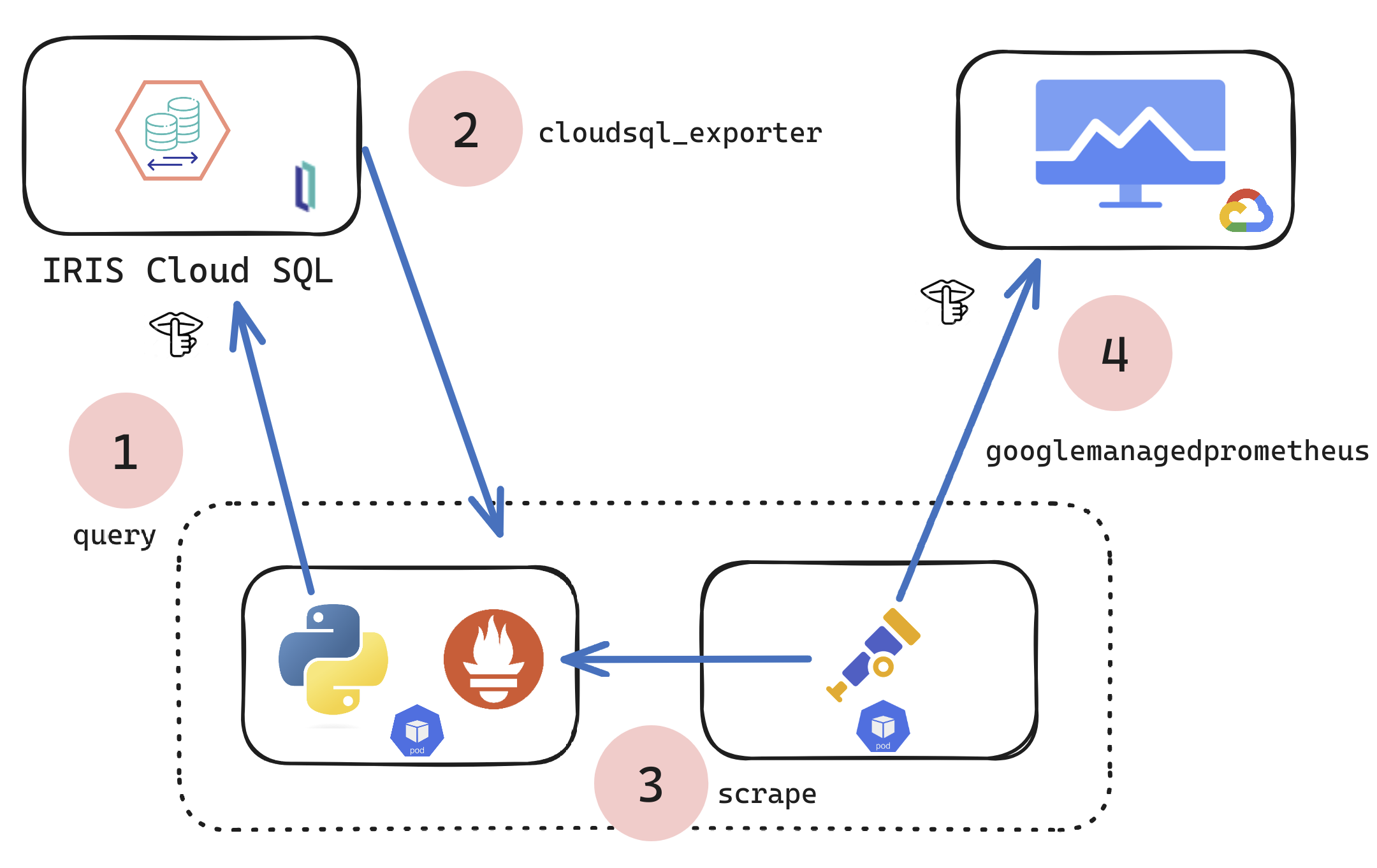
If you are a customer of the new InterSystems IRIS® Cloud SQL and InterSystems IRIS® Cloud IntegratedML® cloud offerings and want access to the metrics of your deployments and send them to your own Observability platform, here is a quick and dirty way to get it done by sending the metrics to Google Cloud Platform Monitoring (formerly StackDriver).
Would like to know if there is an alternative or better way to paginate through a dataset using dynamic SQL than what I am using below. The problem is that as the potential pool of data gets larger, this code slows down to the point of not being useable. In analyzing each line of code below, it appears the slow down is related to the initial rset.%Next() iteration. Is there anything available which does not require a subquery/%VID such as a simple LIMIT/OFFSET?
My code is similar to :
s sql=##class(%SQL.Statement).
Hello IRIS community,
InterSystems Certification is developing a certification exam for InterSystems IRIS Developer professionals, and if you match the exam candidate description given below, we would like you to beta test the exam.
I have an IRIS persistent class with a %Stream property whose value is a JSON object. I'd like to use a SQL trigger to pull some value out of the JSON and persist it in another property, for easy querying and indexing. See below for a minimal example:
ClassExtends%PersistentAsinsertintoContentsHowever, the SQL insert fails in the trigger with a JSON parsing message like this:
<THROW>InsertRow+9^PAB.DebugStream.1 *%Exception.SQL -415 -415 InsertRow+9^PAB.DebugStream.1 Error occurring during INSERT in table 'PAB.DebugStream': $ZE=<THROW>%FromJSON+22^%Library.DynamicAbstractObject.1 *%Exception.General Parsing error 3 Line 1 Offset 1
I am struggling with returning a SQL Query Result that may have multiple rows that can be searched.
set"SELECT Facility FROM FROM osuwmc_EnterpriseDirDB.RelationshipMedCtrID WHERE OSUmedcenterID = ?"I need to take the values that are returned and say search them for a single value. How would I go about returning the EnsLib.SQL.Snapshot into a Array or List for it to be searchable.
Can this be done internally within the DTL, so I don't have to go build a Business Process and Outbound SQL Adapter Operation?
Thanks
I have a general question about HealthShare Provider Directory using Code Tables on disk vs Cache SQL Tables. Why is Provider Directory not using the Cache SQL Tables within the IRIS platform?
When working with InterSystems IRIS, database developers and architects often face a critical decision: whether to use Dynamic SQL or Embedded SQL for querying and updating data. Both methods have their unique strengths and use cases, but understanding their performance implications is essential to making the right choice. Response time, a key metric in evaluating application performance, can vary significantly depending on the SQL approach used. Dynamic SQL offers flexibility, as queries can be constructed and executed at runtime, making it ideal for scenarios with unpredictable or highly variable query needs. Conversely, Embedded SQL emphasizes stability and efficiency by integrating SQL code directly into application logic, offering optimized response times for predefined query patterns.
In this article, I will explore the response times when using these two types of SQL and how they depend on different class structures and usage of parameters. So to do this, I'm going to use the following classes from the diagram:
.png)
The 2024.1.4 and 2023.1.6 maintenance releases of InterSystems IRIS® data platform,InterSystems IRIS® for HealthTM, and HealthShare® Health Connect are now Generally Available (GA). These releases include the fixes for the following alert recently issued - Alert: SQL Queries Returning Wrong Results | InterSystems. Please share your feedback through the Developer Community so we can build a better product together.
I was wondering if someone could help me. In the past I have been able to call external Stored Procedures through a SQL Outbound Connection and have them return me the EnsLib.SQL.Snapshot to use within a BPL to extract data.
But this time instead of using a SQL Outbound BO to make the Stored Procedure call, I decided to create a Linked Stored Procedure through the %JDBC_Server to point to the Stored Procedure out on MS SQL.
However, I am struggling to get the code just right to return the Column value from the Linked Stored Procedure.
set##classHey Community,
We're excited to invite you to the next InterSystems UKI Tech Talk webinar:
⏱ Date & Time: Thursday, April 24, 2025 14.30-15.30 UK
👨🏫 Speaker: @Kinshuk Rakshith, Sales Engineer, InterSystems

An experiment on how to use the LangChain framework, IRIS Vector Search, and LLMs to generate IRIS-compatible SQL from user prompts.
This article was based in this notebook. You can run it with a ready to use environment with this application in OpenExchange.
First, we need to install the necessary libraries:
!pip install --upgrade --quiet langchain langchain-openai langchain-iris pandas
Hello,
Our software commonly returns a full result set to the client and we use the DataTables plugin to display table data. This has worked well, but at datasets grow larger, we are trying to move some of these requests server-side so the server handles the bulk of the work rather than the client. This has had me scratching my head in so many ways.
I'm hoping I can get a mix of general best practice advice but also maybe some IRIS specific ideas.
What I find really useful about IRIS when teaching my subject of Postrelational databases is the fact that it is a multi model database. Which means that I can actually go into architecture and structure and all that only once but then show the usage of different models (like object, document, hierarchy) using the same language and approach. And it is not a huge leap to go from an object oriented programming language (like C#, Java etc) to an object oriented database.
However, along with advantages (which are many) come some drawbacks when we switch from object oriented model to relational. When I say that you can get access to the same data using different models I need to also explain how it is possible to work with lists and arrays from object model in relational table. With arrays it is very simple - by default they are represented as separate tables and that's the end of it. With lists - it's harder because by default it's a string. But one still wants to do something about it without damaging the structure and making this list unreadable in the object model.
So in this article I will showcase a couple of predicates and a function that are useful when working with lists, and not just as fields.
Firstly, we need to understand what prompt words are and what their functions are.
Hint word engineering is a method specifically designed for optimizing language models.
Its goal is to guide these models to generate more accurate and targeted output text by designing and adjusting the input prompt words.
I need to generate a DDL file from a .cls class that already exists, the idea is to create a mirror table in SQL. Is it possible to do this export or do I need to do the CREATE TABLE manually?
I have a business service which is responsible for some batch operations with an SQL table. The process is generally slow but it is possible to scale the performance using multithreading and/or parallel processing and logical partitioning (postgres):
select id, col1, col2, mod(row_number() over (), 4) as partition from some_table;
Thus, a partition index will be assigned to each table row. The idea is to create several instances of my business service using pooling (e.g. Pool Size = 4) so each business service instance will be responsible to hande rows belonging to a certain partition, e.g.