Greetings all,
Need to connect your VSCode to an InterSystems Server?
Heard of this option?
.png)
InterSystems IRIS is a Complete Data Platform
InterSystems IRIS gives you everything you need to capture, share, understand, and act upon your organization’s most valuable asset – your data.
As a complete platform, InterSystems IRIS eliminates the need to integrate multiple development technologies. Applications require less code, fewer system resources, and less maintenance.
Greetings all,
Need to connect your VSCode to an InterSystems Server?
Heard of this option?
Hi Developers,
In the previous article, we describe how to use config-api to configure IRIS.
Now, let's try to combine the library with the ZPM client.
The goal is to load a configuration document during zpm install at the configure phase.
For this exercise, a template repository is available here (this is based on objectscript-docker-template ).
We attempt to :
MYAPPDATA.dc.PackageSample.*.SQLUserRO with read-only SQL role access.SSLAppDefault./rest/myapp.Some changes in IRIS configuration require a restart of IRIS.
This is no big issue as long as I have access to the server command line with sufficient privileges.
In a container, this is not always given.
Stopping IRIS from the terminal/session prompt is no problem.
But the restart after is.
Note1: container start-stop is no option as it might be removed by option --rm in docker run
Note2: the target is linux (manly in docker). Windows is excluded
When you have more than ten thousand users in your database, it becomes time-consuming and inconvenient to assign group access rights through the standard IRIS interface. In this artilce I want to introduce you an application to automate this process.
I’ll show you how to assign and change the role lists for the users, selecting them by context, and I will also show you how to expand this application’s functionality. you know how to apply your work as an administrator and developer to the new features of the well-proven apptools software complex. With the addition of an adminLTE template, you can now quickly and easily create interface interactions for any entity and many functional modules. The goal while developing this toolkit is to write as little JavaScript as possible as well as transfer and implement all the dynamics as much as possible in the ObjectScript.
Hi Developers,
Please welcome the new video specially recorded for Developer Tools programming contest:
⏯ Deploying InterSystems IRIS docker solutions to GKE cloud in 5 minutes
Hi folks!
Often while debugging you want to know the values of all the parameters.
Using VSCode Debugger is not an option.
What do you use to know what parameters came to the method?
My hope if you have a "magic" macro that will store all the variables with their names into a global?
And share your approaches, please?
We released a new version of ZPM (Package Manager)
New in ZPM 0.2.14 release:
See the details below.
Episode 17 of Data Points features a roundtable conversation with Carmen Logue, Benjamin De Boe, and Thomas Dyar about the Analytics & AI area of the InterSystems technology stack. Learn from these product experts about the various technologies and partnerships that exist within the Analytics & AI space at InterSystems, how some customers use these tools, and what might be coming in the future.
greetings Community!
InterSystems Learning Services is working to identify and create libraries of high-quality learning resources for third-party technologies, platforms, and systems that are part of, integrated with, or commonly used with InterSystems products and technologies. we don't create content for these ourselves, but want to support our clients, external and internal, in learning about them and how to use them.
Hi,
We need to implement Oauth2 Code Flow + PKCE. Any experience with InterSystems OAuth2 Server on this would be welcome.
What parameters did you setup on OAuth 2 server configuration page to make it work?
Thanks!
We are looking at moving from Cache to IRIS, if we do this we will want to use Intersystems Reports. We have a lot of Crystal Reports to convert. is there a conversion tool or best practice for doing the conversion
Hi Community,
I see the announcement https://www.intersystems.com/news-events/news/news-item/intersystems-ir…. But I didn't find in the AWS marketplace. Do you know where find this option?
GA releases are now available for the 2020.4 version of InterSystems IRIS, InterSystems IRIS for Health and InterSystems IRIS Studio.
InterSystems IRIS Data Platform 2020.4 makes it even easier to develop, deploy and manage augmented applications and business processes that bridge data and application silos.
Testing ECP-based applications often take quite some effort for setup and preparation.
I have created a Docker-based workbench that allows you to have it quick at hands.
And if you crash it? You just give your containers a fresh start.
The whole setup runs code-based during the start-up of your instance.
In that sense, it is also a portable coding example using ZPM and the objectscript-docker-template
I'm almost running out of disk space so I want to move 1 DB to a different hard drive.
It's a rather simple but lengthy action during a shutdown of IRIS.
But is this somehow possible under runtime in a stand-alone installation?
I'm looking for kind of a "local drive failover"
note: Mirror or Shadow is not an option.
Hey everyone.
I have been revisiting our backup strategy, and spotted that IRIS supports VSS (Volume Shadow Copy Service) in Windows. This is quite attractive as an approach, as it automatically calls the external freeze and thaw commands.
However when calling these manually, there's quite a few parameters that can be set, and the documentation around VSS only states that the freeze/thaw commands are called.
Is there a way of controlling the parameters used, or at the very least know what the defaults are?
Ever noticed that the Type column of the Web Applications page in the Security section of Management Portal is showing you redundant information?
.png)
Hi All!
Examining the page here I see we have one-to-many and parent-child relationships supported in the InterSystems Objects model.
Do we support one-to-one too?
I'm looking for a way to have an IRIS db distributed over several (hw) drives.
Without touching the internal data structures (e.g. mapping) !
Are there any options in file systems to achieve this "splitting" or "appending" ?
Historic background:
This EXTENT was excellently suited to move fresh and active data
to a faster spindle for more performance.
After running an extensive block of daily statistics my IRISTEMP has expanded dramatically.
But FreeSpace shows 97% unused and FREE space.
How can I shrink IRISTEMP in runtime without shutdown and manual intervention
(which was the traditional approach)
Hey Developers,
Please welcome the new video on InterSystems Developers YouTube:
Hi guys,
I've created an iris command line utility to interface the Linux command line with Interface IRIS
https://github.com/RamSailopal/iriscmd
It maybe of use to some of the community
Ram
Hello, in a zen page sometimes I find document.getElementbyId("ID") to set a propertybut also zen("ID").setPr.... So what is the real difference and limitations of each?
What is Distributed Artificial Intelligence (DAI)?
Attempts to find a “bullet-proof” definition have not produced result: it seems like the term is slightly “ahead of time”. Still, we can analyze semantically the term itself – deriving that distributed artificial intelligence is the same AI (see our effort to suggest an “applied” definition) though partitioned across several computers that are not clustered together (neither data-wise, nor via applications, not by providing access to particular computers in principle). I.e., ideally, distributed artificial intelligence should be arranged in such a way that none of the computers participating in that “distribution” have direct access to data nor applications of another computer: the only alternative becomes transmission of data samples and executable scripts via “transparent” messaging. Any deviations from that ideal should lead to an advent of “partially distributed artificial intelligence” – an example being distributed data with a central application server. Or its inverse. One way or the other, we obtain as a result a set of “federated” models (i.e., either models trained each on their own data sources, or each trained by their own algorithms, or “both at once”).
InterSystems IRIS 2019.1 has been out for a while and I would like to cover some enhancements for handling JSON which might have gone unnoticed. Dealing with JSON as a serialization format is an important part of building modern applications, especially when you interact with REST endpoints.
The InterSystems IRIS can be extended using Java or .NET components and its frameworks inside Object Script source code.
I created an application called OCR Service It built with Docker and installs Google Tesseract inside docker instance configured with english and portuguese dialects, but is possible install more than other 100 dialects. Google Tesseract can receive images and return text extracted from it, using OCR. The results are very good with the trained dialects. But you can train Tesseract to read car plates and any other textual patterns and load it to extract text.
In Studio you could open a class directly via it's name, without having to traverse the package tree with multiple clicks until arriving at the desired class.
You would Ctrl + O or (File -> Open) and be able to simply type in the class name, for example:
.png)
You press Enter, and viola - the class is opened.
How do you achieve this in VSCode?
Hey Developers,
See how to use the DTL Generator in InterSystems IRIS to create a data transformation:
Hi Community,
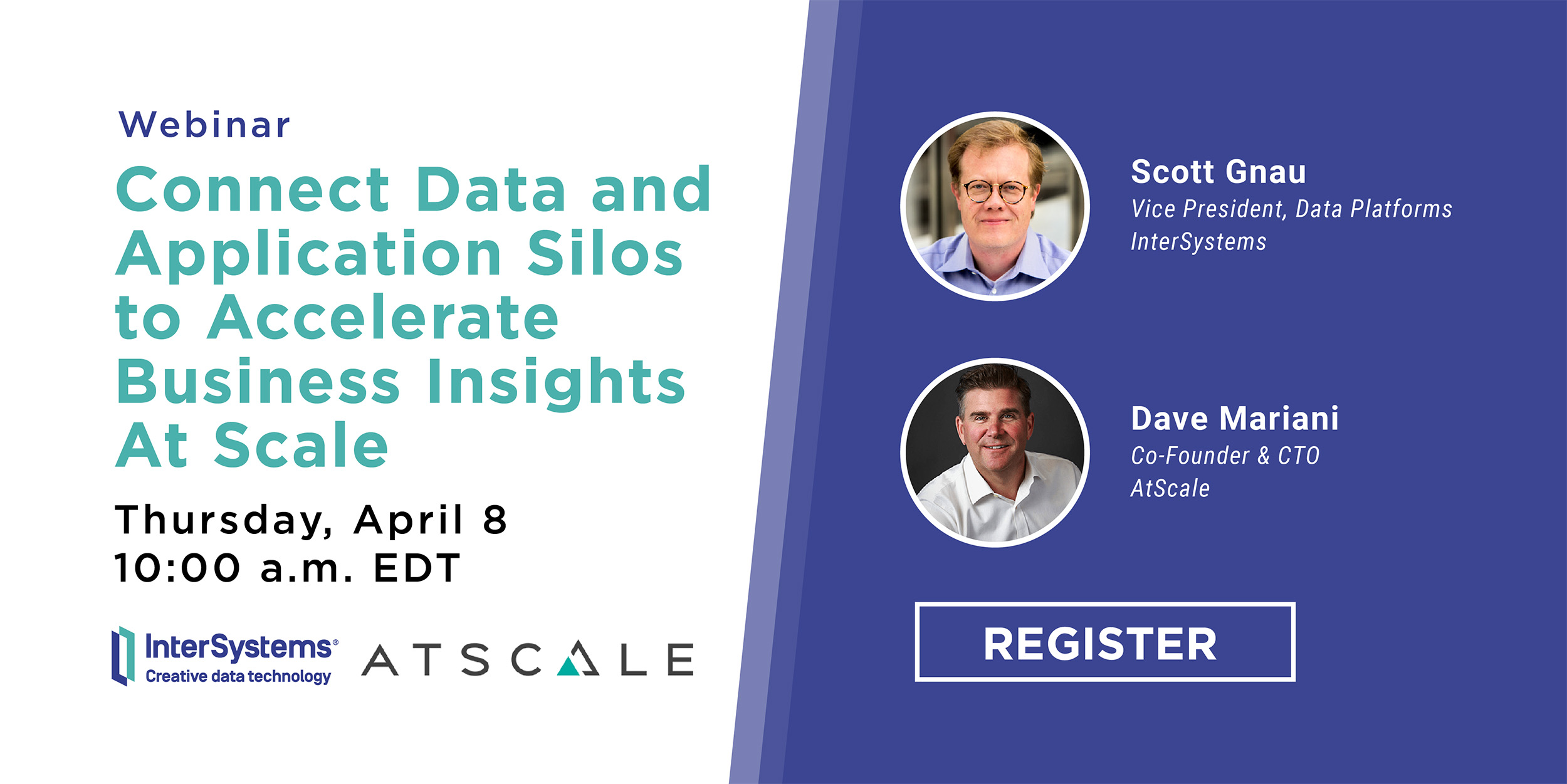
We're pleased to invite you to join the upcoming webinar "Connect Data and Application Silos to Accelerate Business Insights At Scale" on April 8 at 10:00 AM EDT!
The explosion of business systems and processes and their resulting data silos has made an overarching view of enterprise information more challenging than ever. Join two data management industry veterans as they discuss the latest progress in data management technology, working with transactional AND analytic data, and how the financial services industry is addressing challenges to speed insight and innovation.
Now Sapphire enable you load CSV to IRIS. See the steps:
1) Create a sample CSV file using Excel (save file as CSV):
.png)
2) Follow these instructions to install Sapphire into your enviroment: https://openexchange.intersystems.com/package/SAPPHIRE
3) Access Sapphire web page. Go to top menu Import > Load CSV
.png)
4) Configure access to your IRIS target instance, select new table, set your new table name, click Choose button and load your csv file and click upload. Click Get Definitions.
.png)