#Interoperability

7 Followers · 574 Posts

In healthcare, interoperability is the ability of different information technology systems and software applications to communicate, exchange data, and use the information that has been exchanged.

Article Keren Skubach · Dec 29, 2025 2m read

When working with InterSystems Interoperability (Iris / Health Connect / Ensemble), configuration data is often spread across many production items: services, processes, operations, adapters, and their settings.

A common operational or security need is to answer questions like:

  • Which interfaces reference file system paths?
  • Where are directories, network shares, or absolute paths configured?
  • Can I quickly audit or document this information across all my productions?

The ObjectScript utility below solves exactly that problem by exporting selected configuration settings into a CSV file.

0
2 108
Article Henry Pereira · Apr 2, 2025 17m read

Image generated by OpenAI DALL·E

I'm a huge sci-fi fan, but while I'm fully onboard the Star Wars train (apologies to my fellow Trekkies!), but I've always appreciated the classic episodes of Star Trek from my childhood. The diverse crew of the USS Enterprise, each masterminding their unique roles, is a perfect metaphor for understanding AI agents and their power in projects like Facilis. So, let's embark on an intergalactic mission, leveraging AI as our ship's crew and  boldly go where no man has gone before!

2
2 268
Article Georgii Tatevosian · Mar 30, 2025 5m read

Introduction

As AI-driven automation becomes an essential part of modern information systems, integrating AI capabilities into existing platforms should be seamless and efficient. The IRIS Agent project showcases how generative AI can work effortlessly with InterSystems IRIS, leveraging its powerful interoperability framework—without the need to learn Python or build separate AI workflows from scratch.
This project explores how ChatGPT and Anthropic Claude, two of the most advanced AI models, can interact with IRIS using Custom GPTs and the Model Context Protocol (MCP).

10
3 645
Article Yuri Marx · Dec 11, 2025 8m read

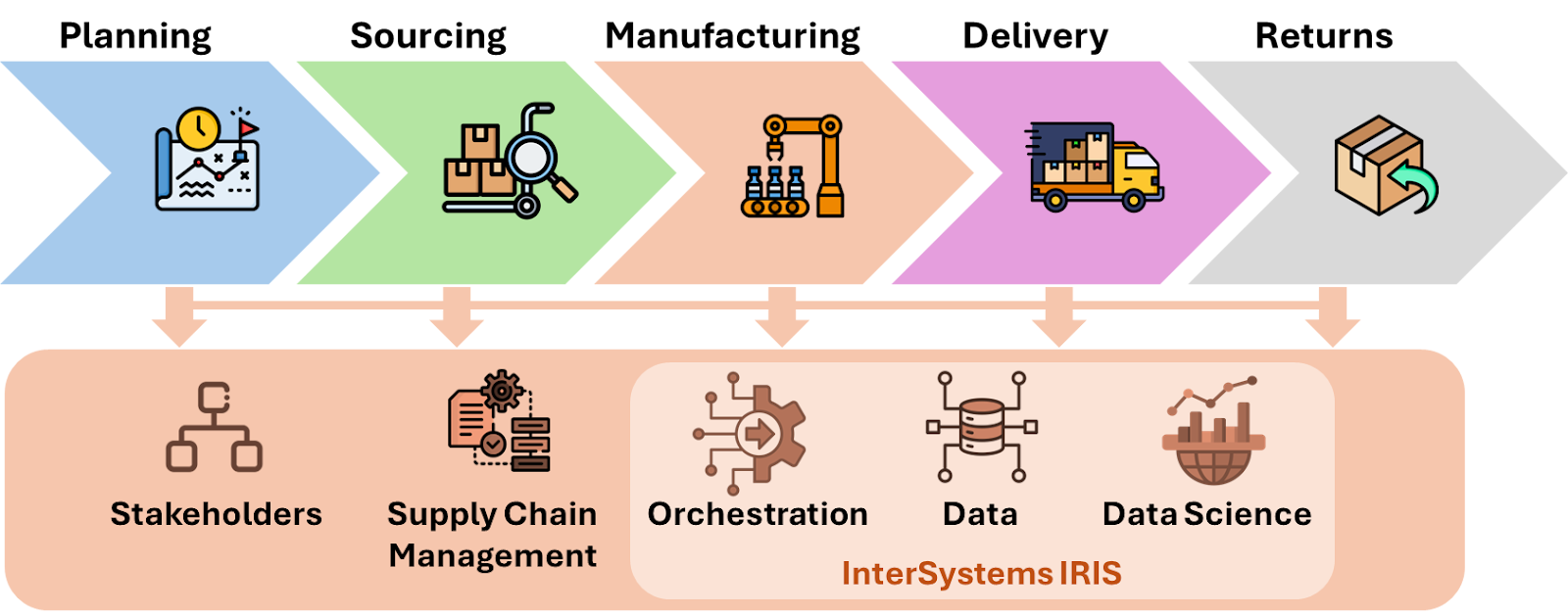
Supply Chain refers to a set of processes and activities performed by the company's business areas and its suppliers and partners (stakeholders), from the acquisition of raw materials, through production, to delivery to the end consumer. It can be better managed using SCM solutions with the orchestration of the InterSystems IRIS:


0
5 187
Question Timothy Leavitt · Aug 26, 2025

What are best practices for JSON transformation in IRIS interoperability? This is for a non-healthcare use case, so any tools we happen to have around FHIR might not be available. The motivating use case is trimming down a verbose and needlessly complex REST API response to feed to an LLM - trying to reduce token usage and maybe get better results from less noisy data.

Specifically, I'm imagining matching based on JSONPath expressions and simplifying structures based on the inferred type of elements rather than a full schema.

10
0 222
Question Julian Matthews · Dec 5, 2025

Hey everyone.

As part of an ongoing mission to track down orphaned HL7 Messages in our integration engine, I have been digging into our environment to track down the causes.

Having looked at various posts here (including one of my own) there are a few scenarios that can create orphaned messages resulting in excessive disk space usage. These scenarios are generally:

  1. Purging an environment with the option "Bodies Too" deselected
  2. Code creating/saving a Message but then not sending it
  3. BPL errors similar to 2, or a scenario where the response to a Call component is not set.
2
0 96
Question Oliver Wilms · Nov 27, 2025

I am using IRIS for Windows (x86-64) 2022.1 (Build 209) Tue May 31 2022 12:27:55 EDT [Health:3.5.0]. I created Interoperability Production with a Service to read file from S3 bucket and an Operation to write files to a different S3 bucket. I specified AWS  ProviderCredentialsFile.

I see "Terminating Job 7096 / 'From S3 Bucket' with Status = ERROR #5023: Remote Gateway Error: Connection cannot be established, %QuitTask=

Do I need anything like Python libraries or AWS CLI to make this work?

2
0 67
InterSystems Official Aya Heshmat · Nov 25, 2025

The Interoperability user interface project has continued from 2025.1 and has incorporated many of the items that you – our customers and partners – have suggested and observed.  We are continuing to invest in feedback and updating this important user experience.   In the latest release, 2025.3 for IRIS, IRIS for Health, Health Connect and Health Connect Cloud, the DTL Editor and Production Configuration applications that are available for opt-in. 
NOTE:

  • You can switch between the modernized and standard experiences. 
  • All other Interoperability screens remain in the Standard user interface.
0
0 130
Announcement Anastasia Dyubaylo · Nov 25, 2025

Hello Community,

Great news for developers who have just started working with InterSystems IRIS! We have hands‑on interactive tutorials available via the Instruqt platform! These are perfect for getting up to speed quickly, playing in real environments, and building confidence with IRIS‑based development.

Here is the list of available tutorials:

0
1 152
InterSystems Official Daniel Palevski · Nov 19, 2025

The 2025.3 release of InterSystems IRIS® data platform, InterSystems IRIS® for Health, and HealthShare® Health Connect is now Generally Available (GA). This is a Continuous Delivery (CD) release.

Release Highlights:

  • Secure Wallet: A new encrypted framework for managing sensitive data, built on the IRISSECURITY database, improving system security and access control.
  • Expanded Observability & Cloud Integrations: Enhanced OpenTelemetry metrics, including new process and ECP metrics, plus journal archiving now supports Azure Blob Storage for cost-efficient retention.
1
0 154
Article Ashok Kumar T · Jun 30, 2025 23m read

Overview

Fast Healthcare Interoperability Resources (FHIR) is a standardized framework developed by HL7 International to facilitate the exchange of healthcare data in a flexible, developer-friendly, and modern way. It leverages contemporary web technologies to ensure seamless integration and communication across healthcare systems.

Key FHIR Technologies

  • RESTful APIs for resource interaction
  • JSON and XML for data representation
  • OAuth2 for secure authorization and authentication
2
9 550
Article Muhammad Waseem · Nov 20, 2025 13m read

Hi Community,

In the first part of this series, we examined the fundamentals of Interoperability on Python (IoP), specifically how it enables us to construct such interoperability elements as business services, processes, and operations using pure Python.

Now, we are ready to take things a step further. Real-world integration scenarios extend beyond simple message handoffs.They involve scheduled polling, custom message structures, decision logic, filtering, and configuration handling.In this article, we will delve into these more advanced IoP capabilities and demonstrate how to create and run a more complex interoperability flow using only Python.

To make it practical, we will build a comprehensive example: The Reddit Post Analyzer Production. The concept is straightforward: continuously retrieving the latest submissions from a chosen subreddit, filtering them based on popularity, adding extra tags to them, and sending them off for storage or further analysis.

The ultimate goal here is a reliable, self-running data ingestion pipeline. All major parts (the Business Service, Business Process, and Business Operation) are implemented in Python, showcasing how to use IoP as a Python-first integration methodology.

2
1 243
Article Yuri Marx · Nov 18, 2025 11m read

Modern data architectures utilize real-time data capture, transformation, movement, and loading solutions to build data lakes, analytical warehouses, and big data repositories. It enables the analysis of data from various sources without impacting the operations that use them. To achieve this, establishing a continuous, scalable, elastic, and robust data flow is essential. The most prevalent method for that is through the CDC (Change Data Capture)  technique. CDC monitors for small data set production, automatically captures this data, and delivers it to one or more recipients, including analytical data repositories. The major benefit is the elimination of the D+1 delay in analysis, as data is detected at the source as soon as it is produced, and later is replicated to the destination.

This article will demonstrate the two most common data sources for CDC scenarios, both as a source and a destination. For the data source (origin), we will explore the CDC in SQL databases and CSV files. For the data destination, we will use a columnar database (a typical high-performance analytical database scenario) and a Kafka topic (a standard approach for streaming data to the cloud and/or to multiple real-time data consumers).


Overview

This article will provide a sample for the following interoperability scenario:


0
4 224
Article Tani Frankel · Jan 14, 2025 6m read

Using embedded Python while building your InterSystems-based solution can add very powerful and deep capabilities to your toolbox.

I'd like to share one sample use-case I encountered - enabling a CDC (Change Data Capture) for a mongoDB Collection - capturing those changes, digesting them through an Interoperability flow, and eventually updating an EMR via a REST API.

2
2 646
Article Robert Barbiaux · Nov 12, 2025 8m read

Introduction

In this article, we will explore various approaches to extending and customizing the behavior of InterSystems IRIS (and IRIS Health) built-in interoperability message routers.

Message routers perform one of the core functions of Enterprise Application Integration (EAI) and are among the most frequently used business processes in interoperability productions.

0
1 205
Article Andrew Sklyarov · Nov 8, 2025 4m read

When I started my journey with InterSystems IRIS, especially in Interoperability, one of the initial and common questions I had was: how can I run something on an interval or schedule? In this topic, I want to share two simple classes that address this issue. I'm surprised that some similar classes are not located somewhere in EnsLib. Or maybe I didn't search well? Anyway, this topic is not meant to be complex work, just a couple of snippets for beginners.

0
0 127
InterSystems Official Aya Heshmat · Mar 27, 2025 4m read

The Interoperability user interface now includes modernized user experiences for the DTL Editor and Production Configuration applications that are available for opt-in in all interoperability products. You can switch between the modernized and standard views. All other Interoperability screens remain in the Standard user interface. Please note that changes are limited to these two applications and we identify below the functionality that is currently available. 

To try out the new screens prior to upgrading, you can download the 2025.

23
4 836
Article Ashok Kumar T · Oct 20, 2025 11m read

What is XML?

XML (eXtensible Markup Language) is a flexible, text-based, and platform-independent format used to store and transport data in a well-structured way that is both human- and machine-readable. XML permits users to define custom tags to describe the meaning and organization of their data. For example: <book><title>The Hitchhiker's Guide</title></book>.

An XML document is self-descriptive and structured as a hierarchical tree of elements. Every document has a single root element that encapsulates all other content.

3
6 375
Article Laura Blázquez García · Feb 23, 2025 4m read

When we create a FHIR repository in IRIS, we have an endpoint to access information, create new resources, etc. But there are some resources in FHIR that probably we wont have in our repository, for example, Binary resource (this resource returns a document, like PDF for example).

I have created an example that when a Binary resource is requested, FHIR endpoint returns a response, like it exists in the repository. 

First of all, we need a Namespace and a FHIR endpoint. After this, we need to configure an Interoperability production that will be connected to the FHIR endpoint.

7
8 458
Article Corentin Blondeau · Feb 24, 2025 4m read

Hello
This article follows up on the question I had asked the community UDP Adapter not working
In this article, I will present to you
1) What is "UDP"?
2) The current state of Iris with UDP
3) My solution with the UDP adapter


1) What is "UDP"?

UDP stands for User Datagram Protocol. It is one of the core protocols of the Internet Protocol (IP) suite, used for transmitting data over a network. Here are some key features of UDP:

  1. Connectionless: UDP does not establish a connection before sending data, which means it can send messages (datagrams) without prior handshaking.
4
4 361
Article Timothy Scott · Feb 28, 2025 7m read

High-Performance Message Searching in Health Connect

The Problem

Have you ever tried to do a search in Message Viewer on a busy interface and had the query time out? This can become quite a problem as the amount of data increases. For context, the instance of Health Connect I am working with does roughly 155 million Message Headers per day with 21 day message retention. To try and help with search performance, we extended the built-in SearchTable with commonly used fields in hopes that indexing these fields would result in faster query times. Despite this, we still couldn't get some of these queries to finish at all.

1
8 307
Article Andrew Sklyarov · Nov 2, 2025 7m read

Over time, while I was working with Interoperability on the IRIS Data Platform, I developed rules for organizing a project code into packages and classes. That is what is called a Naming Convention, usually. In this topic, I want to organize and share these rules. I hope it can be helpful for somebody.


Disclaimer: This guide is a good fit for Interoperability projects. When you have integrations, data flows, when you use IRIS for ETL processes, etc. Overall, when your code is combined with Productions.

4
4 180
Article Eric Fortenberry · Feb 19, 2025 19m read

What is TLS?

TLS, the successor to SSL, stands for Transport Layer Security and provides security (i.e. encryption and authentication) over a TCP/IP connection. If you have ever noticed the "s" on "https" URLs, you have recognized an HTTP connection "secured" by SSL/TLS. In the past, only login/authorization pages on the web would use TLS, but in today's hostile internet environment, best practice indicates that we should secure all connections with TLS.

Why use TLS?

So, why would you implement TLS for HL7 connections?

1
7 704
Article Kate Lau · Oct 13, 2025 13m read


Hi all,


Let's do some more work about the testing data generation and export the result by REST API.😁

Here, I would like to reuse the datagen.restservice class which built in the pervious article Writing a REST api service for exporting the generated patient data in .csv

This time, we are planning to generate a FHIR bundle include multiple resources for testing the FHIR repository.

Here is some reference for you, if you want to know mare about FHIR The Concept of FHIR: A Healthcare Data Standard Designed for the Future


OK... Let's start😆

1. Create a new utility class datagen.utli.

6
0 170
Question Kurro Lopez · Oct 21, 2025

Hi community,

I have a service that uses EnsLib.RecordMap.Service.FTPService to capture files in an FTP directory.

Instead of uploading them all at once, I would need to do so one at a time.

I have a class that extends this class because it preprocesses, saves everything in the RecordMap class, and then processes all the records at once.

When I invoke the BP, it does so through the method set tStatus = ..SendRequest(message, 1).

I've set the SynchronousSend flag to 1, but it continues processing all the files at

1
0 83