Hello everyone,
Is there a required bandwith between client and server for using Studio on a normal basis ?
Thanks
An integrated development environment (IDE) is a software application that provides comprehensive facilities to computer programmers for software development.
The official IDE for InterSystems Data Platform products is Atelier.
Hello everyone,
Is there a required bandwith between client and server for using Studio on a normal basis ?
Thanks
Some thins I have noticed, which I am not sure are bugs or features to come.
1.) Go to type declaration (F3 or ctrl+click on a class/variable/method)
It doesn not work on object variables and methods
Where it does work, it opens the related class but it is not editable.
2. )There is no code indentation correction/ctrl+L ?
Is this planned?
I would very much prefer to have formatting even if it means loosing some COS "functionalty".
Hello!
I'm trying to run a simple SQL query in atelier but it complains about the manager. I'm not sure if this is the best way to do it but here is what I got so far:
	ZNSPACE "User"

	SET domId = 1
	SET flister=##class(%iKnow.Source.SQL.Lister).%New(domId)
	SET myloader=##class(%iKnow.Source.Loader).%New(domId)


SET myquery="select top(10) EntityValue, CorpusFrequencyAsRelation, CorpusSpreadAsRelation from %iKnow_Objects.Documents may be edited on the client independently of a connection to a Caché server. However, when a connection is established with a server for the purposes of saving, compiling and debugging code, then the client and server should agree with respect to the version of documents that are being operated upon. When they achieve this agreement, we say that they are “in-sync” and that the synchronization process is completed.
I have 2 projects in atelier, A and B which map to namespace A and B on the same server.
Namespace B has some classes mapped from namespace A.
I then edit a mapped class in project A and save it(I can see the changes in cache studio as well).
atelier A:

studio:

However in project B the class does not change, even if I click the "syncronize all files with associated namespace " button.
atelier B:

Hello good afternoon.
It is possible to change the background string " output " of the studio?
I would like to add a line in green or red line (TDD).
Hi
In studio when I right-click a package there is no option to delete it.
Also how do I upload an image to this post without linking to an external site?
If you've got more than one developer on a project, do you each work in your own namespace? Or do you all use a common namespace?
Through my work at George James Software I have encountered many different Caché and Ensemble development setups. At risk of over-generalizing, the older and more established users of InterSystems technologies seem more likely to have all their developers working in a common namespace, whereas the newer 'converts' tend to favour giving each developer their own namespace.
As I know Atelier sources already on github, but I think in private repository. May you say when this project will be opened, and how about if I want to contibute to this project?
Atelier shows the classes on server side as non editable grayed versions.
Is there a way to directly load class file from server and just start to edit that version?
Mikko
Currently when class is saved in Atelier it is automatically saved on disk and on server (if there is an active connection).
Is there any way to save file with class or routine just on disk, but not on server?
Hello!
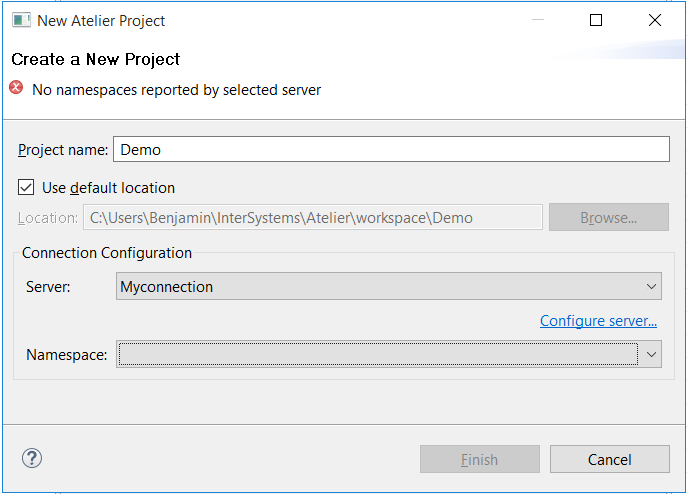
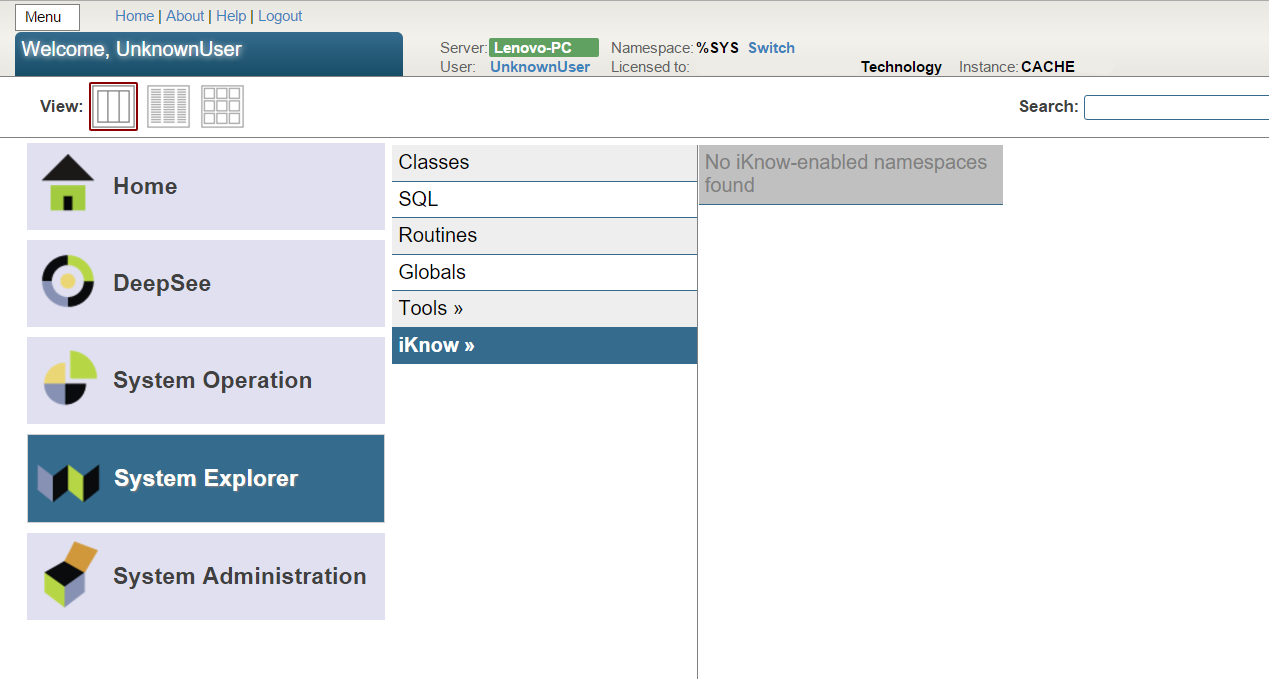
I'm trying to use iKnow but I get the following error "No iKnow-enabled namespaces found" in the Management Portal.
It was working on the 2015.2.2 version but now on 2016.2.0 it doesn't. I very new to Caché and iKnow so it's probably a simple problem.
I was able to create a iKnow domain using the terminal and I can view it in the learning portal (http://localhost:57772/csp/sys/exp/_iKnow.UI.IndexingResults.zen).
What can I do to make it work in Atelier? I've tried authenticating with SYS:SYS and USER:USER but neither seem to have any namespaces.
Very thankful for any help!
There are still so many syntax highlighting errors in Atelier, which still exists from first beta public release.
So another topic that has been of interest to a number of people since the beta was put up last week is in regard to Studio Hooks and Atelier. This requires a bit of background and then some discussion of how the architecture of Atelier necessitates some changes and then what our current thinking on the subject is.
Studio hooks were added to Cache over 10 years ago. They have two primary usages. The first is that on an appropriate action such as creating a new document, or compiling a document a callback is executed whose job is to interact with external source control systems.
I have been meaning to make a post about this topic for a few weeks and the other day an issue came in through the WRC about it so it seems this is a conversation we should be having. I want to begin by taking a few moments to explain "Why Atelier" then we can talk about what this means in the general sense for Studio and Atelier and Caché developers. We have wrestled with what to do with Studio for years. When I moved to Product Management in 2008 this was already a "thing". At the time we could not reach a consensus. Some felt Studio was fine as is.
Atelier needs Java 1.8 to run, but manage diferent versions of Java can be tricky in OSX
Some days ago Alberto has written a very interesting article about the usefulness of ObjectGenerators available in Caché.
In this article, Alberto shows an example RuleEngine based on XData, and how it is possible to improve the process of filling such rules. Caché Studio has a Studio Asist for XData; you may have already seen examples of it if you use ZEN or %Installer.Manifest.
We can use the %XGEN.AbstractDocument class for our task. Unfortunately, InterSystems has marked these classes (all of classes in %XGEN, in fact) as for internal use only.
Caché Monitor is a database\sql tool primarily for InterSystems Caché but can also connect to MS SQL Server, MS Access and more databases. Within Caché Monitors Server Navigator you see all available Namespaces on your Caché Servers. No need to know the name of the Namespace, no need to configure many many JDBC Connections by hand. Just click on the namespace and see all objects like tables, views, classes and more...
There is a beta build available with some new features: A main new feature in this build is called
Hi!
Are there any plans to support Kerberos authentication in Atelier to Caché connection?
Thank you.
Most of projects on Caché, obviously, written not only in Cache ObjectScript, and should contain sources in other languages. Such as js or css for web-projects or any others. And it would be pretty good, if I could see all of files in one project, and possible to edit all of them. How to be in this case ?
And I think it is not a good idea, to place all project's sources in one root folder. Our project contains over 3 thousands classes and routines, and it is too difficult to find anything in such folder. Is not a good for it to use Java-way, and place every package in subfolder ?
Are there any plans to translate Atelier to other languages (e.g. Russian) ?
Hi,
I created with Studio a persistent class with the following field and index:
Property DescriptionDemande As %String(MAXLEN = "");
Index IDXBASDescriptionDemande On (DescriptionDemande) As %iFind.Index.Basic(INDEXOPTION = 1, LANGUAGE = "fr", LOWER = 1);
INDEXOPTION is set to 1 for activating stemming. I'm indexing french documents. I have set lower to 1 because I want to do non case sensitive search.
Announcing Deltanji 6.0, the latest version of the well-respected George James Software source control product formerly known as VC/m.
Deltanji comes in four editions, including Solo which is quick to install on Caché or Ensemble (2009.1 or later), easy to get started with, and perpetually free.
Deltanji runs within the environment whose code it is managing, integrating closely with Studio and Portal, and storing code versions in a CACHE.DAT database.
Please visit http://georgejames.com/deltanji to learn more and download the software.