hi,
I have created a asp web service and it is hosted in our internal server. How can i consume that web service in cache class method? It is a soap web service with xml input and xml output. It works fine in all the browser.
InterSystems Caché is a multi-model DBMS and application server. See more details here.
hi,
I have created a asp web service and it is hosted in our internal server. How can i consume that web service in cache class method? It is a soap web service with xml input and xml output. It works fine in all the browser.
This is the first article in a series discussing how to regain disk space from Caché databases at the operating system level. This introductory article discusses Caché database growth and gives an overview of various methods you can use to return unused disk space that is allocated to database files back to the file system. But before we talk about returning space to the file system, let’s first review how does it get allocated in the first place.
Caché databases always have the name CACHE.
Hi,
I am using the &sql () tag to retrieve the value from the Cache DB.
below is the piece of code i am using:
script language="cache" method="retrieveDetail" arguments="pVariable" returntype="%String" &sql( select columnA, into :tempVariable1 from TABLE where COLUMNC = pVariable
quit tempVariable1
i have to return the ColumnA value back to the calling procedure.
can i know how it can be done ? since i am getting an javascript error.
Beginning in Caché 2013.1, InterSystems introduced Outlier Selectivity to improve query plan selection involving fields with one atypical value.
In this article, I hope to use an example 'Projects' table to demonstrate what Outlier Selectivity is, how it helps SQL performance and a few considerations for writing queries.
First, let's take a quick look at Selectivity. Selectivity is meta information about the values in one column in a table.
I have a following ZEN report:
Class ZENApp.Report Extends %ZEN.Report.reportPage
{
/// Class name of application this report belongs to.
Parameter APPLICATION = "ZENApp.SampleApp";
/// Specifies the default display mode used for this report if
/// the URL parameter, <var>$MODE</var>, is not present.
Parameter DEFAULTMODE As STRING = "xlsx";
/// This XML defines the logical contents of this report.
XData ReportDefinition [ XMLNamespace = "http://www.intersystems.com/zen/report/definition" ]
{
<report xmlns="http://www.intersystems.Hi,
I have a problem which i think has a simple solution but which i and others haven't yet cracked. I want to display text output to a text box in monospaced font. At the moment the style sheet is shown below, I have tried various other options such as specifying a specific font such as Courier New. None of the browsers I have tried (Safari, Firefox on OSX, IE) display as monospace, although the last 2 come close. I wonder whether I need a <pre> tag, but I can't see how to do that in Zen.
Suggestions?
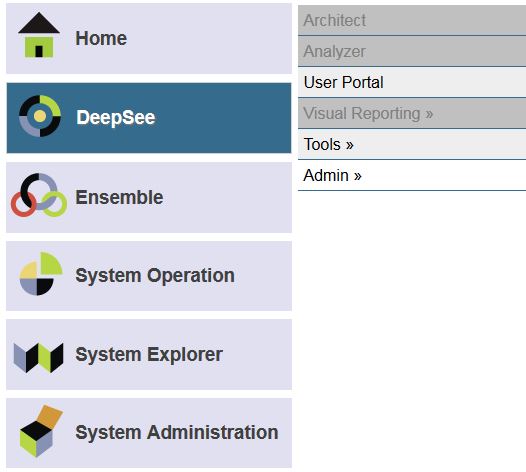
Whether you are accessing DeepSee for the first time ever or you are configuring DeepSee on a new instance, there are two common issues that are encountered after clicking on the “DeepSee” option in the System Management Portal.
Issue #1: Architect/Analyzer is grayed out!
Issue #2: DeepSee must be enabled before use.

There are two common causes for this problem.
The first common cause is that the license does not have these DeepSee options enabled.
Hello!
The question I have today is the next. Suppose I have this simple class describing the REST application:
Hello community!
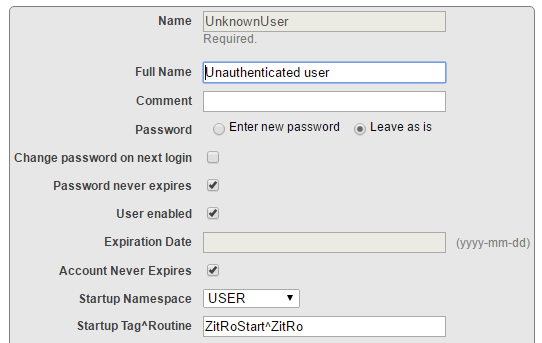
I am trying to set up Startup Tag^Routine field for the UnknownUser as follows:

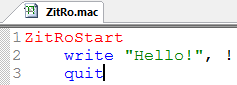
And my simple routine is the next:

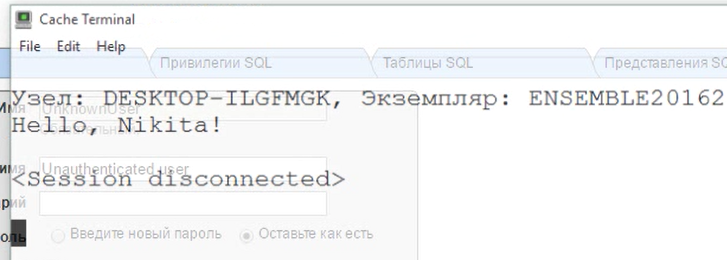
Calling do ZitRoStart^ZitRo in the terminal prints "Hello", but when opening Caché Terminal it results with the next:

And the terminal closes.
// Cache for Windows (x86-64) 2016.2 (Build 636U) Wed Apr 13 2016 20:58:35 EDT
What am I doing wrong in setup?
Thank you very much!
Here's an easy one for you; before I spend another hour looking for the answer, how do you convert %ArrayOfDataTypes to an array (that could, say, fit into the %session.Data array, or maybe just some array named info()), and of course back again?
NS>s aodt=##class(%ArrayOfDataTypes).%New()
NS>w aodt.SetAt("lcavanaugh","username")
1
NS>w aodt.SetAt("organization","coolcompany")
1
NS>w ##class(%ArrayOfDataTypes).BuildValueArray(aodt,.array)
<LIST>zBuildValueArray+1^%Library.ArrayOfDataTypes.1
aodt must be serialzed. What?
NS>zw array
NS>
Hello
I have noticed that Cache (2016.1 at the time of writing) doesn't come with a systemd startup script for RHEL7.
Here is a small example script I have built.
[Unit] Description=Intersystems Cache [Service] Type=forking ExecStart=/bin/bash -c '/usr/cachesys/cstart 2>&1 | logger -t cache_start' ExecStop=/bin/bash -c '/usr/cachesys/cstop quietly 2>&1 | logger -t cache_stop' RemainAfterExit=yes [Install] WantedBy=multi-user.target
The file should be placed as /usr/lib/systemd/system/cache.
Hi All, when I ran the Command to make a folder in particular directory its not working in terminal,but when i run the same command in studio output block it create the folder. Used command: S cmd="mkdir E:\DIRECTORY" O cmd:"QR":10 Suggest Please.
Hi,
Is there any way to track the 'last modified by' cache user name and datetime of last modification for a class or routine definition [Track Last Code Changes]?
Thanks,
Tirthankar
Hi-
I have created a class that extends %Persistent and %Populate and have set the various POPSPEC attributes of my properties to control how the properties are populated. However, when I compile the class and try to run the Populate() method it tells me the method isnt defined.
Here is the class definition:
Class My.
InterSystems is pleased to announce that Caché and Ensemble 2016.2.1 are now available as maintenance releases.
For a complete list of the corrections in 2016.2.1, please review the release notes.
Caché and Ensemble 2016.2.1 are available for the same platforms as 2016.2.0. The complete set of supported platforms, including specific point releases and patches, is detailed in the Supported Platforms document.
The HealthShare team will announce availability of its products separately.
The build corresponding to this release is 2016.2.1.803.0
I try to run the cmd command in the studio terminal, but i am getting the <NOTOPEN> Error.
Even ZF(-1) also not working. Any help, Please!!!
Note: i restart the Cache instance service with full privilege
Code:
Set Path="mkdir E:\Sample\New"
Open Path:"QR":10
Error:<NOTOPEN>
This command working on my PC, but on server throws error.
Many Thanks
Hello,
I'm sending http request through %Net.HttpRequest and I have html page in response. Is there any built-in tool for beautify html for printing in terminal?
Thanks.
Can somebody explain this behaviour of Cache (and many other calculating machine as well) :
WRITE 1/3*12
4
WRITE 1/3*5
1.666666666666666667
W 1/3*18
5.999999999999999999
W 1/3*21
6.999999999999999999
W 1/3*24
7.999999999999999999
How can we make more occurate caculations in Cache ?
Hi All,
How to create a .xlsx or .xls (Activate.Excel ) file using cache.
Thanks, Sansa.S
There is an interesting discussion in the Russian forum going.
What is the best solution for the function which returns the max for the set of parameters?
From the listed solutions I like this one:
ClassMethod max(args...) {
for i=1:1:args { s max(+$g(args(i))) = i }
s i="", max=$o(max(i),-1, i) Q $lb(max, i)
}A group of students at the Chalmers University of Technology (Gothenburg, Sweden) tried different approaches to automatically rating the quality of emergency calls, including iKnow.
Excerpt: "The most impressive results produced by iKnow is its ability to correctly classify 100% of the calls using the Average algorithm. This is quite surprising since iKnow only compares low-level concepts, how words relates to each other."
Full story: http://publications.lib.chalmers.se/records/fulltext/244534/244534.pdf
Hi,
I'm working on a project that integrates the Subversion source control tool with Intersystems Cache Studio. I realize that Atelier has come out with 2016.2 developer edition which has built-in support for source-control, but it needs Cache version 2016.2. We don't work on that as yet. My question is simple. I've built a menu, interfaced with Subversion, validated my globals, and built a fully functioning source control system. However, I need to authenticate the user before every commit to the master repository.
Hello Everyone.
Sorry if it is a dumb question, but I'm new.
First: I have to create a Excel MultipleSheet Report. That I'm fine with doing.. but they want me to give every Workbook that is created it's unique reportName, that is generated with the user input on the page. Is it possible to do so?
Second: I saw when creating the report. Everything is placed in it's own column. Is it possible to have some of the values next to each other and some Beneath each other.
I am using OAuth2 Cache framework, acting as a client to an authorization server. My setup is based on this excellent previous post [Caché Open Authorization Framework (OAuth 2.0) implementation – part 1].
I'm facing ‘Authorization Server Error: Error Processing Response - No match between server name 'googleapis.com' and SSL certificate values google.com…’
It looks like I should set SSLCheckServerIdentity to false but I can’t figure out how. Has anyone had the same issue?
Hey guys
We have a need to mount remote databases using ECP, but with the Application servers mounting some of the remote databases as Read Only. The Data servers will keep them R+W as normal.
From what I can gather this isn't possible using a "Mount Read Only" option, it looks like ECP just inherits the Database servers settings. My reading seems to require roles/access/permissions to enforce Read Only on these remote mounts. Does anyone have an easy guide/cheat sheet to set up read only ECP Application server read-only mounting using roles/permissions?
Has anyone ever used the LogoutAll method in the %CSP.Session class successfully? I'm wondering what I need to do to use it.
Thanks,
Laura
This post is meant to provide a quick possible explanation for a very perplexing problem.
Scenario: You’ve just created your own administrative user in your 2014.1 (or later) instance of Caché. You gave it every possible security role (including %All), so it should in theory be able to do anything within the instance.
You’ve written a very advanced routine with a break command in it for debugging:
MyTestRoutine
set ^MyInitGlobal = 1
write "Hello, my name is.
How can we make sure that the Cache userid passwords are encrypted on storage? We want to make sure that the Cache passwords cannot be decrypted - how can we ensure that?

The topic of reflection hasn't been raised in Caché forums or blogs too often. Perhaps, it happened because the notion of reflection is not explicitly defined in Caché. However, it exists in Caché and can be a very useful development tool.