Hey Developers!
We're pleased to invite you all to the next competition of creating open-source solutions using InterSystems IRIS! Please join:
🏆 InterSystems Analytics Contest 🏆
Duration: December 7 - 27, 2020
Big data is a field that treats ways to analyze, systematically extract information from. Big data challenges include capturing data, data storage, data analysis, search, sharing, transfer, visualization, querying, updating, information privacy and data source.
Hey Developers!
We're pleased to invite you all to the next competition of creating open-source solutions using InterSystems IRIS! Please join:
🏆 InterSystems Analytics Contest 🏆
Duration: December 7 - 27, 2020
Hi Community!
We are pleased to invite all the developers to the upcoming InterSystems Analytics Contest Kick-off Webinar! The topic of this webinar is dedicated to the Analytics contest.
On this webinar, we’ll demo the iris-analytics-template and answer the questions on how to develop, build, and deploy Analytics applications using InterSystems IRIS.
Date & Time: Monday, December 7 — 12:00 PM EDT
Speakers:
🗣 @Carmen Logue, InterSystems Product Manager - Analytics and AI
🗣 @Evgeny Shvarov, InterSystems Developer Ecosystem Manager
As we all well know, InterSystems IRIS has an extensive range of tools for improving the scalability of application systems. In particular, much has been done to facilitate the parallel processing of data, including the use of parallelism in SQL query processing and the most attention-grabbing feature of IRIS: sharding. However, many mature developments that started back in Caché and have been carried over into IRIS actively use the multi-model features of this DBMS, which are understood as allowing the coexistence of different data models within a single database. For example, the HIS qMS database contains both semantic relational (electronic medical records) as well as traditional relational (interaction with PACS) and hierarchical data models (laboratory data and integration with other systems). Most of the listed models are implemented using SP.ARM's qWORD tool (a mini-DBMS that is based on direct access to globals). Therefore, unfortunately, it is not possible to use the new capabilities of parallel query processing for scaling, since these queries do not use IRIS SQL access.
Meanwhile, as the size of the database grows, most of the problems inherent to large relational databases become right for non-relational ones. So, this is a major reason why we are interested in parallel data processing as one of the tools that can be used for scaling.
In this article, I would like to discuss those aspects of parallel data processing that I have been dealing with over the years when solving tasks that are rarely mentioned in discussions of Big Data. I am going to be focusing on the technological transformation of databases, or, rather, technologies for transforming databases.
Hi Community!
Enjoy watching the new video on InterSystems Developers YouTube:
⏯ Big Data in InterSystems IRIS
Hi everyone.
We are a team of company "Constructor" and we develop cutting edge cartographic systems. Recently the amount of image data skyrocketed so we want to give our users the ability to tie images to places automatically. For that, we want to use AI/ML technologies and we have a cool task for you.
https://cloud.mail.ru/public/pHbC/4r7Z58m6f/
There are three collections of datasets and in each you have:
Image from the original camera with no position information and set of images made from different points of view near this original camera with position information (list_files_info.
Hi Community,
The new video from Global Summit 2019 is already on InterSystems Developers YouTube:
⏯ Automated InterSystems IRIS Cloud Scaling
Hi all. Yesterday I tried to connect Apache Spark, Apache Zeppelin, and InterSystems IRIS. During the process, I experienced troubles connecting it all together and I did not find a useful guide. So, I decided to write my own.
What is Apache Spark and Apache Zeppelin and find out how it works together. Apache Spark is an open-source cluster-computing framework. It provides an interface for programming entire clusters with implicit data parallelism and fault tolerance. So, it is very useful when you need to work with Big Data.
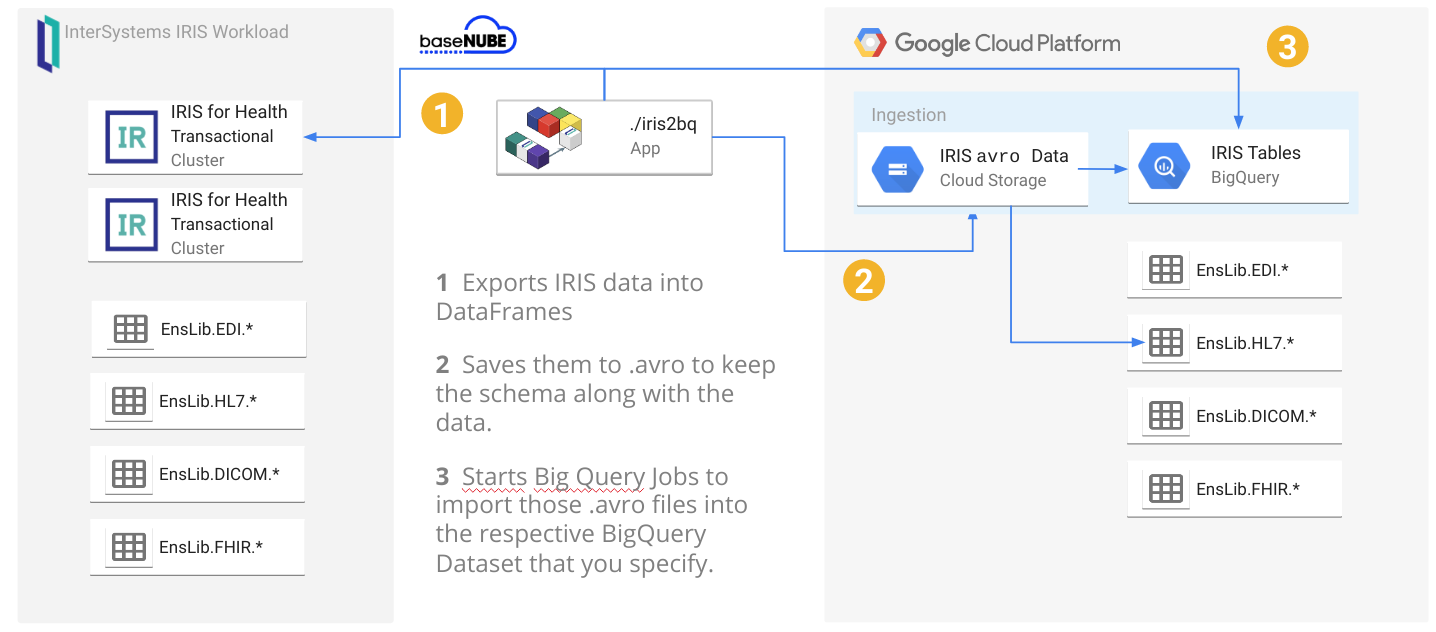
Loading your IRIS Data to your Google Cloud Big Query Data Warehouse and keeping it current can be a hassle with bulky Commercial Third Party Off The Shelf ETL platforms, but made dead simple using the iris2bq utility.
Let's say IRIS is contributing to workload for a Hospital system, routing DICOM images, ingesting HL7 messages, posting FHIR resources, or pushing CCDA's to next provider in a transition of care. Natively, IRIS persists these objects in various stages of the pipeline via the nature of the business processes and anything you included along the way. Lets send that up to Google Big Query to augment and compliment the rest of our Data Warehouse data and ETL (Extract Transform Load) or ELT (Extract Load Transform) to our hearts desire.
A reference architecture diagram may be worth a thousand words, but 3 bullet points may work out a little bit better:
.avro to keep the schema along the data: this will avoid to specify/create the BigQuery table schema beforehands..avro into the respective BigQuery tables you specify.
InterSystems and Intel recently conducted a series of benchmarks combining InterSystems IRIS with 2nd Generation Intel® Xeon® Scalable Processors, also known as “Cascade Lake”, and Intel® Optane™ DC Persistent Memory (DCPMM). The goals of these benchmarks are to demonstrate the performance and scalability capabilities of InterSystems IRIS with Intel’s latest server technologies in various workload settings and server configurations. Along with various benchmark results, three different use-cases of Intel DCPMM with InterSystems IRIS are provided in this report.
Greetings community. I would like to know how to migrate a BD in production to a local environment. When I have a system in production (BD Sql Server) what we do is mount a local copy to do the analysis with the data and not occupy resources of the system in production. My question is: How do you do it with Intersystems technology? I already tested the PowerBi connector and it looks great, but that's where the question came up.
Hi all. Today we are going to upload a ML model into IRIS Manager and test it.
Note: I have done the following on Ubuntu 18.04, Apache Zeppelin 0.8.0, Python 3.6.5.
These days many available different tools for Data Mining enable you to develop predictive models and analyze the data you have with unprecedented ease. InterSystems IRIS Data Platform provide a stable foundation for your big data and fast data applications, providing interoperability with modern DataMining tools.
In this series of articles we explore Data mining capabilities available with InterSystems IRIS.
We have been storing raw messages in a MySQL database for DR and ad hoc purposes. We are thinking of using an Ensemble instance as our data lake instead. We could segregate the source data by namespace or by global. But either way we'll want a custom global to index the data for data retrieval performance purposes.
Anyone else taking this approach? Any feedback?
With the release of InterSystems IRIS, we're also making available a nifty bit of software that allows you to get the best out of your InterSystems IRIS cluster when working with Apache Spark for data processing, machine learning and other data-heavy fun. Let's take a closer look at how we're making your life as a Data Scientist easier, as you're probably already facing tough big data challenges already, just from the influx of job offers in your inbox!
Apache Spark has rapidly become one of the most exciting technologies for big data analytics and machine learning. Spark is a general data processing engine created for use in clustered computing environments. Its heart is the Resilient Distributed Dataset (RDD) which represents a distributed, fault tolerant, collection of data that can be operated on in parallel across the nodes of a cluster. Spark is implemented using a combination of Java and Scala and so comes as a library that can run on any JVM.
This is the first article of a series diving into visualization tools and analysis of time series data. Obviously we are most interested in looking at performance related data we can gather from the Caché family of products. However, as we'll see down the road, we are absolutely not limited to that. For now we are exploring python and the libraries/tools available within that ecosystem.
The series is closely tying into Murray's excellent series about Caché performance and monitoring (see here) and more specifically this article.