2 Followers · 96 Posts

Amazon Web Services (AWS) is a secure cloud services platform, offering compute power, database storage, content delivery and other functionality to help businesses scale and grow.
Learn more.

Article Mark Bolinsky · Feb 12, 2019 32m read

The Amazon Web Services (AWS) Cloud provides a broad set of infrastructure services, such as compute resources, storage options, and networking that are delivered as a utility: on-demand, available in seconds, with pay-as-you-go pricing. New services can be provisioned quickly, without upfront capital expense. This allows enterprises, start-ups, small and medium-sized businesses, and customers in the public sector to access the building blocks they need to respond quickly to changing business requirements.

Updated: 10-Jan, 2023 

3
12 7114
Article Kate Lau · Mar 15, 2023 2m read

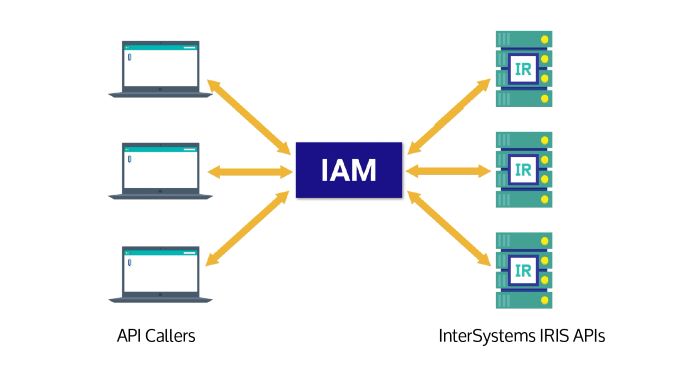
In this article, I am trying to walk through my deploying step of IAM on my EC2(ubuntu).

What is IAM?

IAM is InterSystems API Manager
you may reference to the link below to get more idea about IAM

https://docs.intersystems.com/components/csp/docbook/Doc.View.cls?KEY=PAGE_apimgr

Before deploying IAM

Check the license of your API host


Enable the User IAM

Deploy IAM

Reference 

https://community.intersystems.com/post/introducing-intersystems-api-manager

Download the image from the following link

https://wrc.intersystems.com/wrc/coDistGen.csp

I downloaded the followin

2
0 520
Article Murray Oldfield · Nov 10, 2022 7m read

Overview

Predictable storage IO performance with low latency is vital to provide scalability and reliability for your applications. This set of benchmarks is to inform users of IRIS considering deploying applications in AWS about EBS gp3 volume performance.

Summary

  • An LVM stripe can increase IOPS and throughput beyond single EBS volume performance limits.
  • An LVM stripe lowers read latency.
1
0 2707
Announcement Anastasia Dyubaylo · Aug 4, 2022

Hey Community,

We're excited to announce that Community webinars are back!

Let us invite you all to @sween's webinar on Scaling InterSystems FHIR Server on Amazon Web Services with ECP.

Join this webinar to make a technical deep dive, see a demonstration, and benchmark horizontal scaling InterSystems FHIR Server on Amazon Web Services with Enterprise Cache Protocol (ECP).

Date & Time: Thursday, August 18, 8 AM ET | 2:00 PM CEST
👨‍🏫 Speaker: @sween, Full Stack Architect at Integration Required

8
0 842
Article Michael Braam · Aug 17, 2022 12m read

Being interoperable is more and more important nowadays. InterSystems IRIS 2022.1 comes with a new messaging API to communicate with event streaming platforms like Kafka, AWS SQS/SNS, JMS and RabbitMQ.
This article shows how you can connect to Kafka and AWS SQS easily.
We start with a brief discussion of the basic concepts and terms of event streaming platforms. 

Event streaming platforms purpose and common terms

Event streaming platforms like Kafka or AWS SQS are capable to consume a unbound stream of events in a very high frequency and can react to events. Consumers read the data from stream


0
1 637
Question Diego Petey · May 27, 2022

Hi everyone, I'll be honest with you I don't have much idea how to do this, but I was asked to install IRIS for Health on an AWS ubuntu machine(ssh -i "teleker-net.pem" ubuntu@xx.xxx.xx.xxx(no I will put the real number)). My boss has sent me the .key and .pem files that I am supposed to need for the installation.

I am quite confused with the information that I have found to connect to AWS because it is not that I want to do it from any new, but that I need to connect to a machine that already exists, but I do not think so. I do not know if I explain myself very well. Any help is greatly appr

3
0 443
Question Chip Gore · Sep 22, 2020

Hi -

I'm trying to get my VS Code instance that is connected to an AWS IRIS instance to edit/save/compile .csp files, but it's failing to work and I'm not sure why. The ".csp" is associated with the objectscript-csp code, and the server is connected, but things just don't act like they are enabled.

Should this work? and if so, what might I have missed in configuring things?

5
0 1035
Question Abbad Minhas · Feb 3, 2022

We have a requirement to write to an AWS S3 bucket from Cache.

We haven't upgrade to IRIS yet, but are looking at doing so in the future. This requirement cannot wait for the upgrade to happen, unfortunately.

Will appreciate if any one can share any example code, that enables cache to write to an AWS S3 bucket? 

8
1 932
Question Sivasubramani Nagendran · Sep 1, 2021

Hello,
        
        We are using AWS SSO authentication in our application to validate the users. For validating the users, we are passing the username and password from AWS SSO to our application. We need to validate the user in our application without using the password.

         We developed the login class using zenPage. We used <loginForm> tag in the login page which is used for the automatic validation.
         Is there any possible way to achieve this?
         

Thanks in advance.

1
0 342
Question Tim Stowe · Aug 20, 2021

So I've got the IRIS AMI spun up in AWS EC2; it seems to be running fine.  
I've added an EBS volume to it for persistent storage, and now I'm pondering how to make it actually do something useful.  

What's the best way to do deploy code to this instance?  I can think of a few ways to do it, but what's the least painful way?  Push my code to an S3 bucket and figure out how to load it at system start?  Github project?  

2
0 308
Article Oliver Wilms · Aug 22, 2021 2m read

I have described my efforts to optimize IRIS Mirror deployment in AWS ElasticContainer Service (ECS) in my prior article.

IRIS Mirror in the cloud (AWS) | InterSystems Developer Community | AWS
 

I have come to the opinion that IRIS Mirror is not as reliable as needed when deployed in ECS. The root of the problem is the fact that ECS randomly assigns one of the available IP addresses to each EC2 host or Fargate task it starts.

These get stored in iris.cpf file in MapMirrors section as shown here:

[MapMirrors.IRISMIRROR]

FAILOVER1=10.2ab.1cd.146,2188,,10.2ab.1cd.146,588E6700-DAB7-11EB-9

0
0 471
Article Oliver Wilms · Aug 4, 2021 3m read

I have been working on redesigning a Health Connect production which runs on a mirrored instance of Healthshare 2019. We were told to take advantage of containers. We got to work on IRIS 2020.1 and split the database part from the Interoperability part. We had the IRIS mirror running on EC2 instances and used containers to run IRIS interoperability application. Eventually we decided to run the data tier in containers as well. Later we switched from using EC2 instances to Fargate “server-less” compute. A challenge was that each time AWS Elastic Container Service started a new container, it assi

14
2 1003
Article Oliver Wilms · Jul 27, 2021 2m read

I heard about Message Bank when we started redesigning a Health Connect production to run in containers in the cloud. Since there will be multiple IRIS containers, we were directed to utilize Message Bank as one place to view messages and logs from all containers.

How does Message Bank work?

I added Message Bank operation to our Interoperability Production. It automatically sends messages and event logs to the Message Bank.

Resending Messages

The Message Bank provides an interface for portal user to resend messages from the Message Bank portal. I thought it would be even better

1
0 557
Announcement Ben Spead · Jul 7, 2021

Hello Developers!

Have you ever had to convert HL7v2 messages to FHIR (Fast Healthcare Interoperability Resources) and found the process complicated and confusing? InterSystems is rolling out a new cloud based SaaS offering called InterSystems FHIR Transformation Service, which makes the process easy.  We are excited to announce an Early Access Preview Program for our new offering, and we would love to have you kick the tires and let us know what you think!  All you need is a free AWS account, with an S3 bucket to drop in your HL7v2 messages, and another S3 bucket to get your FHIR output. 

5
0 946
Announcement Anastasia Dyubaylo · May 31, 2021

Hey Developers,

We decided to extend the registration period for the InterSystems FHIR Accelerator Programming Contest and voting will start only on Thursday, June 3! The voting period will last until Sunday, June 6.

So, don't forget to support the best solutions built using the InterSystems IRIS FHIR Accelerator Service (FHIRaaS) on AWS.

➡️ Vote here from June 3rd to June 6th!

How to vote and what's new?

3
0 376
Announcement Anastasia Dyubaylo · May 4, 2021

Hey Community,

Please join the next InterSystems online programming competition:

🏆 InterSystems FHIR Accelerator Programming Contest 🏆

Submit an application that uses InterSystems FHIR-as-a-service on AWS or helps to develop solutions using InterSystems IRIS FHIR Accelerator.

Duration: May 10 - June 06, 2021

Total prize: $8,750 

👉  Landing page 👈


15
1 2899
Article Anton Umnikov · May 31, 2021 6m read

All source code to the article is available at: https://github.com/antonum/ha-iris-k8s 

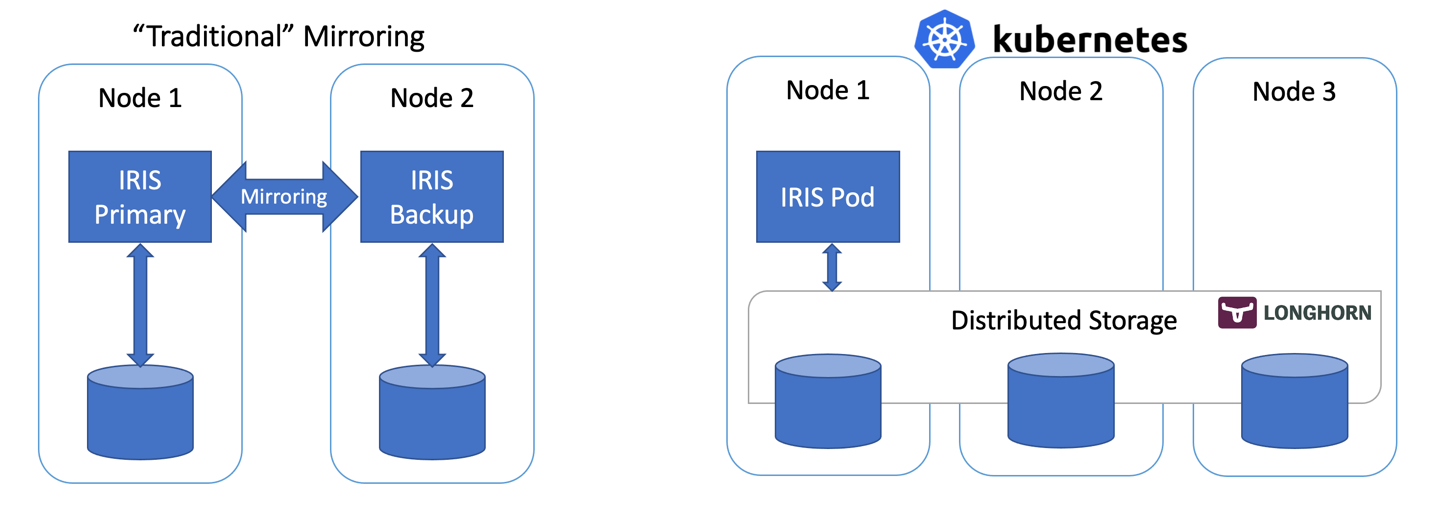
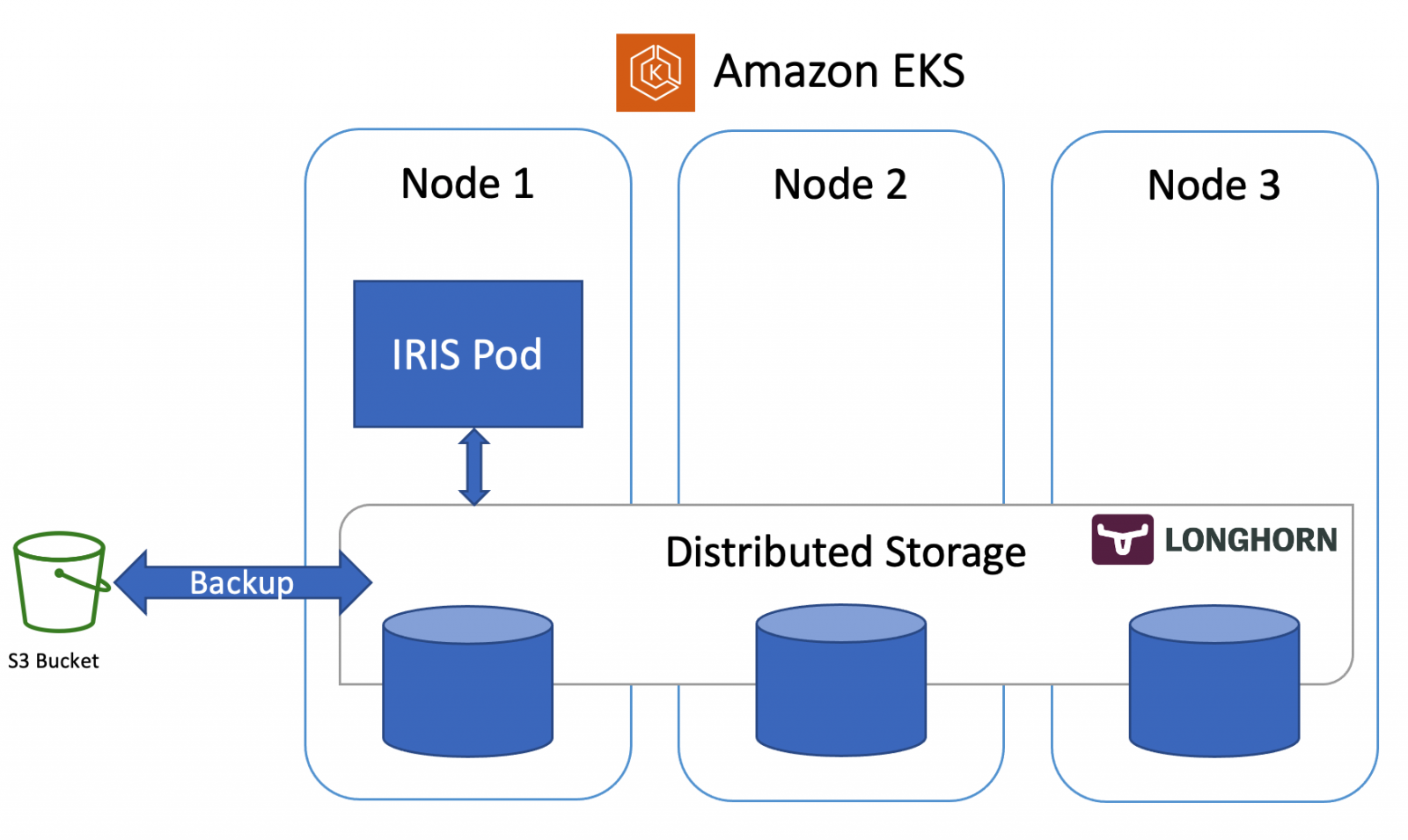
In the previous article, we discussed how to set up IRIS on k8s cluster with high availability, based on the distributed storage, instead of traditional mirroring. As an example, that article used the Azure AKS cluster. In this one, we'll continue to explore highly available configurations on k8s. This time, based on Amazon EKS (AWS managed Kubernetes service) and would include an option for doing database backup and restore, based on Kubernetes Snapshot.

Installation

Let's get right to business. Fir


2
0 1571
Article Evgeny Shvarov · May 28, 2021 1m read

Hi colleagues!

Often when we collaborate to someone's repo in GitHub we do the following cycle:

Fork-Clone-Change-Commit-Push-Pull-Request-Merge to the original repo.

This is all great and works fine!

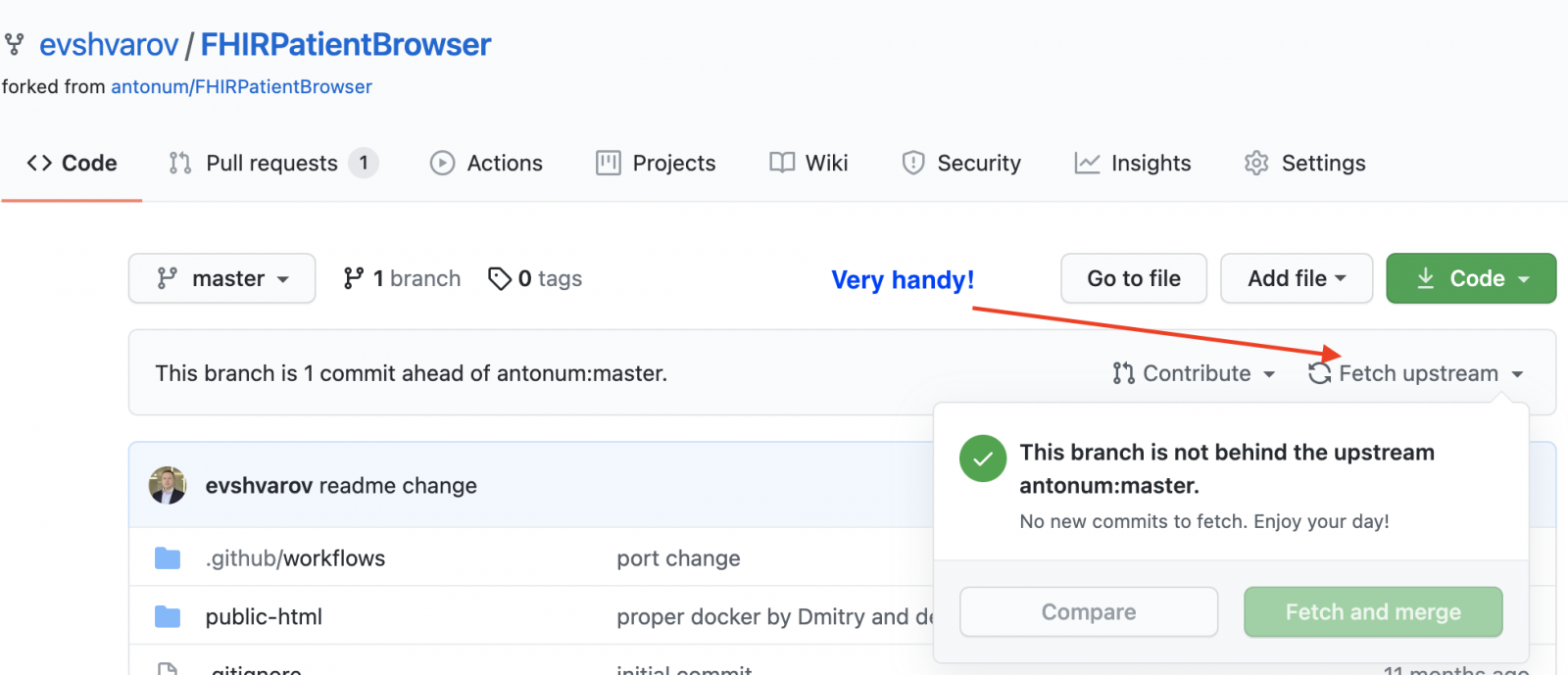
And if we want to make a second collaboration right after the merge you need to perform "Fetch upstream" to your forked repo first to "ingest" your own Pull-request in the original repo.

Geeky git-professionals do it with ease but this was always a headache for me so I usually simply deleted the fork and created a new one.

And today I figured that Github added a new UI feature that I can easily fetch-upstream for my fork with the original one and make it up to date and capable for pull-requests.

Here is where the button is:

This is a relief! )

Wanted to share this relief and productivity tip with you!

Bring more collaborations to Github repos!

And speaking of PR - I just made a PR with docker to Google Cloud Run deployment for the FHIRaaS demo made by @Anton Umnikov for the current FHIR Contest! Looking for more of your contributions!

0
3 562
Announcement Anastasia Dyubaylo · May 7, 2021

Hey developers,

The registration period for the FHIR Accelerator programming contest is in full swing! We invite all FHIR developers to build new or test existing applications using the InterSystems IRIS FHIR Accelerator Service (FHIRaaS) on AWS

And now you have a great opportunity to get FREE access to the FHIRaaS on AWS! So, to take the first step in mastering the FHIRaaS, you need to register on our FHIR Portal using this link:

👉🏼 https://portal.trial.isccloud.io/account/signup

2
0 798
Article Bob Binstock · Apr 26, 2021 9m read

Like hardware hosts, virtual hosts in public and private clouds can develop resource bottlenecks as workloads increase. If you are using and managing InterSystems IRIS instances deployed in public or private clouds, you may have encountered a situation in which addressing performance or other issues requires increasing the capacity of an instance's host (that is, vertically scaling).

One common reason to scale is insufficient memory. As described in Memory Management and Scaling for InterSystems IRIS in the Scalability Guide, providing enough memory for all of the entities running on the host

1
0 547