With the release of InterSystems IRIS, we're also making available a nifty bit of software that allows you to get the best out of your InterSystems IRIS cluster when working with Apache Spark for data processing, machine learning and other data-heavy fun. Let's take a closer look at how we're making your life as a Data Scientist easier, as you're probably already facing tough big data challenges already, just from the influx of job offers in your inbox!
Hello, I'm trying to install CSP Gateway on Ubuntu 18.04 (Apache) with the installer CSPGateway-2018.1.1.638.0-lnxubuntux64.tar.gz but it doesn't seem to work. I keep getting access-denied when I try to open CSP-pages or the CSP Management portal.
Does someone have an installation-manual or so ?
we are receiving the MDM document from one Data Source , we need to convert the MDM to ORU to send to the receiving Data Source. Does HS components could make this conversion or we need to use Ensemble mapping to convert the MDM to ORU message?
Thanks,
I have a batch that uses the record mapper class .I would like to have a custom operation that will write this batch to a csv file .My operation has a batch as its request and I would like to read that batch data to a csv.So far here is what I have.
Method BatchFile(pRequest As ResponseRBAT, Output pResponse As EnsLib.RecordMap.BatchResponse) As %Status
{
 #dim status as %Status=$$$OK
 #dim inrec as HSCIC.DBS.ResponseRMAP.Record=##class(ResponseRMAP.Record).%New()
 set x=0
    set:$$$ISOK(status) status=  ..Adapter.PutLine(pRequest.%Source,pRequest.BatchHeader)
    //set pRequest.Records.Count()
    while (x<pRequest.Records.Count())
    {
     set inrec.ResponseCode=pRequest.Records.GetAt(1)
     set inrec.PatientID =pRequest.Records.GetAt(2)
      set inrec.MultiMatch =pRequest.Records.GetAt(3)

   set:$$$ISOK(status) status=  ..Adapter.PutLine(pRequest.%Source,inrec)
   set x=$INCREMENT(x)
 }


   set:$$$ISOK(status) status=  ..Adapter.PutLine(pRequest.%Source,pRequest.BatchTrailer)
 $$$TRACE($System.Status.GetErrorText(status))
 return status
} So far, dozens of people have started the InterSystems IRIS Experience – we want to hear from you! How are you enjoying the Experience so far? Do you have any suggestions for future challenges or datasets you’d like to see? This is a space for you to interact with both InterSystems staff and your peers about the InterSystems IRIS Experience, so let us know what you think!
Hi all,
Do you know if there is a way to create a Lock that is related to an existing transaction, in the sense that if transaction is finished (commit or rollback) Lock is removed. I ask this because in the following example Lock is there until process is killed.
Example :
TSTART
Lock +^MyLock
TROLLBACK
I know, that, Caché itself is locking internally a table register when doing an OpenId with exclusive flag during the transaction life. For example :
TSTART
Do ##class(MyTable).%OpenId(<TableID>, 4) (This internally is creating a Lock +^User.
InterSystems is pleased to announce that InterSystems IRIS Data Platform 2018.1.0 is now released.
This press release was issued this morning.
InterSystems IRIS is a complete, unified data platform that makes it faster and easier to build real-time, data-rich applications. It mirrors our design philosophy that software should be interoperable, reliable, intuitive, and scalable.
For information about InterSystems IRIS, please visit our website here
Two fairly common requests we receive from HL7 customers are (1) how to remove all trailing delimiters for fields and segments in HL7 messages and (2) how to "find and replace" for an entire HL7 message (as opposed to one segment/field at a time). The code sample below shows a custom function that solves for item 1 and by extension item 2 above. In other words the same approach can be used for finding/replacing any sequence of chars in an entire HL7 message, with some tweaks to the custom function.
Here’s an example of how to actually call the function from DTL.
Has anyone done any kind of integration with Dynatrace, which is a JVM transaction monitoring tool? Our organization uses this extensively with our Java and .Net applications and we wanted to know if it is even possible.
Hi ,
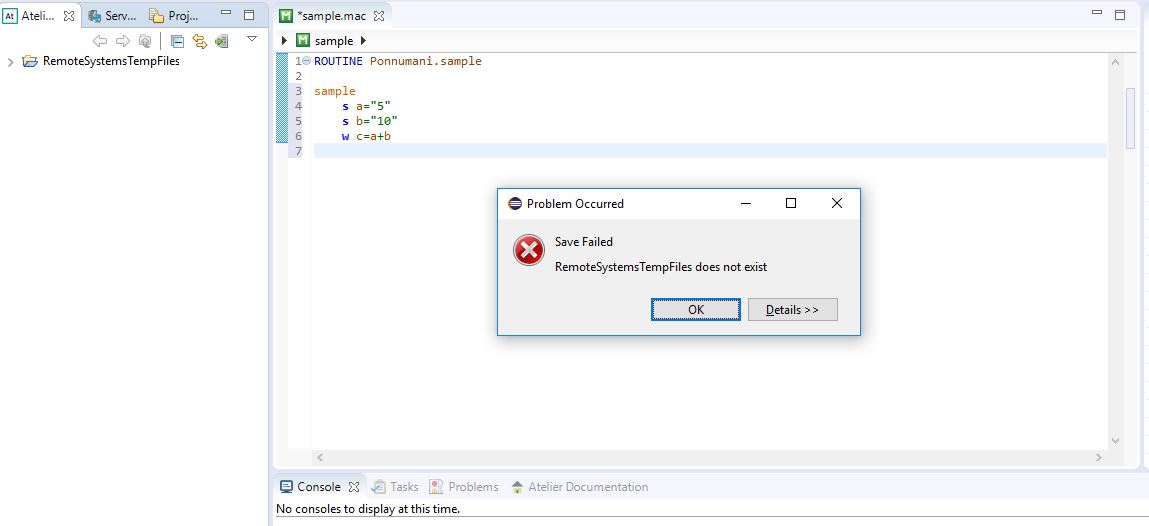
I installed "Atelier" plugin and write sample routine. But I am unable to save it and run it .Please guide me how do I solve this issue.
Hello,
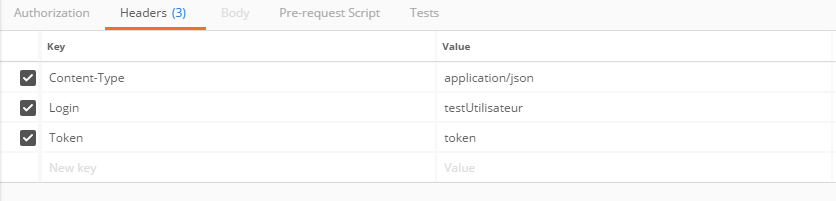
In all web services, i need to my get login and token. So with Postman, i tried to call a HTTP request where I put the login/token in the header :
I tried to get data from Http request header. The REST APi use %CSP.REST. I tried something like that :
But it didn't work..
Someone can give me some example or other method ?
Regards,
Hi Community!
Check the new video on DC YouTube Channel:
SMART on FHIR Apps for Information Exchange
I have a SQL procedure that I call into and it does some processing and passes back any data validations that fail. I would like to receive those message in my operation and act upon the message received .The question is how do you get output messages from a stored procedure I am using MsSQL 2012 with ensemble
In this series of articles, I'd like to present and discuss several possible approaches toward software development with InterSystems technologies and GitLab.
Would anyone recommend techniques on how to limit the amount of calls that external groups are making to our resources?
Recently we had an issue where one of our ODBC accounts maxed out the license to one of our DB servers (50 max).
I have been tasked with creating a class that will handle error logging in a consistent manor for an application I am working on. The need is to have all variables in the calling method logged along with some other information.
The example given was zwrite which is exactly what I need, however, I somehow need to capture the output of ZW and put it into a database table. Any easy way to capture this data? I was able to dump ZW to a file, but that is not ideal.
Any help is appreciated!
Hello Global masters!
I developed Web with Spring framework (JAVA, Jdbc Cache) and I wrote SQL when I made it.
And Window program with VB6, Cache Object and VisM.
Is there a significant performance gap? SQL and Cache Object?
same function, same computer performance just different Java and VB6.
Thank you.
Minsu.
Hello Global masters.
I am junior developer about Intersystems cache in South Korea.
I want to develop process management program on server.
My code :
TESTPID(IP) ;
#include %syPidtab
Set Rset = ##class(%ResultSet).%New("%SYS.ProcessQuery:ListPids")
d Rset.Execute()
&sql(SELECT ClientIPAddress, Pid INTO :ClientIPAddress, :Pid
FROM %SYS.ProcessQuery
WHERE ClientIPAddress = :IP)
While Rset.Next()
{
i SQLCODE'=0 w !,"SQL Error "_SQLCODE continue ; 100 means process does not exist (halted)
I Rset.GetData(1) = Pid D
. w !,Rset.GetData(1)," ",ClientIPAddress," ",Pid
//Set rs=$SYSTEM.Process.Terminate(Pid)
//If rs'=1 {
// Write "Terminate Fialure "_" Pid "_Pid,!
//}
//Else {
// W "Sucess",!
// }
// }
}
d Rset.Close()
QHi,
I wonder if you could help me with a problem with persistent globals and journals.
We have a few interfaces using a persistent global just to translate some codes. The use of that global is like a lookup table.an interface calls a method that search for a field (in the message) in the global.
Too often users finding themselves in need of a software solution do not consider “open source” vs. “proprietary” alternative. Most of them either have their go-to favorite developer or just google for reviews and ready-made answers. However, this alternative must be the starting point of their search, as the decision has the most consequences.
It is not an overstatement to say that open source is the future of technology, albeit, it has its own unique challenges. Here is what users, especially corporate users should consider choosing the software for their business needs.
I just tried doing this with my Mars.1 instance of Eclipse, using https://atelier.artifactoryonline.com/atelier/atelier-beta-1.0/ as the repository to search. It offered me Atelier, but then here's what happened:

Did I do something wrong, or isn't this yet ready?
InterSystems is pleased to announce the availability of these maintenance releases
·Caché and Ensemble 2017.1.3
·HealthShare Health Connect v15.03 for 2017.1.3
For Caché and Ensemble
·Oracle Solaris 10, 11 for SPARC-64 and Oracle Solaris 10, 11 for x86-64 platforms are now approved for release. They were not available for earlier 2017.1 releases.
·The full list of corrections can be found in the release notes
·The version number of the kits is 2017.1.3.317.0
HealthShare Health Connect v15.03 on core technology 2017.1.3.317.
I have a batch and would like to see the records in it on a terminal
First will use .%OpenId(Id) then will want to get the first record something around GetAT(1) with this I get the object reference but will actual need to see the data any help
Hi,
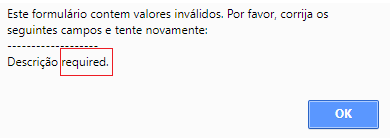
someone knows how to change the "required" to portuguese.
it's a property(Required) on persistence.
i want to change from "required" to "obrigatório"
I have package mapped SYS.History but two classes in the package are giving me problems.
SYS.History.SysData and SYS.History.PerfData has an Include ( Include (%sySite, MONEXT))
When I try to open the corresponding table in SQL I get the following error
ERROR #5540: SQLCODE: 400 Message: Process 213004 failed to compile Cached Query Class %sqlcq.BAM.cls26 with these errors: ERROR #5475: Error compiling routine: %sqlcq.BAM.cls26. Errors: ERROR: %sqlcq.BAM.cls26.
I need to redirect user to a url, which is 5000+ characters long.
To do that I set:
set %response.Redirect = url
However, in the browser I receive this header:
LOCATION: <First 3972 characters of the 'url' variable>
In WriteHTTPHeader method of %CSP.Response, where the LOCATION header is
written:
After I added a buffer flush, after the above-mentioned line:
Then in browser I received full, correct value of a LOCATION header.
Is there a better solution?
It's a rest API, so maybe there's some callback method I can override to flush the output buffer? Set device mode? Change buffer size?
My new question regards connecting to the external database to insert the data. I have the following code:
#include %occInclude// winsurge6// insert winsurge data into cancer registry database
Compiling routine : winsurge6.MAC
ERROR:winsurge6.MAC(30) : SQLCODE=-30 : Table 'WINSURGE_RESULT_FACT' not found within schemas: CANREG,SQLUSER
Detected 1 errors during compilation in 0.026s.
I'm not sure what this error indicates. I've tried a few different things regarding the #SQLCompile Path=canreg and the
&sql(WINSURGE_RESULT_FACT
Hi,
I have a client who is considering encryption options in order to comply with a tendering requirement.
Were they to encrypt the production database then what would be a reasonable expectation forthe impact on message throughput. Or possibly more easily answered: what would be the expected impact be on I/O rate and CPU utilization. Are there any benchmarks to which could support an estimate ?
How would this compare with plan B: to use disk encryption ?
Thanks
Hi, Community!
I have a problem with a table while move it from Cache to SQL Server by SSIS tool, the table was moved but there is an issue in one of the feild, it's bring only the first 2 digit and truncate the other. The datatype for this feild in the Cache is VARCHAR and the same thing in the SQL, I tried multiple datatype (char, number, intger, text.etc) and multiple tool to bring the table again (ESF, SQL Server 2014 Import and Export Data and FullConvert) and the same issue appear. The version of the Cache system is : Cache for UNIX (Oracle Solaris for SPARC-64 U2/M) 2012.
If your looking to develop a Node.JS to Caché library then you might want to consider using a pure TCP connection with a custom message transport protocol. This bypasses the native Caché connector libraries that can get stale with a new release.
Node.JS is very good at non blocking code development, so building a performant solution isn't that complex.
The idea behind this example is that we have a node HTTP server that maps HTTP requests to a Caché TCP connection.