Hey Developers,
Enjoy the new video on InterSystems Developers YouTube
⏯ Integrating AI Agents into InterSystems IRIS - Patterns and Techniques @ READY 2025
Hey Developers,
Enjoy the new video on InterSystems Developers YouTube
⏯ Integrating AI Agents into InterSystems IRIS - Patterns and Techniques @ READY 2025
Parallel query hinting boosts certain query performances on multi-processor systems via parallel processing. The SQL optimizer determines when this is beneficial. On single-processor systems, this hint has no effect.
Parallel processing can be managed by:
Setting the auto parallel option system-wide.
Using the %PARALLEL keyword in the FROM clause of specific queries.Since the introduction of Embedded Python there has always been doubt about its performance compared to ObjectScript and on more than one occasion I have discussed this with @Guillaume Rongier , well, taking advantage of the fact that I was making a small application to capture data from public competitions in Spain and to be able to perform searches using the capabilities of VectorSearch I saw the opportunity to carry out a small test.
Using %get() function, getting error <INVALID OREF>
set iter = identifiers.%GetIterator()
while iter.%GetNext(.key, .value, .type ) {
set type = value.%Get("type")
set text = type.%Get("text")
getting <INVALID OREF> at line set text = type.%Get("text")
How
The Interoperability user interface project has continued from 2025.1 and has incorporated many of the items that you – our customers and partners – have suggested and observed. We are continuing to invest in feedback and updating this important user experience. In the latest release, 2025.3 for IRIS, IRIS for Health, Health Connect and Health Connect Cloud, the DTL Editor and Production Configuration applications that are available for opt-in.
NOTE:
Hello Community,
Great news for developers who have just started working with InterSystems IRIS! We have hands‑on interactive tutorials available via the Instruqt platform! These are perfect for getting up to speed quickly, playing in real environments, and building confidence with IRIS‑based development.
.png)
I am trying to add validation to a RecordMap, because the source of the data sent file sent us bad data within the file. So, I am using PATTERN to verify certain fields start with Numeric, and Alpha where applicable. When the EnsLib.RecordMap.Service.FTPService runs into an issue it doesn't seem like it continues onto the next record if the record does not meet the validation requirements.
How can I tell EnsLib.RecordMap.Service.FTPService to log the error and continue onto the next record, so those records that fail are not processed?
Embedded SQL is a tool that allows us to execute SQL statements in Caché Object Script. For example, to select the name of a person with a particular SSN from the Sample.Person class we can do the following:
&SQL(
SELECT Name into :tName
From Sample.Person
Where SSN = :tSSN
)
The colon syntax is used to identify local variables, in this case tName and tSSN. Here, tSSN will be defined prior to execution and tName will be set during execution of the statement. &SQL indicates to our compiler that this is SQL syntax.
Hey Developers,
Enjoy the new video on InterSystems Developers YouTube
How do I take SVG data to be an image in Logi Reports? Now I can take JPG data and render it in Logi Reports. And I can take the SVG data in ObjectScript, but when I view it in Logi Reports, it won't appear. How do I get the code in ObjectScript to appear and be read in Logi Reports?
Inevitably, you will eventually need to move your code up from one version of IRIS or Cache to a more recent version of IRIS. There are a few good steps you can take to set yourself up for success in that process.
Read Documentation Carefully
Before you move anything you should check out the IRIS documentation page for many useful resources on changes made to various versions of IRIS. If you are upgrading through multiple versions, you will want to check on the documentation for all of them, not just the version to which you will upgrade.
.png)
A simple way to connect, explore, and debug InterSytems Cloud Services over JDBC with sqlline.
I am trying to add some validation to an existing Record Map, because recently we had some wrong data get consumed into the System and is causing all kinds of havoc.
Using the AI on the Developer community it suggested that I use PATTERN within the Datatype Parameters to force some validation on some fields. I have never used PATTERN before...
.png)
When I go to generate the updated Record Map, I am getting the following...
.png)
By the screenshots is my logic not correct?
I copied a Business Process router and did a Save As on its routing rule. I added the new routing rule to my new Business Process router. However, when I click the green circle next to my new Business Process router it shows the old Business Process router connection. Anyone know the cause and fix for this? I found a old post that said to add a Route Alias. But that did not work.
The 2025.3 release of InterSystems IRIS® data platform, InterSystems IRIS® for Health, and HealthShare® Health Connect is now Generally Available (GA). This is a Continuous Delivery (CD) release.
Release Highlights:
Hi community!
I am excited to say that since the beginning of this year we have published many of the client SDKs for InterSystems IRIS, InterSystems IRIS for Health and Health Connect to the corresponding external repositories (Maven, NuGet, npm and PyPI).
Overview
Fast Healthcare Interoperability Resources (FHIR) is a standardized framework developed by HL7 International to facilitate the exchange of healthcare data in a flexible, developer-friendly, and modern way. It leverages contemporary web technologies to ensure seamless integration and communication across healthcare systems.
Key FHIR Technologies
gj :: configExplorer is a new VS Code extension integrating with Server Manager and leveraging Structurizr to produce configuration diagrams of your servers.
Here's a short introductory video.
By using the InterSystems IRIS Native API for Node.js it avoids the need for any support code to be installed on the servers. This technology choice also qualifies it for entry into the current Developer Community contest.
The initial release focuses on two aspects of server configuration:
Suggestions for what to add next are welcome, as is general feedback.
Studio's Output window is interactive, and code can ask questions there if it is a Studio environment. How do I check for that?
Hi,
I want to get the status of a Production (Running, Stopped), Queue length, Time the Production started
I did this:
>zn "test"
>set status=##class(Ens.Director).GetProductionSummary(.pinfo)
>write status
1
>zwrite pinfo
pinfo("PKG.FoundationProduction")=$lb("Stopped","","",0)
pinfo("Report.Print.EnsemblePrintService")=$lb("Stopped","2021-02-09 23:15:57.538","2021-02-09 23:16:15.264",0)
pinfo("TC.hmf.Production")=$lb("Stopped","","",0)
pinfo("TC.hmf.System.Production")=$lb("Running","2025-10-30 10:18:24.
A previous attempt was assisted by an external Python method.
This is all classic CSP written with ISOS, JavaScript, HTML
Besides the graphic, you also get concrete numbers freshly collected from your local
instance or from remote instances that also installed the package.

Hello word!
I am new in this field and i am coming from the dot net and angular world.
So hello to everyone!
Im trying to understand the unit test in the vs code what is works in the community version at home (25.2).
I set the ^UnitTestRoot to somewhere and setted the "unitest: enabled" setting in the settings.json file.
But it is not work and can't run. Is't it scan? It is not a problem because i can run it dircetley with ##class(classname).RunTest() and it runs but doesn't contain anyting. The Restresult is exist but it is empty.
I have a locally saved multiple saved .cls file. How can I bundle them together as a XML file programmatically (ObjectScript) so that I can import in the next environment. Does anyone have a sample code?
Hi,
When we open a terminal in IRIS, we are entering the ObjectScript shell. Within this shell, we can execute IRIS commands, such as:
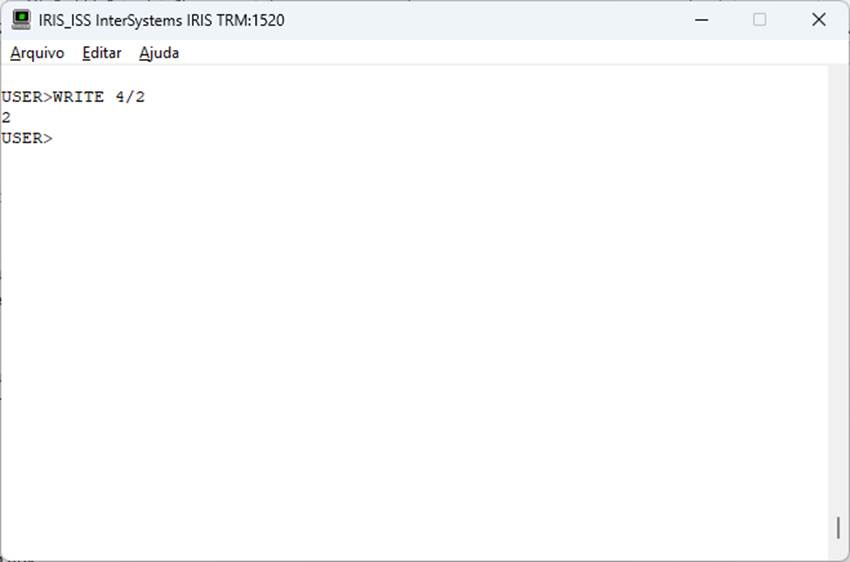
In other words, the ObjectScript command is executed in the current shell. But it's always good to remember that IRIS has other shells
One very interesting aspect is shortcuts. We can access these shells through their calls or via shortcuts, as shown in the table below:
|
Shell |
Call |
Shortcut |
|
SQL |
Do $SYSTEM.SQL.Shell() |
:sql |
|
Python |
Do $SYSTEM.Python.Shell |
:py |
|
TSQL |
Do $SYSTEM.SQL. |
As part of improvements regarding CCR usage and usability, certain transitions are now blocked when a CCR Record has undeployed ItemSets for required Environments.
To promote best practice, when a Tier 1 or Tier 2 CCR moves between Environments, it is important that ItemSets are deployed to required Environments before confirming that the CCR has successfully been implemented in the next Environment. Previously, when progressing a CCR from one Environment to the next, users were not required to deploy ItemSets before performing markMoveToXXXXComplete or markCANCELComplete transitions.
Hey Community!
We're happy to share a new video from our InterSystems Developers YouTube:
⏯ Optimizing Parallel Aggregation Using Shared Globals @ Ready 2025
In today’s healthcare data landscape, FHIR has become the standard for structured clinical data exchange. However, while FHIR excels at interoperability, its JSON format makes analytics challenging—including FHIR QuestionnaireResponse.
This project demonstrates how to transform FHIR QuestionnaireResponse data from nested JSON into relational SQL tables and vector embeddings. By integrating the InterSystems IRIS FHIR SQL Builder and Vector Search, we unlock the semantic meaning behind patient answers.
Terminal Commands for Production:
Do ##class(Ens.Director).StartProduction(“ProductionName”)
Do ##class(Ens.Director).StopProduction()
Do ##class(Ens.Director).UpdateProduction()
Do ##class(Ens.Director).RecoverProduction()
Do ##class(Ens.Director).CleanProduction()
Abort Messages in the queue:
d ##class(Ens.Queue).AbortQueue(“Component Name”)
Get InstanceName :
W !,##class(%SYS.System).GetUniqueInstanceName()
Get Node Name:
W !,##class(%SYS.System).GetNodeName()
Terminate JobId :
d $SYSTEM.
Hola amigo! 😊 Cómo estás hoy,
I would like to share a small part of my learnings from my first ever official project: POS/EDC machine integration with our billing system. This was an exciting challenge where I got hands-on experience working with APIs and vendors.
How does a Payment Machine actually work?
It's simple, start by initiating/creating a transaction, then retrieve its payment status.
Here, initiate/create refers to POST methodand Retrieve refers to GET.
Abstract Set Query, ASQ, is a super set of JSON Path Language, JPL, which was first introduced by the 2016 ISO SQL Standard. JPL is only defined within the context of SQL. In 2023.3, we introduced classes that implement ASQ. It works on any implementation of %Library.AbstractSet. The complete syntax for ASQ will be documented later. This is just a quick introduction to a few of its features. This implementation comes with a nice utility as well. You will know it when you see it!
First, let's get some data from the NHL database. This step requires a valid SSL/TLS configuration.