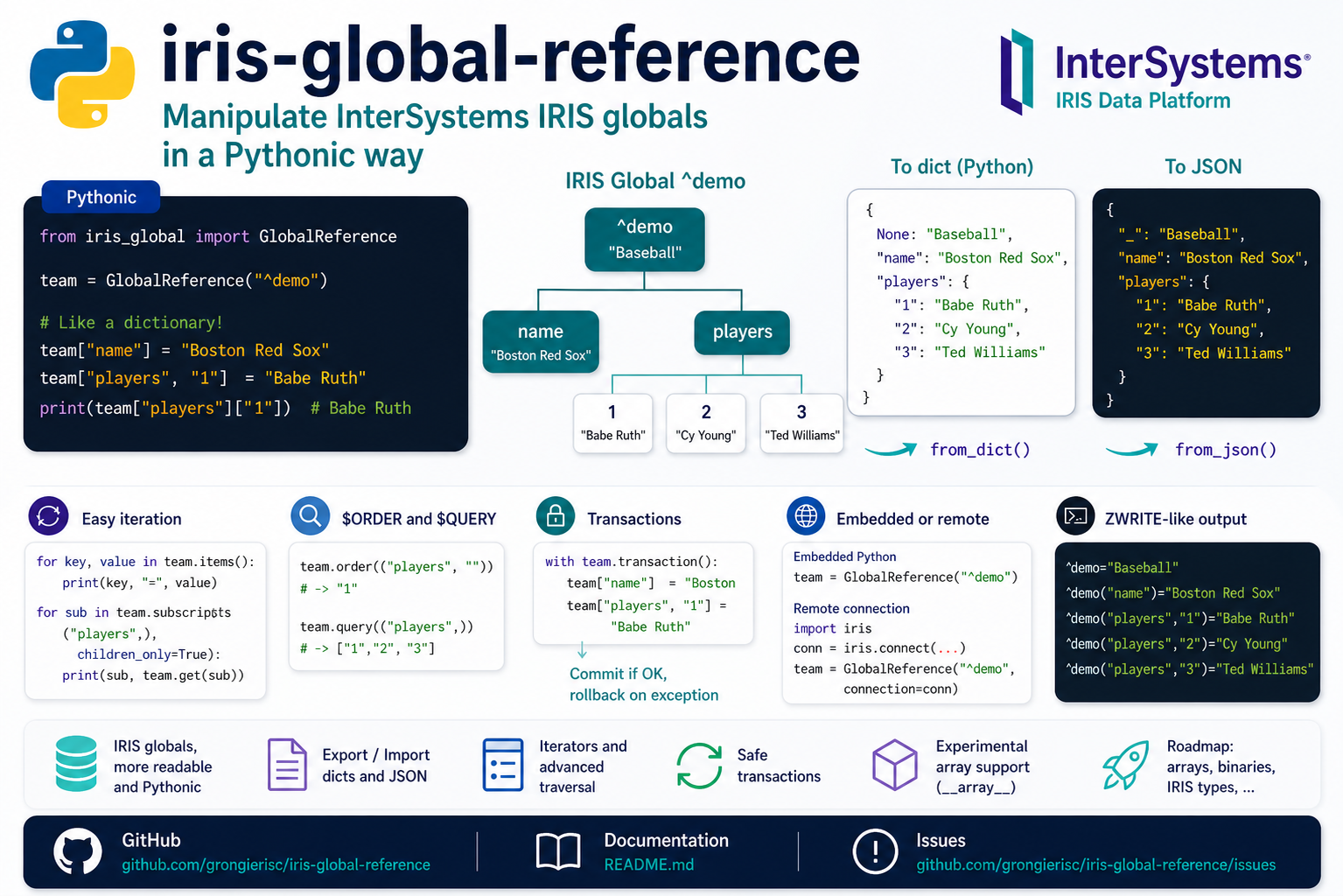
Embedded Python is a game-changer for InterSystems IRIS, offering access to the vast Python ecosystem directly within the database. However, bridging the gap between ObjectScript and Python can sometimes feel like translating between two different worlds.
There is a neat feature of ObjectScript classes - Query element, which allows you to write in a clear SQL (without any & or ()), pass parameters to it and call it from ObjectScript as do QueryNameFunc() or via Call SQLProcedureName via SQL, .e.g.
You send an HTTP request and get back an HTTP error but with an HTML error page which you didn't expect... what's happening?... 🤔
Specifically for example, perhaps you tried to READ a FHIR Resource (e.g. /Patient/123) and you get back a 404 error page, even though with other Patient IDs, you get back the Resource payload, so "the page" definitely does exist... why should you be getting a 404 error page? 🙄
We have created a CSP application in the path /csp/ourapp. Due to some session handling issues, we created a new web application /csp/ourapp/hl7mapping that points to the sane namespace, and we now access the CSP pages using this new URL. This works fine in the local system.
After deploying the app to server, we are facing issues around compiling CSP pages.
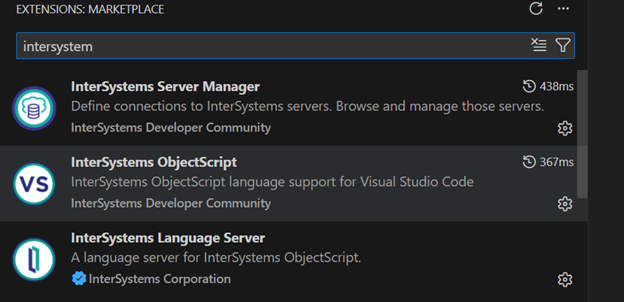
It was encouraging to see more people building VS Code extensions for the recent contest. However I noticed that of of the three extensions requiring credentials with which to make their connections only mine, gj :: dataLoader, leverages the long-established and officially-supported InterSystems Server Manager extension to obtain the connection definitions and to handle credentials securely.
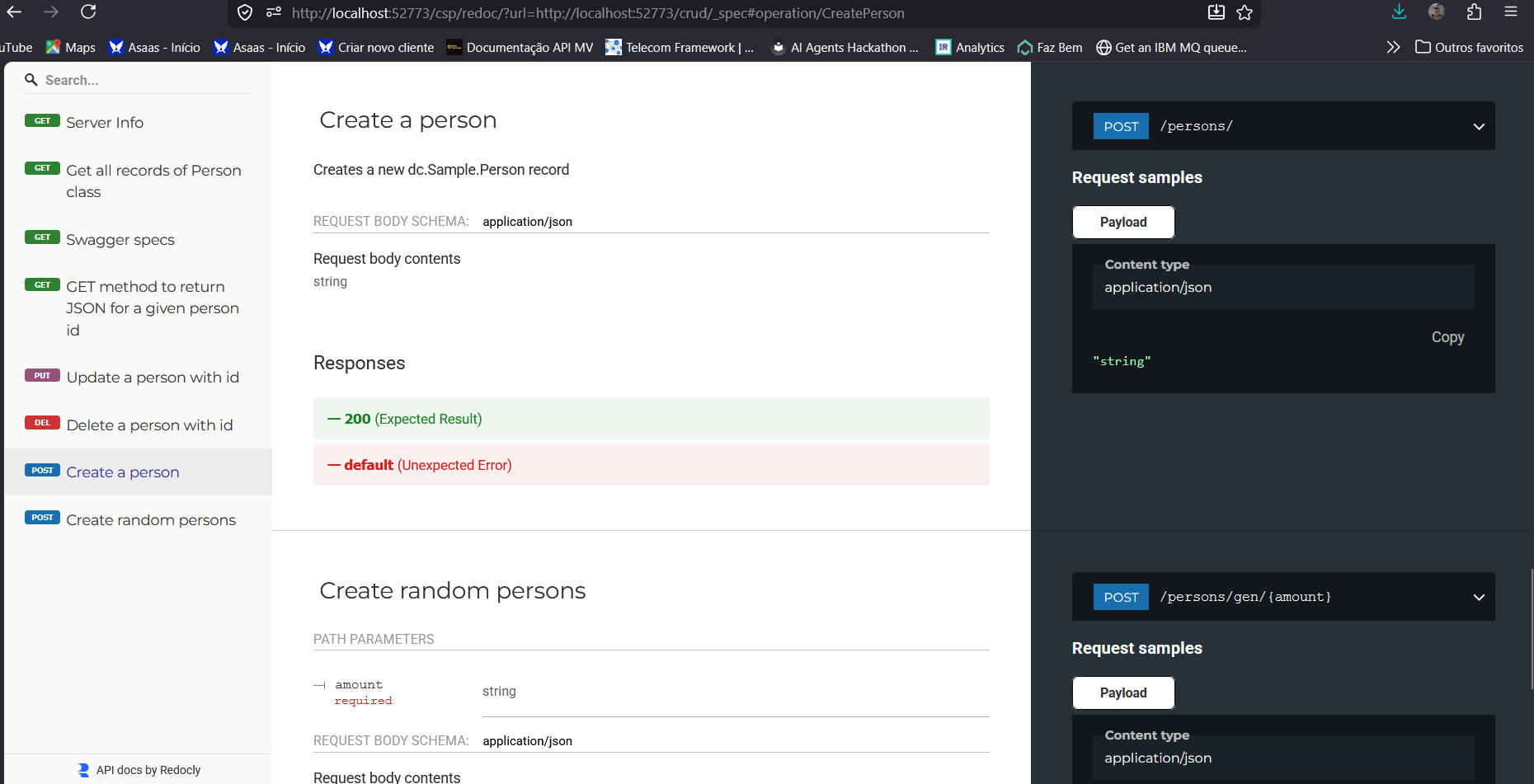
Defining my first REST API within InterSystems using iris-rest-Api-template as a basis and I am seeing if someone could provide me some guidance to see if I can make it work.
When working with InterSystems Interoperability (Iris / Health Connect / Ensemble), configuration data is often spread across many production items: services, processes, operations, adapters, and their settings.
A common operational or security need is to answer questions like:
As I am iterating through the FHIR JSON Response from a Patient Search, I am running into an issue where the extracted values are not being popualted into the Response object that I have created. If I do a $$$LOGINFO on them they will show up in the Object log, however if I try the following for example I get an error.
I'm going to give you a quick tip on how to implement an AI agent to search the Intersystems documentation integrated into Teams.
Yes, I know the documentation page has its own AI search engine and it's quite effective, but this way we'd have faster access, especially if Teams is your company's corporate tool.
You can also create another AI agent to search articles published in the developer community (which also has its own integrated AI search engine).
Does IRIS have any support for paginating FHIR searches other than the standard next/prev links as defined in the FHIR spec? For instance, some servers support an _offset or _skip parameter to allow for jumping to specific pages in a result set.
If you try to kill a global that is mapped at the subscript level from the top node, you will get a <SLMSPAN> error and it will not be deleted. This is because the kill command for subscript-level mapped globals cannot be used across mappings.
https://www.youtube.com/embed/HZrxAxrQges [This is an embedded link, but you cannot view embedded content directly on the site because you have declined the cookies necessary to access it. To view embedded content, you would need to accept all cookies in your Cookies Settings]
Let's meet at the online meetup with the winners of the InterSystems "Bringing Ideas to Reality" Contest! It's a great opportunity to chat with the InterSystems experts team and our contestants.
Winners' demo included!
Date & Time: Thursday, December 18, 11:00 am EST | 5:00 pm CEST
I have a question regarding the priority when applying a default configuration.
I have several Business Services that use the same class, so I want them all to have a common "Schedule" configuration.
However, there's one that I don't want this default configuration applied to, so I've tried setting the Schedule value to empty for that element based on its name:
In this case, the elements that use the class Kurro.BS.SFTP.Marca have the default value "CargaFicheros".
I am trying to centralize our FHIR queries into a single BP object that would send the FHIR query to the EMR, interpret the response into a %Persistent structure that could be sent back to the requestor. In theory it seemed like it would work but I am running into an issue..
https://www.youtube.com/embed/ofEfLqi-kU8 [This is an embedded link, but you cannot view embedded content directly on the site because you have declined the cookies necessary to access it. To view embedded content, you would need to accept all cookies in your Cookies Settings]
Using a Workflow Task within HealthShare Provider Directory, when a user clicks on Resubmit message within my Business Process, I check the status of the response. If the response is "Resend Message", I have my Business Process executing the following...
InterSystems API Manager (IAM) is a core component of the InterSystems IRIS Data Platform, offering centralized API management with a strong emphasis on security. IAM simplifies the entire API lifecycle, from creation to retirement, and provides a developer portal for easy API discovery and integration. Access control features allow administrators to define precise permissions, and IAM seamlessly integrates with the IRIS Data Platform, enhancing data management and integration capabilities.
I want to extract data from IRIS (Health Share Provider Directory) and write the data out to a file that I can use within an external system. Using EnsLib.SQL.Service.GenericService do I need to supply Credentials if I am querying IRIS locally? I have always used JDBC to connect externally when creating Services and Operations to read/write SQL data from external Databases, but never internally. Normally I would just use sql or code to pull the data within a Process or DTC. But in this case, I want the Service to drive the workflow, and query the data from Local Tables
For the question in the Title, the AI Chat gave a response of:
The ‘Current Users’ value displayed by the $System.License.ShowSummary() method represents real-time license usage tracked in shared memory on the local system.
We are trying to reconcile which user/process are associated with the counts that are returned.
Does anyone know how to get the detail of 'license usage tracked in shared memory on the local system.'?
Hi all, it's me again for sharing what I am studying recently.😓
Recently, I am studying how to setup OAuth2 authentication for the InterSystems FHIR repository. And I found the following articles are very good and easy to follow.😁
If you want to generate JWT from x509 cert/key, any operation (including reading) on %SYS.X509Credentials requires U on %Admin_Secure resource.%Admin_Secure is required because %SYS.X509Credentials is persistent, and it's implemented th
https://www.youtube.com/embed/WjE3JkDU-EU [This is an embedded link, but you cannot view embedded content directly on the site because you have declined the cookies necessary to access it. To view embedded content, you would need to accept all cookies in your Cookies Settings]