I am developing a C++ based program to access the IRIS database using iris-callin.h
I need to know what dll/dlls to use for the Iris object module?
InterSystems IRIS is a Complete Data Platform
InterSystems IRIS gives you everything you need to capture, share, understand, and act upon your organization’s most valuable asset – your data.
As a complete platform, InterSystems IRIS eliminates the need to integrate multiple development technologies. Applications require less code, fewer system resources, and less maintenance.
I am developing a C++ based program to access the IRIS database using iris-callin.h
I need to know what dll/dlls to use for the Iris object module?
IRIS can use a KMS (Key Managment Service) as of release 2023.3. Intersystems documentation is a good resource on KMS implementation but does not go into details of the KMS set up on the system, nor provide an easily followable example of how one might set this up for basic testing.
The purpose of this article is to supplement the docs with a brief explanation of KMS, an example of its use in IRIS, and notes for setup of a testing system on AWS EC2 RedHat Linux system using the AWS KMS. It is assumed in this document that the reader/implementor already has access/knowledge to set up an AWS EC2 Linux system running IRIS (2023.3 or later), and that they have proper authority to access the AWS KMS and AWS IAM (for creating roles and polices), or that they will be able to get this access either on their own or via their organizations Security contact in charge of their AWS access.
The 2025.1.3 maintenance releases of InterSystems IRIS® data platform,InterSystems IRIS® for HealthTM, and HealthShare® Health Connect are now Generally Available (GA).
I have always struggled with Iterating through a JSON response to pull out certain fields into a Data Class Structure to use to populate fields in a DTL. So I defined the whole structure for the following JSON, with the base structure extending Ens.Response, %XML.Adaptor, and %JSON.Adaptor.
There seems to be a generous use of ClassMethods in ObjectScript code generally. I hope my own experiences aren't representative, but I bet they are. Forgive me for giving away the ending of this article, but in short: don't use them. Unless you can make a pretty convincing case that you have to, just never use them.1
What is a ClassMethod? In an ObjectScript class, you can define methods in two different ways: in a Method, you must instantiate an instance of the class to call the method, and in a ClassMethod, you can call the method without instantiating the class. Of course, in a ClassMethod, you don't have access to any properties of the object (because there's no object), but you can access globals (they are global, after all) and Parameters (which are class constants).
Hey Community!
We're happy to share a new video from our InterSystems Developers YouTube:
The third developer previews of InterSystems IRIS® data platform,InterSystems IRIS® for Health, and HealthShare® Health Connect 2026.1 have been posted to the WRC developer preview site. Containers can be found on our container registry and are tagged latest-preview.
These developer previews includes the dropping of Mac Intel support starting from 2026.1.0, and the adding back of Windows Server 2019 support to 2026.1.0.
Initial documentation can be found at these links below:
This article explains how to deploy InterSystems IRIS Community Edition on Azure using the Azure Marketplace and a Virtual Machine. It covers prerequisites, instance selection, authentication, SSH access, first verification steps, and how to delete resources to avoid charges. The deployment can typically be done using Azure free credits and is suitable for developers who want to quickly start working with IRIS in the cloud.
Who this guide is for. This guide is intended for developers, solution architects, and DevOps engineers who want to deploy InterSystems IRIS Community Edition on Microsoft Azure. No prior Azure automation experience is required, but basic familiarity with the Azure Portal and SSH is helpful.
After following this guide, you will be able to:
Prerequisites
Deployment overview
iris password to change _SYSTEM/SYS; start a session with iris session irishttp://YOUR_VM_IP:52773/csp/sys/UtilHome.cspIf you work with Productions, highlighting connections between Business Hosts is a very convenient feature, allowing developers to get a visual representation of a data flow.
This feature works by default with all system Business Hosts. If a user writes their own Business Services, Processes, or Operations, they must implement the OnGetConnections method for this functionality to work with their custom Business Hosts (or use Ens.DataType.ConfigName properties for connections).
That said, the SMP shows only the first layer of connections of the selected Business Host. Sometimes, we need to get connections of connections recursively to build a complete data flow graph. Or we might need this connection information to check which downstream systems might be affected by a change upstream.
PEP 578 added Python Audit hooks. A rich variety of events (module load, os interactions and so on) triggers audit events which you can subscribe to.
Here's how to do that. First create an embedded python hook:
Class User.Python
{

/// do ##class(User.Python).Audit()
ClassMethod Audit() [ Language = python ]
{
import sys
import time
def logger(event,args):
     if event=='import':
        module = args[0]
        print(f"Loading {module}")
        if module == "numpy":
            print(f"Module {module} forbidden. Terminating process in 3.")
time.Who hasn't been developing a beautiful example using a Docker IRIS image and had the image generation process fail in the Dockerfile because the license under which the image was created doesn't contain certain privileges?
In my case, what I was deploying in Docker is a small application that uses the Vector data type. With the Community version, this isn't a problem because it already includes Vector Search and vector storage. However, when I changed the IRIS image to a conventional IRIS (the latest-cd), I found that when I built the image, including the classes it had generated, it returned this error:

In Part 1, we laid the technical foundation of MAIS (Multi-Agent Interoperability Systems). We have successfully wired up the 'Brain', built a robust Adapter using LiteLLM, locked down our API keys with IRIS Credentials, and finally cracked the trick code on the Python interoperability puzzle.
However, right now our system is merely a raw pipe to an LLM. It processes text, but it lacks identity.
Today, in Part 2, we will define the Anatomy of an Agent We will move from simple API calls to structured Personas.
In my previous HttpRequests, I have used Content-Type = application/json but I have a vendor that is requesting we send application/x-www-form-urlencoded. How would I go about formatting the Payload as x-www-form-urlencoded?
Thanks
Hi everyone,
Does anyone know how to export projects via VSC?
I opened the project through the "InterSystems Tools" plugin (command is "Edit Code in Project") and I can correctly work on it.
However, when I try using the "ObjectScript" plugin to export the project (right click on the project -> "Export Project Contents")
.png)
This message appears and it is not possible to export the project:
.png)
I've tried also to open a new window, then a folder and finally the project, but nothing changes.
This is an example of my workspace:
.png)
Anyone knows how to do it?
Thank you!
As applications grow, every database eventually hits scaling limits. Whether it's storage capacity, concurrent users, query throughput, or I/O bandwidth, single-server architectures have inherent constraints. This guide explains fundamental approaches to database scalability and shows how InterSystems IRIS implements these patterns to support enterprise-scale workloads.
We'll explore two complementary scaling strategies: horizontal scaling for user volume (distributing computational load) and sharding for data volume (partitioning datasets). Understanding the general principles behind these approaches will help you make informed decisions about when and how to scale your IRIS applications.
The examples in this guide use InterSystems IRIS in Docker containers.
IPM version 0.10.5 has been released on January 15, 2026. This new version contains a ton of improvements and bug fixes so be sure to check it out either directly from the GitHub page or from the Community Registry!
1-command only required for an entire IRIS instance for Data Science projects, and leveraging this to compare query methods' speed (Dynamic SQL, Pandas Query, and Globals).
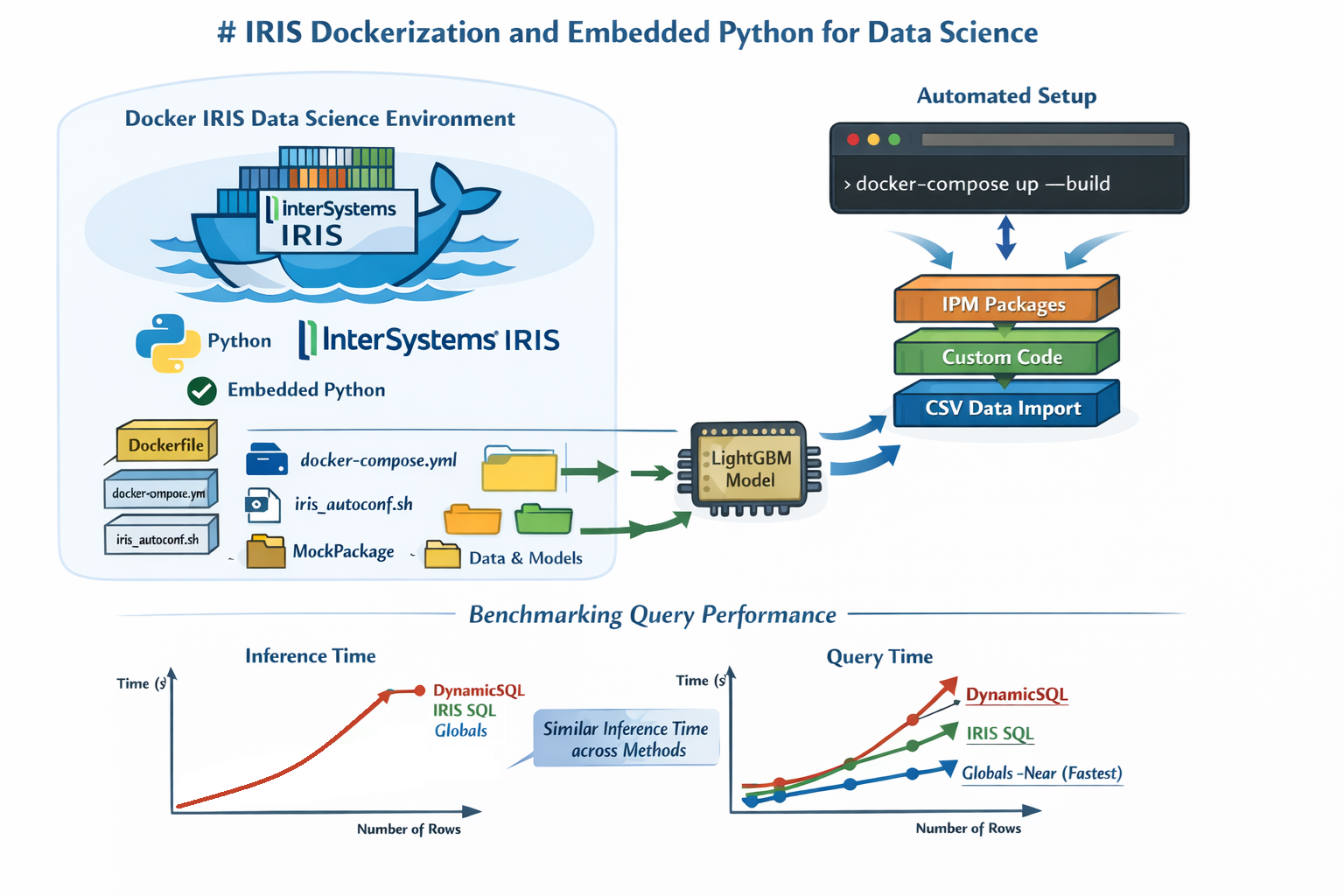
Before joining InterSystems, I worked in a team of web developers as a data scientist. Most of my day-to-day work involved training and embedding ML models in Python-based backend applications through microservices, mainly built with the Django framework and using Postgres SQL for sourcing the data.
I wanted to try vibecoding a real backend + frontend setup on InterSystems IRIS, ideally using something realistic rather than a toy example. The goal was simple: take an existing, well-known persistent package in IRIS and quickly build a usable UI and API around it — letting AI handle as much of the boilerplate as possible. Here is the result of the experiments.
I've modified the class file, but messages still arrive as a single line (e.g., "H|.../rQ|.../rL") instead of separate lines in the ASTM service. The <ENQ>..<EOT> header looks correct, logs show no errors, and the service receives messages fine. Is there an Ensemble 2018.1 engine setting (like line terminator handling or TCP framing) to fix the line splitting?
Hello! In this article, I will be discussing database degrade, a type of data integrity issue one can face when using IRIS. First, I will be going over a review of the structure of IRIS databases. I'll then discuss how database degrade can manifest and common causes of degrade issues. I'll then conclude with general tips we give our customers about how to prevent or prepare for database degrade issues.
What exactly is a database? An IRIS database is a single file that consists of a fundamental unit called the "block".
Hello everybody,
I would like to export project contents using Visual Studio Code, as well as I do with InterSystems Studio.
However, while attempting the export through the InterSystems extension I get the following error:
- There are no folders in the current workspace that code can be exported to.
.png)
These are the step to reproduce my error:
.png)
Anyone can help me solving this issue?
Hey Community!
We're happy to share a new video from our InterSystems Developers YouTube:
⏯ Multi-threading an HL7 Interface and scaling beyond FIFO constraints @ Ready 2025
Who this guide is for.
This guide is intended for developers, solution architects, and DevOps engineers who want to deploy InterSystems IRIS Community Edition on Amazon Web Services (AWS). No prior AWS automation experience is required, but basic familiarity with EC2 and SSH is helpful.
What you will achieve.
After completing this guide, you will be able to:
Prerequisites
Before you begin, make sure you have:
Deployment overview
The deployment process consists of the following steps:
Hi Gang!
Did you know you can deploy InterSystems IRIS Community Edition on the cloud without paying for a license? You can try for free, and it could even come in handy if you want to show off that shiny new app you've created (maybe for the full stack competition..?)
In this article I will provide a complete walkthrough on how to deploy IRIS on Amazon Web Services (AWS), and will also add a follow up for deploying on Azure.
Now before I begin the walkthrough, I want to admit that I was terrified of using AWS the first time because I'd seen memes about how easy it is to rack up costs on AWS. So if you're thinking the same, I suggest you start by signing up to a Free Tier Account, which gives you $100 free credit to evaluate, and automatically shuts off to prevent charges. InterSystems IRIS Community Edition has a free license so if you pair the two, you can deploy without risk and completely for free. (Disclaimer: although I'm sure this is true, please do read the free account terms and make your own decisions 😅 )
Note, this article walks through deploying IRIS Community on AWS, however the same guide can be followed to deploy IRIS for Health Community Edition, or with Bring-your-own-licence editions of IRIS and IRIS for Health, to deploy a fully licensed, production version of IRIS on AWS.
Here at InterSystems, we often deal with massive datasets of structured data. It’s not uncommon to see customers with tables spanning >100 fields and >1 billion rows, each table totaling hundred of GB of data. Now imagine joining two or three of these tables together, with a schema that wasn’t optimized for this specific use case. Just for fun, let’s say you have 10 years worth of EMR data from 20 different hospitals across your state, and you’ve been tasked with finding….
Can the IRIS SQL engine be extended with custom optimization rules (e.g., prioritizing certain indices or join orders)? If not, is there a supported way to influence cost models?
Hi Community,
What is the correct syntax in a merge.cpf file to create a database with its associated resource ?
where can use sandbox in InterSystems IRIS Data Platform 2025.3
How many times have you had to receive or generate a JSON and wished you could work on it using DTLs without having to deal with DynamicObjects trying to remember the name of each field? Do you want to break down and make your giant JSON file more digestible?

In my case, never, but I thought that someone might find it useful to have a feature that captures your JSON and breaks it down into a series of ObjectScript classes that you can work with more easily and conveniently.
Well then...behold JSON2Class in all its glory!
Job Title: InterSystems Developer / Specialist (IRIS / HealthShare)
Location: New York City, NY (Hybrid / Remote)
Duration: Contract (2+ years)
Experience: Min. 8 Years
We are looking for an experienced InterSystems Developer / Specialist with expertise in InterSystems IRIS / HealthShare to support healthcare integration and interoperability initiatives. The ideal candidate should have hands-on experience in ObjectScript development, healthcare data standards, and integration protocols supporting EHR/HIE

Some concepts make perfect sense on paper, whereas others require you to get your hands dirty. Take driving, for example. You can memorize every component of the engine mechanics, but that does not mean you can actually drive.
You cannot truly grasp it until you are in the driver's seat, physically feeling the friction point of the clutch and the vibration of the road beneath. While some computing concepts are intuitive, Intelligent Agents are different. To understand them, you have to get in the driver's seat.