Hi,
Is there any way to recover management portal _system user password?
Thanks
InterSystems IRIS for Health™ is the world’s first and only data platform engineered specifically for the rapid development of healthcare applications to manage the world’s most critical data. It includes powerful out-of-the-box features: transaction processing and analytics, an extensible healthcare data model, FHIR-based solution development, support for healthcare interoperability standards, and more. All enabling developers to realize value and build breakthrough applications, fast. Learn more.
Hi,
Is there any way to recover management portal _system user password?
Thanks
Hi Community,
The new video from Global Summit 2019 is available on InterSystems Developers YouTube:
The healthcare technology market is in strong evolution. Gartner's wave chart for healthcare technologies demonstrates what these technologies are, very well reflected by healthcare.digital. I call this HealthTech See:
.png)
These technologies can use InterSystems technologies (ISC Health Tech), see:
.png)
.png)
Consent Management uses InterSystems Healthshare Stack to do MPI and consent management, see:
.png)
.png)
.png)
.png)
.png)
I have been walking through this with a few team members and as such I thought there might be others out there who could use it, especially if you work with HL7 & Ensemble/HealthConnect/HealthShare and never venture out past the Interoperability section.
First, I would like to establish that this is an extension of the already established documentation on importing and exporting SQL data found here: https://docs.intersystems.com/iris20241/csp/docbook/DocBook.UI.Page.cls?
We currently have Business Operation that we built to use the EnsLib.SQL.OutboundAdapter so we can make Microsoft SQL Server Stored Procedure calls. The BO is attached to a Java Gateway Service.
Some of our MS SQL Databases have moved from being OnPrem to Azure Cloud. We have started seeing where we are receiving errors on the BO saying that we cannot connect to the Azure Database, but we never receive a Disconnect from the Azure Database.
Hi Everyone,
So after @Ariel.
If you want to raise an arbitrary custom error in a TRY block, you can pass an exception with a throw as follows. In the following example, a custom error is raised if Stcount is less than 1.
Class User.Test
{
ClassMethod ExceptionTest()
{
try
{
// : some codes
if (Stcount<1) {
throw ##class(%Exception.General).%New("User-defined error", "5001", "location", "Data at location error")
// User-created errors are 5001 and above
}
}
catch ex
{
write "Errors #", ex.Code, ": ", ex.Name, " : ", ex.FHIR Server
A FHIR Server is a software application that implements the FHIR (Fast Healthcare Interoperability Resources) standard, enabling healthcare systems to store, access, exchange, and manage healthcare data in a standardized manner.
Intersystems IRIS can store and retrieve the following FHIR resources:
Fast Healthcare Interoperability Resources (FHIR) is a standardized framework created by HL7 International to facilitate the exchange of healthcare data in a flexible, developer-friendly, and modern way. It leverages contemporary web technologies to ensure seamless integration and communication across various healthcare systems.
I am trying to help another group within our organization access a SQL Table that I have created to populate Epic Department Data within our environment and came across the ability to use SQL Seach REST Interface using iKnow.
However, I am having issues trying to get it to work via POSTMAN before I hand off the solution...
the POST URL... https://<servername>/api/iKnow/latest/TESTCLIN/table/osuwmc_Epic_Clarity.DepartmentMaster/search
where osuwmc_Epic_Clarity.DepartmentMaster is the table
In the
Often times when working with FHIR data, for example with IRIS For Health, you'll find it useful to create a custom FHIR operation. The FHIR Standard comes with a set of defined operations (such as $everything) but a custom operation comes in handy when you need to create some extra functionality that goes beyond the set of standard FHIR operations. The docs take you step-by-step (though this comment may be helpful to those of you just getting started). One thing I would highlight, purely for aesthetic purposes, is how to syntactically name your function such that you can call it with hyphens.
.png)
.png)
Lets zero in on the use of the word professional and put it into some context. It was written by industry experts who wrapped it up in a fee based service with support and some guardrails around flexible options to contribute to its behavior. I feel its an important distinction to either an open or home grown solution (though it may do the same thing) to consider it to scale or provide mission critical value on the other side of it.
We have a task that runs objectscript code to load data into a linked external table. After upgrading from 2024.1 to 2025.1, the load is throwing an error, with error code -400, and no error message. The data DOES get loaded into the external table in its entirety, so with no meaningful error message, its hard to determine what the issue is. The result is the same with and without the USING clause, so don't let that confuse you.
Mirroring only synchronizes database files.
To synchronize other files required for your application (CSP files, images, documents, etc.) between the two servers that make up the mirror set follow one of the approaches:
..Contains(source.{ORCgrp(x1).OBRuniongrp.NTEi2(x2):Comment(x3)},"(")&&..Matches(source.{ORCgrp(x1).OBRuniongrp.NTEi2(x2):Comment(x3)},"^[A-Z][0-9][0-9]$")
I want to do this to match strings such as X98. Community AI tells me this is correct but I get an error in testing. Specifically, this is the part causing the error;
..Matches(source.{ORCgrp(x1).OBRuniongrp.NTEi2(x2):Comment(x3)},"^[A-Z][0-9][0-9]$")
.png)
What do I need to change?
InterSystems FAQ rubric
In InterSystems IRIS, you can create linked tables using commands, instead of using System Explorer > SQL > Wizard > Linked Tables in the Management Portal:
.png)
To create a linked table, use the CreateLinkedTable method of the %SYSTEM.SQL.Schema class. See the class reference for details.
To execute it, follow these steps:
set sc = $SYSTEMSQL.Schema.I created a Custom Search Table that extends EnsLib.HL7.Search Table. I saved, compiled, and rebuilt the index however when I go into Message Search to try to use the Search Table, within the conditions the proper fields are not showing up that was defined. It is showing the fields from EnsLib.HL7.SearchTable. I did a build index on both EnsLib.HL7.SearchTable and OSU.HL7.SearchTable.
Class OSU.HL7.SearchTable Extends EnsLib.HL7.SearchTable
{
Parameter DOCCLASS = "EnsLib.HL7.Message";
Parameter EXTENTSIZE = 4000000;
XData SearchSpec [ XMLNamespace = "http://www.intersystems.
#InterSystems Demo Games entry
Did you know that 80% of healthcare data is stuck in unstructured formats such as fax? If you take a walk down to Mass General in Boston, you'll literally see a state-of-the-art MRI machine next to a fax machine. Healthcare keeps building incredible new technology but can't let go of legacy technology. We call this the "legacy modernization paradox". This short film follows a care manager at Blue Plan who spends her days doing chart reviews, reading faxes line-by-line, struggling to provide her members the care they need. Everything changes when Blue Plan pilots InterSystems Health Evolve, a solution that transforms her faxes into machine-readable FHIR data ready for AI and analysis. To access our fully working Text-to-FHIR prototype, visit HealthEvolve.de.
Presenters:
🗣 @Vishal Pallerla, Sales Architect, InterSystems
🗣 @Erica Song, Sales Engineer, InterSystems
🗣 @Louis Kabelka, Sales Engineer, InterSystems
🗣 Zelong Wang, Sales Engineer, InterSystems
🗣 John Murtha, Health Plan Executive, InterSystems
#InterSystems Demo Games entry
Managed Cloud Solutions to Help Streamline Your Health Services.
This demo showcases composing several InterSystems Managed Cloud Services to solve various use-cases.
The video is actually built of 6 short chapters (each ~2.5 minutes long) showing each part of the story, demoing a different service.
You can watch each "chapter" individually if you're interested in a specific service, but there is value in viewing the whole composition and observing the full flow.
[Note the "FHIR IntelliChat" part is not an actual formal InterSystems service, it is just a demonstration of a possibility (based on this solution by @José Pereira)]
Presenters:
🗣 @Tani Frankel, Sales Engineer Manager, InterSystems
🗣 @Keren Skubach, Senior Sales Engineer, InterSystems
🗣 @Ariel Glikman, Sales Engineer, InterSystems
#InterSystems Demo Games entry
Shows how IRIS for Health can supercharge AI development with a Smart Data Fabric to train and feed their AI Models.
Presenters:
🗣 @Kevin Kindschuh, Senior Sales Engineer, InterSystems
🗣 @Jeff Semmens, Sales Engineer, InterSystems
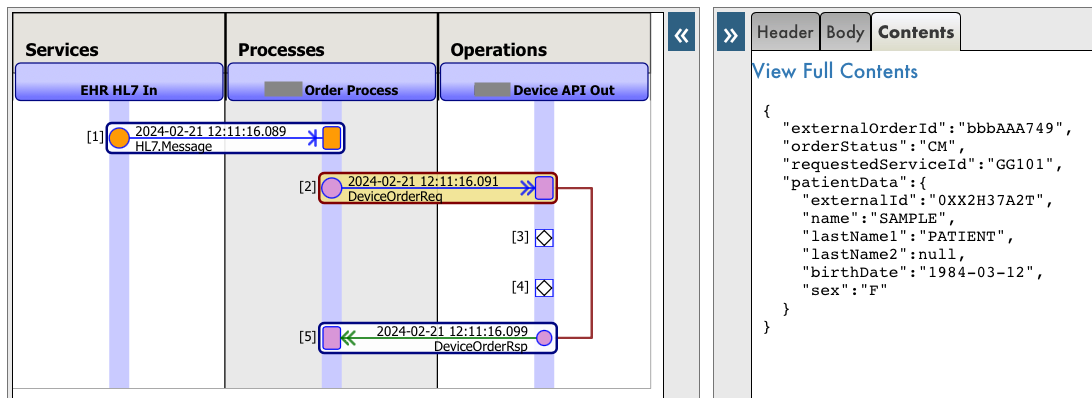
InterSystems IRIS interoperability production development involves using or writing various types of components. They include services (which handle incoming data), processes (which deal with the data flow and logic), and operations (which manage outgoing data or requests). Messages flowing through those components constantly require being adapted to consuming applications. Therefore,Data transformations are by far the most common component in interoperability productions.
In the early stages of data transformation development, thetest tool from the Management Portal becomes quite handy.
I had a need for a Filter, but did not want to recreate the wheel by creating another Data Lookup Table, so instead I created a Linked Table that points to a MS SQL Table outside of IRIS.
Once I had the Linked Table, I created a Class Method Function that would query the Linked Table and return a 1 if a result came back.
ClassMethod CheckPDMProviderType(pInput As %String) As %Boolean
{
set ExtDisplay = ""
&sql(SELECT SecurityGroup_k INTO :ExtDisplay
FROM osuwmc_CPD_SQL.InterSystems FAQ rubric
There is data, such as execution log data, that you do not want to return to its previous state even if a rollback occurs during a transaction. The above requirement can be met by placing that data in the IRISTEMP database, which will not be rolled back.
Temporary Globals and the IRISTEMP Database
By mapping the table entities you do not want to roll back to this database, you can retain the information after the rollback.
IAM - InterSystems API Manager is a great tool for monitoring your traffic. If you are trying to use it in your Kubernetes cluster you may have tried doing a deployment similar to this one:
apiVersion: intersystems.com/v1alpha1
kind: IrisCluster
metadata:
name: iris
spec:
licenseKeySecret:
name: iris-key-secret
configSource:
name: iris-cpf
imagePullSecrets:
- name: intersystems-pull-secret
topology:
data:
image: containers.intersystems.com/intersystems/iris-arm64:2024.1
compatibilityVersion: "2024.1.Hi,
I need a custom operation on patient type that will receive a business identifier and will search them and for each paient it will return a $everything for all the found patients written with object script
I have a need to create a specific Search Table outside of the EnsLib.HL7.SearchTable specifically for HL7 MFN messages in HealthShare Provider Directory.
Our Code is created in a different namespace then the main HSPD namespace and is mapped within the HSPD namespace mapping.
I created a copy of EnsLib.HL7.SearchTable, named OSU.HL7.SearchTable what all needs mapped to make this new search table available in HSPD namespace?
If I go to Global within the Custom Code Namespace, I cannot see my new Search Table being created.
What am I missing to make sure that the OSU.HL7.
Developing with InterSystems Objects and SQL – In Person September 15-19, 2025
Interoperability on Python (IoP) is a proof-of-concept project designed to showcase the power of the InterSystems IRIS Interoperability Framework when combined with a Python-first approach.IoP leverages Embedded Python (a feature of InterSystems IRIS) to enable developers to write interoperability components in Python, which can seamlessly integrate with the robust IRIS platform. This guide has been crafted for beginners and provides a comprehensive introduction to IoP, its setup, and practical steps to create your first interoperability component. By the end of this article, you will get a clear understanding of how to use IoP to build scalable, Python-based interoperability solutions.
.png)
While starting with Intersystems IRIS or Cache, developers often encounter three core concepts: Dynamic Objects, Globals & Relational Table. Each has its role in building scalable and maintainable solutions. In this article, we'll walk through practical code examples, highlight best practices, and show how these concepts tie together.
1. Working with Dynamic Objects:
Dynamic objects (%DynamicObject and %DynamicArray) allow developers to manipulate JSON-like structures directly in Objectscript. They are especially useful for modern applications that need to parse, transform or generate JSON.