Hi Developers,
Tap to watch the brand new video on InterSystems Developers YouTube:
.png)
InterSystems IRIS for Health™ is the world’s first and only data platform engineered specifically for the rapid development of healthcare applications to manage the world’s most critical data. It includes powerful out-of-the-box features: transaction processing and analytics, an extensible healthcare data model, FHIR-based solution development, support for healthcare interoperability standards, and more. All enabling developers to realize value and build breakthrough applications, fast. Learn more.
Hi Developers,
Tap to watch the brand new video on InterSystems Developers YouTube:
In evaluating an IBM Support notification, InterSystems has determined a potential impact for our customers. The notification in question is:
This issue affects versions 2022.x and 2023.x of
It also affects other InterSystems products based on the InterSystems IRIS family of products.
In the Business Operation, how do we get to know which source is currently sending primary request if there are multiple requests coming at the same time?
Do I always see the IP address of the current host in the [MirrorMember] configuration information in the iris.cpf file? The AgentAddress in my current [MirrorMember] configuration file is empty, SystemName=ip/instance name. Will the SystemName here be in the form of ip/instance name? It could be instance name without ip?
I am fairly new to using Docker, and instead of trying to get IIS, a Web Gateway, and Docker desktop working within my Windows environment, I thought I would try running it in a WSL2 Ubuntu environment since this is similar to how use it on my server. I have installed Apache and the Web Gateway on my WSL2 Ubuntu.
I went through Apache Web Gateway with Docker | InterSystems Developer Community however that is already bundled and requires TLS certificate setup which I don't care about since this is running locally on my machine.
We recently uploaded to OpenExchange a small application that I developed a while ago (and that @Jose-Tomas Salvador improved and refined) that I often use when I need to generate large volumes of HL7 messaging.
The application is developed in NodeJS and works by generating patient and doctor data from seed files that you can modify to your liking to personalize the generated patients. The application will use the generated patients to prepare different types of HL7 messages. At the moment the application can generate the following types of messages.
I have created a custom Business Process setting called X509CredentialAlias in which I load the name of the credential alias to use for some background processes. I have looked through EnsPortal.Component but do not see an option for selecting X509 certs stored within IRIS. How might I adjust this setting to query all X509 certs saved within IRIS and offer a drop-down selection to the user within the business process? Similar to the EnsPortal.Component.sslConfigSelector.
.png)
You can see in the above X509CredentialAlias that I am manually typing the credential alias name.
I have a fixed width complex recordmap that is an older version of a file format. I am trying to retool it to fit the latest version. The old recordmap has almost 500 entries on it and the new version has a few more fields added along with changes to some field lengths. Adding a new field adds it at the end of the recordmap and moving it from field 490 to field 139 is a painful process. Is there an easier way of doing this?
I have tried editing the recordmap by going to studio and moving the fields to the correct location.
When trying to save ZAUTHENTICATE.mac the following error occurs
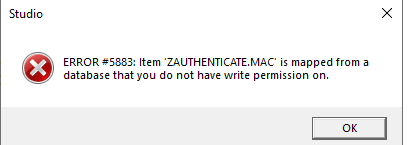
If it is wrongly named as like ZATHIENTICATE.mac in the %SYS namespace it saves ok so it is something blocking saving a new fresh ZAUTH code of the correct name- we have no other delegated auth that I am aware of.
Is it possible to add quotations " " so that it is part of the output?
For example:
set b = "Cat"
Set c = b
w c giving an output of "Cat" as opposed to Cat.
Given the number of new features in this release, InterSystems has decided to add this fifth preview as part of the 2024.1 developer preview program. This extended developer preview release only includes InterSystems IRIS® for HealthTM, and HealthShare® Health Connect.
❗This announcement does not apply for InterSystems IRIS®
In this release, you can expect a host of exciting updates, including:
Record maps are used to efficiently map files containing delimited records or fixed-width records to message classes used by the interoperability function, and to map files from interoperability function message classes to text files.
Record map mapping definitions can be created using the Management Portal, and we also provide a CSV record wizard that allows you to define while reading a CSV file.
To use a record map in production, just add a record map business service or business operation and specify the record map definition class you created.
We are investigating option of populating .pdf Custom Properties Name-Value pairs with episode/billing information from the TrakCare database, using Logi Reports. Resulting .pdf would be stored in a designated network folder. Would welcome suggestions on feasibility / technique to achieve / code to achieve (or alternative approach).
Intent is for further (watcher) process to detect new .pdf file in network folder and determine actions and/or process flow based on Name-Value pair information in pdf's Custom Properties.
Hey Community,
Watch the new video on InterSystems Developers YouTube:
⏯ Clinical Research Data Pipeline Using FHIR & OMOP @ Global Summit 2023
Hello, I created HL7 router Extends Ens.Rule.Definition. When I click the dot to the left, it does not draw lines to targets. I tried to add ClassMethod OnGetConnections(), but it does not get executed.
Hi, what is the easiest way to clear all the tables which store FHIR data? The most straitforward approach is to get a list of tables using the information_schema.tables view, then execute dynamic SQL with the "delete from" clause, but perhaps some helper class has already been written for this purpose?
Hi,
I am having an issue when I am publishing data to FHIR which is hosting in AWS. I am sending the data to the Cloud FHIR url but getting the below error.
Any idea how to resolve this issue? Any example to cretae FHIR repository using Object script?
:<!DOCTYPE HTML PUBLIC "-//IETF//DTD HTML 2.0//EN"> <html><head> <title>404 Not Found</title> </head><body> <h1>Not Found</h1> <p>The requested URL was not found on this server.</p> </body></html>
Hi All,
I am writing few test for REST API need help from you guys as I am new to Objectscript. I want to implement mocking into testcase but didn't get any good resource for the same. please help me
What are the advantages/disadvantages of using the Person resource with a link to the Patient and Practitioner resources, rather than using the Patient and Practitioner resources directly without using the resources?
Hey Community,
Enjoy watching the new video on InterSystems Developers YouTube:
You can use the %IndexBuilder class to perform index rebuilding using multiple processes.
Here is an example for the purpose of defining the standard index HomeStateIdx for the Home_State (state information of contact address) column of Sample.Person.
The steps are as follows:
1. Hide the index name to be added/rebuilt from the query optimizer.
>write$system2. Add %IndexBuilder to the rightmost superclass of the class definition that defines the new index.
3. Register the index name to be rebuilt in the INDEXBUILDERFILTER
I participated in InterSystems Women’s Health FHIR contest, because I loved the challenge to learn a new-to-me technology. I wanted to develop an app that receives data from a mobile device like my Fitbit or a Smart Watch. I did not get access to such data except when I downloaded a spreadsheet (CSV file) showing my daily steps and sleep data. I saw in iris-fhir-template it imported some patient data to a FHIR server. I figured out how to use a Data Transformation to transform a record from a delimited file into FHIR data which I could store into the FHIR server.
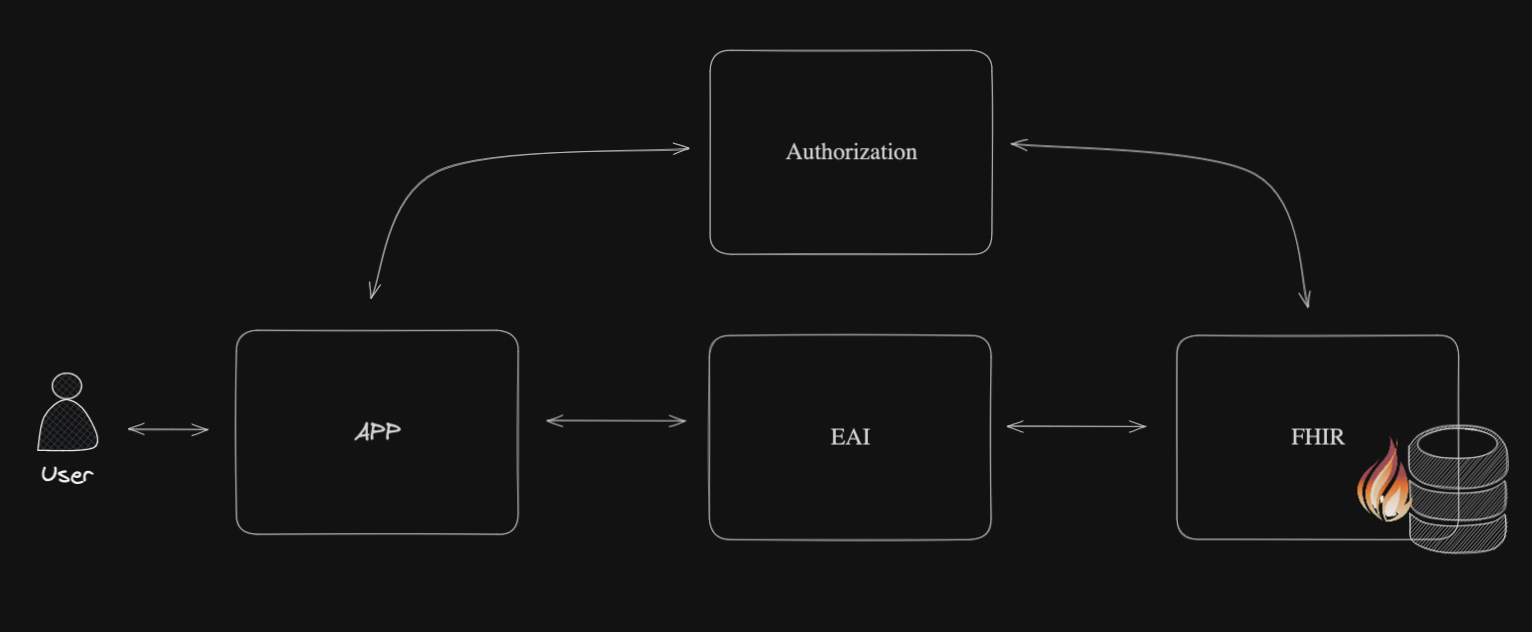
The objective of the article is to provide the reader with the following informations:
Schema of the article:
How can we have the multiple business rules run on a single cloned-object(EnsLib.HL7.Message), and send the cloned-object in Rule Editor?
Any sample code? The purpose is to edit the HL7 ORU R01 message
Thx!
I had a question about using ZSTART, ZSTOP, and ZMIRROR.
Has anyone come up with a way to put a delay in a routing rule? We have text and PDF results sending to EPIC and need to put a delay on the PDF send so the text posts first in EPIC.
Thank you!
InterSystems announces its fourth preview, as part of the developer preview program for the 2024.1 release. This release will include InterSystems IRIS®, InterSystems IRIS® for HealthTM, and HealthShare® Health Connect.
Many updates and enhancements have been added in 2024.1 and there are also brand-new capabilities, such as Using vectors in ObjectScript, Vector Search (experimental), Multi-Volume Database, the ability to use Fast Online Backup (experimental),and the introduction of Multiple Super Server Ports
While creating the WSDL, I'm encountering the following error:
"Mismatched definition of ELEMENTQUALIFIED for the class in the namespace http://www.test.xx/xyx/abc-ns/xsd/v1: CSP Error"
Why am I getting this error while generating the WSDL?
Can someone guide me to understand this issue?
Hi all,
Does anybody have the same issue?
$ZF(-100) to run python script not work when directly execute in studio or in storedproc called by TrakCare, but can work when do in iris session.
The python script imports a "barcode" package. It seems that when directly execute in studio or in storedproc called by TrakCare, the package can not be imported.
sr$ZFfromdeftestEan(str)