#Interoperability

7 Followers · 563 Posts

In healthcare, interoperability is the ability of different information technology systems and software applications to communicate, exchange data, and use the information that has been exchanged.

Article Eric Fortenberry · May 30, 2025 3m read

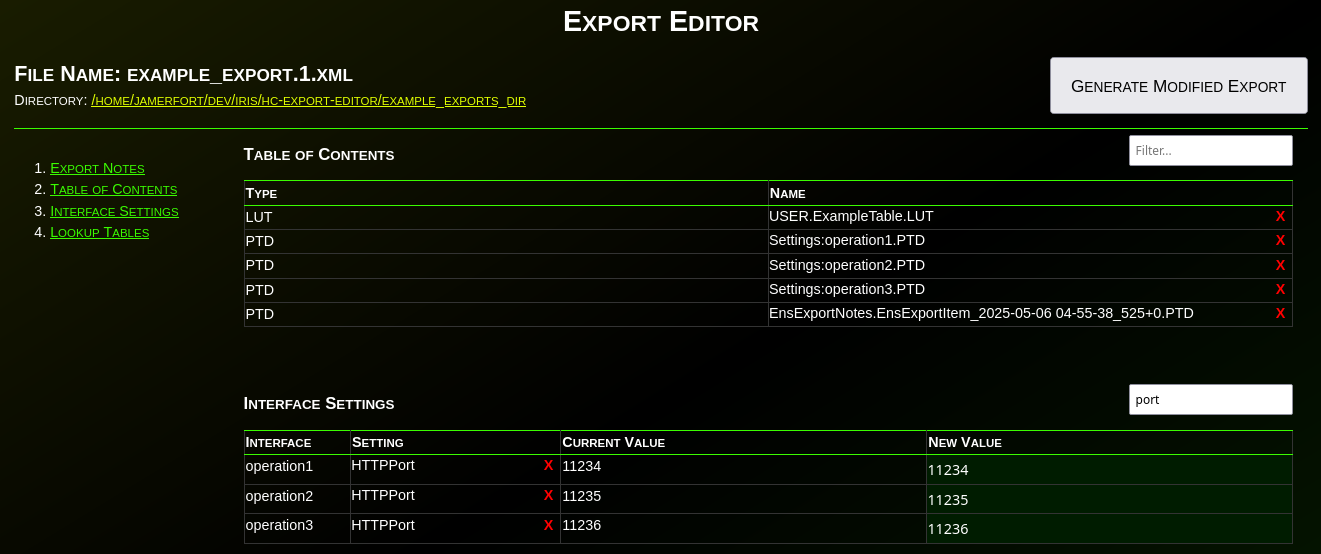
Have you ever needed to change an IP or port before deploying an interface to production? Needed to remove items from an export? What about modifying the value(s) in a lookup table before deploying? Have you wanted to disable an interface before deploying? What about adding a comment, category, or alert setting to an interface before deploying to production?

If you’ve ever needed to make any changes to an interface or lookup table before deploying to production, then Export Editor is for you!

1
0 184
New
Article Sanjib Pandey · Feb 20 5m read

Project Overview:

The Clinical Staff Master Data Management (CSMDM) system is a full-stack healthcare integration application built on InterSystems IRIS for Health. It centralizes and standardizes clinical staff metadata into a single authoritative repository, exposed through RESTful CRUD APIs and reusable backend methods.

The platform eliminates fragmented lookup tables and hardcoded mappings that commonly cause errors in HL7 and FHIR integration workflows, ensuring data consistency and interface reliability.

Application to Other Domains:

0
0 16
New
Article Geet Kalra · Feb 18 6m read

Intersystems IRIS Productions provide a powerful framework for connecting disparate systems across various protocols and message formats in a reliable, observable, and scalable manner. intersystems_pyprod, short for InterSystems Python Productions, is a Python library that enables developers to build these interoperability components entirely in Python. Designed for flexibility, it supports a hybrid approach: you can seamlessly mix new Python-based components with existing ObjectScript-based ones, leveraging your established IRIS infrastructure. Once defined, these Python components are

0
3 105
New
Article Henry Pereira · Feb 16 15m read

Welcome to the finale of our journey in building MAIS.

  • In Part 1, we constructed the agnostic "Brain" using LiteLLM and IRIS.
  • In Part 2, we designed the "Persona", mastering Dynamic Prompt Engineering and the ReAct theory.

Now, the stage is set. Our agents are ready, defined, and eager to work. However, they remain frozen in time. They require a mechanism to drive the conversation, execute their requested tools, and pass the baton to one another.

0
0 29
New
Question Jordan Everett · Feb 11

Hey everyone,

I'm just seeking some guidance and confirmation on what I'm doing for my production health monitoring.

We utilize Grafana to have reporting/monitoring dashboards and I have made a REST API to query the health of our productions. I believe I have everything figured out except for one thing that I'm uncertain about and that is the Production Item Color indicators:

3
0 49
Article Eduard Lebedyuk · Sep 27, 2023 2m read

If you work with Productions, highlighting connections between Business Hosts is a very convenient feature, allowing developers to get a visual representation of a data flow.

This feature works by default with all system Business Hosts. If a user writes their own Business Services, Processes, or Operations, they must implement the OnGetConnections method for this functionality to work with their custom Business Hosts (or use Ens.DataType.ConfigName properties for connections).
That said, the SMP shows only the first layer of connections of the selected Business Host. Sometimes, we need to get connections of connections recursively to build a complete data flow graph. Or we might need this connection information to check which downstream systems might be affected by a change upstream.

6
1 458
New
Article Alberto Fuentes · Feb 13 10m read

10:47 AM — Jose Garcia's creatinine test results arrive at the hospital FHIR server. 2.1 mg/dL — a 35% increase from last month.

What happens next?

  • Most systems: ❌ The result sits in a queue until a clinician reviews it manually — hours or days later.
  • This system: 👍 An AI agent evaluates the trend, consults clinical guidelines, and generates evidence-based recommendations — in seconds, automatically.

No chatbot. No manual prompts. No black-box reasoning.

This is event-driven clinical decision support with full explainability:

image

Triggered automatically by FHIR events ✅ Multi-agent reasoning (context, guidelines, recommendations) ✅ Complete audit trail in SQL (every decision, every evidence source) ✅ FHIR-native outputs (DiagnosticReport published to server)

Built with:

  • InterSystems IRIS for Health — Orchestration, FHIR, persistence, vector search
  • CrewAI — Multi-agent framework for structured reasoning

You'll learn: 🖋️ How to orchestrate agentic AI workflows within production-grade interoperability systems — and why explainability matters more than accuracy alone.

<iframe width="560" height="315" src="https://www.youtube.com/embed/43Vl7cU_uNY?si=o3NZ3AqPOdFkCn9w" title="YouTube video player" frameborder="0" allow="accelerometer; autoplay; clipboard-write; encrypted-media; gyroscope; picture-in-picture; web-share" referrerpolicy="strict-origin-when-cross-origin" allowfullscreen></iframe>
2
2 134
Article Henry Pereira · Feb 4 11m read

In Part 1, we laid the technical foundation of MAIS (Multi-Agent Interoperability Systems). We have successfully wired up the 'Brain', built a robust Adapter using LiteLLM, locked down our API keys with IRIS Credentials, and finally cracked the trick code on the Python interoperability puzzle.

However, right now our system is merely a raw pipe to an LLM. It processes text, but it lacks identity.

0
0 105
Article Sue O'Leary · Jan 16 6m read

Introduction

The recent addition of FIFO groups allows First-In, First-Out (FIFO) message processing to be maintained in an interoperability production even when a Pool Size is greater than 1, enabling higher performance without sacrificing correctness. This feature first appears in InterSystems IRIS® data platform, InterSystems IRIS® for Health, and InterSystems Health Connect™ in version 2025.3.

First-In, First-Out message processing is critical in many integration scenarios, especially in healthcare. Traditionally, FIFO ordering is enforced by configuring each business host to process only one message at a time (Pool Size = 1). While effective, this approach can limit throughput and underutilize system resources. FIFO groups preserve FIFO ordering where needed without requiring a Pool Size of 1.

2
2 37
Job Ratnesh Shrivastava · Jan 27

Job Title: InterSystems Developer / Specialist (IRIS / HealthShare)
Location: New York City, NY (Hybrid / Remote)
Duration: Contract (2+ years)
Experience: Min. 8 Years 

Job Summary

We are looking for an experienced InterSystems Developer / Specialist with expertise in InterSystems IRIS / HealthShare to support healthcare integration and interoperability initiatives. The ideal candidate should have hands-on experience in ObjectScript development, healthcare data standards, and integration protocols supporting EHR/HIE environments.

Key Skills Required

0
0 73
Article Henry Pereira · Jan 26 6m read

Some concepts make perfect sense on paper, whereas others require you to get your hands dirty. Take driving, for example. You can memorize every component of the engine mechanics, but that does not mean you can actually drive.

You cannot truly grasp it until you are in the driver's seat, physically feeling the friction point of the clutch and the vibration of the road beneath. While some computing concepts are intuitive, Intelligent Agents are different. To understand them, you have to get in the driver's seat.

0
2 170
Article Ashok Kumar T · Jan 14 14m read

What is a FHIR Profile?

A FHIR profile is a collection of rules and constraints used to customize and refine a base Fast Healthcare Interoperability Resources (FHIR) resource. Profiling is a vital process that adapts the base FHIR resource standard to satisfy the unique requirements of a specific use case, geographic region, medical institution, or clinical workflow.

While the base FHIR specification provides generic, flexible definitions for resources (such as Patient, Observation, or Medication), profiles transform these generic resources into more precise ones. This ensures consistent and interoperable data exchange tailored for a particular community or implementation.

FHIR is designed to cover various healthcare scenarios globally. Profiles allow implementers to adapt this general platform without losing the benefits of standardization.

2
1 109
Article Yuri Marx · May 5, 2025 10m read

RabbitMQ is a message broker that allows producers (those who send a data message) and consumers (those who receive a data message) to establish asynchronous, real-time, and high-performance massive data flows. RabbitMQ supports AMQP (Advanced Message Queuing Protocol), an open standard application layer protocol. 
The main reasons to employ RabbitMQ include the following:

  • You can improve the performance of the applications using an asynchronous approach.
  • It lets you decouple and reduce dependencies between services, microservices, and applications with the help of a data message mediator, meaning that there is no need for producers and consumers of exchanged data to know each other.
  • It allows the long-running processing of sent data (with the results) to be delivered after utilizing a response queue.
  • It helps you migrate from monolithic to microservices, where microservices exchange data via Rabbit in a decoupled and asynchronous way.
  • It offers reliability and resilience by making it possible for messages to be stored and forwarded. A message can be delivered multiple times until it is processed.
  • Message queueing is the key to scaling your application. As the workload increases, you will only have to add more workers to handle the queues faster.
  • It works well with data streaming applications.
  • It is beneficial for IoT applications.
  • It is a must for Bots’ communication.
2
3 298
Article Vachan C Rannore · Dec 28, 2025 1m read

SETassigns value to the variable at RUNTIME.

#DIM declare the variable and it's Data Type at COMPILE TIME.

SET #DIM
Makes the variables Dynamic. Improves Readability.
No Data Type Declaration. Enables IDE auto-completion.
Runtime Useful for Object references.
#DIM name As%StringSet name = "Micheal Scott"#DIM age As%NumericSet age = 36#DIM employer As App.Employer               ; compile timeSet employer = ##class(App.Employer).%New() ; runtime 


SETor #DIM? Your design, your rules.

18
4 279
Discussion Daniel Kutac · Dec 18, 2025

Hello community!
I have a small challenge for you :)

One of customers is sending quite a lot of messages between interoperability components, which mix standard request content and streams representing serialized JSON objects. As these JSON streams can be quite long (but not too long, just couple hundreds of characters) they would appreciate if the JSON content of stream was displayed in a nice-to-read way, using syntax highlighting by message trace view.

4
0 106
Question Scott Roth · Oct 22, 2025

I am looking for a way to capture Data Quality issues with the Source data that is populating HealthShare Provider Directory. 1 way is to use Managed Alerts, but since it could be multiple Providers and different messages it seems silly to alert on every message that has the error. Instead, I was thinking of using the Workflow Engine so it could populate a Worklist for someone to review and work.

Looking over the Demo.Workflow Engine example, I am not comprehending on how to send a task to the Workflow manager to populate the worklist from a DTL.

2
0 76
Article Keren Skubach · Dec 29, 2025 2m read

When working with InterSystems Interoperability (Iris / Health Connect / Ensemble), configuration data is often spread across many production items: services, processes, operations, adapters, and their settings.

A common operational or security need is to answer questions like:

  • Which interfaces reference file system paths?
  • Where are directories, network shares, or absolute paths configured?
  • Can I quickly audit or document this information across all my productions?

The ObjectScript utility below solves exactly that problem by exporting selected configuration settings into a CSV file.

0
2 98
Article Henry Pereira · Apr 2, 2025 17m read

I'm a huge sci-fi fan, but while I'm fully onboard the Star Wars train (apologies to my fellow Trekkies!), but I've always appreciated the classic episodes of Star Trek from my childhood. The diverse crew of the USS Enterprise, each masterminding their unique roles, is a perfect metaphor for understanding AI agents and their power in projects like Facilis. So, let's embark on an intergalactic mission, leveraging AI as our ship's crew and  boldly go where no man has gone before!  This teamwork concept is a wonderful analogy to illustrate how AI agents work and how we use them in our DC-Facilis

2
2 259
Discussion Eyal Levin · Feb 6, 2024
Hi everyone,
I was discussing the interoperability side of FHIR as part of a discussion about the best resource/s that should be used in order to represent Antibiotic resilience, and although we've reached an agreement, that got me thinking of two thing, and I'd love to know your thoughts on those matters.
1. How can you make sure that data from another organization is represented the same way it does on your side, I mean how do you get minimal transformation between organizations and minimal translations, for example I use Task in order to represent morbidity, while another organization
5
1 419
Article Yuri Marx · Dec 11, 2025 8m read

Supply Chain refers to a set of processes and activities performed by the company's business areas and its suppliers and partners (stakeholders), from the acquisition of raw materials, through production, to delivery to the end consumer. It can be better managed using SCM solutions with the orchestration of the InterSystems IRIS:


0
5 174
Question Timothy Leavitt · Aug 26, 2025

What are best practices for JSON transformation in IRIS interoperability? This is for a non-healthcare use case, so any tools we happen to have around FHIR might not be available. The motivating use case is trimming down a verbose and needlessly complex REST API response to feed to an LLM - trying to reduce token usage and maybe get better results from less noisy data.

10
0 208
Question Julian Matthews · Dec 5, 2025

Hey everyone.

As part of an ongoing mission to track down orphaned HL7 Messages in our integration engine, I have been digging into our environment to track down the causes.

Having looked at various posts here (including one of my own) there are a few scenarios that can create orphaned messages resulting in excessive disk space usage. These scenarios are generally:

  1. Purging an environment with the option "Bodies Too" deselected
  2. Code creating/saving a Message but then not sending it
  3. BPL errors similar to 2, or a scenario where the response to a Call component is not set.
2
0 87
Question Oliver Wilms · Nov 27, 2025

I am using IRIS for Windows (x86-64) 2022.1 (Build 209) Tue May 31 2022 12:27:55 EDT [Health:3.5.0]. I created Interoperability Production with a Service to read file from S3 bucket and an Operation to write files to a different S3 bucket. I specified AWS ProviderCredentialsFile.

I see "Terminating Job 7096 / 'From S3 Bucket' with Status = ERROR #5023: Remote Gateway Error: Connection cannot be established, %QuitTask=

Do I need anything like Python libraries or AWS CLI to make this work?

2
0 60
InterSystems Official Aya Heshmat · Nov 25, 2025

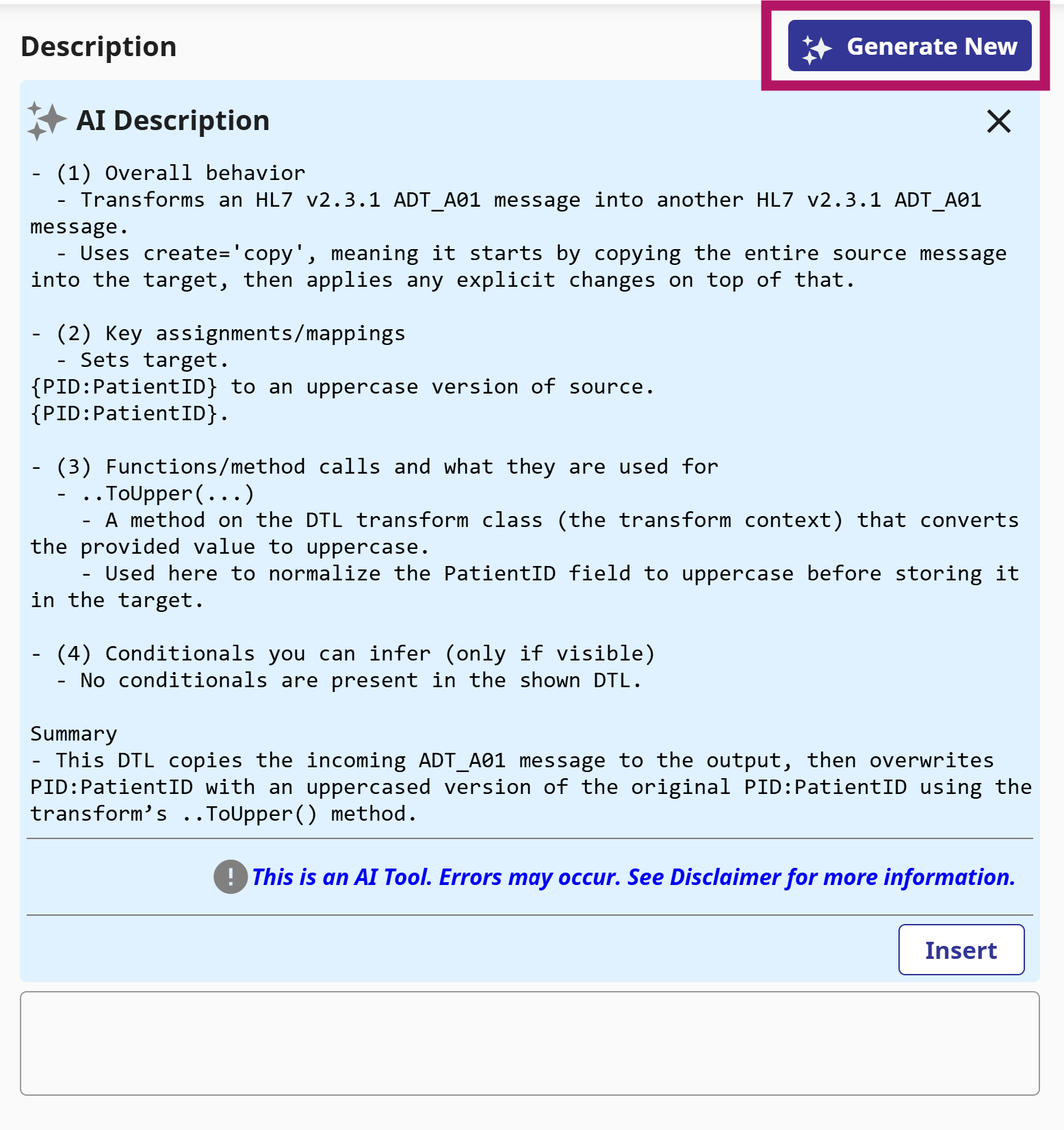
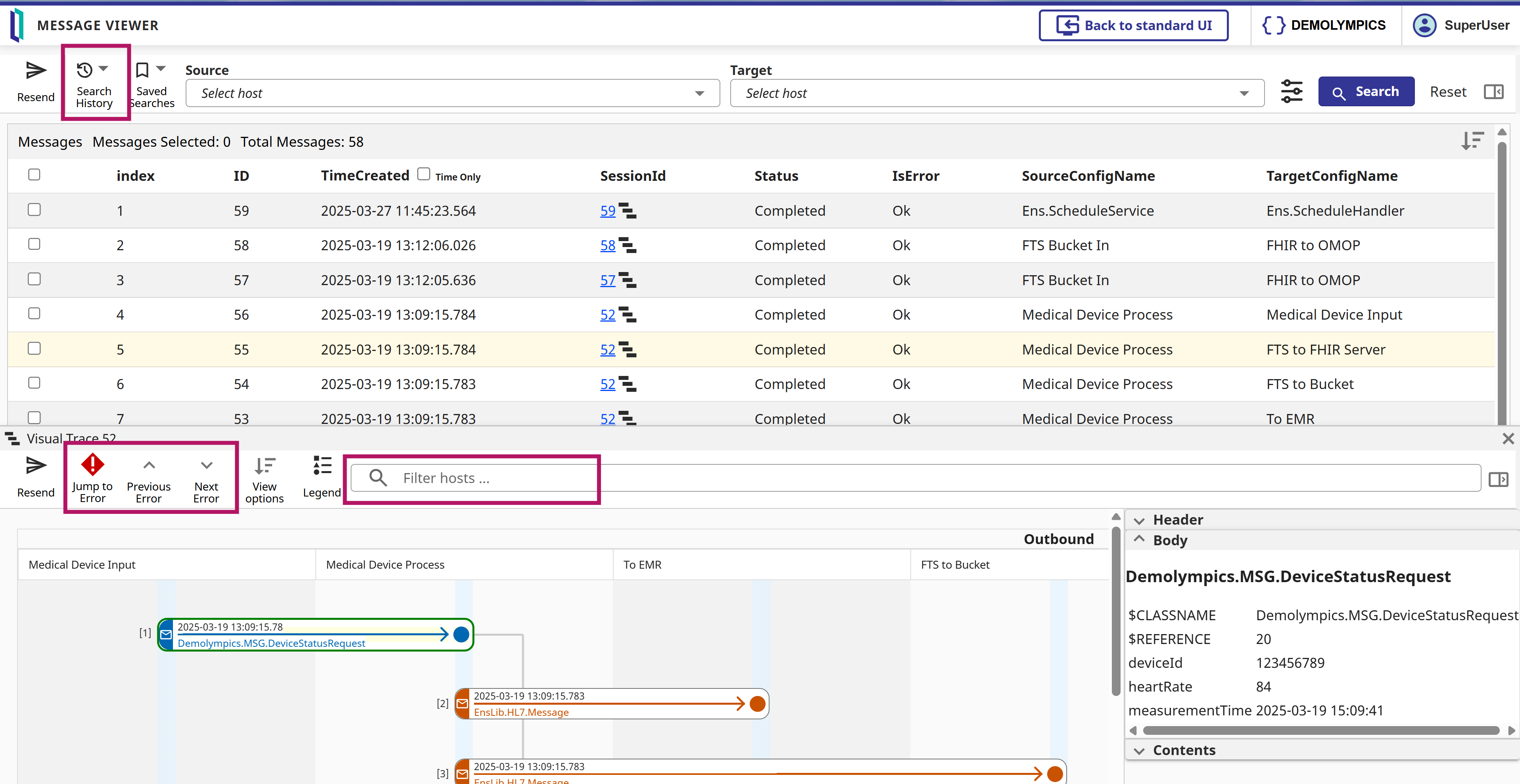
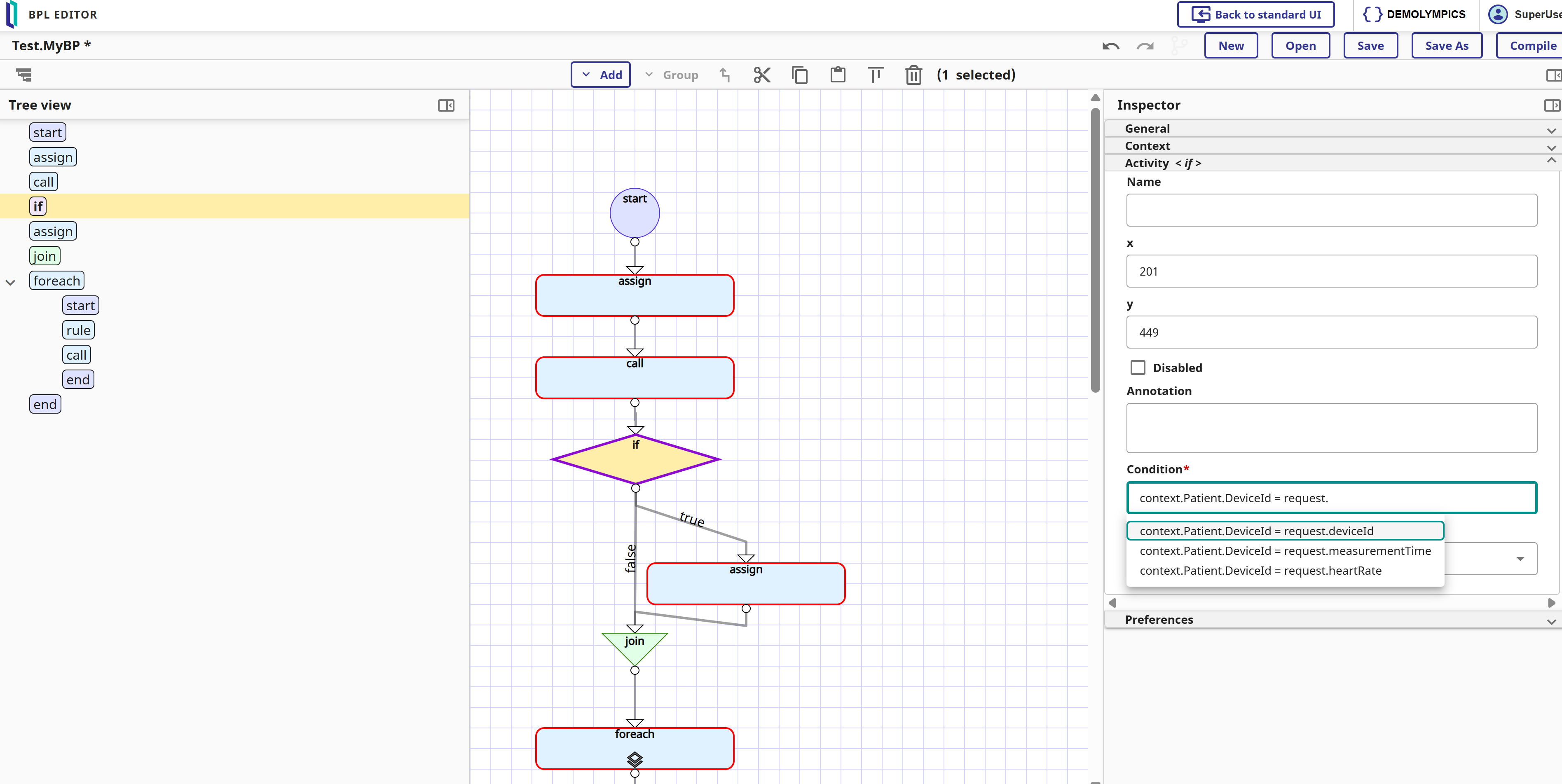
The Interoperability user interface project has continued from 2025.1 and has incorporated many of the items that you – our customers and partners – have suggested and observed.  We are continuing to invest in feedback and updating this important user experience.   In the latest release, 2025.3 for IRIS, IRIS for Health, Health Connect and Health Connect Cloud, the DTL Editor and Production Configuration applications that are available for opt-in. 
NOTE:

0
0 117