Hi Developers,
Let's meet in-person at our next Developer Meetup in Boston on March 27 5:30 pm!
>> RSVP here <<

Generative AI refers to algorithms and models in artificial intelligence that are capable of generating new data or content that is similar to existing data. These models are trained on large datasets and learn to generate new examples that mimic the patterns and characteristics of the original data.
Hi Developers,
Let's meet in-person at our next Developer Meetup in Boston on March 27 5:30 pm!
>> RSVP here <<
Hi Community,
Thank you for participating in our recent mini-contest! We received many great ideas, and we hope you enjoyed the process.
The mastermind of the winning concept will receive 5,000 points, while the astute "investors" in said concept will receive 200 points each.
The Winning Concept: Senior people loneliness
Loneliness experiences by older people and lack of conversations can negatively impact their mental well-being, concerning their families about difficulties in being able to ask for help on their own.
Hi Developers,
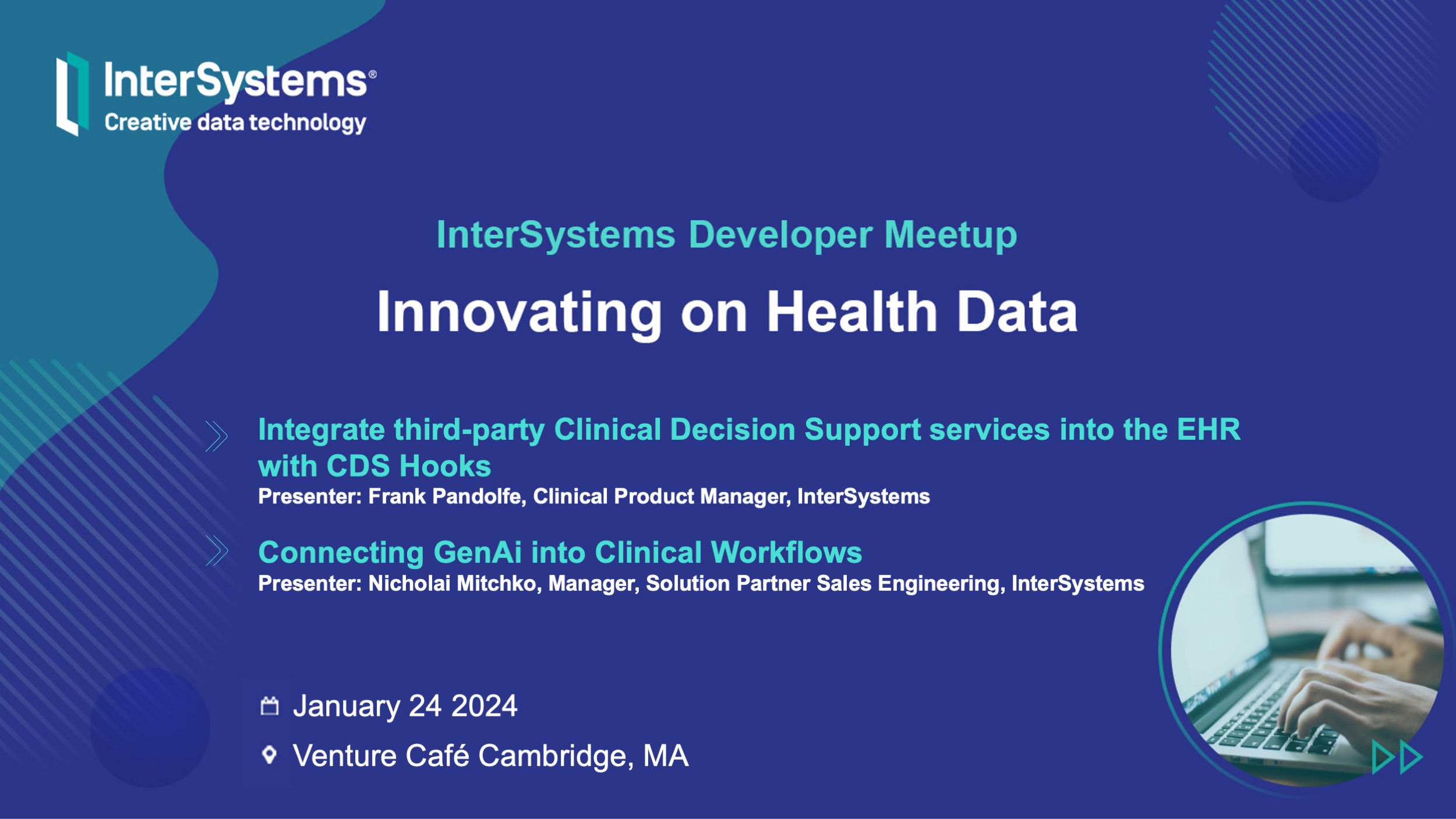
We will be hosting the first in-person meetup in 2024 in Boston on January 24. Join us to explore the latest trends, tools, and features for innovating with health data.
RSVP here
Presentations:
"Integrate third-party Clinical Decision Support services into the EHR with CDS Hooks" - by Frank Pandolfe, Clinical Product Manager, InterSystems.
"Connecting GenAi into Clinical Workflows" - by Nicholai Mitchko, Manager, Solution Partner Sales Engineering, InterSystems
 Hi Community,
Round 2 of the GenAI Crowdsourcing Mini-Contest is here! Everyone can join, even if you missed Round 1. You have $5 million in fantasy funds to invest in up to 5 promising submissions.
Dive into the game, strategically allocate your virtual investments, and aim for maximum returns! Deadline: Dec 31st, 2023
Hi Community,
Round 2 of the GenAI Crowdsourcing Mini-Contest has been extended. The new deadline for all investments is tomorrow - Friday, January 5th.
For more information on round 2, see @Alki Iliopoulou's announcement here.

Hi Community,
InterSystems Innovation Acceleration Team invites you to take part in the GenAI Crowdsourcing Mini-Contest.
GenAI is a powerful and complex technology. Today, we invite you to become an innovator and think big about the problems it might help solve in the future.
Your concepts could be the next big thing, setting new benchmarks in technology!
1.

Artificial intelligence is not limited only to generating images through text with instructions or creating narratives with simple directions.
You can also make variations of a picture or include a special background to an already existing one.
Additionally, you can obtain the transcription of audio regardless of its language and the speed of the speaker.
So, let's analyze how the file management works.
This article aims to explore how the FHIR-PEX system operates and was developed, leveraging the capabilities of InterSystems IRIS.
Streamlining the identification and processing of medical examinations in clinical diagnostic centers, our system aims to enhance the efficiency and accuracy of healthcare workflows. By integrating FHIR standards with InterSystems IRIS database Java-PEX, the system help healthcare professionals with validation and routing capabilities, ultimately contributing to improved decision-making and patient care.
Currently, many digital artists use generative AI technology as a support to accelerate the delivery of their work. Nowadays it is possible to generate a corresponding image from a text sentence. There are several market solutions for this, including some available to be used through APIs. See some at this link: https://www.analyticsvidhya.com/blog/2023/08/ai-image-generators/.
I created a new application to use in IRIS taking advantage of one of these APIs. I chose the Imagine API.
InterSystems would like to optimize IRIS to take advantage of modern CPU instruction set extensions. That’s great for product performance, but how do you know if your CPU will still be supported for new IRIS builds? Here’s how to know your CPU’s microarchitecture family as well as how to find out your CPU’s specific instruction set extensions.
I tried OpenAI GPT's coding model a couple of weeks ago, to see whether it can do e.g. some message transformations between healthcare protocols. It surely "can", to a seemingly fair degree.
It has been nearly 3 weeks, and it's a long, long time for ChatGPT, so I am wondering how quickly it grows up by now, and whether it could do some of integration engineer jobs for us, e.g. can it create an InterSystems COS DTL tool to turn the HL7 into FHIR message?
Immediately I got some quick answers, in less than one minute or two.
Yet another example of applying LangChain to give some inspiration for new community Grand Prix contest.
I was initially looking to build a chain to achieve dynamic search of html of documentation site, but in the end it was simpler to borg the static PDFs instead.
mkdir chainpdf

cd chainpdf

python -m venv .
.png)
Hi Community
In this article, I will introduce my application IRIS-GenLab.
IRIS-GenLab is a generative AI Application that leverages the functionality of Flask web framework, SQLALchemy ORM, and InterSystems IRIS to demonstrate Machine Learning, LLM, NLP, Generative AI API, Google AI LLM, Flan-T5-XXL model, Flask Login and OpenAI ChatGPT use cases.
Hi Everyone,
Join us at the online Developer Roundtable to discuss Generative AI Use Cases in Healthcare on August 31, 10 am ET.
Learn Use Cases + Reference Architecture in Healthcare, and witness the demo of LLMs. We will have time for Q&A and open discussion as usual.
Speaker: @Nicholai Mitchko , Manager, Solution Partner Sales Engineer, InterSystems
Background: Nicholai runs a team of 10 solution engineers at InterSystems that help healthcare companies design, develop, and deliver solutions at enormous scale. In his free time, Nicholai works on large language models, including developing his own models which appear on the Huggingface OpenLLM leaderboard.
See the recording on our YouTube channel:
.png)
FHIR has revolutionized the healthcare industry by providing a standardized data model for building healthcare applications and promoting data exchange between different healthcare systems. As the FHIR standard is based on modern API-driven approaches, making it more accessible to mobile and web developers. However, interacting with FHIR APIs can still be challenging especially when it comes to querying data using natural language.
Introducing the FHIR - AI and OpenAPI Chain application, a solution that allows users to interact with FHIR APIs using natural language queries.
With rapid evolution of Generative AI, to embrace it and help us improve productivity is a must. Let's discuss and embrace the ideas of how we can leverage Generative AI to improve our routine work.
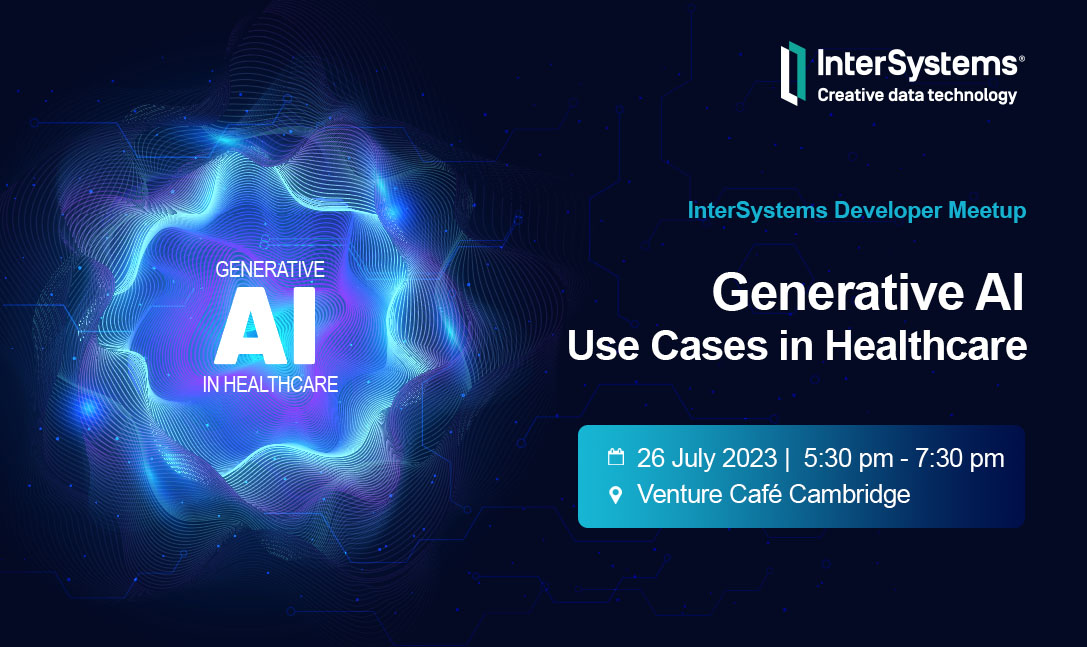
Our next Developer Meetup will take place on July 26, 17:30 pm at the CIC Venture Café in Cambridge.
Join us to learn Generative AI Use Cases + Reference Architecture in Healthcare, witness the demo of LLMs in Healthcare and share your thoughts on the topic.
As said in the previous article about the iris-fhir-generative-ai experiment, the project logs all events for analysis. Here we are going to discuss two types of analysis covered by analytics embedded in the project:
In order to extract useful data to apply analytics, we used the iknowpy library - an opensource library for Natural Language Processing based in the iKnow for IRIS Data Platform. It makes possible identifies entities (phrases) and their semantic context in natural language text in several languages.
Previous post - Using AI to Simplify Clinical Documents Storage, Retrieval and Search
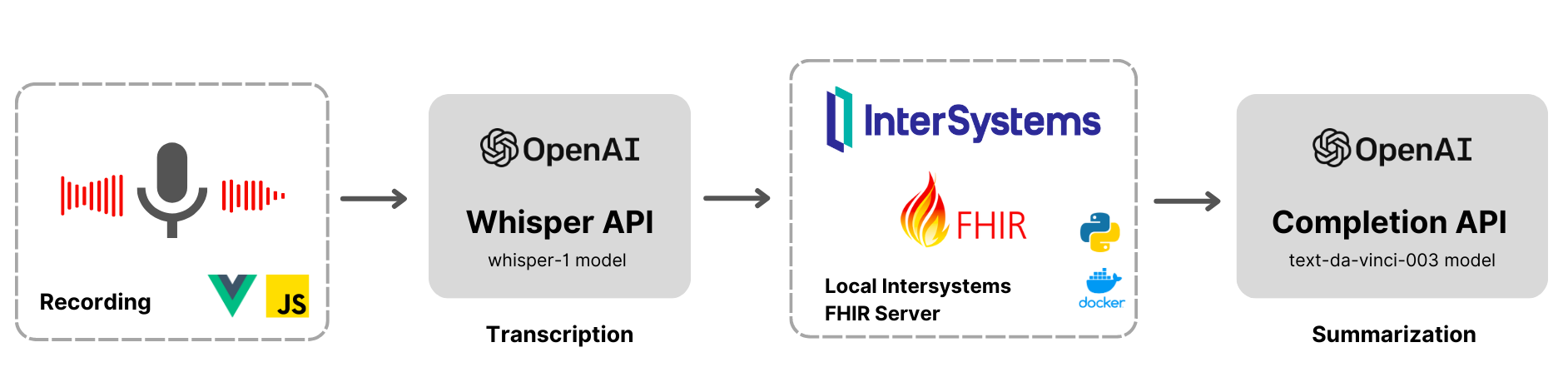
This post explores the potential of OpenAI's advanced language models to revolutionize healthcare through AI-powered transcription and summarization. We will delve into the process of leveraging OpenAI's cutting-edge APIs to convert audio recordings into written transcripts and employ natural language processing algorithms to extract crucial insights for generating concise summaries.
This project is an experiment to use OpenAI API to answer to user prompts in the healthcare domain using FHIR resources and Python code.
Generative AIs, like the LLM models available on OpenAI, has been demonstrated remarkable power to understand and answer high level questions. They use huge amounts of data to train their models, so they can answer complex questions.
They can even use programming languages to create code based on prompts - and I have to confess that the idea of getting my work automated causes me some anxiety.
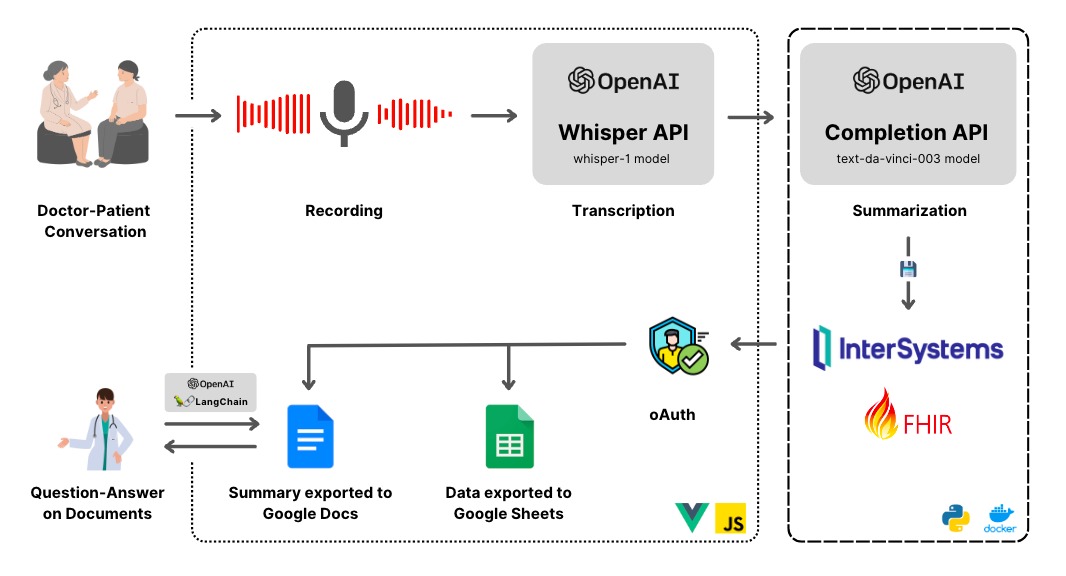
In a fast-paced clinical environment, where quick decision-making is crucial, the lack of streamlined document storage and access systems poses several obstacles. While storage solutions for documents exist (e.g, FHIR), accessing and effectively searching for specific patient data within those documents meaningfully can be a significant challenge.
AI has made document search remarkably powerful. Question and answering over docs has never been easier with open-source tools like Chroma and Langchain to store and use vector embeddings to query across Generative AI APIs.
As you all know, the world of artificial intelligence is already here, and everyone wants to use it to their benefit.
There are many platforms that offer artificial intelligence services for free, by subscription or private ones. However, the one that stands out because of the amount of "noise" it made in the world of computing is Open AI, mainy thanks to its most renowned services: ChatGPT and DALL-E.
 What is Open AI?
Hi Community!
Just want to share with you an exercise I made to create "my own" chat with GPT in Telegram.
It became possible because of two components on Open Exchange: Telegram Adapter by @Nikolay Solovyev and IRIS Open-AI by @Kurro Lopez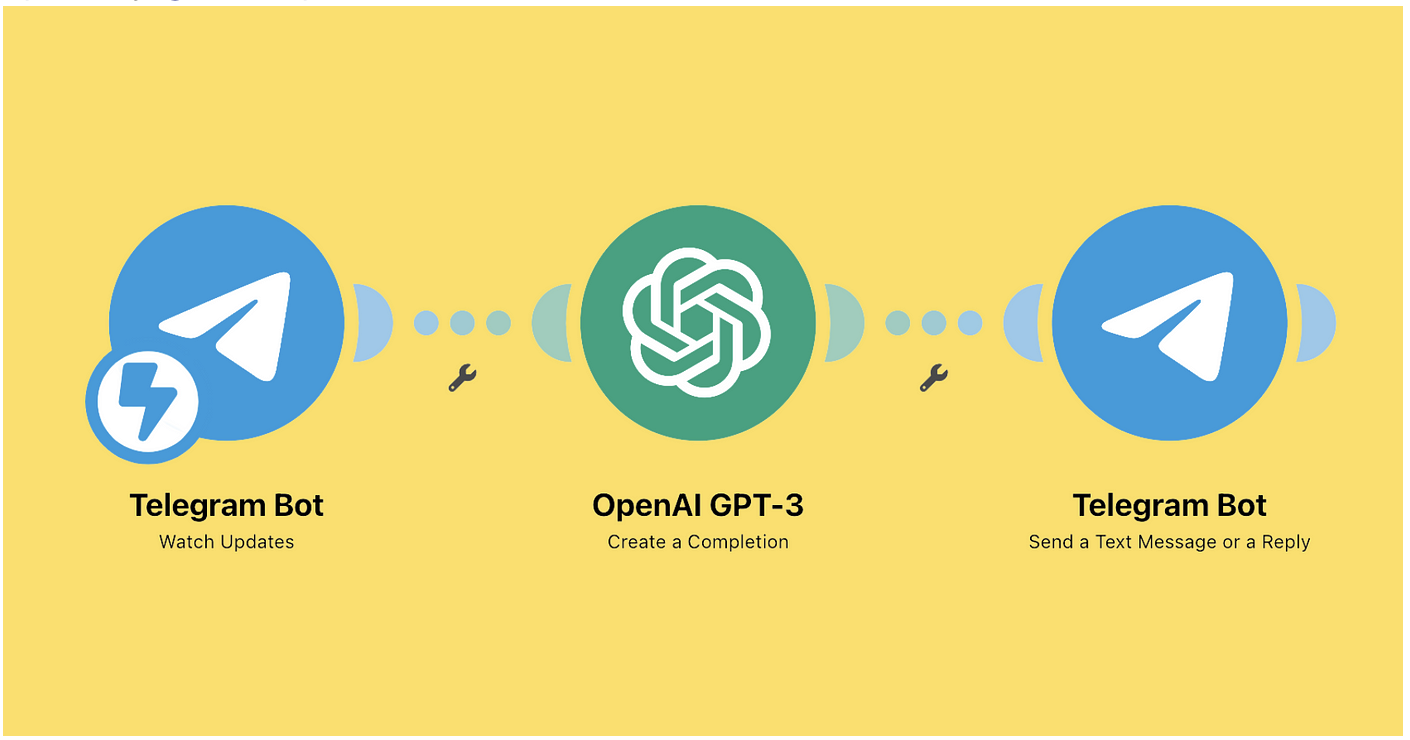
So with this example you can setup your own chat with ChatGPT in Telegram.
Let's see how to make it work!
Let's say you have Python including variable-length arguments methods. How can you call it from ObjectScript?
def test1(*args):
  return sum(args)

def test2(**kwargs):
  a1 = kwargs.get("a1",None)
  a2 = kwargs.get("a2",None)
  return a1+a2
You can call this "a.py" from ObjectScript as below. For **kwargs argument, create Dynamic Object in ObjectScript and put it into methods with <variablename>... (3 dots) format.
    set a=##class(%SYS.Python).Import("a")
    write a.test1(1,2,3)   ;; 6
    set req={}
    set req.a1=10
    set req.a2=20
write a.In recent years, artificial intelligence technologies for text generation have developed significantly. For example, text generation models based on neural networks can produce texts that are almost indistinguishable from texts written by humans.
ChatGPT is one such service. It is a huge neural network trained on a large number of texts, which can generate texts on various topics and be matched to a given context.
A new task for people is to develop ways to recognize texts written not only by people but also by artificial intelligence (AI).
Keywords: ChatGPT, COS, Lookup Table, IRIS, AI
Here is another quick note before we move on to GPT-4 assisted automation journey. Below are some "little" helps ChatGPT had already been offering, here and there, during daily works.
And what could be the perceived gaps, risks and traps to LLMs assisted automation, if you happen to explore this path too. I'd also love to hear anyone's use cases and experiences on this front too.
One of the simplest tasks could be Lookup tables.
Large language models are stirring up some phenomena in recent months. So inevitably I was playing ChatGPT too over last weekend, to probe whether it would be a complimentary to some BERT based "traditional" AI chatbots I was knocking up, or rather would it simply sweep them away.
A thought comes to mind while playing. By going slightly theoretical or philosophical, eventually interoperability standards such as HL7 and FHIR etc are kind of "languages", right? HL7 has its own grammar, rules, vocabulary and even dialects - every system speaks its own tone.
After seeing several article raving about how ground-breaking the recent release of ChatGPT is, I thought I would try asking it to help with a Caché newbie question: How do you find the version of InterSystems Caché?
To be honest, I was quite surprised at what the chat bot told me: