Is there a way for me to break down the what contributes to the 100% highest license use so i can clearly analyze what processes or user has consume these licenses which cause the 100% license usage?
We have an application that is logged using AWS SSO. We are passing username and password from the AWS SSO to our application for validating the user. But what we need is, we need to login to application without using the password. Is there any possible way available for this?
select vet.ID, svp.ID_PACIENTE, vet.conselho, vet.uf, vet.numConselho, vet.nome, svp.SEQ_SOLICITANTE, vet.numConselho , vlab.numConselho
from RPE.Veterinario vet
inner join RPE.VeterinarioLab vlab
    ON vet.conselho = vlab.conselho
    AND vet.numConselho = vlab.numConselho
    AND vet.uf = vlab.uf
left join MySevi.SolicitanteVeterinarioPaciente svp
    on svp.ID_VETERINARIO = vet.ID
where svp.ID_PACIENTE in ('6408||284144||47633', '6408||284145||47634')
How can you find referenced entries in a table that have been deleted with the drop column? I have to find all fields in the database afterwards and then delete them properly. Has anyone had this problem yet? Can the information be found in the class or storage definitions?
After linking in Oracle Table with Field Column's Data Types of NUMBER, my updates into these table fields are resulting in data that is being rounded to 2 decimal places. I insert a record with 1234.1234 and 1234.12 is stored.
It appears Cache xDBC might be manipulating my values prior to sending to Oracle. Is there a setting or system parameter that is controlling this? If so, is there a way to relax this from occurring so the values I send are being stored in Oracle with the same values?
In Html sometimes we need to use entities code for don't have problems with browsers all over the world. Ex. 'á' is converted to code: 'á' / 'é' is converted to 'é'.
I have a question, how can i convert a string like my name to this type of code? Ex. "Flávio" will be "Flávio". I tried this way:
When used in certain Deltanji workflows, triggering an automatic checkout on first keystroke could result in the developer working on an outdated copy of the code and only being notified of this later when saving their changes. In order to prevent this from happening checkout now reloads the document immediately.
Error messaging has been improved in two areas - when attempting to cancel code that is not checked out, and when trying to register new code onto a withdraw system.
We have also improved interoperability between the Deltanji extension and the InterSystems ObjectScript one, as well as its handling of multi-component objects.
If you're already a user of Deltanji then your extension with automatically update. You can find out more information on Deltanji and the latest release here.
I'm trying to implement an OAuth2 server, but I have som issues when trying to setup JWT under OAuth 2.0->Client.
I get the error message saying "No match between server name 'localhost' and SSL certificate values 'cache'". I have set up a SSL/TLS configuration as simple as possible without any certificate files. I'm accessing my server via HTTPS with an unsigned certificate.
Can anyone point me in the right direction on how to resolve the issue I'm encountering.
My objective is to find routine's Date/Time Saved someplace inside Cache. The routine's Date/Time Modified as returned by various queries like %Library.RoutineIndex and as seen on the File Open screen is actually Date/Time Compiled last, not Date/Time Saved last. Does anyone know if Date/Time Saved is created when the Save icon is pressed or the routine is imported? Such a timestamp should be immune to subsequent compilations with no changes.
In a typical database, changing the type of a column from some kind of date/time to a string would require a degree of migration effort for existing values. In Caché, my suspicion is that this is not the case, and I could simply change a property definition from %Timestamp to %String (MAXLEN = "30") and recompile, without needing to worry about damaging the existing data stored for this property. Is this correct? Or would I find the existing data in this property being lost or corrupted?
How strange this is to me. I'm querying a table against a numeric(15,2) column call max_client_resp_service. When I query max_client_resp_service > 0 or any number, I get results, but they are not always right, for example where max_client_resp_service > 5 returns values less than 5, e.g.


 By update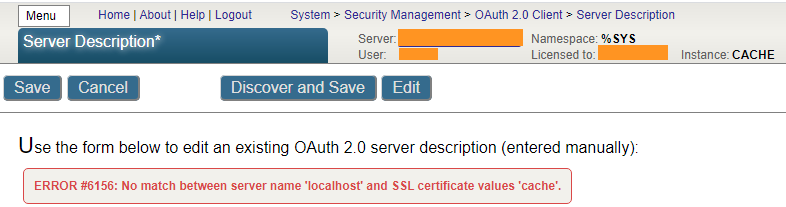
 Open Exchange app