Hi Developers!
I'm pleased to present to you a new feature of Open Exchange - ZPM Package Manager support!
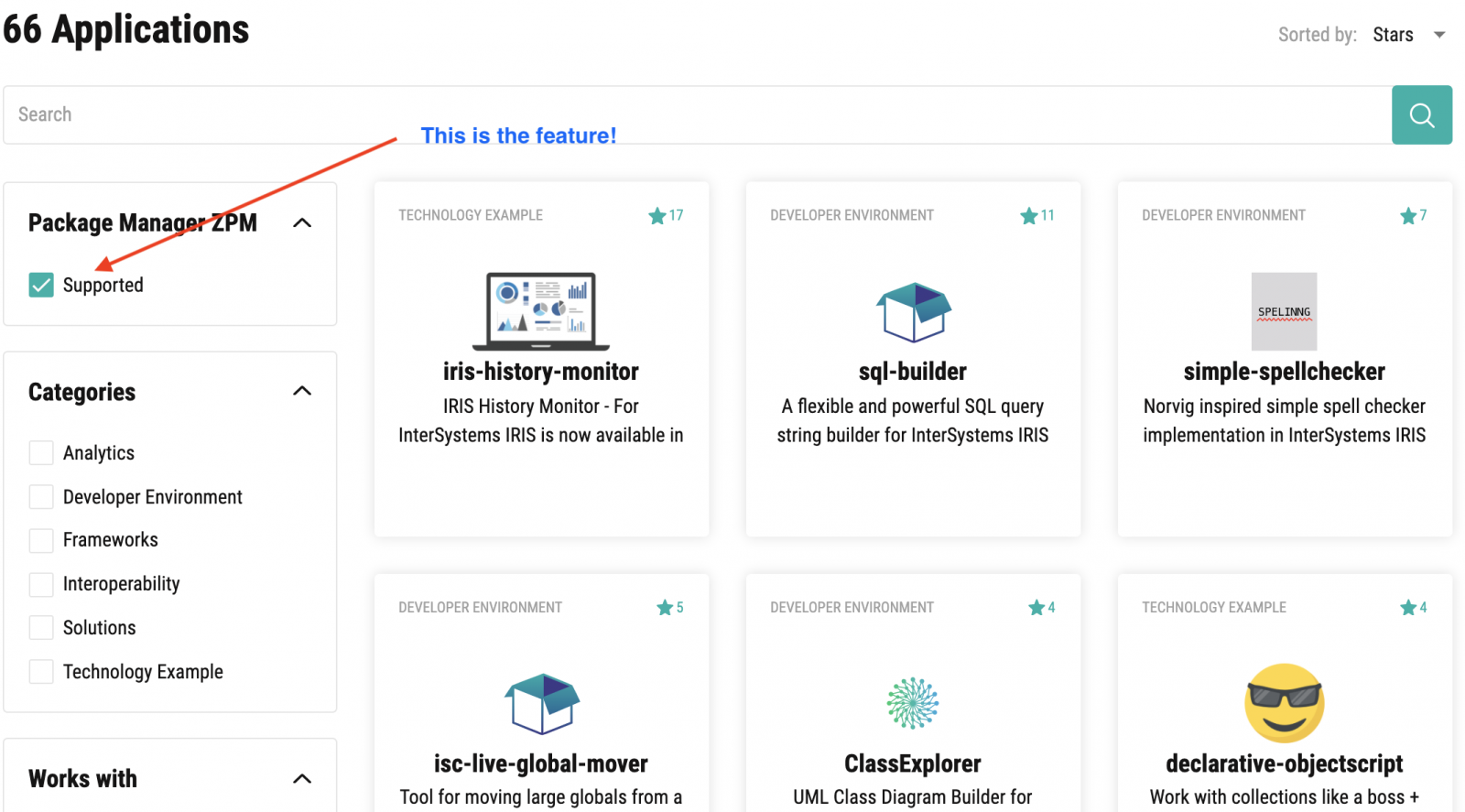
What's about it?
Hi Developers!
I'm pleased to present to you a new feature of Open Exchange - ZPM Package Manager support!
What's about it?
Hello
This is Shashank with Randstad. I am working on to fill Cache ObjectScript Developer role with our direct client in USA. Please let me know if anyone would be interested and can contact me through email: shashank.gundu@randstadusa.com
Thanks
Using the community edition of IRIS, how do I read the HealthShare and Trak doc?
Hi, what’s the syntax for picking up low/high cases?
I have tried
*.zip;*.ZIP
But, it’s not working any pointers much appreciated.
GA releases are now available for the first version (v1.0) of InterSystems System Alerting and Monitoring (InterSystems SAM for short)
InterSystems SAM v1.0 provides a modern monitoring solution for InterSystems IRIS based products. It allows high-level views of clusters and single-node drilled down metrics-visualization together with alerts notifications. This first version provides visualization for more than one hundred InterSystems IRIS kernel metrics, and users can extend the default-supplied Grafana template to their liking.
V1.0 is meant to be a simple and intuitive baseline.
If you found your way here you’re one of the people who’ve been asked to work from home for the time being. At this point we don’t know how long the crisis is going to last or even how the situation is going to look in a few weeks. Nevertheless you need to get your work done. You rarely worked from home before and now you are faced with a number of challenges. Let’s talk a bit about what’s going to keep you sane on the home front.
You shouldn’t. You can. Nobody is forcing you.
Hi,
A device is sending me HL7 messages (ORM^O01)
the framing is set to "None"
and i get the following error:
3 Segments
Build Map Status = 'ERROR <EnsEDI>ErrMapRequired: Missing required PID element at segment 2 (PID)'
'ERROR <EnsEDI>ErrMapRequired: Missing required OBR element at segment 2 (PID)'
'ERROR <EnsEDI>ErrMapSegUnrecog: Unrecognized Segment 2:'PID' found after segment 1 (MSH)'
i seems that there framing chars in at the beginning and end of each segment
(in Hex)
0b (MSH DATA HERE) 1c 0d 0b (PID DATA HERE) 1c 0d 0b (OBR DATA HERE) 1c 0d
i have tried all the Framing options of no
Hi Developers!
The InterSystems IRIS AI Contest is over. Thank you all for participating in our IRIS AI Competition!
And now it's time to announce the winners!

A storm of applause goes to these developers and their applications:
Hi Community!
Please welcome the next video from Global Summit 2019 on InterSystems Developers YouTube:
It would be interesting if there is some recommended documentation about best practices using Healthshare for interoperability.
Also, some how-tos or frequently asked questions about ObjectScript.
Or event better, if there are experienced developers who would like to share some common habits on their work with Studio / ObjectScript, which are valuable to do the developing work better.
For example, How to get the XML of a class and write it into a REST operation:
...
set status=wri
This is a sample to use %JSON.Adaptor class available in IRIS to produce a snapshot of your object.
The sample consists of 2 classes that are variations of what was known in Caché/SAMPLES as Sample.Person.
Be aware that the possibilities are limited by %JSON.Adapter and how you make use of it.
Once in place, you create some test data by Populate().
You select an object and take a snapshot.
You apply changes to your object and take another snapshot.
And see the difference.
BINGO!
It's also an example of a customized SystemFunction extension (ZZISJSON) in Caché & IRIS
This time it is to be included in %ZLANGF00.mac
A JSON string is mostly imported from a file or over REST
You rely on a clean and compatible structure. This is the check.
required: ZPretty.mac
demo
USER>ZWRITE jsn
jsn="{"Name":"Li,Robert K.","SSN":"672-92-9664","DOB":"1975-01-12","Home":{"Street":"986 Washington Blvd","City":"Boston","State":"PA","Zip":"95802"},"Office":{"Street":"6012 First Place","City":"Reston","State":"MT","Zip":"77739"},"Spouse":{"Name":"Avery,Zelda H.t's also an example for a customized command extension (ZZJSN) in Caché & IRIS
This is the Caché version for fast JSON formatting but it also works in IRIS.
Requires package ZPretty
To allow parallel existence in IRIS this is named ZZJSN
see:
USER>ZWRITE jsn
jsn="{"Name":"Li,Robert K.","SSN":"672-92-9664","DOB":"1975-01-12","Home":{"Street":"986 Washington Blvd","City":"Boston","State":"PA","Zip":"95802"},"Office":{"Street":"6012 First Place","City":"Reston","State":"MT","Zip":"77739"},"Spouse":{"Name":"Avery,Zelda H.Hi,
Recently I have encountered a new issue, more and more 3rd party applications move to the cloud.
Web-hooks incoming from their sites can no longer be identified using a known and fixed IP address, so our customer's security department blocks them.
In past similar cases we use to grant access in the customer's Fire-Wall to the specified IP address - this is no longer applicable.
Has anyone else encountered this problem ? do you have any ideas ?
Thanks
t's also an example for a customized command extension (ZZJSON) in IRIS
IRIS has a nice %JSON.Formatter class.
But for debugging it is not really handy.
see:
ZWRITE js1
js1="{""Name"":""Cunningham,John C."",""SSN"":""294-11-9150"",""DOB"":""1933-01-08"",""Home"":{""Street"":""4249 Ash Street"",""City"":""Tampa"",""State"":""MD"",""Zip"":""30176""},""FavoriteColors"":\[""White"",""Red"",""Green""]}"
so you proceed for the most simple case
set formatter=##class(%JSON.Formatter).%New()
do formatter.Format(js1)
{
"Name":"Cunningham,John C.Henry Elliott is currently recruiting for Sr. Developers with InterSystems technology stack experience including Cache, IRIS for Health, HealthShare, Ensemble. Experience in any of the following preferred: FHIR, AWS, VA VistA, APIs, RPCs. These are remote opportunities. Please send resume to Mary Pion- mpion@henrye.com or call me at 781-416-9915 to discuss further.
It is a classic Global Mapping exercise presenting ^SPOOL as Class / Table
Device #2 named SPOOL dates back to the predecessors of Caché and IRIS
It was the first "%Stream" like option to buffer output before printing.
It is also the first and till today the most simple way of output redirection.
This is also an example of a mapped Global.
USE 2 redirects the output into the Global ^SPOOL
You can read the global manually or with some ancient utilities
or use this mapping to access it as class or a SQL table.
Hi,
I am attempting to set up a security role for our support team so they can have read access to the production and messages.
I have given the role RW rights on the resource associated with the database. However, when I log into Management Portal and select "Ensemble", the "Available Ensemble namespaces" list is empty.
What permissions do i need to set to be able to navigate to the production?
Hi
What would be the best way to restrict use of a set of SOAP services so that they could only be called from specific white-listed IPs?
Thanks
This is my introduction to a series of posts explaining how to create an end-to-end Machine Learning system.
Our IRIS Development Community has several posts without tags or wrong tagged. As the posts keep growing the organization of each tag and the experience of any community member browsing the subjects tends to decrease.
We can think some usual solutions for this scenario, like:
The guide “Extending Languages with %ZLANG Routines”
Tells you all details you need to know to extend your programming language.
EXCEPT: How to do it in a clean way.
This example of a %ZLANGC00.mac may show a possible approach
to get an easy to overview and to manage setup.
With less than 50 lines of code you might not be affected.
But if your Studio shows close to 1000 rows or more you may get in troubles.
My recommendation is simple.
Instead of adding line-by-line commands and it's code
you isolate each command and its code into a separate Include file.
Sapphire has CSV import, create and train IntegratedML model and I will create more features. See the pool. Check sapphire in https://openexchange.intersystems.com/package/SAPPHIRE
Hey Developers!
This week is a voting week for the InterSystems IRIS AI Programming Contest!
So, it's time to give your vote to the best AI- and ML-enabled solution on InterSystems IRIS!
🔥 You decide: VOTING IS HERE 🔥

How to vote? This is easy: you will have one vote, and your vote goes either in Experts Nomination or in Community Nomination.
IRIS and Caché / Ensemble offer the possibility to add Languages Extension as SystemFunctions, SystemVariables, SystemCommands
The related documentation tells you where to add the system-wide extension. Parameter passing is not covered explicitly.
Currently, the process of using machine learning is difficult and requires excessive consumption of data scientist services. AutoML technology was created to assist organizations in reducing this complexity and the dependence on specialized ML personnel.
AutoML allows the user to point to a data set, select the subject of interest (feature) and set the variables that affect the subject (labels). From there, the user informs the model name and then creates his predictive or data classification model based on machine learning.
Hi Developers,
Please welcome the new video, specially recorded by @José Pereira for the InterSystems IRIS AI Programming Contest:
Hi Team,
When I tried to open ensemble in my system I got bellow error.
I have done lots of code in my local system but now not able to open the ensemble.
.png)
.png)
GA releases are now published for the 2020.2 version of InterSystems IRIS, IRIS for Health, and IRIS Studio!
A full set of containers for these products are available from the WRC Software Distribution site, including community editions of InterSystems IRIS and IRIS for Health.
The build number for these releases is 2020.2.0.211.0.
InterSystems IRIS Data Platform 2020.2 provides an important security update with the following enhancements:
InterSystems IRIS for Health 2020.2 includes all of the enhancements of InterSystems IRIS.
This is the second post of a series explaining how to create an end-to-end Machine Learning system.
The InterSystems IRIS already has what we need to explore the data: an SQL Engine! For people who used to explore data in csv or text files this could help to accelerate this step. Basically we explore all the data to understand the intersection (joins) which should help to create a dataset prepared to be used by a machine learning algorithm.