Hi guys,
It's FHIR contest and this time, they provided something really cool: FHIRaaS
And to be part of this, @José Pereira and I team up (again) to deliver something easy to use and easy to understand how we did.
Hi guys,
It's FHIR contest and this time, they provided something really cool: FHIRaaS
And to be part of this, @José Pereira and I team up (again) to deliver something easy to use and easy to understand how we did.
In the first article, a simple tutorial helped you to set up your FHIRaaS deployment.
Now, let's move forward and introduce a JS library to access the FHIR resource.
In the end, two examples of usage of this library will be presented, exploring the Appointment FHIR resource type.
FHIR is a REST API, so you can use any HTTP client in order to use it. But, it’s always a good idea to have help.
Furthermore, there is a cool initiative called SMART which aims to provide standards for easy access to health data stored over health systems.
This article aims to provide an overview of InterSystems IRIS FHIR Accelerator Service (FHIRaaS) driven by the implementation of application iris-on-fhir, available in OEX developed for the FHIRaaS contest.
A basic tutorial will guide you in configuring a function FHIRaaS deployment, including an API key and an OAuth 2.0 server.
A library to use FHIR resources through FHIRaaS also is briefly discussed.
Finally, some features of the iris-on-fhir application are shown in separted articles. You can check out the full code at the application’s github repository.
I'm probably missing something really basic here -
It seems to connect OK; I can see the %SYS and USER namespaces. I clicked the "edit code in namespace" button and created a bit of hello world code. However, when I try to save it, I get "failed to save file 'filename.mac' on the server.
Is there a way to add/substract from a pivot variable?
I have this MDX:
SELECT
  NON EMPTY [DateOfSale].[Actual].[YearSold].&[$variable.Year] ON 0,
  NON EMPTY [Product].[P1].[Product Name].Members ON 1
FROM [HOLEFOODS]
And with pivot variable Year equal to, say, 2016 it works:
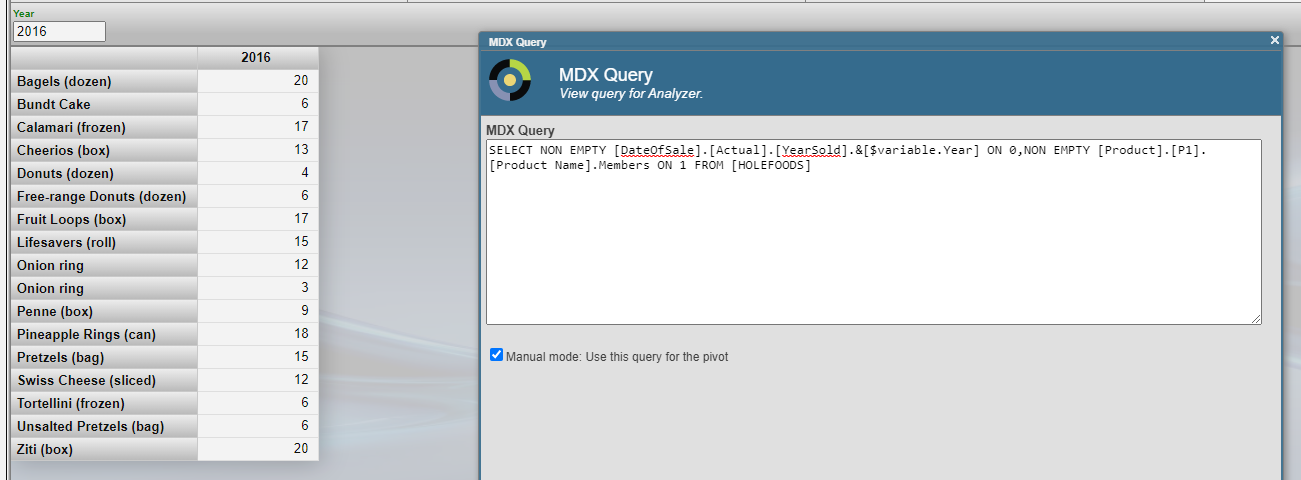
Now I want to add previous year first with one pivot variable and one explicit reference. It also works:
SELECT
  NON EMPTY
  {
    [DateOfSale].[Actual].[YearSold].&[$variable.Year],
    [DateOfSale].[Actual].[YearSold].&[2015]
  } ON 0,
NON EMPTY [Product].[P1].[Product Name].In this article, I will show how you can easily containerize .Net/Java Gateways.
For our example, we will develop an Integration with Apache Kafka.
And to interoperate with Java/.Net code we will use PEX .
Our solution will run completely in docker and look like this:
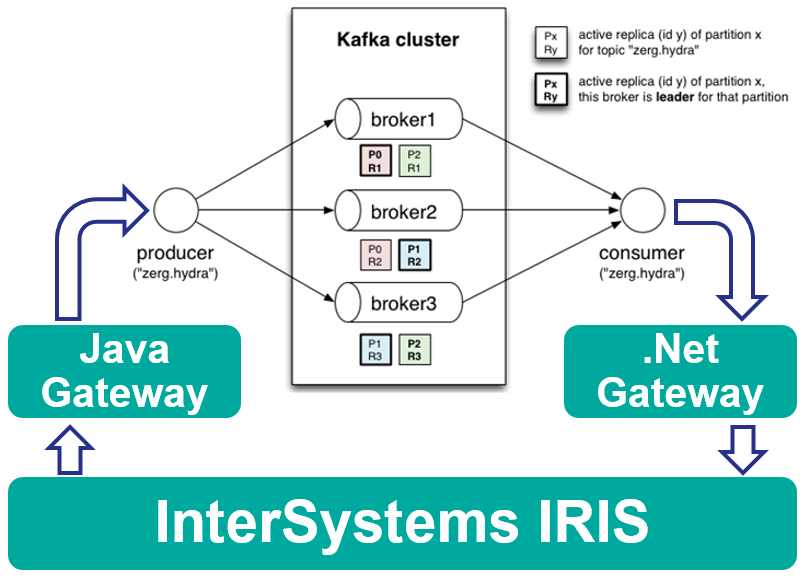
First of all, let's develop Java Operation to send messages into Kafka. The code can be written in your IDE of choice and it can look like this.
In short:
Is there a way in BI (DeepSee) to compare current value, to a value of a previous year?
For example I can hardcode this explicitly:
.png)
But I want in a widget to filter by year (1st column) and get the value for a previous year in a next column. YTY would be even better.
What MDX functions should I use? Examples?
Episode 19 of Data Points features a conversation with Benjamin De Boe about the 2021.1 release of InterSystems IRIS! The conversation covers new improvements in analytics, business intelligence, machine learning, development gateways, FHIR capability, and more.
This time I want to talk about something not specific to InterSystems IRIS, but that I think is important if you want to work with Docker and your server at work is a PC or laptop with Windows 10 Pro or Enterprise.
As you likely know, containers technology comes basically from Linux world and, nowadays, is on Linux hosts were it shows maximum potential. Those who use Windows on a normal basis see that both, Microsoft and Docker, have done important efforts during these last years that allow us to run containers based on Linux images on our Windows system in a really easy way... but it's something not supported for production systems and, this is the big problem, is not reliable if we want to keep persistent data outside of containers, in the host system,... mostly due to the big differences between Windows and Linux file systems. In the end, Docker for Windows itself uses a small linux virtual machine (MobiLinux) to run the containers... it does it transparently for the windows user... and it works perfectly well if, as I said, you don't require that your databases survive longer than the container...
Well,...let's get to the point,... the point is that many times, to avoid issues and simplify, we need a full Linux system and, if our server is based on Windows, the only way of having it is through a virtual machine. At least till WSL2 in Windows is released, but that will be another story and sure it'll take a bit of time to become robust enough.
In this article, I'll tell you, step by step, how to install an environment where you'll be able to work, if you need it, with Docker containers on an Ubuntu system in your Windows server. Let's go...

What’s new from InterSystems Learning Services? Be the first to know – subscribe to the monthly Learning Newsletter! Read May's newsletter and subscribe.
Hello All,
InterSystems Certification has developed a certification exam for HealthShare Patient Index and, if you match the exam candidate description given below, we would like you to beta test the exam.
Hey Developers,
Here is a digest of the Developer Community videos on InterSystems Developers YouTube Channel in May 2021:
Hi guys,
How can we remove a business host from a running production?
I've read and tested how to add it to a production, while when I try to remove it from the production with the following codes:
Set tSC = $$$OK
    Set prodName = "CDRDemo.DemoProduction"
    Set confName = "TEST1"
    Set className = "Demo.LISClient.Operation.PatientOperation"
    #Dim prodConf As Ens.Config.Production = ##class(Ens.Config.Production).%OpenId(prodName)
    Set itemId = ""
&SQL(Select ID into :itemId from Ens_Config.I've poked through the class documentation and globals and I can't seem to find what I'm looking for, namely a mechanism that will give me the PropName key and value for each of the Items in an EnsLib.HL7.SearchTable definition. Is there some sort of query that will turn the list of Items in the XData SearchSpec section into a key/value pair of some sort?
For example:
<Items>
<Item DocType="" PropName="MSHTypeName" Unselective="true">{1:9.1}_"_"_{1:9.I've been tasked with an interface that needs to supply some additional metadata for the indexing of HL7v2 messages. After toying with a couple of ideas, I thought that it would be useful to subclass EnsLib.HL7.Message, add a %DynamicObject property, and store the metadata in it (it ends up getting sent to the target in JSON form anyway).
And, well, it seems to work just fine ... so far.
I seem to remember that %DynamicObjects are not persistent, and for that reason not something you would normally stuff into a database.
When using Studio, ODBC or a terminal connection to Caché or Ensemble, you may have wondered how to secure the connection. One option is to add TLS (aka SSL) to your connection. The Caché client applications - TELNET, ODBC and Studio - all understand how to add TLS to the connection. They just need to be configured to do it.
Configuring these clients is easier in 2015.1 and later. I'm going to be discussing this new method. If you're already using the old, legacy method, it will continue to work, but I would recommend you consider switching to the new one.
I need assistance to delete an instance of HealthShare that I am sure it way out of date. From the VM Server Control Panel when I try to Uninstall, I get the error Message: "Error: Could not detect INSTANCE name!"
Are there commands in SQL that may help uninstall the instance of the application? Other Suggestions?
Hello,
We have a need to track Database changes over time - down to the SQL level of granularity if possible. Such as: User xyz runs routine ^abc and we get something similar to a changelog that tells us: table A had this value updated, insert, update etc....
Is that possible using IRIS level tools (Audit Log, Journal File, etc...) , is there a way to convert the global sets and kills from the journals into SQL level changes?
I also found a third-party java-based tool named Liquibase , but it seems more oriented to tracking schema and table based changes or pre-defined definitions.
Thanks,
James
Hi Community,
Please welcome the new video on InterSystems Developers YouTube:
Hey Community,
Please join the next InterSystems online programming competition:
🏆 InterSystems FHIR Accelerator Programming Contest 🏆
Submit an application that uses InterSystems FHIR-as-a-service on AWS or helps to develop solutions using InterSystems IRIS FHIR Accelerator.
Duration: May 10 - June 06, 2021
Total prize: $8,750
👉 Landing page 👈

Is there an option to change the favicon, once user logs into Clinical Viewer.
Its available by default under this path.
"/csp/healthshare/hssys/hsnavigation/ui/favicon.ico"
Hi,i have created a simple production with:
Business Service-EnsLib.HL7.Adapter.TCPInboundAdapter
Business Process - EnsLib.HL7.MsgRouter.RoutingEngine
Business Operation - EnsLib.SQL.OutboundAdapter
the sending application requires a ACK wich is different than the ACK i choose from in the AckMode settings of the Business Service.
How do i create a custom ACK?
Thanks
Hi community,
I am in the process of building a React Native Application for a restaurant.
I am not quite sure if we can use IRIS as the main database for this and if there is a possibility I am not quite sure how to do it.
If there is a possibility could some one help me out with it please?
Or do you think using AWS is a better choice?
Please let me know your ideas and guidelines in the comments or please feel free to reach out to me directly.
Hoping to hear soon.
Regards.
What is the syntax in Zen PDF Reports to form feed between tables?
HA backup strategy
we use Rose to do HA with cache2016.2, the database is placed on the hard disk array, which is essentially an instance, and the same array disk is mounted by rose switch, another mirror machine is made.
Is there any problem with this structure for disaster recovery and backup, I hope to give some advice. Thanks!
All source code to the article is available at: https://github.com/antonum/ha-iris-k8s
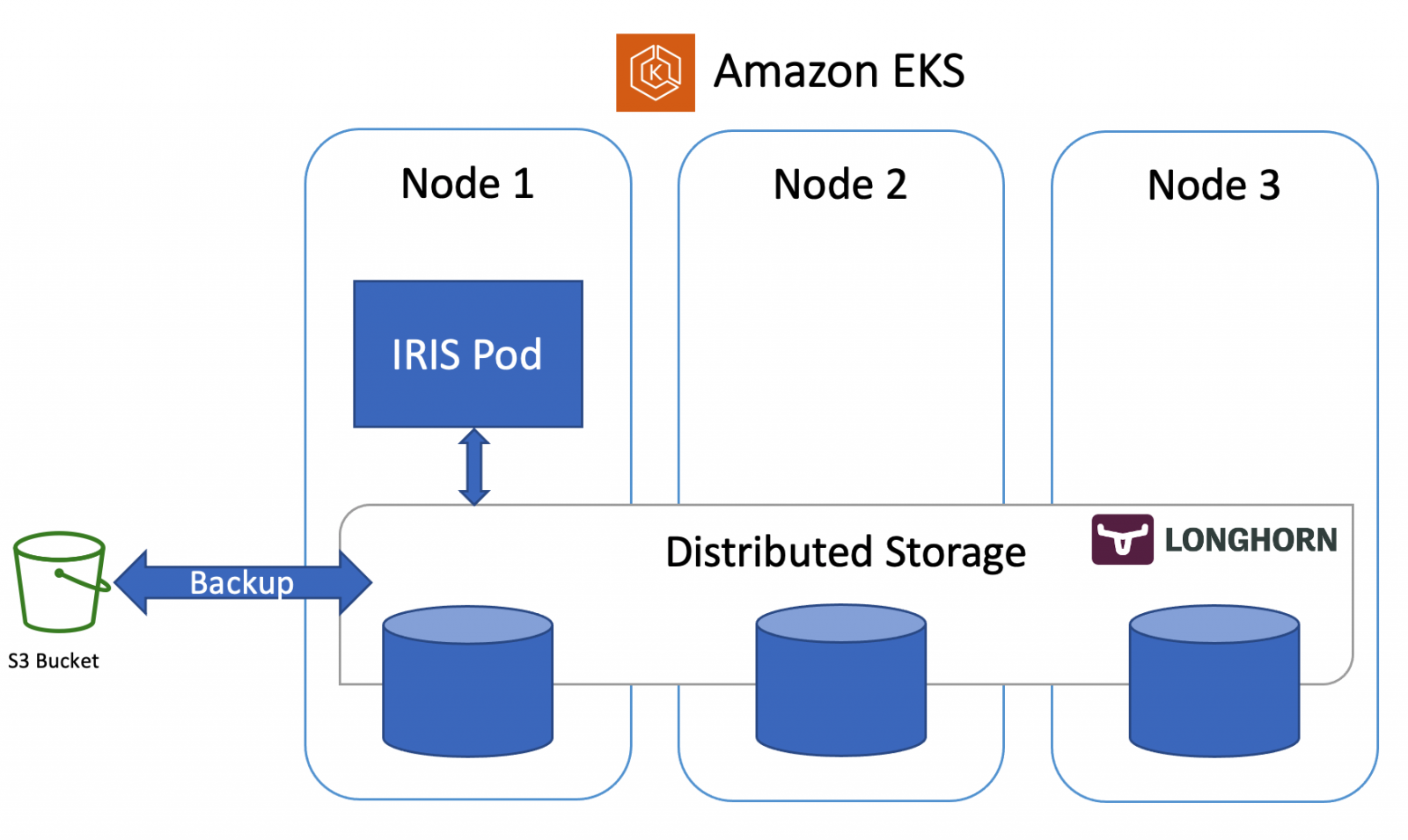
In the previous article, we discussed how to set up IRIS on k8s cluster with high availability, based on the distributed storage, instead of traditional mirroring. As an example, that article used the Azure AKS cluster. In this one, we'll continue to explore highly available configurations on k8s. This time, based on Amazon EKS (AWS managed Kubernetes service) and would include an option for doing database backup and restore, based on Kubernetes Snapshot.
Let's get right to business.
Hello,
First of all thank you for reading this question
Also thank you for giving an answer
We would need some help
Our objective is to spot all REST Services in a namespace
➡️ How could we detect all services with AdapterClassname = EnsLib.HTTP.InboundAdapter , in an automatic way, in a namespace?
Does InterSystems IRIS will support Visual Studio 6.0 Enterprise Edition (Visual Basic)?
We are in the process of transitioning Intersystems Cache 2017 to Intersystems IRIS 2020 version.
For terminal based applications we can able to use the same DAT file used for Cache with minor changes.
For Web based we are using Visual studio 6.0(Visual Basic). Will IRIS supports Visual Studio 6?
While I am configuring from that GUI application, I am getting the error like, Access Denied or No connection could be established. Same configuration followed in Cache that works.