Article Muhammad Waseem · Dec 8, 2025 4m read


Apache Airflow is the leading open-source platform to programmatically author, schedule, and monitor data pipelines and workflows using Python. Workflows are defined as code (DAGs), making them version-controlled, testable, and reusable. With a rich UI, 100+ built-in operators, dynamic task generation, and native support for cloud providers, Airflow powers ETL/ELT, ML pipelines, and batch jobs at companies like Airbnb, Netflix, and Spotify.

Airflow Application Layout
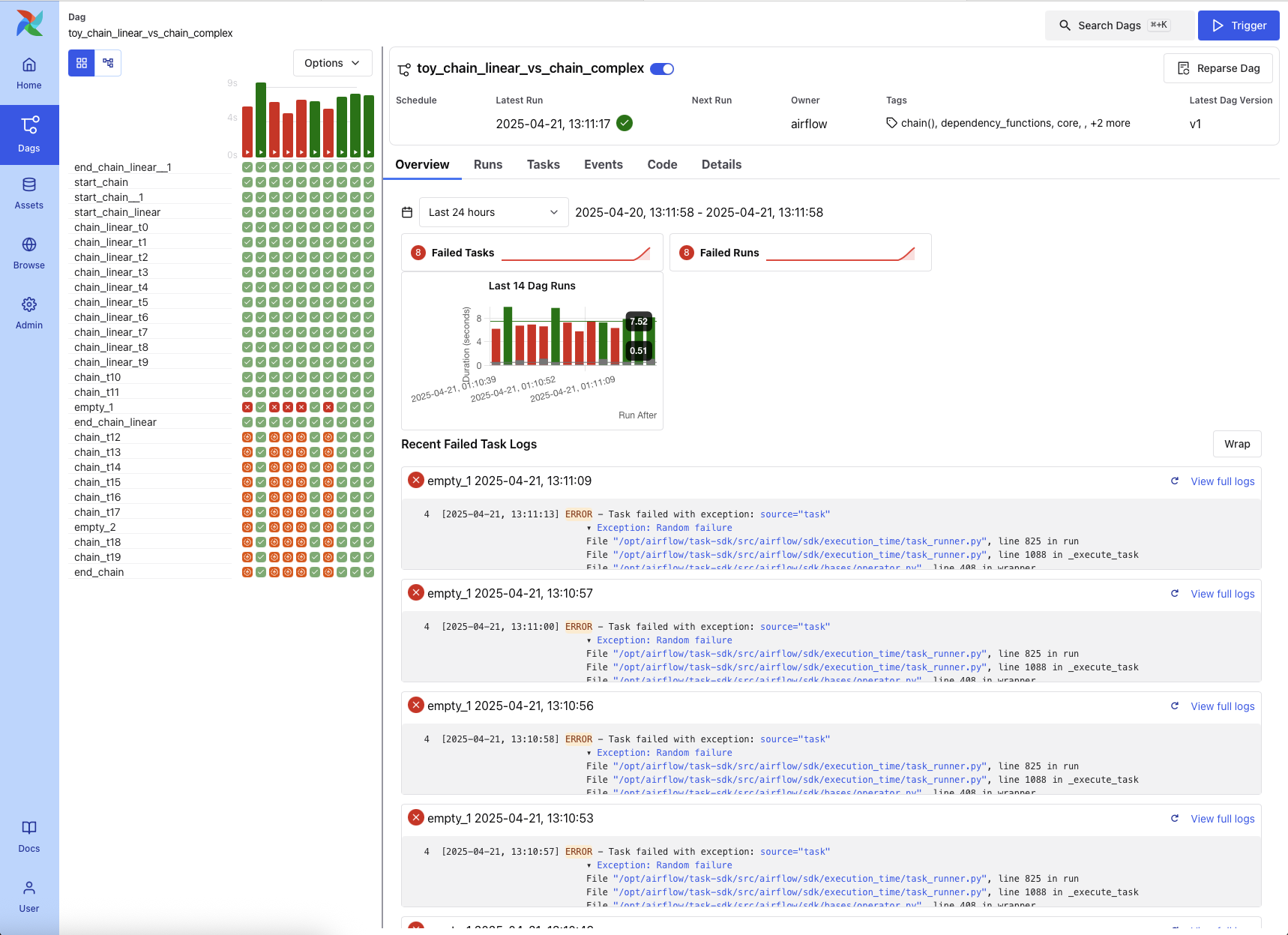
Dag Details Page in light mode showing overview dashboard and failure diagnostics

7
4 161
Article Muhammad Waseem · Nov 20, 2025 13m read

Hi Community,

In the first part of this series, we examined the fundamentals of Interoperability on Python (IoP), specifically how it enables us to construct such interoperability elements as business services, processes, and operations using pure Python.

Now, we are ready to take things a step further. Real-world integration scenarios extend beyond simple message handoffs.They involve scheduled polling, custom message structures, decision logic, filtering, and configuration handling.In this article, we will delve into these more advanced IoP capabilities and demonstrate how to create and run a more complex interoperability flow using only Python.

To make it practical, we will build a comprehensive example: The Reddit Post Analyzer Production. The concept is straightforward: continuously retrieving the latest submissions from a chosen subreddit, filtering them based on popularity, adding extra tags to them, and sending them off for storage or further analysis.

The ultimate goal here is a reliable, self-running data ingestion pipeline. All major parts (the Business Service, Business Process, and Business Operation) are implemented in Python, showcasing how to use IoP as a Python-first integration methodology.

2
1 235
Article Muhammad Waseem · Aug 18, 2025 7m read

Interoperability on Python (IoP) is a proof-of-concept project designed to showcase the power of the InterSystems IRIS Interoperability Framework when combined with a Python-first approach.IoP leverages Embedded Python (a feature of InterSystems IRIS) to enable developers to write interoperability components in Python, which can seamlessly integrate with the robust IRIS platform. This guide has been crafted for beginners and provides a comprehensive introduction to IoP, its setup, and practical steps to create your first interoperability component. By the end of this article, you will get a clear understanding of how to use IoP to build scalable, Python-based interoperability solutions.

6
5 465
Article Muhammad Waseem · May 28, 2025 4m read


Hi Community,
In this article, I will introduce my application iris-fhir-bridge 
IRIS-FHIR-Bridge is a robust interoperability engine built on InterSystems IRIS for Health, designed to transform healthcare data across multiple formats into FHIR and vice versa. It leverages the InterSystems FHIR Object Model (HS.FHIRModel.R4.*) to enable smooth data standardization and exchange across modern and legacy healthcare systems.

2
1 297
Article Muhammad Waseem · Apr 5, 2025 6m read

Hi Community,
Traditional keyword-based search struggles with nuanced, domain-specific queries. Vector search, however, leverages semantic understanding, enabling AI agents to retrieve and generate responses based on context—not just keywords.
This article provides a step-by-step guide to creating an Agentic AI RAG (Retrieval-Augmented Generation) application.

Implementation Steps:

  1. Create Agent Tools
    • Add Ingest functionality: Automatically ingests and index documents (e.g., InterSystems IRIS 2025.1 Release Notes).
    • Implement Vector Search Functionality
  2. Create Vector Search Agent
  3. Handoff to Triage (Main Agent)
  4. Run The Agent 
0
1 688
Article Muhammad Waseem · Apr 1, 2025 7m read

Hi Community,
In this article, I will introduce my application iris-AgenticAI .

The rise of agentic AI marks a transformative leap in how artificial intelligence interacts with the world—moving beyond static responses to dynamic, goal-driven problem-solving. Powered by OpenAI’s Agentic SDK , The OpenAI Agents SDK enables you to build agentic AI apps in a lightweight, easy-to-use package with very few abstractions. It's a production-ready upgrade of our previous experimentation for agents, Swarm.
This application showcases the next generation of autonomous AI systems capable of reasoning, collaborating, and executing complex tasks with human-like adaptability.

Application Features

  • Agent Loop 🔄 A built-in loop that autonomously manages tool execution, sends results back to the LLM, and iterates until task completion.
  • Python-First 🐍 Leverage native Python syntax (decorators, generators, etc.) to orchestrate and chain agents without external DSLs.
  • Handoffs 🤝 Seamlessly coordinate multi-agent workflows by delegating tasks between specialized agents.
  • Function Tools ⚒️ Decorate any Python function with @tool to instantly integrate it into the agent’s toolkit.
  • Vector Search (RAG) 🧠 Native integration of vector store (IRIS) for RAG retrieval.
  • Tracing 🔍 Built-in tracing to visualize, debug, and monitor agent workflows in real time (think LangSmith alternatives).
  • MCP Servers 🌐 Support for Model Context Protocol (MCP) via stdio and HTTP, enabling cross-process agent communication.
  • Chainlit UI 🖥️ Integrated Chainlit framework for building interactive chat interfaces with minimal code.
  • Stateful Memory 🧠 Preserve chat history, context, and agent state across sessions for continuity and long-running tasks.
0
0 358
Article Muhammad Waseem · Feb 28, 2025 7m read

Hi Community, 
In this article, we will explore the concepts of Dynamic SQL and Embedded SQL within the context of InterSystems IRIS, provide practical examples, and examine their differences to help you understand how to leverage them in your applications.

InterSystems SQL provides a full set of standard relational features, including the ability to define table schema, execute queries, and define and execute stored procedures. You can execute InterSystems SQL interactively from the Management Portal or programmatically using a SQL shell interface. Embedded SQL enables you to embed SQL statements in your ObjectScript code, while Dynamic SQL enables you to execute dynamic SQL statements from ObjectScript at runtime. While static SQL queries offer predictable performance, dynamic and embedded SQL offer flexibility and integration, respectively.

8
5 544
Article Muhammad Waseem · Jan 20, 2025 9m read

Hi, Community!

In the previous article, we introduced the Streamlit web framework, a powerful tool that enables data scientists and machine learning engineers to build interactive web applications with minimal effort. First, we explored how to install Streamlit and run a basic Streamlit app. Then, we incorporated some of Streamlit's basic commands, e.g., adding titles, headers, markdown, and displaying such multimedia as images, audio, and videos.

Later, we covered Streamlit widgets, which allow users to interact with the app through buttons, sliders, checkboxes, and more. Additionally, we examined how to display progress bars and status messages and organize the app with sidebars and containers. We also highlighted data visualization, using charts and Matplotlib figures to present data interactively.

In this article, we will cover the following topics:

1
0 339
Article Muhammad Waseem · Dec 16, 2024 5m read

image
Hi Community,
In this article, I will introduce my application iris-HL7v2Gen .

IRIS-HL7v2Gen is a CSP application that facilitates the dynamic generation of HL7 test messages. This process is essential for testing, debugging, and integrating healthcare data systems. The application allows users to generate a wide variety of HL7 message types, validate their structure against HL7 specifications, explore the message hierarchy, and transmit messages over TCP/IP to production systems. These features are particularly useful in settings where compliance with HL7 standards is mandatory for interoperability between different healthcare organizations or systems.


Application Features

  • Dynamic HL7 Message Generation: Instantly create HL7 messages for a range of message types, facilitating comprehensive testing.
  • Message Structure Exploration: Visualize the structure of generated messages based on HL7 specifications.
  • Value Set Visualization View predefined sets of allowable coded values for specific fields.
  • Message Validation: Validate messages against HL7 standards to ensure compliance.
  • TCP/IP Communication: Easily transmit messages to production using TCP/IP settings.
  • Broad Message Type Support: Supports 184 different HL7 message types, ensuring versatility for various healthcare integration needs.
  • ClassMethod: Generate a Test Message by Invoking a Class Method
  • Version Support: Currently Supports HL7 Version 2.5
0
4 453
Article Muhammad Waseem · Nov 18, 2024 8m read


Hi, Community!
In this article, I will introduce Python Streamlit Web Framework.
Below, you can find the topics we will cover:

  • 1-Introduction to Streamlit Web Framework
  • 2-Installation of Streamlit module
  • 3-Running Streamlit Application
  • 4-Streamlit Basic commands
  • 5-Display multimedia 
  • 6-Input widgets
  • 7-Display progress and status
  • 8-Sidebar and container
  • 9-Data Visualization
  • 10-Display a DataFrame

So, let's start with the first topic.

1
1 1119
Article Muhammad Waseem · Sep 23, 2024 4m read

image

Hi Community,
In this article, I will introduce my application iris-DataViz
iris-DataViz is an Exploratory Data Analysis and Visualization Streamlit Application that leverages the functionality of IRIS embedded python and SQLAlchemy to interact with IRIS, as well as the PyGWalker python library for data analysis and data Visualization. PyGWalker (Python Graphic Walker) is an interactive data visualization library built for Python, aiming to bring the ease and functionality of Tableau-style drag-and-drop visualization into Python environments.


Application Features 

  • Drag-and-Drop Visualization
  • Ma
3
0 309
Article Muhammad Waseem · Aug 12, 2024 8m read

Artificial intelligence (AI) has transformative potential for driving value and insights from data.As we progress toward a world where nearly every application will be AI-driven, developers building those applications will need the right tools to create experiences from these applications.Tools like vector search are essential for enabling efficient and accurate retrieval of relevant information from massive datasets when working with large language models.

0
5 550
Article Muhammad Waseem · Jul 31, 2024 5m read

image
Hi Community,
In this article, I will introduce my application iris-RAG-Gen .

Iris-RAG-Gen is a generative AI Retrieval-Augmented Generation (RAG) application that leverages the functionality of IRIS Vector Search to personalize ChatGPT with the help of the Streamlit web framework, LangChain, and OpenAI. The application uses IRIS as a vector store.
image

Application Features

  • Ingest Documents (PDF or TXT) into IRIS
  • Chat with the selected Ingested document
  • Delete Ingested Documents
  • OpenAI ChatGPT
1
0 355
Article Muhammad Waseem · Jun 16, 2024 6m read

By default, all files created inside a container are stored on a writable container layer. This means that:

  • The data doesn't persist when that container no longer exists, and it can be difficult to get the data out of the container if another process needs it.
  • A container's writable layer is tightly coupled to the host machine where the container is running. You can't easily move the data somewhere else.
2
5 528
Article Muhammad Waseem · Jun 3, 2024 8m read

In our previous article, we have explored the most common Kubernetes components:

  • We started with the pods and the services we needed to communicate with each other.
  • Then, we examined the  Ingress component used to Route traffic into the cluster.
  • We also skimmed through an external configuration using ConfigMaps and Secrets.
  • Afterward, we analyzed Data persistence with the help of Volumes.
  • Finally, we took a quick look at pod blueprints with such replicating mechanisms as Deployments and StatefulSets (the latter is employed specifically for such stateful applications as databases).

In this article, we will explore Kubernetes architecture and configuration.

0
0 358
Article Muhammad Waseem · May 22, 2024 3m read


Hi Community,
In this series of articles, we will explore the following InterSystems SQL usage options:

  1. Embedded SQL

  2. Dynamic SQL

  3. Class Queries


SQL Overview

InterSystems SQL provides a full set of standard relational features, including the ability to define table schema, execute queries, and define and execute stored procedures.You can execute InterSystems SQL interactively from the Management Portal or programmatically from using a SQL shell interface.

0
2 340
Article Muhammad Waseem · May 13, 2024 3m read

Hi Community,
In this article, I will introduce my application iris-VectorLab along with step by step guide to performing vector operations.

IRIS-VectorLab is a web application that demonstrates the functionality of Vector Search with the help of embedded python. It leverages the functionality of the Python framework SentenceTransformers for state-of-the-art sentence embeddings.

Application Features

  • Text to Embeddings Translation.
  • VECTOR-typed Data Insertion.
  • View Vector Data
  • Perform Vector Search by using VECTOR_DOT_PRODUCT and VECTOR_COSINE functions.
  • Demonstrate the difference between normal and vector search
  • HuggingFace Text generation with the help of GPT2 LLM (Large Language Model) model and Hugging Face pipeline
0
1 539
Article Muhammad Waseem · Apr 1, 2024 2m read


Generative artificial intelligence is artificial intelligence capable of generating text, images or other data using generative models, often in response to prompts. Generative AI models learn the patterns and structure of their input training data and then generate new data that has similar characteristics.

Generative AI is artificial intelligence capable of generating text, images and other types of content. What makes it a fantastic technology is that it democratizes AI, anyone can use it with as little as a text prompt, a sentence written in a natural language.

how large language models

1
1 613
Article Muhammad Waseem · Mar 25, 2024 7m read

In this article, we will cover below topics:

  • What is Kubernetes?
  • Main Kubernetes (K8s) Components


What is Kubernetes?

Kubernetes is an open-source container orchestration framework developed by Google. In essence, it controls container speed and helps you manage applications consisting of multiple containers. Additionally, it allows you to operate them in different environments, e.g., physical machines, virtual machines, Cloud environments, or even hybrid deployment environments.


What problems does it solve?

The emergence of containerization in microservices technology has given rise to

0
3 412
Discussion Muhammad Waseem · Mar 12, 2024

Hi Community!
As an AI language model, ChatGPT is capable of performing a variety of tasks like language translation, writing songs, answering research questions, and even generating computer code. With its impressive abilities, ChatGPT has quickly become a popular tool for various applications, from chatbots to content creation.
But despite its advanced capabilities, ChatGPT is not able to access your personal data. So we need to build a custom ChatGPT AI by using LangChain Framework:
Below are the steps to build a custom ChatGPT:

  • Step 1: Load the document 

  • Step 2: Splitting the document into chunks

  • Step 3: Use Embedding against Chunks Data and convert to vectors

  • Step 4: Save data to the Vector database

  • Step 5: Take data (question) from the user and get the embedding

  • Step 6: Connect to VectorDB and do a semantic search

  • Step 7: Retrieve relevant responses based on user queries and send them to LLM(ChatGPT)

  • Step 8: Get an answer from LLM and send it back to the user

  For more details, please Read this article

6
1 456
Article Muhammad Waseem · Mar 10, 2024 6m read

Introduction

Visual Studio Code (VS Code) is a free source code editor made by Microsoft for Windows, Linux, and macOS. It provides built-in support for JavaScript, TypeScript, and Node.js. You can add extensions to provide support for numerous other languages including ObjectScript.

The InterSystems extensions enable you to use VS Code to connect to an InterSystems IRIS server and develop code in ObjectScript. The Visual Studio Code Documentation is an excellent resource on VS Code, so it is a good idea to be familiar with it.

5
5 717
Article Muhammad Waseem · Feb 2, 2024 3m read

Sometimes we need to convert FHIR message to HL7 V2, e.g. to register a patient to the PACS system.
In this article, I will explain the steps to achieve the desired by using IRIS FHIR Server production.

Below are the steps we need to follow:

  1. Make sure FHIRServer production is started.
  2. Register Business Service with FHIRServer endpoint.
  3. Define Business Processes to convert FHIR message to SDA and then Convert SDA to HL7 v2.
  4. Post JSON resource to FHIRServer endpoint and get HL7 V2 response.

Let's review the steps in detail.
 

Step 1. Make sure FHIRServer production is started

Open the production page and make sure Production is started. In the next step, we need to make sure business service HS.FHIRServer.Interop.Service is registered with FHIRServer

0
0 764
Article Muhammad Waseem · Jan 22, 2024 2m read


All FHIR resources have a Meta element containing metadata about the resource. Some attributes are updated by the server, others are populated by the app constructing the resource.


Here are the 3 common attributes of FHIR’s Meta element: 

1. versionId
This is an ID that identifies a saved version of the resource on the FHIR server. Many servers use a GUID here, others use an integer. But it’s a string value, so don’t write code against this assuming a sequential integer, regardless of what the server does.

2. lastUpdated
The date and time that the resource was last updated, populated by the server.

0
0 589
Article Muhammad Waseem · Jan 16, 2024 2m read

In the context of HL7 FHIR (Fast Healthcare Interoperability Resources), the terms "id" and "identifier" refer to specific elements used for identifying resources within the FHIR data model. For a newbie, these terms can be confusingly similar, but they serve distinct purposes.  

Look at the below Patient resource for August T. Faulkner:

The resource has an id of “1” — generated by the FHIR server when the resource was created.
Patient August T. Faulkner also has a identifier (Medical Record Number) — possibly provided by the hospital — of 78510398960

0
0 1093
Article Muhammad Waseem · Jan 9, 2024 9m read

  Hi, Community!

Since this article is an overview of Flask Login, let's begin with Flask Introduction!

What is Flask?

In the realm of web development, Python has emerged as a formidable force, offering its versatility and robustness to create dynamic and scalable applications. For that reason, tools and services compatible with this language are in demand these days. Flask is a lightweight and easy-to-use web framework for Python. It stands out as a lightweight and user-friendly option. Its simplicity and flexibility have made it a popular choice for developers, particularly for creating smaller-scale applications. It is based on the Werkzeug toolkit and provides a simple but powerful API for building web applications. 
Unlike its full-stack counterparts, Flask provides a core set of features, focusing on URL routing, template rendering, and request handling. This minimalist approach makes Flask lightweight and easy to learn, allowing developers to build web applications quickly and without the burden of unnecessary complexity.

0
1 1952
Article Muhammad Waseem · Nov 16, 2023 9m read

Hi, Community!

This article is an overview of SQLAlchemy, so let's begin!

SQLAlchemy is the Python SQL toolkit that serves as a bridge between your Python code and the relational database system of your choice. Created by Michael Bayer, it is currently available as an open-source library under the MIT License. SQLAlchemy supports a wide range of database systems, including PostgreSQL, MySQL, SQLite, Oracle, and Microsoft SQL Server, making it versatile and adaptable to different project requirements.

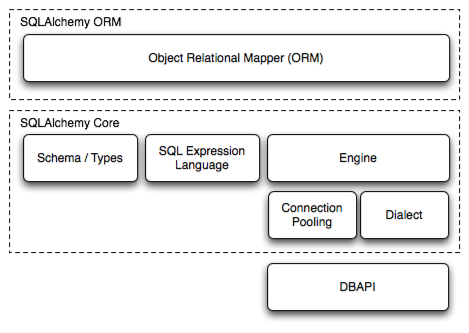
The SQLAlchemy SQL Toolkit and Object Relational Mapper from a comprehensive set of tools for working with databases and Python. It has several distinct areas of functionality which you can use individually or in various combinations. The major components are illustrated below, with component dependencies organized into layers:

_images/sqla_arch_small.png

8
4 1009
Article Muhammad Waseem · Sep 21, 2023 7m read

image

Hi Community,
In this article, I will demonstrate below steps to create your own chatbot by using spaCy (spaCy is an open-source software library for advanced natural language processing, written in the programming languages Python and Cython):

  • Step1: Install required libraries

  • Step2: Create patterns and responses file

  • Step3: Train the Model

  • Step4: Create ChatBot Application based on the trained model

So Let us start.

1
1 3744