In today's data landscape, businesses encounter a number of different challenges. One of them is to do analytics on top of unified and harmonized data layer available to all the consumers. A layer that can deliver the same answers to the same questions irrelative to the dialect or tool being used.

11 2
1 530

Apache Spark has rapidly become one of the most exciting technologies for big data analytics and machine learning. Spark is a general data processing engine created for use in clustered computing environments. Its heart is the Resilient Distributed Dataset (RDD) which represents a distributed, fault tolerant, collection of data that can be operated on in parallel across the nodes of a cluster. Spark is implemented using a combination of Java and Scala and so comes as a library that can run on any JVM.

11 5
1 2.8K

If you are a customer of the new InterSystems IRIS® Cloud SQL and InterSystems IRIS® Cloud IntegratedML® cloud offerings and want access to the metrics of your deployments and send them to your own Observability platform, here is a quick and dirty way to get it done by sending the metrics to Google Cloud Platform Monitoring (formerly StackDriver).

11 1
2 374

Using embedded Python while building your InterSystems-based solution can add very powerful and deep capabilities to your toolbox.

I'd like to share one sample use-case I encountered - enabling a CDC (Change Data Capture) for a mongoDB Collection - capturing those changes, digesting them through an Interoperability flow, and eventually updating an EMR via a REST API.

11 2
2 623

ObjectScript Kernel Logo
Jupyter Notebook is an interactive environment consisting of cells that allow executing code in a great number of different markup and programming languages.

To do this Jupyter has to connect to an appropriate kernel. There was no ObjectScript Kernel, that is why I decided to create one.

You can try it out here.

Here's a sneak peek of the results:

10 4
3 1K
Article
· Dec 6, 2022 3m read
OCR DEMO

OCR DEMO

This is a demo of the OCR functionality of the pero-ocr library.

It used in the iris application server in python.

Demo

This is an example of input data :

input

This is the result of the OCR :

In this example you have the following information:

10 6
2 589
Article
· Mar 24, 2024 8m read
Python BPL in preview

BPL from 10,000 feet

BPL stands for Business Process Language.
This is an XML format for describing complex information orchestration interactions between systems.
InterSystems Integration engine has for two decades, provided a visual designer to build, configure, and maintain, BPL using a graphical interface.
Think of it like drawing a process flow diagram that can be compiled and deployed.

10 4
0 544

Let me introduce my new project, which is irissqlcli, REPL (Read-Eval-Print Loop) for InterSystems IRIS SQL

  • Syntax Highlighting
  • Suggestions (tables, functions)
  • 20+ output formats
  • stdin support
  • Output to files

Install it with pip

pip install irissqlcli

Or run with docker

docker run -it caretdev/irissqlcli irissqlcli iris://_SYSTEM:SYS@host.docker.internal:1972/USER

Connect to IRIS

$ irissqlcli iris://_SYSTEM@localhost:1972/USER -W
Password for _SYSTEM:
Server:  InterSystems IRIS Version 2022.3.0.606 xDBC Protocol Version 65
Version: 0.1.0
[SQL]_SYSTEM@localhost:USER> select $ZVERSION
+---------------------------------------------------------------------------------------------------------+
| Expression_1                                                                                            |
+---------------------------------------------------------------------------------------------------------+
| IRIS for UNIX (Ubuntu Server LTS for ARM64 Containers) 2022.3 (Build 606U) Mon Jan 30 2023 09:05:12 EST |
+---------------------------------------------------------------------------------------------------------+
1 row in set
Time: 0.063s
[SQL]_SYSTEM@localhost:USER> help
+----------+-------------------+------------------------------------------------------------+
| Command  | Shortcut          | Description                                                |
+----------+-------------------+------------------------------------------------------------+
| .exit    | \q                | Exit.                                                      |
| .mode    | \T                | Change the table format used to output results.            |
| .once    | \o [-o] filename  | Append next result to an output file (overwrite using -o). |
| .schemas | \ds               | List schemas.                                              |
| .tables  | \dt [schema]      | List tables.                                               |
| \e       | \e                | Edit command with editor (uses $EDITOR).                   |
| help     | \?                | Show this help.                                            |
| nopager  | \n                | Disable pager, print to stdout.                            |
| notee    | notee             | Stop writing results to an output file.                    |
| pager    | \P [command]      | Set PAGER. Print the query results via PAGER.              |
| prompt   | \R                | Change prompt format.                                      |
| quit     | \q                | Quit.                                                      |
| tee      | tee [-o] filename | Append all results to an output file (overwrite using -o). |
+----------+-------------------+------------------------------------------------------------+
Time: 0.012s
[SQL]_SYSTEM@localhost:USER>

10 20
2 949

We have a yummy dataset with recipes written by multiple Reddit users, however most of the information is free text as the title or description of a post. Let's find out how we can very easily load the dataset, extract some features and analyze it using features from OpenAI large language model within Embedded Python and the Langchain framework.

10 3
2 433
Article
· Jun 12, 2023 3m read
LangChain fixed the SQL for me

This article is a simple quick starter (what I did was) with SqlDatabaseChain.

Hope this ignites some interest.

Many thanks to:

sqlalchemy-iris author @Dmitry Maslennikov

Your project made this possible today.

The article script uses openai API so caution not to share table information and records externally, that you didn't intend to.

A local model could be plugged in , instead if needed.

10 7
3 3.7K

This is the first article of a series diving into visualization tools and analysis of time series data. Obviously we are most interested in looking at performance related data we can gather from the Caché family of products. However, as we'll see down the road, we are absolutely not limited to that. For now we are exploring python and the libraries/tools available within that ecosystem.

9 4
1 1.8K

As we keep updating our software, we often realize that we require more and more modern solutions. So far, only one major piece of our software relies on reading barcodes in documents and images. Since Cache did not have a means of reading barcodes in the past, we have always achieved our goals by using a Visual Basic 6 application. However, it is no longer an ideal solution because it is currently complicated to maintain it. IRIS also lacks this capability, but it has recently got an option that makes up for it: embedded Python!

9 2
1 558

Following this GitHub we will see how the FIX protocol can be implemented easily using IRIS and Python.

If you don't have much time focus on the Send a Quote before the Order part near the end, as it will, in a matter of minute, tell you how to send a Quote Request followed by an Order Request and show you the result from the server, and that in no more than five clicks.

9 4
0 1.1K

Many factors affect a person's quality of life, and one of the most important is sleep. The quality of our sleep determines our ability to function during the day and affects our mental and physical health. Good quality sleep is critical to our overall health and well-being. Therefore, by analyzing indicators preceding sleep, we can determine the quality of our sleep. This is precisely the functionality of the Sheep's Galaxy application.

9 5
0 387

Introduction

As the health interoperability landscape expands to include data exchange across on-premise as well as hosted solutions, we are seeing an increased need to integrate with services such as cloud storage. One of the most prolifically used and well supported tools is the NoSQL database DynamoDB (Dynamo), provided by Amazon Web Services (AWS).

9 4
0 468

If you are using Python, you can use the built-in venv module to create a virtual environment. This module is the recommended way to create and manage virtual environments.

A virtual environment is a tool that helps to keep dependencies required by different projects separate by creating isolated python virtual environments for them. It solves the “Project X depends on version 1.x but, Project Y needs 4.x” dilemma, and keeps your global site-packages directory clean and manageable.

So if like me you work a lot with Python, you can use the venv module to create a virtual environment for your project. This will allow you to install packages without affecting the global Python installation.

You will find here two neat alias to create and activate a virtual environment.

Python aliases

alias venv="python3 -m venv .venv; source .venv/bin/activate"
alias irisvenv="python3 -m venv .venv; source .venv/bin/activate; pip install https://github.com/grongierisc/iris-embedded-python-wrapper/releases/download/v0.0.3/iris-0.0.3-py3-none-any.whl"

9 3
2 2.1K
Article
· Mar 17, 2025 2m read
Ollama AI with IRIS

In this article I will be discussing the use of an alternative LLM for generative IA. OpenIA is commonly used, in this article I will show you how to use it and the advantages of using Ollama

In the generative AI usage model that we are used to, we have the following flow:

9 2
2 370

img

This will be an introduction to Python programming in the context of IRIS.

Before anything I will cover an important topic: How python works, this will help you understand some issues and limitations you may encounter when working with Python in IRIS.

All the articles and examples can be found in this git repository: iris-python-article

9 0
3 234
Article
· Dec 7, 2020 6m read
IRIS Python Native API in AWS Lambda

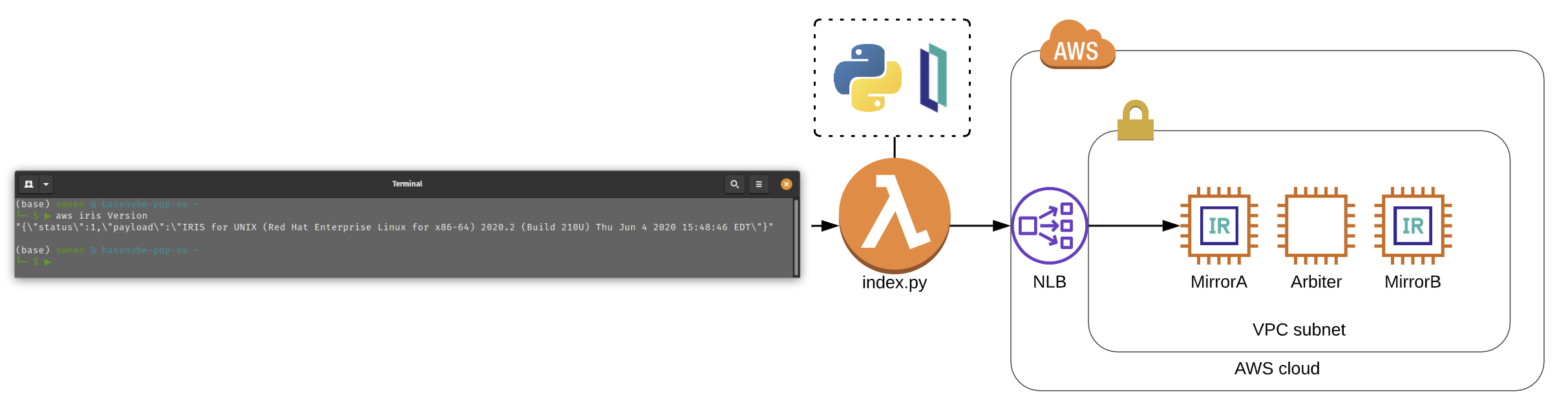
If you are looking for a slick way to integrate your IRIS solution in the Amazon Web Services ecosystem, server less application, or boto3 powered python script, using the IRIS Python Native API could be the way to go. You don't have to build out to far with a production implementation until you'll need to reach out and get something or set something in IRIS to make your application do its awesome sauce, so hopefully you will find value in this article and build something that matters or doesn't matter at all to anybody else but you as that is equally important.

image

8 2
2 1K

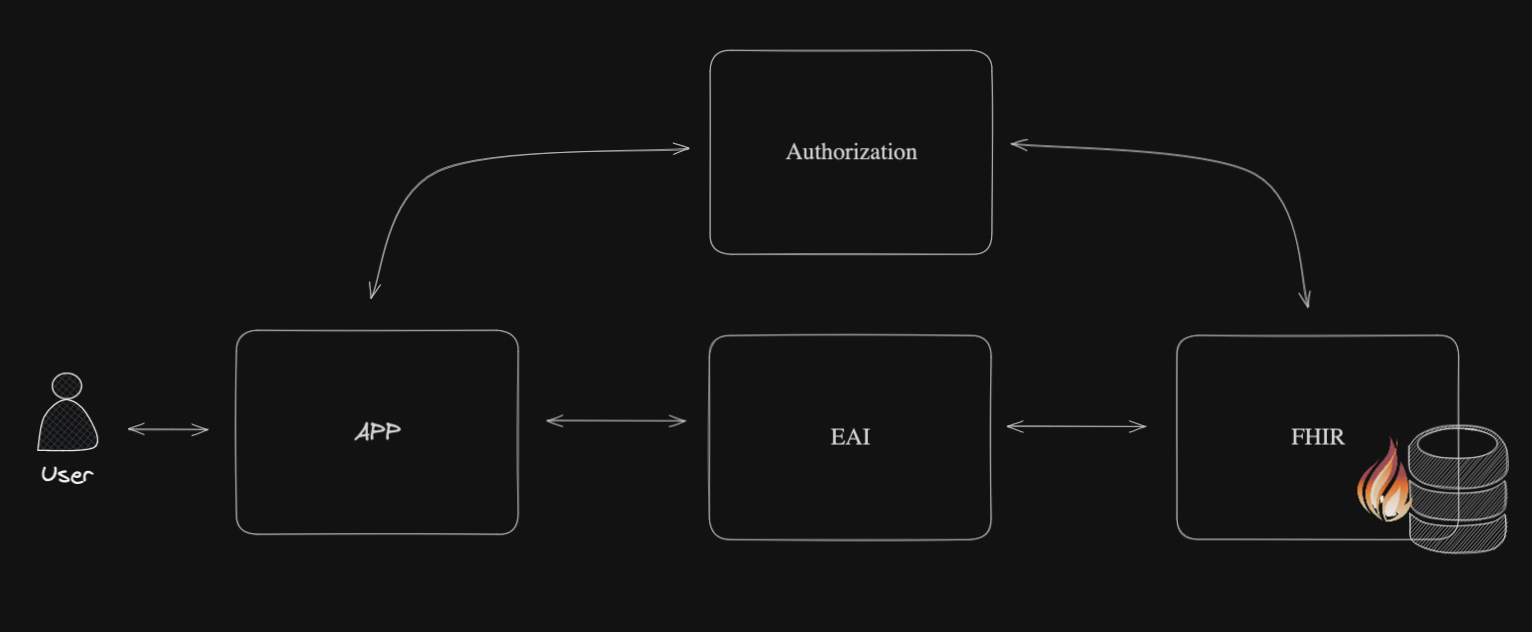
The objective of the article is to provide the reader with the following informations:

  • Configure and use the FHIR server
  • Create an OAuth2 Authorization Server
  • Bind the FHIR server to the OAuth2 Authorization Server for support of SMART on FHIR
  • Use the interoperability capabilities of IRIS for Health to filter FHIR resources
  • Create a custom operation on the FHIR server

Schema of the article:

Schema

8 3
6 505

Hi, Community!

This article is an overview of SQLAlchemy, so let's begin!

SQLAlchemy is the Python SQL toolkit that serves as a bridge between your Python code and the relational database system of your choice. Created by Michael Bayer, it is currently available as an open-source library under the MIT License. SQLAlchemy supports a wide range of database systems, including PostgreSQL, MySQL, SQLite, Oracle, and Microsoft SQL Server, making it versatile and adaptable to different project requirements.

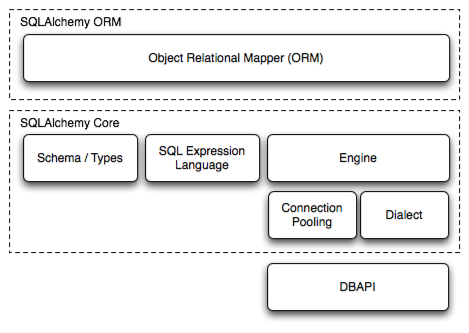
The SQLAlchemy SQL Toolkit and Object Relational Mapper from a comprehensive set of tools for working with databases and Python. It has several distinct areas of functionality which you can use individually or in various combinations. The major components are illustrated below, with component dependencies organized into layers:

_images/sqla_arch_small.png

8 8
4 991