
#Journaling

4 Followers · 46 Posts

Global journaling records all global update operations performed on a database, and used in conjunction with backup makes it possible to restore a database to its state immediately before a failure or crash.

While backup is the cornerstone of physical recovery, it is not the complete answer. Restoring a database from backup does not recover global updates made since that backup, which may have been created a number of hours before the point at which physical integrity was lost. These post-backup updates can be restored to the database from journal files after the database is restored from backup, bringing the database up to date. Any transactions open at the time of the failure are rolled back to ensure transaction integrity.

Documentation.

Question Malaya Acharya · Mar 2

I had configured the environment as follows:

OS: Redhat Linux 9.4

IRIS 2025.2 installed on local directory

IRIS Database: One LVM is created with 20 Storage luns and the LVM is mounted on a mount point. IRIS database is created on that

Primary and Alternate Journal: One LVM is created with 5 Storage luns and the LVM is mounted on a mount point. IRIS database is created on that.

WIJ: One LVM is created with 5 Storage luns and the LVM is mounted on a mount point. IRIS database is created on that.

So Data, WIJ and Journal is mounted on 3 separate mount point.

2
0 103
Question Scott Roth · Jun 1, 2025

I am attempting to failover my TEST environment to the Backup, and I keep getting an error stating that 

06/01/25-18:47:54:516 (11864) 1 [Utility.Event] Primary startup failed, failed to read header of /archive/journal/MIRROR-IRISTEST-20250513.007 (file #63653)

however, when I go to /archive/journal/, I am not finding any record of MIRROR-IRISTEST-20250513.007 (file #63653)

to get out of this error message I have to restart what was the Primary and restart the Backup to get it back into a state that we can use it.

1
0 108
Question Mike Williamson · Nov 17, 2023

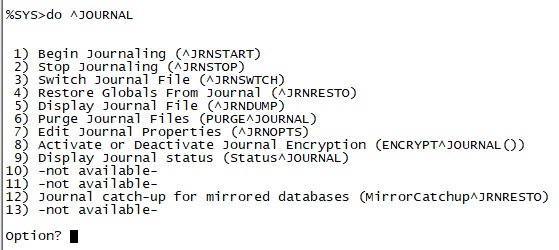
I'm working for an organisation that is running a very old version of InterSystems Cache (5.016) which runs on AIX . The last two times we have re-booted Cache, we have encountered rollbacks. I've been asked two questions. During the rollback it was "How long is it going to take?" and after the system returned, it was "So what caused it?". My answer to both was "I don't know".

4
0 546
Question Lorenzo Scalese · Aug 7, 2023

Hi!

Currently, I'm working on a script using %SYS.Journal API.

My journal files are compressed, following the documentation the compression is zstd.

I tried to unzip a file with zstd tool, ex: 

apt-get update
apt-get install zstd

zstd -d 20230806.001z -o 20230806.001

20230806.001z        : 92.03%   (909312 => 836859 bytes, 20230806.001) 

Unfortunately, the unzipped file is invalid:

Write ##class(%SYS.Journal.File).IsValidJournal("/usr/irissys/mgr/journal/20230806.001")
2
0 614
Question Norman W. Freeman · Jul 10, 2023

I have several 1GB journals from a LIVE server that I would like to inspect (eg: check which globals have been updated over the time).

Is there a simple way to view those journals using another IRIS instance ? (eg: local installation).

I have been tempted to put those files directly into the journal folder of my local installation and restart the system, however I am concerned that the transactions they contains will be restored and will corrupt the local database.

I have checked documentation but couldn't find anything.

10
1 574
Question Fabio Care · May 26, 2023

In the Windows Ressource Manager I can observe multiple parallel processes coming from cache.exe with read operations to journaling files.

All except one of these processes have the same reads(Byte/s). The processes point to different journal files and constantly read between 200 and 3000 Bytes/s.

The corresponding process via PID in the management portal of Caché shows the process %SYS.Monitor.Control.1. In 3 days of uptime on the server it has run 181.632.583 commands and modified 32.140.642 globals. 

These processes are not writing to the journal at any point.

2
0 323
Question Daniel Metcalfe · Oct 7, 2022

Hi All,

Our mirrored HealthShare environment has failed over a few times recently due to underlying infrastructure issues (that are being worked on and resolved).

In the HealthShare logs we are seeing:

10/06/22-00:54:35:925 (4736) 1 Journal Daemon has been inactive with I/O pending for 10 seconds:
gjrnoff=524741316,iocomplete=523852600,filecnt=1011,fail=0
10/06/22-00:54:55:086 (4736) 3 CP: Pausing users because Journal Daemon has not shown
    signs of activity for 30 seconds.

4
2 709
Question Stefan Schick · Jul 20, 2022

Hello everyone,

I want to restore a database from an external backup with the journal files.

The manual says I should (in short):

  1. Stop journaling with ^JRNSTOP
  2. Restore the database file IRIS.DAT
  3. Run the journal restore utility with ^JRNRESTO
  4. Restart journaling ^JRNSTART

Since I want to restore one database only step 1 would disable journaling for the whole instance, not only for the database to be restored. As I understand, it would be impossible to restore a different database if there occurs a problem while journaling is disabled during the recovery process?

6
0 991
Question Eudoro van der Biest · Apr 23, 2021

I am new to Cache, we are trying to move a 4 TB database over the internet, but this will be take too long to copy the single backup file. In Oracle and MS-SQL Server there is an option of doing log shipping. Is there such an option in Cache?

I want to copy the initial backup file one weekend, then keep sending the Journals (logs) the new location.

Thank you,

Eudoro

5
0 411
Question Julian Matthews · Nov 5, 2020

Hey everyone.

I have noticed that my backup mirror is warning that the MirrorDatabaseLatencyTime is having a bad time (time in ms is 3000, and warnvalue is 3000). While I look into what may be causing this latency between the two servers, I was considering if reducing the size of the journal files would improve this value in any way.

My assumption is that reducing the file size would mean that the frequency of the journal files being created would be increased, but the reduced size would mean that the transfer and application of each file would be reduced.

Has anyone had experience in this area?

2
0 936
Question Muni Ganesh · Aug 1, 2020

Hi,

We are using CACHE 2017.2.1, I would like to retrieve data from Journal for killed global. Let say we have global name ^ EMP(123) with data and also have some child nodes and it has been killed by using cache kill command for some reason and we don't know who has executed this and when. My questions are below.

1) Can we get back the data of killed global from journal files,Is it possible or not ?

2) If above question is Yes, then how to find that specific journal file, which has the global which has been killed?

5
0 831
Question Augusto Estefan · Mar 30, 2020

Hi, 

I'm having a problem when I'm attempting to freeze the instance.

I have a pre-script and post-script to freeze and unfreeze the instance, but when the script execute: 

 csession INSTANCE_NAME -U '%SYS' "##Class(Backup.General).ExternalFreeze(\"$SNAPLOG\",,,,,,1800)"

 It's give me this error and fails the freeze: 

Backup.General.ExternalFreeze: Failed, Unable to switch local journal file, Error: -99,ERROR #1142: Error switching journal file: 0
vi

At cconsole.

4
0 778
Question Bharath Nunepalli · Aug 20, 2019

I'm a DBA and support Caché databases on AIX. I coded shell scripts for monitoring journaling status, databases size, license end date.

We recently got a new instance of Caché on Windows. I'm just curious to know whether anyone coded database monitoring scripts on Windows using PowerShell or any other scripting language.

If yes, please share the details.

Thanks & Regards,

Bharath Nunepalli.

3
0 596
Question Robert Gasper · Aug 8, 2019

Just wondering if anyone knows if there is a way to get daily emails or alerts about changes to a cache database.  I know that all of that information is contained within the journal files, just wondering if there is a way to bundle it up each day and send it off for auditing, etc.

Any solution where a plain-text/readable format of changes to the cache database could be sent or stored for review would solve the issue.

Thanks!

3
0 570
Question lw wei · Jul 17, 2019

The steps are as follows:

1. create global

 For I=1:1:200 Set ^ABC(I)=""
 For I=1:1:200 Set ^XYZ(I)=""
 For I=1:1:100 Kill ^ABC(I)

2. create ZJRNFILT

ZJRNFILT(jid,dir,glo,type,restmode,addr,time)    /*Filter*/
  Set restmode=1                                  /*Return 1 for restore*/
  If glo["^ABC",type="K" Set restmode=0           /*except if a kill on ^ABC*/
  Quit
  ;

3. restore

s RestOref=##class(Journal.Restore).%New()
s RestOref.FirstFile="20190717.007"
s RestOref.LastFile="20190717.007"
s RestOref.JournalLog="journal.log"
s RestOref.Filter="^ZJRNFILT"
s Status=RestOref.

7
0 604
Question Sergey Pavlov · Jul 3, 2019

Hello, community!

I've stumbled on some unexpected behavior, and decided to check with you if this is normal. Basically, I'm rebuilding indices and the result is not journaling (which leads to missing indices at shadow server).
The $ZV is "Cache for UNIX (Red Hat Enterprise Linux for x86-64) 2015.2.1 (Build 705U) Mon Aug 31 2015 16:53:38 EDT"

I have an example class 

Class tmp.A As %Persistent;

Index IP1 On P1;

Property P1 As %String;

for example there is one object which have P1 = 1, so

^tmp.AI("IP1",1,1) = ""

If I rebuild it wth 

1
0 378
Question Arun Madhan · Oct 18, 2018

Hi,

We have Mirroring established between NODE 1 & Node 2 . We have set the "cachesys" database enabled for Journalling. But we dont see the User Accounts , Roles, Resources created on Node 1 ( favoured Primary) reflected on Node 2 . Is creating them manually again is the only option for this ? . Is there any way to sync them or would adding %SYS to MIRROR a possible solution. Would it be great if anyone has faced this as we have an issue that during failovers Team is locked out . 

Best Regards,

Arun Madhan

10
1 1115
Question Alexey Maslov · Jun 14, 2018

I am still working on a generic task where I need to apply journal file records to another database. Initially I didn't want to use Journal.Restore class methods as I need to perform some data transformation, and it seemed that the clearest way to achieve it was to read journal file record by record using %SYS.Journal.Record API. 

This approach worked (with some help from @Dmitry Konnov Maslennikov and @Eduard Lebedyuk), while it turned that the processing speed of %SYS.Journal.Record:List query was very slow, about 1MB of journal data per second on a mid-range server.

8
0 667
Question Alexey Maslov · Jun 7, 2018

I'm working on a task where I need to apply journal file records to another database. I can't use Journal.Restore class methods as I need to perform some data transformation, therefore I'm reading journal file record by record using %SYS.Journal.Record API.  

It seems that there are only few journal records that I need to process, namely:

Type TypeName

No problem, while I'm just curious: which COS command could provide KILLdes record? I've met it only once in the context like this:

KILLdes ^SYS("Task","TaskD",1006,"EmailOnError",1)
4
0 547
Question Barry Veach · Jun 2, 2018

In System Administration | Configuration |  System Configuration | Journal Settings there is a check box for Freeze on error.

From reading the documentation, it sounds like the choice to freeze on error is one of system availability vs system integrity.

Curious to know whether Ensemble users choose to freeze on error or not.

If you have a best practice recommendation based upon your experience or knowledge, that would be helpful information too.

3
0 464
Question Mack Altman · Mar 19, 2018

Currently, we are running 2014.1 on two different servers (OpenVMS, RHEL). The plan is to transition from OpenVMS to RHEL, but our Write Daemon is in a Troubled state on both servers.

On the OpenVMS server, we have a WIJ file that's 26G and can grow to 40G (size of database cache). Since it hasn't grown to 40G, we don't believe the size of the WIJ file to be the issue.

What else should we be looking at regarding the performance of the Write Daemon?

1
0 1093
Question Pravin Barton · Aug 1, 2017

I'm purging a lot of management data from an Ensemble production, which is creating 100s of GBs of journals. Has anybody succeeded in disabling journaling on an Ensemble purge? The user interface doesn't have an option for this, but I'm thinking you might be able to identify the process and externally disable journaling on it.

3
0 1014
Question Rafael Vergani · Mar 21, 2017

One of my journal spaces has status "IOER" in MSM MUMPS.

I think this is happend during system freeze.

I never seeing a journal file status like that.  I did not find anything about it in the intersystems documentation.

I can simply delete the damaged file, but I'd like to know how to prevent this from happening.

Anyone have some idea about it?

My MSM-UNIX Version is 4.4.0.

Thanks

2
0 447
Question Heikki Koivulehto · Oct 26, 2016

We are finally planning to migrate some ancient Caché applications that are run on Caché 5.0.21 to a new server with Caché 2016.2.0 or so.

I wonder if we could use Shadowing between those to keep the data on the new server up to date?

We would copy the Caché backup from the old environment to the new and do a RESTORE there and then start shadowing.

I know than 5.0.21 is no more officially supported by ISC.

5
0 849