Hi Community,
I need to find a good way to queue messages and then send them later by document type where document type is an HL7 attribute of the message.
Any suggestions?
Thanks
Regards
Mike

InterSystems HealthShare is a healthcare informatics platform for hospitals, integrated delivery networks (IDNs) and regional and national health information exchanges (HIE). HealthShare includes health information exchange, data aggregation, workflow, text analysis, and analytics technology.
Hi Community,
I need to find a good way to queue messages and then send them later by document type where document type is an HL7 attribute of the message.
Any suggestions?
Thanks
Regards
Mike
Hi Team ,
Can I please check if anyone has encountered SOAP authentication error when trying to submit a certificate signing request or when trying to get certificate .
I configured a local CA server without SMTP configuration and I configured a local CA client. These steps worked okay.
Then I tried to Submit Certificate Signing Request to Certificate Authority server and I am getting the following error :
.png)
Similar error is appearing when I try to use the Get Certificate(s) from Certificate Authority server option
.png)
InterSystems announces another developer preview release, as part of the developer preview program for the 2022.3. Many updates and enhancements have been added in 2022.3 and there are also brand new capabilities, such as the new FHIR SQL Builder, improvements for Columnar Storage, and adds support to SUSE 15 SP4 and Oracle Linux 9. Some of these features or improvements may not be available in this current developer preview.
Future preview releases are expected to be updated biweekly and we will add features as they are ready.
InterSystems announces another developer preview release, as part of the developer preview program for the 2022.3. Many updates and enhancements have been added in 2022.3 and there are also brand new capabilities, such as the new FHIR SQL Builder, improvements for Columnar Storage, and support to SUSE 15 SP4 and Oracle Linux 9. Some of these features or improvements may not be available in this current developer preview.
Future preview releases are expected to be updated biweekly and we will add features as they are ready.
In the previous article, we've discussed the origin of the standard HL7v2, the structure and the types of messages. Let's now look at one of the most used types of messages and an example of its structure. I'm talking about ADT.
HL7 ADT messages (Admit, Discharge, Transfer) are used to communicate basic patient information, visit information and patient state at a healthcare facility. ADT messages are one of the most widely-used and high volume HL7 message types, as it provides information for many trigger events including patient admissions, registrations, cancellations, updates, discharges, patient data merges, etc.
.png)
InterSystems is pleased to announce that the extended maintenance releases of InterSystems IRIS, InterSystems IRIS for Health, and HealthShare Health Connect 2022.1.2 are now available. These releases provide a few selected features and bug fixes for the 2022.1.0 and 2022.1.1 releases.
You can find additional information about what has changed on these pages:
Please share your feedback through the Developer Community so we can build a better product together.
Hello community,
is there anything special to consider when running a foundation production regarding purge jobs (Ens.Util.Tasks.Purge)? I am thinking specifically of the QuickStreams, which according to my information are stored in a temporary database until the system is restarted. Since a system reboot is much less frequent then the purges, I wonder what happens to the QuickStreams whose messages and headers have already been purged. Is there a way to view Quickstreams (not content, but rather metadata) e.g. via the Management Portal?
Thanks for your comments and hints,
best regards, Martin
InterSystems announces another developer preview release, as part of the developer preview program for the 2022.3. Many updates and enhancements have been added in 2022.3 and there are also brand new capabilities, such as the new FHIR SQL Builder, improvements for Columnar Storage, and support to Oracle Linux 9. Some of these features or improvements may not be available in this current developer preview.
Future preview releases are expected to be updated biweekly and we will add features as they are ready.
I am currently trying to better my development process by using Visual Studio Code because I'm more familiar and comfortable with it than Studio.
I've followed the guide here, but I'm still having issues. I initially didn't have the Web Socket protocol allowed on my Web Gateway server, but I enabled that and restarted the server with no luck.
Am I just on too old of a version? Is there any way I'd be able to use Visual Studio Code and be able to debug with what I currently have? I wish I could upgrade to IRIS, but that doesn't seem to be an option.
I've disabled TLS v1.0 and 1.1 within Healthshare setting, but still seeing these error messages when running a security scan. We do have apache being used. What else can I try?
Error messages:
| The remote host supports the use of SSL ciphers that offer medium strength encryption. Nessus regards medium strength as any encryption that uses key lengths at least 64 bits and less than 112 bits, or else that uses the 3DES encryption suite. Note that it is considerably easier to circumvent medium strength encryption if the attacker is on the same physical network. |
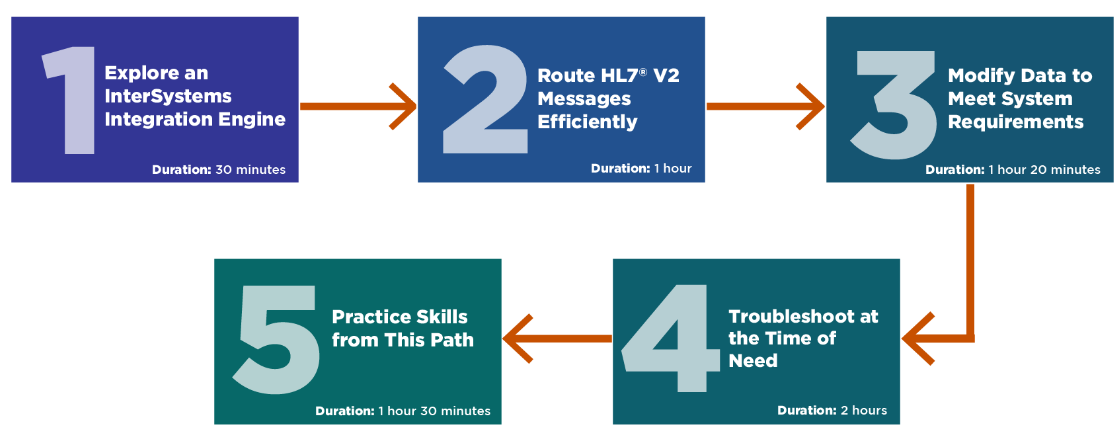
Because I had no idea how to build an integration solution for HL7 and didn't know where to start, I decided to follow the course Building Basic HL7 Integrations with InterSystems on Learning portal to get at least the idea of where to begin. After I studied all of it, I decided it might be a good idea to share my thoughts and reflections about it with everyone.
The InterSystems learning site now has updated offerings for HealthShare customers.
We recently updated courses about Health Insight Data Flow and Dynamic Cohorts. The dynamic cohorts course provides you with a virtual machine with Health Insight installed, which you can use as a learning sandbox.
For the full set of Health Insight offerings, visit the Health Insight Learning Path.
Hi Community,
Watch this video to learn what's in store for patient experience initiatives for our hospital clients:
While you don't need to take your exam before the end of 2022, the vouchers provided to the UK&I Summit 2022 must be redeemed before January 1, 2023. Please register for an exam before time runs out.
You can find additional information about the InterSystems Certification Program here.
What I can do:
Get a subset of HL7 messages.
Send the messages to a RecordMap (with key fields from the HL7 message).
Save each message to a file.
How can I send all messages until a set time (e.g. 9am each day) to single file?
Scenario:
In the period 09:00 1 Jan 2022 to 09:00 2 Jan 2022 there are say 50 messages to save to file: File001.txt
In the period 09:00 2 Jan 2022 to 09:00 3 Jan 2022 there are say 40 messages to save to file: File002.
I have been creating classes using the below REST url.
http://localhost:57772/api/atelier/v1/ENSDEMO/doc/Demo.HL7.MsgRouter.Te…
The only caveat is that I want to only load in the compiled code of the classes, as they appear in deployed mode.
How do I define this in the content of the JSON payload being sent across?
Is anybody using the EPRSave() Edge Gateway method/API?
It is documented in:
https://docs.intersystems.com/hs20222/csp/docbook/DocBook.UI.Page.cls?K…
Enrico
Hi,
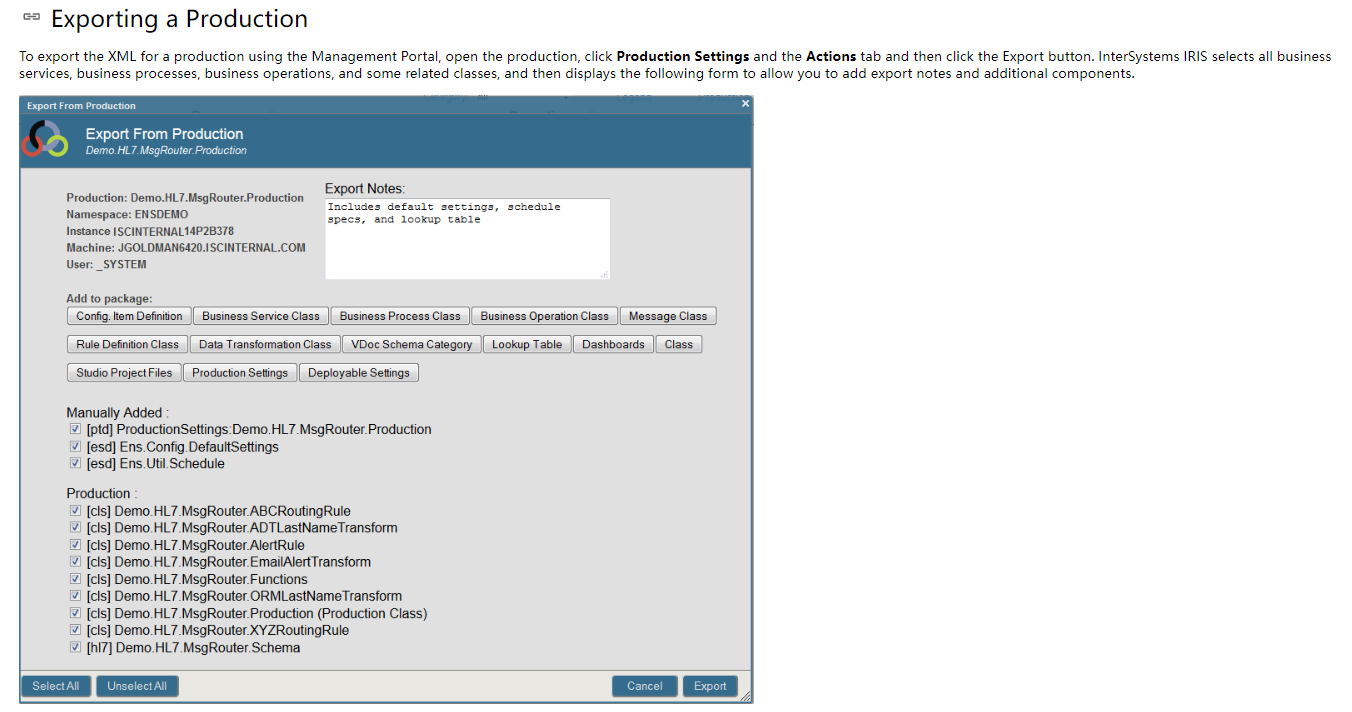
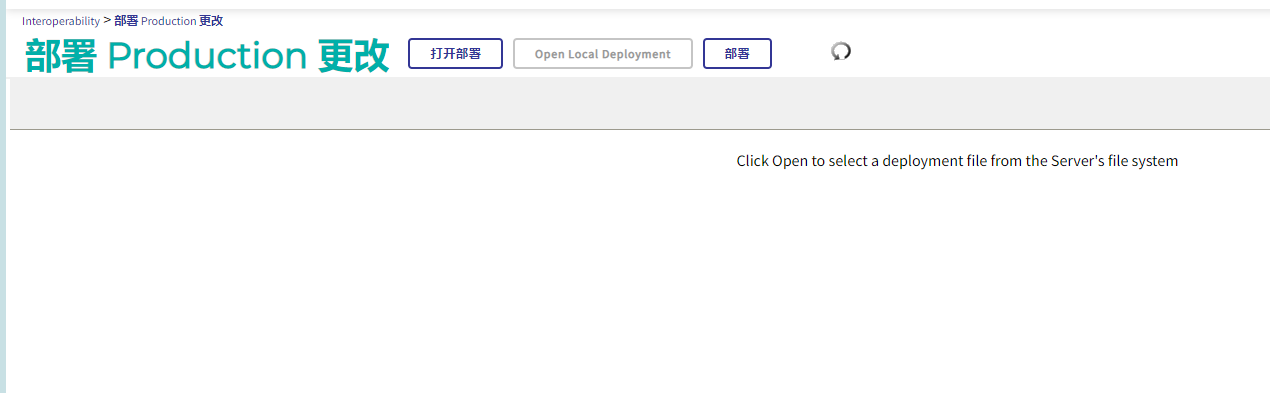
I want to realize configuration export and deployment through code, such as the export of Protol pages and production deployment. What should I do duction deployment. What should I do
The following is a picture of export and deployment
--------------------------------------------------------------------------------------------------------------
When recieivng a response and calling SendDeferredResponse I get the warning below and no response is sent.
|
When the initial request comes in I am calling DeferResponse but the message never goes into a state of Deferred.
How do I resolve this warning and get the response working?
In the previous article, we talked about the flow of data to request the test and receive the results of the requested test. Now let's talk about one of the most important messages of HL7v2 standard.
Every time a receiving application accepts a message and consumes the message data, it is expected to send an ACKnowledgement (ACK) message back to the sending application. The sending application is expected to keep on sending a message until it has received an ACK message. It is done to inform the sending application that its message was successfully received, that it is (not) valid in accordance with HL7 rules and, if it is compliant, that it will be processed at some point.
.png)
Hi Community,
How do I include the users on the Patient Index worklist to be part of the users on the arrow below?
.png)
HL7 (Health Level 7) is a set of technical specifications for computerized exchanges of clinical, financial and administrative data between hospital information systems (HIS). These specifications are variously integrated into the corpus of formal American (ANSI) and international (ISO) standards.
The L7 of HL7 indicates that it is a standard that operates at layer 7, in other words at the application layer, of the OSI model. This means that HL7 does not have to take into account exchange security considerations, or those of message transport (this being ensured by lower-level layers such as SSL/TLS for security or TCP for the transport of data for example). To be more precise, layer 7 supports communications for end-user processes and applications and the presentation of data for user-facing software applications. As the highest layer of the OSI model, and the closest to the end user, layer 7 provides application-specific functions such as identifying communication partners and the quality of service between them, determining resource availability, considering privacy and user authentication, and synchronizing communication, as well as connecting the application to the lower levels of the OSI model.
Returning to the HL7 standard, the HL7 version 2 standard (also known as Pipehat) was originally created in 1989 but is still being used and updated regularly, resulting in versions 2.1, 2.2, 2.3, 2.3.1, 2.4, 2.5, 2.5.1, 2.6, 2.7, 2.7.1, 2.8, 2.8.1, 2.8.2 and 2.9. The v2.x standards are backward compatible (e.g., a message based on version 2.3 will be understood by an application that supports version 2.6) and in higher versions, you will see some fields are left just for it.

Despite it being more than 30 years old, HL7v2 remains the most widely used healthcare interface standard by a large margin according to the HL7.org portal that tells that:
In the previous article, we've seen the structure of one of the most used types of HL7 message - ADT (Admit, Discharge, Transfer) and an example of ADT^A04 with the description of all its fields. Now let's look at another flow of data having to do with ordering and fulfilling the orders of tests. I'm talking about ORM (as of version 2.5 you should use specific messages to order tests, like OMG, OML, OMD, OMS, OMN, OMI, and OMP), ORL and ORU messages. In a very simplified case, the exchange of data may look like this.
.png)
Let's look at these messages in more detail.
InterSystems announces another developer preview release, as part of the developer preview program for the 2022.3. Many updates and enhancements have been added in 2022.3 and there are also brand new capabilities, such as the new FHIR SQL Builder, improvements for Columnar Storage, and support to Oracle Linux 9. Some of these features or improvements may not be available in this current developer preview.
Future preview releases are expected to be updated biweekly and we will add features as they are ready.
Cures Act USCDI/ C-CDAv21 certification. I am looking for SDA3 examples for Newman-Bates-Kid/registry settings/advices on how to learn / whatever is helpful. InterSystems xsl files are clean but I am not working very often with xsl. I am mainly looking at Provenance and Clinical Notes, the 2 last errors we have. InterSystems documentation, so far I know, is very poor: only classes and some pages. Support has a small knowledge about SDA3 -> C-CDAv21 even if they try very hard to help.
Of course I am wondering if my company is using an almost dead technology. Is everybody on fhir now?
When creating a PRA (Privileged Routine Application; which by the way is not relevant just for Routines but also for Classes/Methods), it is important to make sure you include a new $ROLES, before calling AddRoles(). For example:
 new $ROLES
 set status=$System.Security.AddRoles("MyPrivilegedRoutineApplication")
This way you ensure that indeed the added (elevated) roles "evaporate" for the User running this code, once the User is out of the scope of that routine/method.
[Thank you @Andreas Dieckow for validating this]
Look forward to the first Dutch HealthShare user group next Friday in Groningen. We have great topics to discuss with some Dutch HealthShare users:
Hi Community,
I need assistance to query ODS FHIR server to retrieve only one record.At the moment I am getting multiple records returned as seen below.
Is there a way to specify a parameter that will return a single record instead of 21 because it's the same practitioner returned 21 times.
.png)
Hi Community,
Can someone assist me to check why HealthShare Iris install disk space increased, I want to know what contributed to Disk space utilization increase as it it now running at 81%. I am running Redhat Linux machine which is hosted on AWS.
.png)
