Hi Community!
Please welcome a new video on InterSystems Developers YouTube Channel:
Alexa: Connect Me with the World of IoT
Artificial Intelligence (AI) is the simulation of human intelligence processes by machines, especially computer systems. These processes include learning (the acquisition of information and rules for using the information), reasoning (using rules to reach approximate or definite conclusions) and self-correction.
Hi Community!
Please welcome a new video on InterSystems Developers YouTube Channel:
Alexa: Connect Me with the World of IoT
Hi all. We are going to find duplicates in a dataset using Apache Spark Machine Learning algorithms.
Note: I have done the following on Ubuntu 18.04, Python 3.6.5, Zeppelin 0.8.0, Spark 2.1.1
In previous articles we have done the following:
In this series of articles, we explore Machine Learning and record linkage.
Hi all.
I want to insert my dataframe into InterSystems IRIS. So, I tried to do this:
df = spark.read.load("/home/imported-openssh-key/zeppelin-0.8.0-bin-all/bin/resultData3/DF.json", format="json")
df.write.format("com.intersystems.spark").\
option("url", "IRIS://localhost:51773/DEDUPL").\
option("user", "********").option("password", "********").\
option("dbtable", "try.test1").save()
And got this error:
Py4JJavaError: An error occurred while calling o80.save.
: java.lang.NoSuchMethodError: org.apache.spark.sql.execution.datasources.jdbc.JdbcUtils$.Bring your laptop to the Experience Lab on Global Summit 2018 and engage with our technologies in a whole new way!
We’re now less than a month away from our annual conference, the InterSystems Global Summit. This year, we’ll be descending on the beautiful outskirts of San Antonio, a city worth visiting for its wonderful river walkway and its 18th century Spanish Mission, even if it hadn’t been the location of this year’s InterSystems event. Leaving the tourist guidance to the tourist guides, let’s take a closer look at what the conference has in stock for you, including a dedicated post-summit symposium on AI and ML on Wednesday October 3!
Hi Community!
Please welcome a new video on InterSystems Developers YouTube:
Deploying Shards Using the API
Hi Community!
New video "Deploying Shards Using InterSystems Cloud Manager" is available now on InterSystems Developers YouTube:
Hi Everyone!
Very soon, almost every product and application will include artificial intelligence (AI).
On the afternoon of Wednesday, October 3, at the Global Summit 2018 in San Antonio we’re pulling together experts from InterSystems and from the front lines of the AI industry to discuss the current and future state-of-the-art for AI solutions.
Learn more about our Post-Summit Symposium: Artificial Intelligence and Machine Learning.
In a single server environment, it is rather easy to create a transaction consistent backup.
Simplified:
You find (or force a specific point in time with no open transactions.
Freeze your server, take a snapshot and you are done.
Hi Everybody!
The previous webinar rescheduled due to technical issues.
We are pleased to invite you again to the live webinar "It’s Machine Learning, Not Rocket Science!" on 31st of July at 11:00 a.m. EDT!
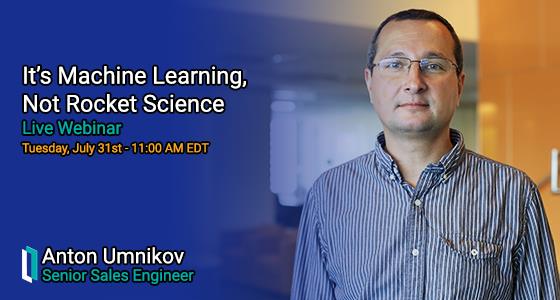
The recording of Anton Umnikov's It's Machine Learning, Not Rocket Science! webinar is now available on learning.intersystems.com.
In it, Anton provides a great, high-level introduction to machine learning and shows why you don't need to be a "unicorn" data scientist to start using machine learning to your advantage!
Hi all. Today we are going to use k-means algorithm on the Iris Dataset.
Note: I have done the following on Ubuntu 18.04, Apache Zeppelin 0.8.0, python 3.6.5.
K-Means is one of the simplest unsupervised learning algorithms that solves the clustering problem. It groups all the objects in such a way that objects in the same group (group is a cluster) are more similar (in some sense) to each other than to those in other groups. For example, assume you have an image with a red ball on the green grass. K-Means will split all pixels into two clusters.
Hi Everybody!
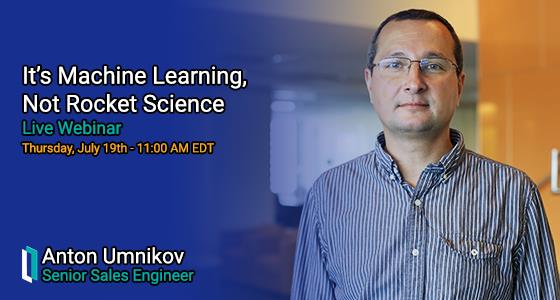
We are pleased to invite you to the upcoming live webinar "It’s Machine Learning, Not Rocket Science!" on 19th of July at 11:00 a.m. EDT!
Hi Everybody!
We are pleased to invite you to the upcoming webinar "It's just machine learning, not quantum physics!" on 22th of June at 14:00 (Moscow time)!
Hi Everybody!
We are pleased to invite you to the upcoming webinar "Sharding as the basis of Scaling in InterSystems IRIS Data Platform" on 24th of July at 10:00 (Moscow time)!
With the release of InterSystems IRIS, we're also making available a nifty bit of software that allows you to get the best out of your InterSystems IRIS cluster when working with Apache Spark for data processing, machine learning and other data-heavy fun. Let's take a closer look at how we're making your life as a Data Scientist easier, as you're probably already facing tough big data challenges already, just from the influx of job offers in your inbox!
Hi Everyone!
New session recording from Global Summit 2017 is already on InterSystems Developers YouTube:
Predicting Your Manhattan Cab Ride Fare
Last week, we announced the InterSystems IRIS Data Platform, our new and comprehensive platform for all your data endeavours, whether transactional, analytics or both. We've included many of the features our customers know and loved from Caché and Ensemble, but in this article we'll shed a little more light on one of the new capabilities of the platform: SQL Sharding, a powerful new feature in our scalability story.
Hi, Community!
Check a new session recording from Global Summit 2017:
iKnow What You'll Do Next Summer
Last week saw the launch of the InterSystems IRIS Data Platform in sunny California.
For the engaging eXPerience Labs (XP-Labs) training sessions, my first customer and favourite department (Learning Services), was working hard assisting and supporting us all behind the scene.
Before the event, Learning Services set up the most complicated part of public cloud :) "credentials-for-free" for a smooth and fast experience for all our customers at the summit.
Hi Guys,
Can you please guide me on how to develop the machine learning concepts like as Chatbots, voice recognition, etc...
If any lead would be appreciate.
Thanks in Advance.
Thanks and Regards,
Arun Kumar Durairaj.
Apache Spark has rapidly become one of the most exciting technologies for big data analytics and machine learning. Spark is a general data processing engine created for use in clustered computing environments. Its heart is the Resilient Distributed Dataset (RDD) which represents a distributed, fault tolerant, collection of data that can be operated on in parallel across the nodes of a cluster. Spark is implemented using a combination of Java and Scala and so comes as a library that can run on any JVM.
Several years ago everyone got mad about BigData – nobody knew when smallish data will become BIGDATA, but all knows that it’s trendy and the way to go. Time passed, BigData is not a buzz anymore (most of us missed the moment when Gartner has removed BigData term from their 2016 buzzword 2016 curve http://www.kdnuggets.com/2015/08/gartner-2015-hype-cycle-big-data-is-out-machine-learning-is-in.html), so it’s probably a good time to look back and realize what it is (what it was)…
Let’s start from the beginning: what is the moment when “not so big data” becomes BigData?