New
Hey Community!
We're happy to share the next video in the "Code to Care" series on our InterSystems Developers YouTube:
Artificial Intelligence (AI) is the simulation of human intelligence processes by machines, especially computer systems. These processes include learning (the acquisition of information and rules for using the information), reasoning (using rules to reach approximate or definite conclusions) and self-correction.
Hey Community!
We're happy to share the next video in the "Code to Care" series on our InterSystems Developers YouTube:
A Continuous Training (CT) pipeline formalises a Machine Learning (ML) model developed through data science experimentation, using the data available at a given point in time. It prepares the model for deployment while enabling autonomous updates as new data becomes available, along with robust performance monitoring, logging, and model registry capabilities for auditing purposes.
InterSystems IRIS already provides nearly all the components required to support such a pipeline. However, one key element is missing: a standardised tool for model registry.
Hi folks,
One of the things I've been thinking about recently: how strong AI is changing my work as an ObjectScript developer right now! Yeah, yeah, I know I'm not a very fast, it should have happened 2-3 years ago... But it's only now that I've realized that I am not writing the code all my workday like before.
Why do we need this?
Lack of Compiled Context: AI tools only see source code; they don't know what the final compiled routine looks like.
Macro Hallucination: Because AI doesn't see our #include files or system macros, it often makes them up, wasting time during debugging.
The Documentation Gap: Deep logic optimization often requires understanding internal macros that aren't fully covered in public documentation.
Manual Overhead: Currently, the only way to fix this is to manually use the IRIS VS Code extension to find the "truth" in the routine.
v2026.1 was just released as GA, and one of the features I'm looking forward to using is the DTL Explainer feature.
This allows you to take a Data Transformation, and with a click of a button get a human-readable description of the transformation (which you can also use as the basis for the DTL Description).
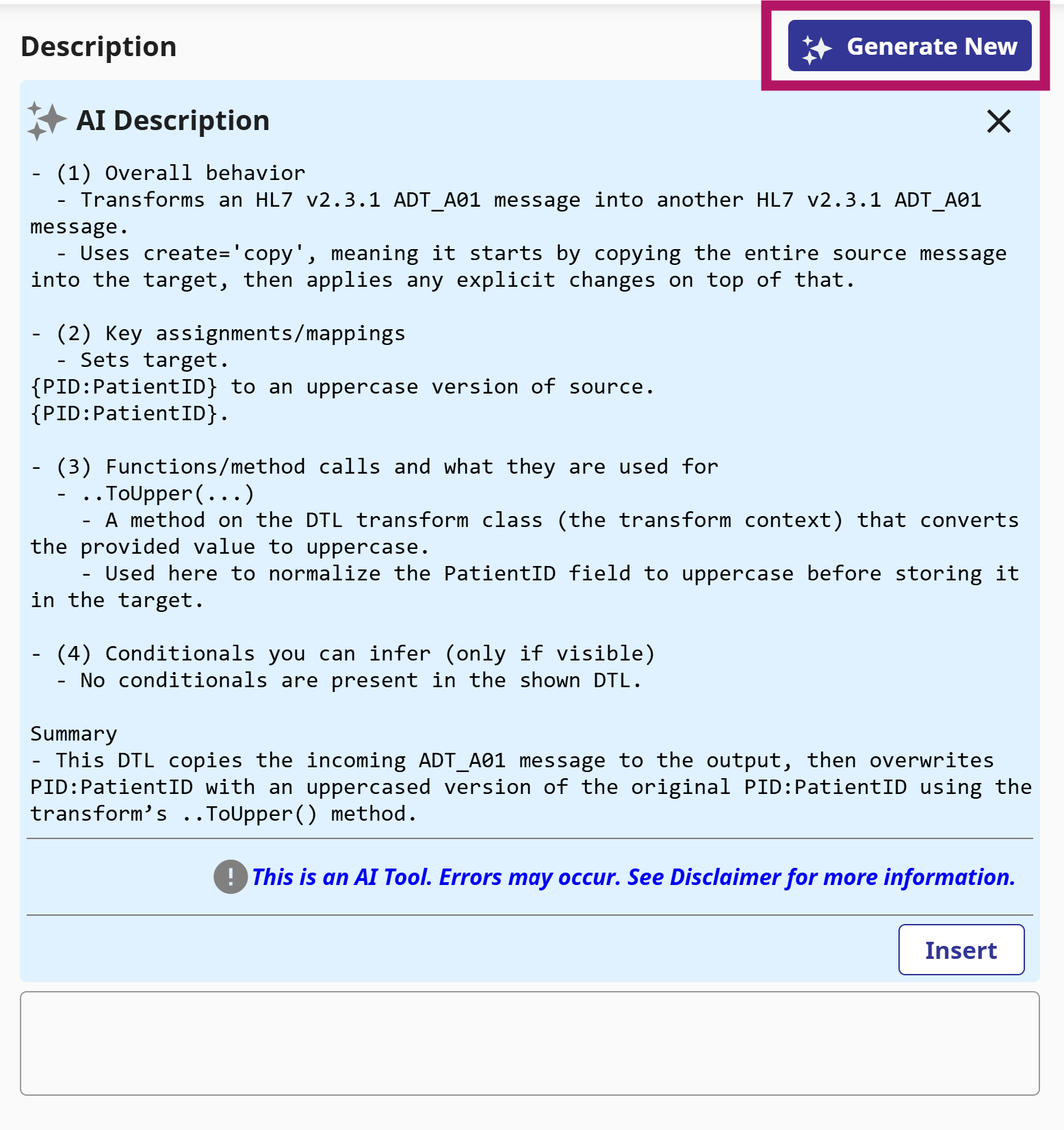
For complex DTLs, especially ones you didn't write yourself, or you did but a long time ago, this will allow you to get a clear quick understanding of what it's doing.
Hi Community,
Enjoy the new video on InterSystems Developers YouTube:
What is Unstructured Data?
Unstructured data refers to information lacking a predefined data model or organization. In contrast to structured data found in databases with clear structures (e.g., tables and fields), unstructured data lacks a fixed schema. This type of data includes text, images, videos, audio files, social media posts, emails, and more.
Why Are Insights from Unstructured Data Important?
According to an IDC (International Data Corporation) report, 80% of worldwide data is projected to be unstructured by 2025, posing a significant concern for 95% of businesses.

In the previous article, we saw in detail about Connectors, that let user upload their file and get it converted into embeddings and store it to IRIS DB. In this article, we'll explore different retrieval options that IRIS AI Studio offers - Semantic Search, Chat, Recommender and Similarity.
Keywords: Vibe coding, Windsurf, IRIS, TIE
Has anyone not been trying "vibe coding" so far?
Even merely 3 years ago, if anyone asked
Keywords: IRIS, Agents, Agentic AI, Smart Apps
Transformer based LLMs appear to be a pretty good "universal logical–symbolic abstractor". They started to bridge up the previous abyss among human languages and machine languages, which in essence are all logic symbols that could be mapped into the same vector space.
Wondering for 3 years we might be able to just use English (etc human natural languages) to do IRIS implementations as well, one day.

You’ve seen how tools like Lovable are shaking up web development. People are spinning up entire apps just by talking to an AI, almost like pair‑programming on steroids.
Now imagine bringing that same “vibe coding” experience into healthcare. know, it sounds crazy. Healthcare is complex, full of regulations, and usually gives us a headache just thinking about the interoperability rules.
That’s exactly the space where withLove lives: an AI‑Native, Low‑Code platform built entirely on InterSystems IRIS for Health.
Hi developers!
I'm testing vibecoding with ObjectScript and my silicon friend created a code-block that got me thinking "what's wrong"?
Here is the piece of code:
for i=0:1:(json.%Size()-1) {

set p = json.%Get(i)

if (p="value1")!(p="value2") {

quit 1
}
AI wanted to quit from a method with a return value. Good intention, but bad use of the command.
And ObjectScript compiler compiles this code with no error(?) (syntax linter in VSCode says it's a syntax, kudos @Brett Saviano ).
But in action, it produces <COMMAND>, of course.

Welcome to the finale of our journey in building MAIS.
Now, the stage is set. Our agents are ready, defined, and eager to work. However, they remain frozen in time. They require a mechanism to drive the conversation, execute their requested tools, and pass the baton to one another.
Today, we will assemble the Nervous System

Ever since I started using IRIS, I have wondered if we could create agents on IRIS. It seemed obvious: we have an Interoperability GUI that can trace messages, we have an underlying object database that can store SQL, Vectors and even Base64 images. We currently have a Python SDK that allows us to interface with the platform using Python, but not particularly optimized for developing agentic workflows. This was my attempt to create a Python SDK that can leverage several parts of IRIS to support development of agentic systems.
10:47 AM — Jose Garcia's creatinine test results arrive at the hospital FHIR server. 2.1 mg/dL — a 35% increase from last month.
What happens next?
No chatbot. No manual prompts. No black-box reasoning.
This is event-driven clinical decision support with full explainability:
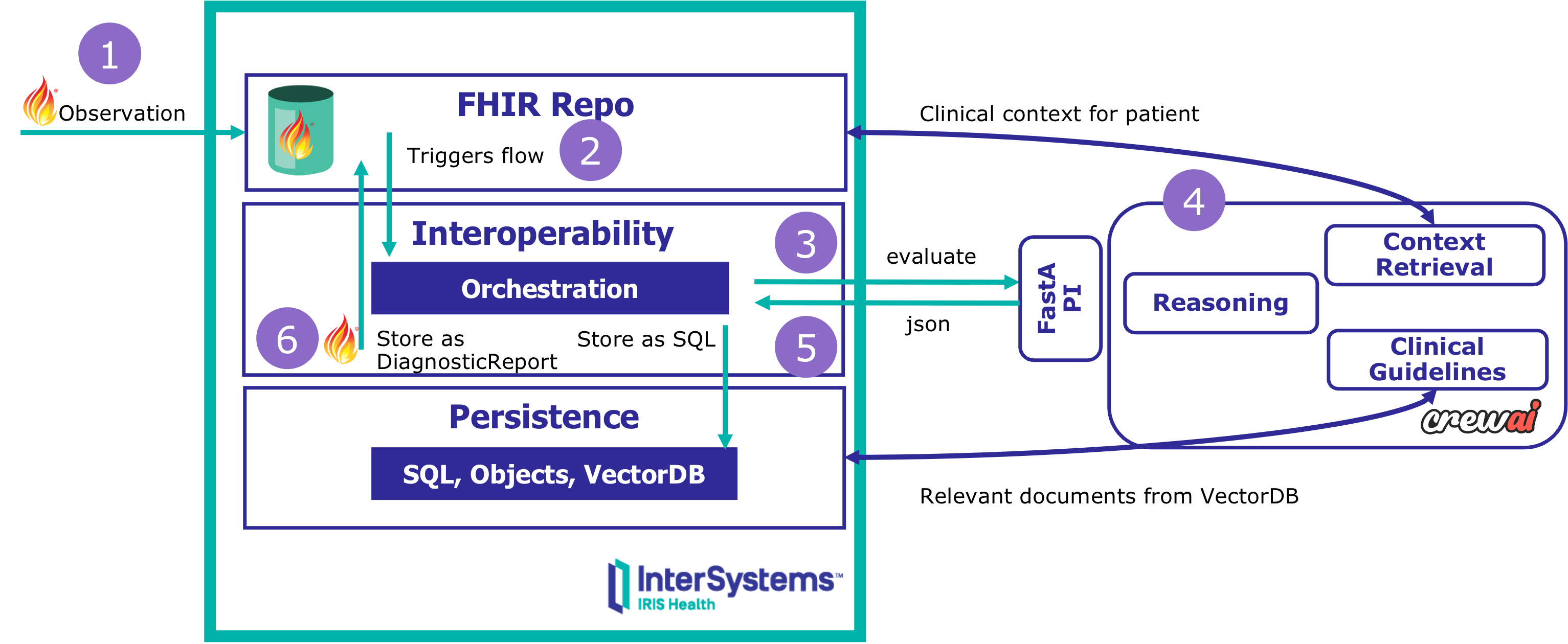
✅ Triggered automatically by FHIR events ✅ Multi-agent reasoning (context, guidelines, recommendations) ✅ Complete audit trail in SQL (every decision, every evidence source) ✅ FHIR-native outputs (DiagnosticReport published to server)
Built with:
You'll learn: 🖋️ How to orchestrate agentic AI workflows within production-grade interoperability systems — and why explainability matters more than accuracy alone.
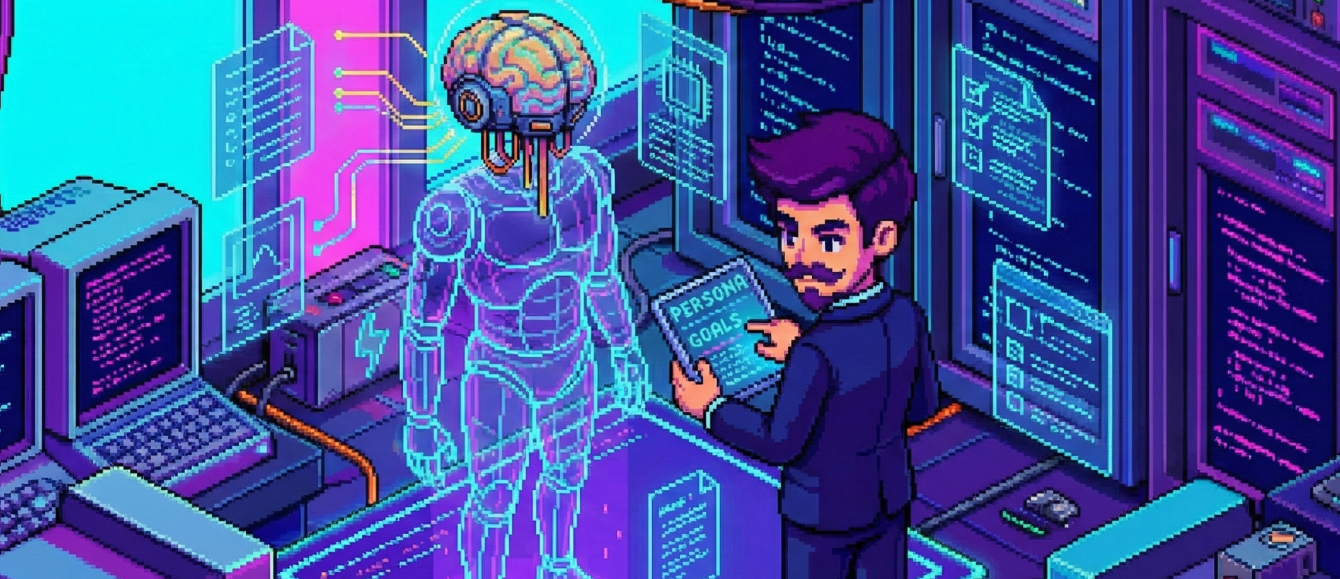
In Part 1, we laid the technical foundation of MAIS (Multi-Agent Interoperability Systems). We have successfully wired up the 'Brain', built a robust Adapter using LiteLLM, locked down our API keys with IRIS Credentials, and finally cracked the trick code on the Python interoperability puzzle.
However, right now our system is merely a raw pipe to an LLM. It processes text, but it lacks identity.
Today, in Part 2, we will define the Anatomy of an Agent We will move from simple API calls to structured Personas.

Some concepts make perfect sense on paper, whereas others require you to get your hands dirty. Take driving, for example. You can memorize every component of the engine mechanics, but that does not mean you can actually drive.
You cannot truly grasp it until you are in the driver's seat, physically feeling the friction point of the clutch and the vibration of the road beneath. While some computing concepts are intuitive, Intelligent Agents are different. To understand them, you have to get in the driver's seat.
Hey Community!
We're happy to share the next video in the "Code to Care" series on our InterSystems Developers YouTube:

I'm a huge sci-fi fan, but while I'm fully onboard the Star Wars train (apologies to my fellow Trekkies!), but I've always appreciated the classic episodes of Star Trek from my childhood. The diverse crew of the USS Enterprise, each masterminding their unique roles, is a perfect metaphor for understanding AI agents and their power in projects like Facilis. So, let's embark on an intergalactic mission, leveraging AI as our ship's crew and boldly go where no man has gone before
Hi everyone.
I'm going to give you a quick tip on how to implement an AI agent to search the Intersystems documentation integrated into Teams.
Yes, I know the documentation page has its own AI search engine and it's quite effective, but this way we'd have faster access, especially if Teams is your company's corporate tool.
You can also create another AI agent to search articles published in the developer community (which also has its own integrated AI search engine).
Hi,
We're working on new capabilities to help you build Agents and AI applications faster with InterSystems IRIS. In order to better understand which entry points and development methodologies would help you most, we've created this brief survey: Building AI solutions with InterSystems IRIS.
Filling it in should not take much more than 5 minutes, and your feedback on this exciting topic will help us fine tune our designs and prioritize the right features.
Thanks in advance!
benjamin
Hey Community!
We're happy to share the next video in the "Code to Care" series on our InterSystems Developers YouTube:

In this article I will be discussing the use of an alternative LLM for generative IA. OpenIA is commonly used, in this article I will show you how to use it and the advantages of using Ollama
In the generative AI usage model that we are used to, we have the following flow:
Hey Developers,
Enjoy the new video on InterSystems Developers YouTube
⏯ Integrating AI Agents into InterSystems IRIS - Patterns and Techniques @ READY 2025
Hey Developers,
Enjoy the new video on InterSystems Developers YouTube
Hey Community,
Enjoy the new video on InterSystems Developers YouTube:
⏯ Analytics and AI with InterSystems IRIS - From Zero to Hero @ Ready 2025
Yes, yes! Welcome! You haven't made a mistake, you are in your beloved InterSystems Developer Community in Spanish.
You may be wondering what the title of this article is about, well it's very simple, today we are gathered here to honor the Inquisitor and praise the great work he performed.
Perfect, now that I have your attention, it's time to explain what the Inquisitor is. The Inquisitor is a solution developed with InterSystems technology to subject public contracts published daily on the platform https://contrataciondelestado.es/ to scrutiny.
Hey Community,
Enjoy the new video on InterSystems Developers YouTube:
This anthropic article made me think of several InterSystems presentations and articles on the topic of data quality for AI applications. InterSystems is right that data quality is crucial for AI, but I imagined there would be room for small errors, but this study suggests otherwise. That small errors can lead to big hallucinations. What do you think of this? And how can InterSystems technology help?