Starting with the Field Test of 2017.1 InterSystems products will include Feature Tracker. It is enabled by default during the Field Test and is explained more fully in the product documentation included below. Information collected by Feature Tracker is limited to technology usage information and instance identification. This tool has been carefully crafted to not transmit sensitive information related to customer applications or data.
Hi All,
I need some help to create mdx for the following scenario.
My source table is like this format
| FileName | AuditDate | FileType | FileStatus | AuditStatus |
| A | 20161102 | 20 | open | 0 |
| A | 20161101 | 20 | read | 1 |
| A | 20161031 | 20 | write | 0 |
| A | 20161030 | 20 | close | 1 |
| B | 20161102 | 40 | open | 1 |
| C | 20161101 | 45 | read | 1 |
| D | 20161031 | 40 | read | 1 |
| E | 20161031 | 20 | open | 0 |
| E | 20161102 | 40 | read | 1 |
| F | 20161102 | 45 | read | 1 |
When the user selects any Date in my application, Till selected date results are displayed for all filename.
My current MDX is
SELECT
{
[FileTypeD].[H1].[FileType].&[20],
[FileTypeD].[H1].[FileType].&[40],
[FileTypeD].[H1].[FileType].&[45]
} ON 0,
CROSSJOIN([FileStatusD].[H1].
Hello!
The question I have today is the next. Suppose I have this simple class describing the REST application:
Class Playground.Rest Extends %CSP.REST
{
XData UrlMap
{
<Routes>
<Route Url="/index" Method="GET" Call="Index"/>
<Route Url="/logout" Method="GET" Call="Logout"/>
</Routes>
}
ClassMethod Index() As %Status
{
write "You're logged in as " _ $Username
quit $$$OK
}
ClassMethod Logout() As %Status
{
write "Bye, " _ $Username _ "!"
do %session.
{
XData UrlMap
{
<Routes>
<Route Url="/index" Method="GET" Call="Index"/>
<Route Url="/logout" Method="GET" Call="Logout"/>
</Routes>
}
ClassMethod Index() As %Status
{
write "You're logged in as " _ $Username
quit $$$OK
}
ClassMethod Logout() As %Status
{
write "Bye, " _ $Username _ "!"
do %session.
As per the documentation of QueueCountAlert:
Number of messages on this item's queue needed to trigger an Alert message to be sent. Note that no further alerts will be sent unless the number of messages on the queue drops below 80% of this number and then rises again to this number.
Note that this alert will be sent even if AlertOnError is False.
Zero means no alerts of this type will be sent.
Now, the question is,
If QueueCountAlert is set to 10, and the queue size become 11 we will be getting email once.
Hello community!
I am trying to set up Startup Tag^Routine field for the UnknownUser as follows:
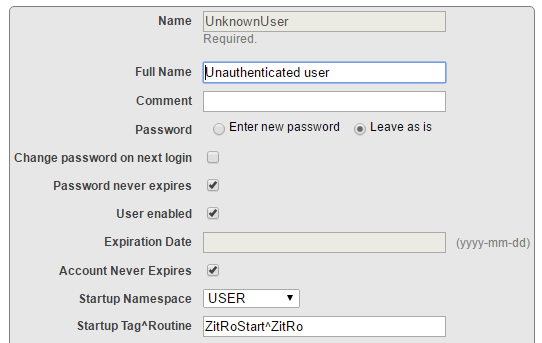
And my simple routine is the next:
Calling do ZitRoStart^ZitRo in the terminal prints "Hello", but when opening Caché Terminal it results with the next:
And the terminal closes.
// Cache for Windows (x86-64) 2016.2 (Build 636U) Wed Apr 13 2016 20:58:35 EDT
What am I doing wrong in setup?
Thank you very much!
Here's an easy one for you; before I spend another hour looking for the answer, how do you convert %ArrayOfDataTypes to an array (that could, say, fit into the %session.Data array, or maybe just some array named info()), and of course back again?
NS>s aodt=##class(%ArrayOfDataTypes).%New()
NS>w aodt.SetAt("lcavanaugh","username")
1
NS>w aodt.SetAt("organization","coolcompany")
1
NS>w ##class(%ArrayOfDataTypes).BuildValueArray(aodt,.array)
<LIST>zBuildValueArray+1^%Library.ArrayOfDataTypes.1
aodt must be serialzed. What?
NS>zw array
NS>
Hello
I have noticed that Cache (2016.1 at the time of writing) doesn't come with a systemd startup script for RHEL7.
Here is a small example script I have built.
[Unit]
Description=Intersystems Cache

[Service]
Type=forking
ExecStart=/bin/bash -c '/usr/cachesys/cstart 2>&1 | logger -t cache_start'
ExecStop=/bin/bash -c '/usr/cachesys/cstop quietly 2>&1 | logger -t cache_stop'
RemainAfterExit=yes

[Install]
WantedBy=multi-user.target
The file should be placed as /usr/lib/systemd/system/cache.
Hi All, when I ran the Command to make a folder in particular directory its not working in terminal,but when i run the same command in studio output block it create the folder. Used command: S cmd="mkdir E:\DIRECTORY" O cmd:"QR":10 Suggest Please.
I've asked a lot of questions leading up to this, so I wanted to share some of my progress.
The blue line represents the number of messages processed. The background color represents the average response time. You can see ticks for each hour (and bigger ticks for each day). Hovering over any point in the graph will show you the numbers for that period in time.
This is super useful for "at a glance" performance monitoring as well as establishing patterns in our utilization.

Here is the query used:
SELECT
    mh.name                                  AS MessageType,
    COUNT(mh.name)                           AS MessageCount,
    CAST(AVG(ResponseTime) AS DECIMAL(5, 2)) AS AvgResponseTime
FROM
    (
     SELECT
            li.SessionId,
            li.Name,
            DATEDIFF(s, MIN(li.TimeCreated), MAX(lo.TimeCreated)) AS ResponseTime
       FROM
            (
             SELECT
                    SessionId,
                    name,
                    TimeCreated
               FROM
                    ens.messageheader h1,
                    HS_Message.XMLMessage m1
              WHERE
                    h1.MessageBodyId = m1.ID
                AND h1.TimeCreated > DATEADD(hh, -1, GETUTCDATE())) li
       JOIN
            (
             SELECT
                    SessionId,
                    TimeCreated
               FROM
                    ens.messageheader h2,
                    HS_Message.XMLMessage m2
              WHERE
                    h2.MessageBodyId = m2.ID
                AND h2.TimeCreated > DATEADD(hh, -1, GETUTCDATE())) lo
         ON
            li.SessionId = lo.SessionId
   GROUP BY
            li.SessionId) mh
WHERE
    mh.name LIKE '%REQUEST'
GROUP BY
mh.nameIf I run SELECT * FROM HS_Message.PatientSearchRequest ORDER BY ID Desc every row has a unique ID but every other row is an exact duplicate. Why would this be?
A short post for now to answer a question that came up. In post two of this series I included graphs of performance data extracted from pButtons. I was asked off-line if there is a quicker way than cut/paste to extract metrics for mgstat etc from a pButtons .html file for easy charting in Excel.
See: - Part 2 - Looking at the metrics we collected
pButtons compiles data it collects into a single html file to make it easier to send to WRC and review the collated data.
This is a follow-up to Murray's article for scripting pButtons data extraction on Unix/MacOS: Extracting pButtons data to CSV for UNIX/MacOS
###Extracting pButtons data to a CSV file on Windows
PowerShell scripting was used in this article because it is available by default on Windows platforms.
The script, Extract_pButtons.ps1, will search the given pButtons file until it finds the marker for the beginning of the section. The section will be printed line-by-line, from the header to the line before the section end marker.
Hi,
Is there any way to track the 'last modified by' cache user name and datetime of last modification for a class or routine definition [Track Last Code Changes]?
Thanks,
Tirthankar
Hi-
I have created a class that extends %Persistent and %Populate and have set the various POPSPEC attributes of my properties to control how the properties are populated. However, when I compile the class and try to run the Populate() method it tells me the method isnt defined.
Here is the class definition:
Class My.PrimaryClass Extends (%Populate, %Persistent)

{

Property Name As %String(POPSPEC = "NAME");

Property Title As %String(POPSPEC = "TITLE");

Property City As %String(POPSPEC = "CITY");

Property State As %String(POPSPEC = "STATE");

Property Zip As %String(POPSPEC = "ZIP");

Property Employment As VA.SecondaryClass;

}The iKnow documentation shows an example for adding sources to a domain after an initial loading of sources.
The example uses text files. However, our data is now in Cache SQL tables.
Is it possible to add sources from a Cache SQL table, and is there an example of how this is done?
Thank you.
Hi everybody,
My name is Sérgio Fernandes and I'm from Brazil.
I need to get the size of file that the user wants to upload in my application.
I'm getting it name with %request.GetMineData("fileName").FileName, but not found it at Ensemble documentation how would i get the size of file.
My version is Ensemble 2013.1.6.950.0 and I'm doing it at csp.
Thaks
InterSystems is pleased to announce that Caché and Ensemble 2016.2.1 are now available as maintenance releases.
For a complete list of the corrections in 2016.2.1, please review the release notes.
Caché and Ensemble 2016.2.1 are available for the same platforms as 2016.2.0. The complete set of supported platforms, including specific point releases and patches, is detailed in the Supported Platforms document.
The HealthShare team will announce availability of its products separately.
The build corresponding to this release is 2016.2.1.803.0
I'm trying to start a Production and the following error is shown.
Any idea how to solve?
translations: - Produção 'BUS.BusProduction' está sendo iniciada...
- Production 'BUS.BusProduction' is being initialized
- A produção não pode ser iniciada - precisa ser ativada
- The production can't be initialized - it must be activated.
11:10:01.549:Ens.Director: Produção 'BUS.BusProduction' está sendo iniciada...
11:10:01.550:BUS.BusProduction: ERRO <HSErr>ConfigurationNotActivated: A produção não pode ser iniciada - precisa ser ativada
11:10:01.551:BUS.BusProduction: Startup Error 0 ¨"<HSErr>ConfigurationNotActivatedwBUSm"e^zEnsError+
1^Ens.Util.Error.1^1-e^zOnStart+9^HS.Util.AbstractProduction.1^2(e^zStartProduction+40^Ens.Director.1^1
(e^zStartProduction+9^%SYS.Ensemble.1^1'e^zStartProduction+8^Ens.Director.1^13e^zStartProduction+2^
EnsPortal.StartStopFrame.1^1,e^zOnPage+132^EnsPortal.StartStopFrame.1^1/e^zPage+9^EnsPortal.Template.
standardPage.1^2$e^CSPDispatch+444^%SYS.cspServer^2$d^CSPDispatch+280^%SYS.cspServer^1&d^zProcessRequest+
1^%CSP.Session.1^1!d^Request+612^%SYS.cspServer2^1 d^Request+25^%SYS.cspServer2^1&d^zProcessRequest+
1^%CSP.Request.1^1d^css+42^%SYS.cspServer2^1 d^SuperServer+48^%SYS.SERVER^3d^^^0
11:10:01.551:Ens.Director: ERRO <HSErr>ConfigurationNotActivated: A produção não pode ser iniciada - precisa ser ativada
11:10:01.552:Ens.Director: ERRO <HSErr>ConfigurationNotActivated: A produção não pode ser iniciada - precisa ser ativada
Produção 'BUS.BusProduction' não foi iniciada:
ERRO <HSErr>ConfigurationNotActivated: A produção não pode ser iniciada - precisa ser ativada
I try to run the cmd command in the studio terminal, but i am getting the <NOTOPEN> Error.
Even ZF(-1) also not working. Any help, Please!!!
Note: i restart the Cache instance service with full privilege
Code:
Set Path="mkdir E:\Sample\New"
Open Path:"QR":10
Error:<NOTOPEN>
This command working on my PC, but on server throws error.
Many Thanks
I'm trying to setup a webserver in health share.
I'm stuck in premission set up.
When I select Unauthenticaded login method in EDIT WEB APLICATION the page freeze and after some time, about a minute, the login page is shown.
Someone knows what is happening?
Hello,
I'm sending http request through %Net.HttpRequest and I have html page in response. Is there any built-in tool for beautify html for printing in terminal?
Thanks.
Can somebody explain this behaviour of Cache (and many other calculating machine as well) :
WRITE 1/3*12
4
WRITE 1/3*5
1.666666666666666667
W 1/3*18
5.999999999999999999
W 1/3*21
6.999999999999999999
W 1/3*24
7.999999999999999999
How can we make more occurate caculations in Cache ?
I'm writing an operation to use the LDAP Outbound Adapter to query AD.
The operation's settings include a basic Credentials selector, to allow you to use the built in Credentials function of Ensemble. This can be referenced in the operation with ..Adapter.Credentials
But when it comes to specifying the credentials in the Bind method, the documentation indicates that only a format of $lb(Username,Domain,Password) is supported. I tried ..Adapter.Credentials and $lb(..Adapter.Credentials)
I'm trying to schedule a task hourly. It's currently set to execute "Daily" but run every 60 minutes. It's only running daily. Do I need to change the "Daily" to OnDemand in order to get it to run hourly?
Hi All,
How to create a .xlsx or .xls (Activate.Excel ) file using cache.
Thanks, Sansa.S
I have recently updated assigning authority in the Registry . How can I update the existing patient records in Health Insights with new code? (HSAA.Patient.PatientNumbers)
There is an interesting discussion in the Russian forum going.
What is the best solution for the function which returns the max for the set of parameters?
From the listed solutions I like this one:
ClassMethod max(args...) {
  for i=1:1:args {  s max(+$g(args(i))) = i }
  s i="", max=$o(max(i),-1, i) Q $lb(max, i)
}This article contains the tutorial document for a Global Summit academy session on Text Categorization and provides a helpful starting point to learn about Text Categorization and how iKnow can help you to implement Text Categorization models. This document was originally prepared by Kerry Kirkham and Max Vershinin and should work based on the sample data provided in the SAMPLES namespace.
A group of students at the Chalmers University of Technology (Gothenburg, Sweden) tried different approaches to automatically rating the quality of emergency calls, including iKnow.
Excerpt: "The most impressive results produced by iKnow is its ability to correctly classify 100% of the calls using the Average algorithm. This is quite surprising since iKnow only compares low-level concepts, how words relates to each other."
Full story: http://publications.lib.chalmers.se/records/fulltext/244534/244534.pdf
Hi,
I am using iknow text categorization to classify texts. I have 11 medical articles as my training set. Here is part of the source code:
ListerAndLoader
SET domId=domoref.Id
SET flister=##class(%iKnow.Source.File.Lister).%New(domId)
SET myloader=##class(%iKnow.Source.Loader).%New(domId)
UseLister
SET dirpath = "D:\iKnowTestCase\SmallDataBase\Medical"
SET stat = myloader.SetLister(flister)
SET stat = myloader.ProcessList(dirpath,$LB("txt"),0,"")
IF stat '= 1 {WRITE "The lister failed: ",$System.Status.DisplayError(stat) QUIT }
TrainingSet
SET tTrainingSet = ##class(%iKnow.Filters.