Hi Developers!
The InterSystems IRIS for Health FHIR Contest is over. Thank you all for participating in our FHIR Competition!
And now it's time to announce the winners!

A storm of applause goes to these developers and their applications:
Hi Developers!
The InterSystems IRIS for Health FHIR Contest is over. Thank you all for participating in our FHIR Competition!
And now it's time to announce the winners!
A storm of applause goes to these developers and their applications:
Caused by a conflict in the port assignment I get this entry in mesages.log and SMP doesn't respond:
The first line is true, the second is just wishful thinking 
demo code on GitHub
Hey Developers!
This week is a voting week for the InterSystems IRIS for Health FHIR Contest!
So, it's time to give your vote to the best FHIR solutions built with InterSystems IRIS for Health.
🔥 You decide: VOTING IS HERE 🔥

How to vote? This is easy: you will have one vote, and your vote goes either in Experts Nomination or in Community Nomination.
The fhir-react project defines a unique component which renders the interface based on FHIR resource type. There's no need for any configuration because the library uses the standard of defined by the resource type.
So, I decided to apply the same idea, but for charts. The basic idea is depicted below:

For instance, some FHIR resources like Observation, Condition etc., has a code. Thus, we can aggregate all codes and count them.
Such aggregation creates a standard data model.

Finally, this model could be adapted for any char library.
I use these example classes:
{Property Street As %String;
Property City As %String;
Property State As %String(POPSPEC = "USState()");
Property Zip As %String;}
Class Sample.Person1 Extends (%Persistent, %Populate)
{ Property Name As %String;
Property Home As Sample.Address;
Property AR As array Of Sample.Address; }
In SQL it is Table Sample.Person1.png)
No problem to define INDEX on Home_State
But Table Sample.Person1_AR.png)
HowTo define an INDEX on AR_State ?
Does not compile!
The fhir-react project is a React UI framework based on Google Material Design, which covers almost all FHIR resources for versions DSTU2, STU3 and R4.
It design it's really friendly - there's just one component! As FHIR resource types are standards, the framework resolves internally what rendering class must be used.
To display your FHIR resource just write this component:
<FhirResource fhirResource={fhirResource} fhirVersion={fhirVersions.STU3} />
Where fhirResource is a JSON containing any FHIR resource.
Hello Developer Community!
We are looking to better understand how our users configure and manage our products. If you have a few minutes, please fill out this quick survey https://www.surveymonkey.com/r/N2JX3TQ
If you're willing to participate in an in-depth interview about your experiences, you might be eligible for a $100 gift card! Indicate in the survey that you'd like to talk to us and we will be in touch the second week in September!
Feedback from real users like you in invaluable to us and helps us create better product.
Thank you so much!
I am able to get a service class property DISPLAYLIST into the SETTINGS PARAMETER using the below example from the documention but I am not able to get an adapter property in the same manner. Is there a way to obtain the DISPLAYLIST values from an adapter property into the SETTINGS Parameter?
for reference I am extending the adapter:
Example from documentation:
selector?context={Ens.ContextSearch/getDisplayList?host=@currHostId&prop=Framing}Thanks,
David
As I said in the previous article, I started to learn about FHIR for the contest, and I'd like to share an update in my application: detection of inconsistencies in FHIR data.
Note: This document it's also availble in GitHub.
A useful usage for FHIR unified schema is search for inconsistencies. As suggested by @Qi Li, one example could be find patients with records for diabetes medication, however, without diabetes condition.
Another example is search conditions with findings (like diabetes, for instance) and a record for resources denoting "no known problems", e.g.
Hi Developers!
Here're the technology bonuses for the FHIR programming contest that will give you extra points in the voting:
See the details below.
Hi,
In my previous articles, one of the most exciting things about FHIR that I mentioned it's the wide range of possibilities that we have and not only for creating something but the ways to achieve this goal.
For the FIleSpec on a file service can you use a multiple wildcard values like *CLINICALENCOUNTER*.xml?
It seems like you are restricted to a single wildcard value.
Nowadays, there is a lot of applications that are using Open Authorization framework (OAuth) to access resources from all kinds of services in a secure, reliable and efficient manner. InterSystems IRIS is already compatible with OAuth 2.0 framework, in fact, there is a great article in the community regarding OAuth 2.0 and InterSystems IRIS in the following link here.
NLP stands for Natural Language Processing which is a field of Artificial Intelligence with a lot of complexity and techniques to in short words "understand what are you talking about".
FHIR stands for Fast Healthcare Interoperability Resources and is a standard to data structures for healthcare. There are some good articles here explainig better how FHIR interact with Intersystems IRIS.
In a previous article, I discussed patterns for running unit tests via the InterSystems Package Manager. This article goes a step further, using GitHub actions to drive test execution and reporting. The motivating use case is running CI for one of my Open Exchange projects, AppS.REST (see the introductory article for it here). You can see the full implementation from which the snippets in this article were taken on GitHub; it could easily serve as a template for running CI for other projects using the ObjectScript package manager.
Hi Community,
I shared my experience working with FHIR for the first time in this article.
In that article, I wrote how I explored the FHIR Resources and talked about the information that I found useful in FHIR documentation.
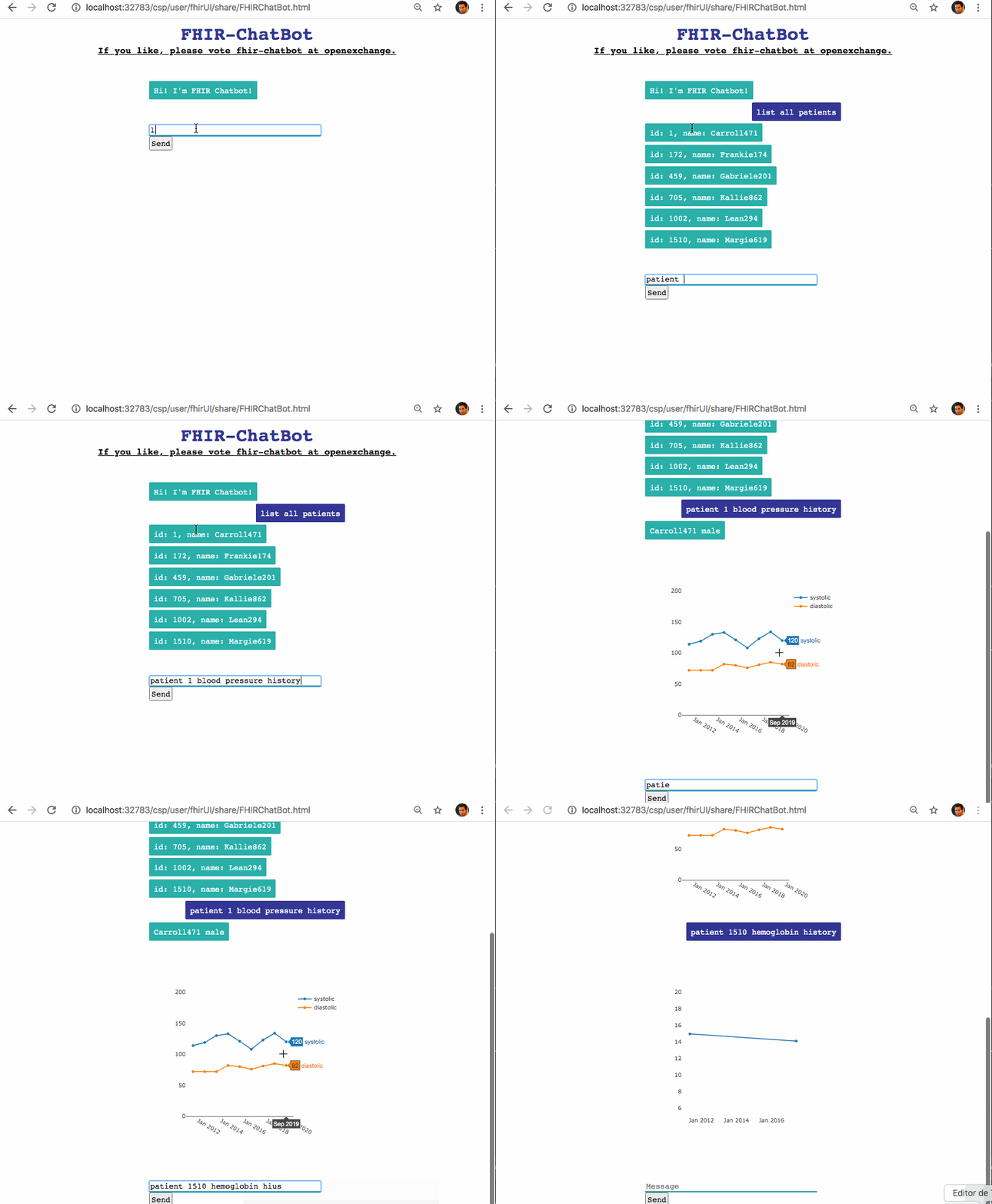
The first version of my app only shows the information that FHIR Resource provides.
I wanted to make the user able to update the patient details, so I to search for an example of how to do it.
The Github page of fhir.js has an example of how to update a resource.
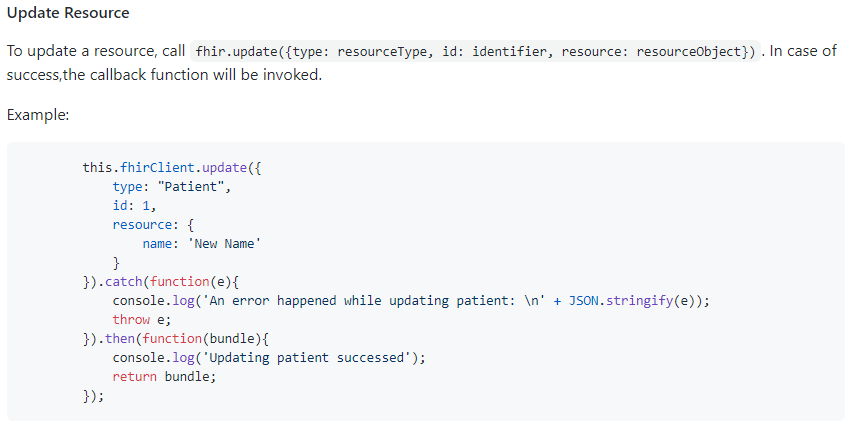
Looking at this example made me think that it was effortless.
Hi
My HIS System is a Microservice architecture base dubbo. To call remote service must through dubbo rpc.
But , I canot direct call his's dubbo service because ensemble cannot support dubbo protocol.
So I want to add support to ensemble.
where Can I start?
Does ensemble has low level interface like dll or linux so, I can add dubbo support to the ensemble just by implementing these interfaces.
I known java Gateway maybe ok, but I want to direct not throught middle layer to do this.
Tks.
Hi Community,
I want to share my experience creating the iris-fhir-portal with FHIR.
I decided to take a step forward and join the IRIS for Health FHIR contest, but I had never worked with FHIR before.
After the FHIR Contest Kick-Off Webinar, where we got an overview of how the IRIS for Health works with FHIR, I started to looking at the FHIR documentation to create my Patient Chart project.
At HL7 FHIR (release 4) website, I found a "Resource Map":

The leading FHIR Resource for my Patient Chart it's the "Patient Resource".
I have a class:
Class test.Person Extends (%Persistent, %XML.Adaptor)
{
Property Name;
}
I want to serialize it into this XML:
<Person>
    <Id>1</Id>
    <Name>Ed</Name>
</Person>
Is it possible?
It's for the Visual Trace so I can't use %XML.Writer.
Hi guys.
Recently, I get interest in FHIR in order to run for the IRIS for Health FHIR contest. As a beginner on this topic, I've heard somewhat about it, but I didn't know how complex and powerful was FHIR. As pointed out by @Henrique.GonçalvesDias here, you can model several aspects of the patient history and other related entities.
Fortunately, the DC provide very nice material about FHIR and how IRIS for Health could help us to deal with such complexity.
Hi Community,
I am looking some kind of logic or trigger some events when cache process ends.
For example, if I set some X global when i logged into terminal and when I closed the terminal or process ends by its own, global to be removed.
Thanks in advance!!!.
SR
Hello,
we use a NAS to archive stream from database to files. If we look at the file size on disk, it is bigger than expected.
For example :
File size is 127K
ls -alh | grep write-chupmb-pdf
127K 2020-07-02 10:43 write-chupmb-pdf
Size on disk is 192K
du -sh * | grep write-chupmb-pdf
192K    write-chupmb-pdf
Or expected size is 128K (with 4K blocs)
I tried with %Stream.FileBinary, %FileBinaryStream and OPEN/USE/WRITE and with multiple files and file type (PDF, JPG, PNG) and I have the same problem each time.
Does anyone have a Dockerfile for .Net/Java Gateways to share?
I'm trying out PEX and I think being able to run it as a docker container would be great.
To clarify I'm interested in container without IRIS, gateway only.
Hi all.
I have a reponse message that has a property of the type %Collection.ListOfObj and I need to search for an item in this list. Let me show you.
Hi Community,
Please welcome the new video from Global Summit 2019 on InterSystems Developers YouTube:
⏯ Scaling Up and Out on InterSystems IRIS
Hi Community,
As you may know, on Global Masters you can redeem a consultation with InterSystems expert on any InterSystems product: InterSystems IRIS, IRIS for Health, Interoperability (Ensemble), IRIS Analytics (DeepSee), Caché, HealthShare.
And we have exciting news for you: now these consultations available in the following languages: English, Portuguese, Russian, German, French, Italian, Spanish, Japanese, Chinese.Also! The duration is extended to 1.5 hours for your deep dive into the topic.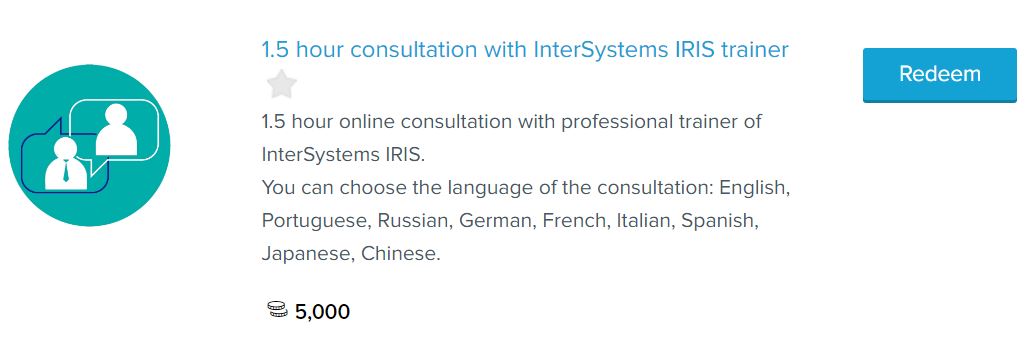
I try to compare classic JOIN against implicit JOIN.
It is a simple case. But I am surprised.
The class:
{ Property Name As %String;
Property Home As Sample.Address;
Property AR As array Of Sample.Address; }
Query #1 - classic:
select name,home_state,a.* from sample.person1 p
join sample.person1_AR a on p.Id=a.person1
and home_state=AR_state
Query #2 - implicit
select person1->name,person1->home_state,*
from sample.person1_AR where person1->home_state=AR_state
for both I have the same query plan:
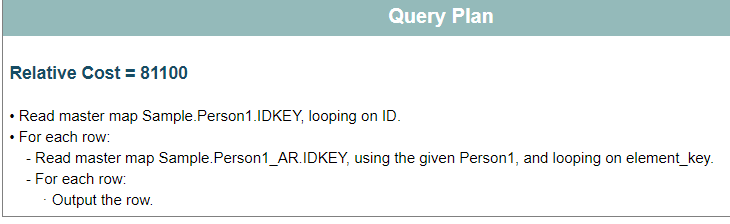
It is a simple query on 2 or 1 simple tables.
Keywords: IRIS, IntegratedML, Machine Learning, Covid-19, Kaggle
Continued from the previous Part I ... In part I, we walked through traditional ML approaches on this Covid-19 dataset on Kaggle.
In this Part II, let's run the same data & task, in its simplest possible form, through IRIS integratedML which is a nice & sleek SQL interface for backend AutoML options. It uses the same environment.
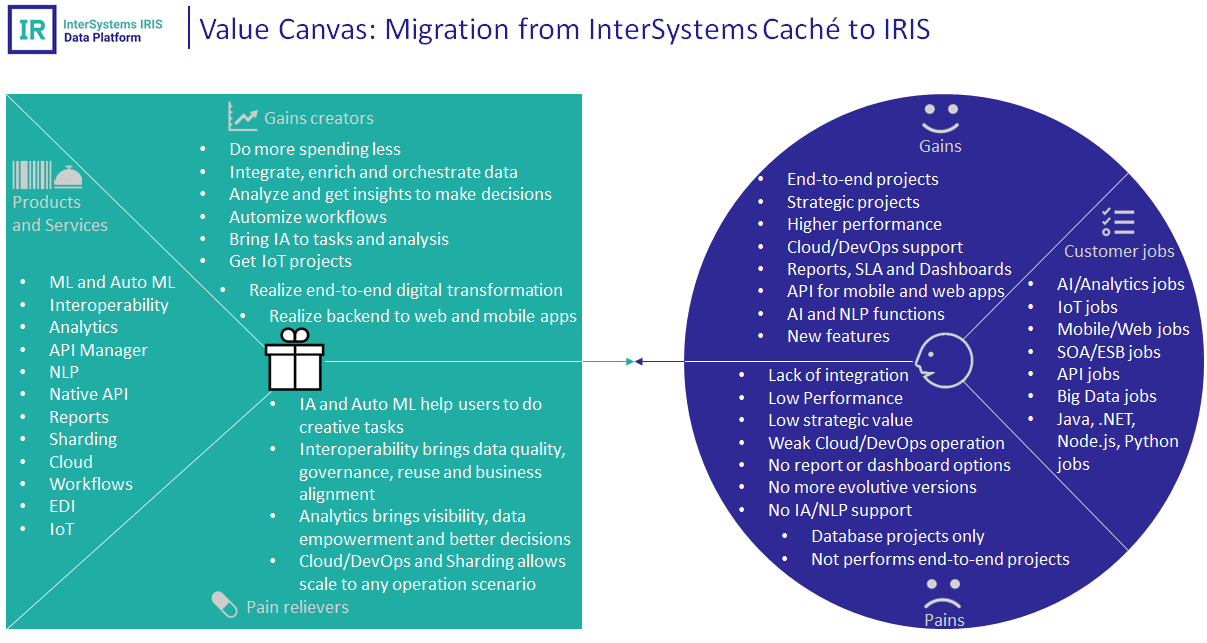
Some clients ask me about migrate from Cache to IRIS. Why migrate to IRIS? Cache is excellent, stable, has good performance. These clients are right, but in the last years, the digital transformation imposed more complete solutions for the new requirements and InterSystems was a visionary to perceive it and launch IRIS.
It is a data platform ready to this digital transformation challenge. To show this, I created a Value Canvas.
Value canvas are a perfect tool to show in a few minutes the value of the change.
Hi,
We are using CACHE 2017.2.1, I would like to retrieve data from Journal for killed global. Let say we have global name ^ EMP(123) with data and also have some child nodes and it has been killed by using cache kill command for some reason and we don't know who has executed this and when. My questions are below.
1) Can we get back the data of killed global from journal files,Is it possible or not ?
2) If above question is Yes, then how to find that specific journal file, which has the global which has been killed?