Long story short, I created some test data, then deleted it. The database (cache.dat) is 67 GB in size (was around 1 GB before tests).
How do I compact that?
System administration refers to the management of one or more hardware and software systems.
Long story short, I created some test data, then deleted it. The database (cache.dat) is 67 GB in size (was around 1 GB before tests).
How do I compact that?
During recent large scale benchmarking activities, we were seeing excessive %sys CPU time that negatively impacted scaling of the application.
Problem
We have found that a lot of the time was spent in the localtime() system call due to the TZ environment variable not being set. A simple test routine was created to confirm the observation, and the elapse time differences and CPU resources needed with TZ set versus TZ not set were astonishing. It was discovered that the inherit use of stat() system calls to /etc/local_time from localtime() are very expensive when TZ is not set.
Recommendation
The Update Checklist for v2015.1 recommends setting the TZ environment variable on Linux platforms and points to the manpage for tzset. This is recommended to improve the performance of Cache’s time-related functions. You can find out more about this here:
https://community.intersystems.com/post/linux-tz-environment-variable-not-being-set-and-impact-caché
The manpage on my CentOS 7 test system (RHEL 6 says the same) has this to say:
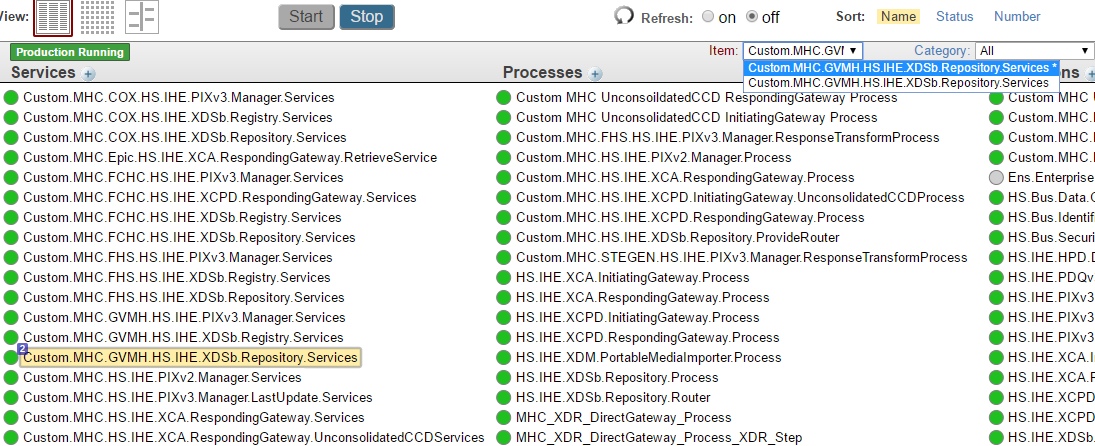
Occasionally I see a production item with a little 2 flag. When it has that, there is an "Item" dropdown. What does this mean?
Mirroring provides an admin capability to Stop Mirroring on this member, which causes a non-primary member to temporarily disconnect from the primary, stop dejournaling, etc. While most system administrators may never need or use this function, some employ it for certain kinds of maintenance or other special cases.
If I have a cache.dat file from a Windows 2012 (64-bit) machine and I want to mount it on a Caché instance running on RHEL, will it work? Assume the versions of Caché are the same.
Post updated in August 2025 to include links to IRIS.
I have seen customer problems where the use of a virus scanner running over Caché or IRIS databases was causing intermittent application slowdowns and bad user response times.
This is a surprisingly common problem, so this short post is just a reminder to exclude key Caché and IRIS components from your virus scanning.
Hi,
Our Cache server(version 5.0.15) has recently crashed. We are in the process of recovery. We had replaced the server's hard disk and trying to install the cache(5.0.15) But getting the following error. Any body show some light on the issue.
CctrlInstallStartCP( CACHE ) failed! Return value: 1 CctrlGetLastError() returned:
Hello!
I am trying to install Caché 2016 on a Debian Jessie machine; so I downloaded the latest release from WRC, OS RHEL x86_64, in tarball format.
I untarred it, then launched cinstall; unfortunately a library was missing. I then elected to kill all the processes (which wasn't easy), remove the two users created, and start again.
Unfortunately, for some reason, when I relaunch the install again, the install process still detects the old instance which I installed previously... And I cannot find where this information came from (I removed the install directory by hand entirely).
I just recently got a mail regarding the latest and greatest.
I find the mail impossible to read or make any sense of.
At the bottom it says to manage my subscription.
I clicked on the link and it took me to a page that says I am denied.
All the time I am still logged in.
Then, can you tell me how do I manage my subscriptions and stop those impossible emails?
I sure wish we were back to the Google Group, I understood that.
Introduction
I followed the Documentation instructions to install Caché on my Linux box and it seems to be running fine except when I try to modify the configuration. I keep getting errors that a previous cache.cpf file (e.g., cache.cpf_8503) cannot be opened. Is my Linux "user who owns instance" account deficient in Linux permissions?
The following situation always catches out new Ensemble users, and is likely to continue doing this until it is addressed..
A business operation, service or other host that is configured with a dedicated # of actors, (ie, not using the actor pool) runs with the version of compiled code that existed when the host was started. This code is loaded in memory.
During a fine breakfast at Global Summit 2016 I was asked about the %DEFAULTDB database that now appears when creating the %ALL namespace. Until the documentation on "Mapping a Package Across Multiple Namespaces" is updated to include the use of subscript level mapping for all namespaces here is a brief explanation for this change in 2016.1: When creating a global subscript level mapping in the %ALL namespace the database that was used for the non-subscripted global could not be set to be the default database for each namespace. This behavior prevents using %ALL namespace to help manage
Does anyone know any sites who configure an async reporting member to connect to two different failover mirroring sets ?
I know this is supported, but I would like to know how it is working in real world systems.
Any information would be appreciated.
Presenters: Pete Greskoff, Sebastian Musielak
Task: Ensure high availability of your HealthShare deployments
Approach: Discuss high-availability options and focus on HealthShare’s new support for database mirroring
With the new release of HealthShare, Mirroring is now support for high availability. This session will describe high availability options and focus on mirroring your HealthShare deployments.
Content related to this session, including slides, video and additional learning content can be found here.
Presenter: Ray Fucillo
Task: Provide high availability (HA) and disaster recovery (DR) in diverse architectures that demand high performance, including replication over long distances
Approach: Give examples of mirror architectures in disparate environments, including geographically separated systems. Discuss performance considerations and advances in InterSystems’ mirroring technology
In this session you will learn about deploying Mirroring to provide HA and DR in diverse architectures that demand high performance and throughput. Challenges and solutions to achieving high throughput will be covered along with mirror architectures that involve long distances and disparate environments.
Content related to this session, including slides, video and additional learning content can be found here.
Presenter: Kerry Kirkham
Task: Prevent application-to-application interface problems from escalating
Approach: Give examples of using alerts to get the right person working on a problem as soon as possible
Problems with application-to-application interfaces are inevitable but in most cases they can be fixed with little disruption as long as the right person gets to know about it as soon as possible. But delays in attention cause problems to escalate, pressure mounts and business suffers. This session looks at how monitoring and alerting can be set up to recognize problems and get the right person working on the problem in the shortest possible time so that small problems don’t turn into major issues.
Solution: Using alerts to minimize interface problems
Content related to this session, including slides, video and additional learning content can be found here.
Presenter: Murray Oldfield
Task: Avoid bottlenecks caused by scaling up, before they become a problem
Approach: Discuss what operating system and InterSystems metrics you should look at and how to interpret them
Systems behave differently when database activity scales up. In the worst case, bottlenecks appear and users are impacted. This session shows you which operating system and InterSystems metrics you should be looking at and how to interpret them so you can head off bottlenecks before they impact users. This sessions also shows strategies for planning infrastructure taking into consideration InterSystems' data platforms requirements.
Content related to this session, including slides, video and additional learning content can be found here.
Hi -
I was looking at the “Purge Data Management” page, and one of the “Record Types” is the “I/O Log” which sometimes doesn’t clear when you purge all of the message.
But I’m not sure what it’s actually reporting as “I/O Log” messages (and I can’t find anyplace to view what is being considered I/O Logged Messages - so I can understand what’s happening)
Can anyone shed some light on these messages?
Whichever way you want to look at it, their numbers are impressive... growing revenue year-on-year of 69% is amazing... and now they are opening DCs in Canada and India...
http://cloud-computing-today.com/2016/01/29/1074342/
--
Do you use any public cloud? Any private one?
Straight-forward way to do it is well known and looks like this:
------------------------------------------------------------ sample #1 --------
echo "Try to freeze Cache instance $instance"
rm -f $mydir/db_temp
csession $instance -U%SYS << EOF >/dev/null
zn "%SYS"
set rc=##Class(Backup.General).ExternalFreeze()
set fn="$mydir/db_temp"
o fn:("WNS"):1 if \$t u fn w rc c fn
h
EOF
read rc < db_temp
if [ "$rc" = "1" ]
then
echo "...OK, system is frozen."
else
echo "** Copy ABORTED: freeze rc = $rc"
exit
fi
-----------------------------------------------------------------------------------
Here are a few tips that might be useful to people who are running applications in an environment that's configured to use InterSystems mirroring.
A simple and rather automated search portal leveraging iFind capabilities for rich text search in 2016.1. It has simple faceting, result ranking, highlighting of search results etc and just works off any table you point it to that has an iFind index by appending ?t=MyPackage.TableName to the URL.
See also https://github.com/bdeboe/isc-iknow-ifindportal for more details and the latest version.
Hi,
Can a Cache Mirror be used in the cloud ? (ie stand up a Primary and Backup member instances in a High Availability Cache Mirroring configuration)
I'm investigating the validity of this configuration, because I was of the understanding that this may not possible due to these cloud servers not (typically) having fixed ip addresses, which interferes with the Virtual IP settings for the mirror set.
Is this correct, and if there are workarounds (like Load Balancing ?) can I have details on how this should be configured ?
Attached is an example of a web service client that can be used to do a lookup against the CMS NPPES database to validate and retrieve information about a given National Provider Identification (NPI).
I'm working on a proposal for a deployment tool development project and I was wondering if anyone had any experience with such a thing.
We use Healthshare and implementations for new clients are tedius and lengthy. Lots of ensemble service, registry value, lookup tables, namespaces and other things have to be created and configured.
I would like to create a Zen or CSP page based deployment tool that can do all this with a few parameters and some custom code.
Has anyone done this? What are some pitfalls you ran into? Any unique ideas you included? Other general thoughts?
C:\data\backup.bat :
C:\InterSystems\Ensemble\bin\cache -s"C:\InterSystems\Ensemble\Mgr" -U%%SYS ##Class(Backup.General).ExternalFreeze() <C:\data\login.scr
echo %ERRORLEVEL%
rem note that we need to check errorlevel from highest to lowest here....
if errorlevel 5 goto OK
if errorlevel 3 goto FAIL
echo errorlevel returned wrong value
goto END
:OK
echo SYSTEM IS FROZEN
xcopy c:\InterSystems\Ensemble\mgr\ z:\backup\Ensemble /s /e /y /i
echo %ERRORLEVEL%
goto END
:FAIL
echo SYSTEM FREEZE FAILED
:END
rem Now unfreeze the system
Some third party backup products may by default restore CACHE.DAT files as UNIX sparse files when there are trailing zeroes in the backup file.
The support for sparse files vary from UNIX distribution and file system types. Sparse files attempt to use file system space more efficiently when blocks allocated to the file are mostly empty similar to thin-provisioned storage. The file system transparently converts metadata representing empty blocks into "real" blocks filled with zero bytes at runtime. The application is suppose to be unaware of this conversion.
The Problem
Attached to this post is a PDF document outlining some of the key enhancements included with 2016.2. I will be giving a WebEx session that is open to all tomorrow at 11 AM EST. Once the WebEx is over I will be adding a link to the recording for those who cannot attend.
2016.2 Field Test Launch
Tuesday, February 2, 2016
11:00 am | Eastern Standard Time (New York, GMT-05:00) | 30 mins
Meeting number: 747 673 229
Join by phone
Call-in toll-free number: 1-866-8576852 (US)
Call-in number: 1-636-6925389 (US)