

1. set tSC=...
do $SYSTEM.Status.DisplayError(tSC)
Is there a meaningful difference between the two? Should one be used over the other for any reason? Should something else be used?
InterSystems ObjectScript is a scripting language to operate with data using any data model of InterSystems Data Platform (Objects, Relational, Key-Value, Document, Globals) and to develop business logic for serverside applications on InterSystems Data Platform.
“I have been waiting for thirty seconds for service. This is outrageous! I am leaving!”
“I am very sorry to hear that, sir. Perhaps, next time, you should make a reservation.”
If you heard that comment at your favorite restaurant, you would think the person saying it was being ridiculous. However, in the context of your API, it makes perfect sense. Just like your favorite eatery, your API has some regular patrons who, as you know, will be visiting one day or another. It would be great to be able to make a standing reservation for them as well.
It will involve a couple of IRIS fundamentals.
Hi Community,
Is there a way to call HL7 Data transformation directly from Business service without using Rule functionality in the production
In this scenario i need to call a data transformation in directly in business service and give the transformed message to Business operation
Please share if you have any ideas to implement this.
Thanks,
Smythee
Hello everyone!
I need to transform a String, which is a numerical value, to an Integer.
The value gets returned in my Rest service as "testingID": "1234567", but I need it to be "testingID": 1234567
Thanks beforehand! Appreciate all the help I can get! :)
Does the GetValueAt method of an EnsLib.HL7.message object change the contents of the HL7 message?
We want to do two things, given an incoming HL7 message, in our production:
set""""
If we sequence these as (1) generate XML, (2) extract value using GetValueAt, it works.
Hi all,
I'm very new to this ecosystem so please bear with me:
I've startted learning online and have installed everything I need. I have VS code and I have most definitely installed the pack (3 packages) needed for working on it with ObjectScript. Even though this is the case I'm running into 2 problems:
1. when I type "class" I only get 4 option for auto complete. no "class with multiple inheritances" or anything of the sort. In fact, no Class at all, only ClassMethod. ClassResponse etc.
2.
Interacting with Users in the Terminal: A Guide to Using %Library.Prompt in IRIS
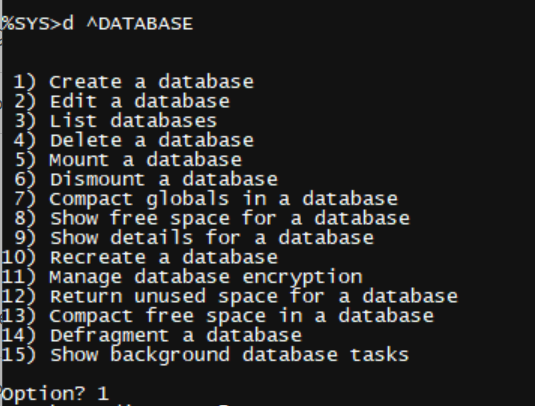
Have you ever wondered how commands like ^DATABASE engage users in the terminal? Or perhaps you're writing an automation routine and want ways to specify options directly from the terminal. Thankfully, the %Library.Prompt class in IRIS offers a straightforward way to do so!
For basic input, such as asking the user to provide a filepath or namespace, use the following code:
set status = ##class(%Library.Prompt).GetString("Input filepath:", .path)Hi community.
Yes, I know that there is other question "VS Code - debugging doesn't work" that is the same issue, but my IRIS instance is not using IIS.
Some times ago, I could debug without problems, but after some updates of Visual Studio, I get the following error
Failed to start the debug session. Check that the Intersystems server's web server supports WebSockets
I've activated the WebSocket protocol in the server (Windows Server 2019) but it still doesn't work.
The IRIS instance is not using IIS, I think it is using the Apache by default.
Do I need to do anything in special?
The launch.
Hello Community,
SQL language remains the most practical way to retrieve information stored in a database.
The JSON format is very often used in data exchange.
It is therefore common to seek to obtain data in JSON format from SQL queries.
Below you will find simple examples that can help you meet this need using ObjectScript and Python code.
ObjectScript : using Dynamic SQL with %SQL.Statement
Introduction
This article attempt to summarize and update on the exchanges in this post. Please feel free to comment.
ObjectScript is based on MUMPS, a programming language dating back to 1966. At the time, and for quite a long period, memory and cpu resources were scarce, as was terminal screen space, and a very concise (and easily decodable) syntax was preferred (as, for example in C). Nowadays, we no longer have the same memory and screen limitations, and code readability and maintainability is far more important.
Looking at enabling long file paths (see https://learn.microsoft.com/en-us/windows/win32/fileio/maximum-file-pat…) on some Windows machines - does anyone know offhand if IRIS plays well with this in all respects?
Hello,
How can I send a request via a SOCKS5 proxy in IRIS, using, for example, EnsLib.REST.Operation?
I need to access APIs inside my corporate network, to which I don't have direct access from my home office. I've set up a SOCKS5 proxy via SSH on my host machine like this:
ssh -D 9999 server.corporate.com
I can then make requests with curl to the APIs I need:
curl -x socks5h://localhost:9999 https://api.corporate.com/api/some/endpoint
And I receive a response. Simple!
Also, inside the containerized IRIS, I can execute the request:
curl -x socks5h://host.docker.internal:9999 https://api.corporate.com/api/some/endpoint
Hi Community!
Coding guidelines discussion. Consider you have For with one command in the cycle. Here are the options:
One
For i=1:1:1000 set ^Test(i)=""Two
For i=1:1:1000 {
 set ^Test(i)=""
}
Same for the "If":
if a set b=aor
Your choice? Or maybe even other options?
In VS Code using the InterSystems ObjectScript extensions, I'd like the indentation applied to match that of IRIS Studio. Specifically for comments and dot syntax, I'd like pressing enter (carriage return) to preserve the current dot depth and same comment beginning.
In IRIS Studio after changing the indentation settings to custom using " \t.
Hello everyone!
I am wondering how I can retrieve multipart form-data from a request that is coming into my REST-service.
I am supposed to retrieve a string and a file. The file is being retrieved without issues, but the "testprofile" string is not being retrieved at all.
It just logs a an empty entry.
The request that is sent to my REST-service has the Content-Type: multipart/form-data
Thanks beforehand for the help! :)
Down below is the code I use right now to retrieve the string and file from Form-data Rest HTTP-request to my service.
set vProfile = %request.
Hello everyone!
I am receiving a HTTP multipart/form-data request into my rest service.
How can I read the values for each Key in the form?
The key "Profile" is sent to my service as a String data type.
The code I have below does not seem to work, where I try to read the Key profile in the form..png)
I appreciate all the help I can get! :)
Hi, developers!
Currently, I'm working on a project that requires highly dynamic event management. In the context of the Java programming language, my first instinct should be to opt for the "Observer Pattern", which is an approach to managing interactions between objects by establishing a notification mechanism. It allows multiple observers to react to changes in the state of a subject autonomously, promoting code flexibility and modularity. If you are not familiar with this design pattern, check out Wikipedia to find more information about it.
While it's natural and commonly used in certain programming languages as Java and C++, in ObjectScript, it's quite a different story.
So far, we have covered how to use ObjectScript to manage users, roles, resources, and applications. There are a few other classes in this package that work similarly to the ones mentioned above. However, these four classes are the ones everyone will have to use to manage their application security. Suppose you wanted to create your own Security management portal for this package. There would be some specific issues to think about for an API. Since the classes use similar methods, we can create fewer API endpoints using indirection.
Hi
I'm having a tidy up of code across my multiple namespaces, and have moved the common code to a new database called DEVTOOLS.
Currently, I'm copying code and updating code into new namespaces.
How might I make code from namespace available to others?
Cheers
Andy
1. set tSC=...
    do $SYSTEM.Status.DisplayError(tSC)
Is there a meaningful difference between the two? Should one be used over the other for any reason? Should something else be used?
We are running Batch job in scheduled task and the messages are picking in single session and it is not easy to trace the record.
I used the Set ..%SessionId= "" at before sending the message to BP but I see the session Id is '1' created for each message.
Is there anyother way to create new session for each message sending to BP?
Thanks,
I am trying to work on a ZMIRROR that will execute a shell script to failover our VIP at the hardware level when NotifyBecomePrimary occurs.
ZMIRROR ; Custom logic for specific mirroring eventsqI verified the $ZF syntax by creating a smaller script and executing it via terminal. However when ZMIRROR is executed when I am attempting to failover I am getting the following in messages.log
01/13/24-14:47:47:812 (4104771) 1 [Utility.Event] NotifyBecomePrimary^ZMIRROR error: <ILLEGAL VALUE>NotifyBecomePrimary+3^ZMIRROR
ZPM is a package manager designed for convenient deployment of applications and modules on the IRIS platform.
Module developers, in order for their module to be installed using ZPM, need to follow a series of simple steps.
I am trying to write a ZMIRROR routine that makes a shell script call using $ZF
Set"/usr/local/sbin/failover-intengtest-vip"The script I am calling is returning an output to the screen, how do I get around this using $ZF without having to rewrite the scripts?
Thanks
Scott
Hi all,
The last time I used CSP was back in 2008, so I am very rusty on it.
This question might have been asked many times, and the answer probably is that it is a matter of preference.
Are there scenarios to which CSP pages is easier/better to use than classes extending from %CSP.Page?
I want to build a little thing and don't want to start at the wrong end.
Doing an API-based, heavy client-side framework is not a requirement, and I would prefer not to do it that way.
Some of the criteria
HI *,
So last night I was doing a deployment which had a query to select from a large dataset of joined tables, to iterate through and populate data in a new table.
This was done in a classmethod using embedded SQL and the %PARALLEL keyword.
On a testing environment with the same dataset, this worked perfectly a few days earlier.
It was going to be a long-running process, so we started it from a csession using the JOB command.
Then get the PID with $zchild, go to Processes and monitor it there.
It would terminate after a minute or so with a <STORE> error.
The per process memory is set at 1GB.
Hello Guys,
Our cache application uses REST web services and handles single API request perfectly with response (response status and related data). But sometimes user sends multiple requests to the same API simultaneously ( ie, without waiting for the first to respond ), where one request will succeed (not necessarily the first) and the others will fail.
So, I need to handle the requests one by one after completing and sending the response for first request in the queue then process the next request and so on.
Is there any appropriate way of handling this problem?
Hey Community,
Our huge thanks to everyone who participated in the Advent of Code 2023! We're pleased to present the winners and distribute all the prizes.
Our congratulations to these developers:
🥈 @Maksym Shcherban (w/ repo)
🥉 @Yuval Golan (w/ repo)
Here's the final InterSystems leaderboard:
Now, let’s say you can’t access the terminal or simply you just rather execute it from a web interface. In this article, I will show you how to execute terminal commands from a simple web page.
For example, in the image below you see how we execute $zv on a webpage:
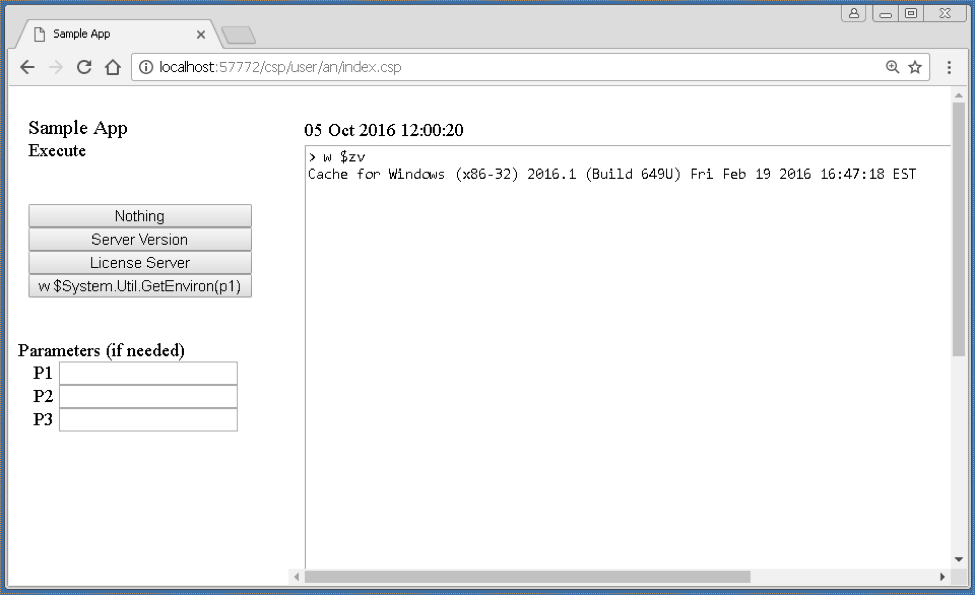
This is mostly possible due to the XECUTE command in Caché ObjectSCript. This command takes a string as a parameter and tries to execute it. This is the command used from the webpage, to execute what is being passed from the left navigation menu.
This article contains three snippets of code.
I got a problem to resolve, to sum it up I need to extract a function body from a JS file with cos.
I already got the JS code in a string and the function name but I'm kinda stuck as to how to get my function body, I already tried a few things (regEx, counter bracket) but there are comment and strings that block them from functioning. Is there a javascript parser or a good way to do it except by creating a javascript parser?
Hi Community,
We know you're eagerly anticipating this moment for an entire year (and we've even got messages asking if it is happening 😉)... Well, the moment is now here!
Join the Advent of Code 2023 with InterSystems and engage in our ObjectScript contest for a chance to win fabulous prizes!
.jpg)