#OAuth2

2 Followers · 108 Posts

Articles and Questions regarding OAuth2 Authentication.
Article Ariel Glikman · Jan 22 7m read

This article is intended as a beginner level article for people that want to learn how to use OAuth2 in their web applications natively.

There is an accompanying video/demo that may be helpful here: 

and you can reproduce this locally with the Open Exchange application attached.

OAuth2 as a native authentication type for web applications

OAuth (Open Authorization) 2.0 is a standard way to let one application call another application’s API without sharing a username and password. Instead of sending credentials on every request, the client sends an access token (typically in an Authoriz


0
1 52
Article Kate Lau · Jan 5 3m read

Hi, now I would like to continuous on the topic that we talk about previously

Using Postman for testing the OAuth2.0 of the InterSystems FHIR repository - Part1


Question 1: Where is my client_id and client_secret come form?

Short answer: Authentication Server.

If you don't have an Authentication Server, you may set up one as following

Provide the hostname (the host must support Https), at least 1 grand type (we choose client credential here), and SSL/TSL configuration

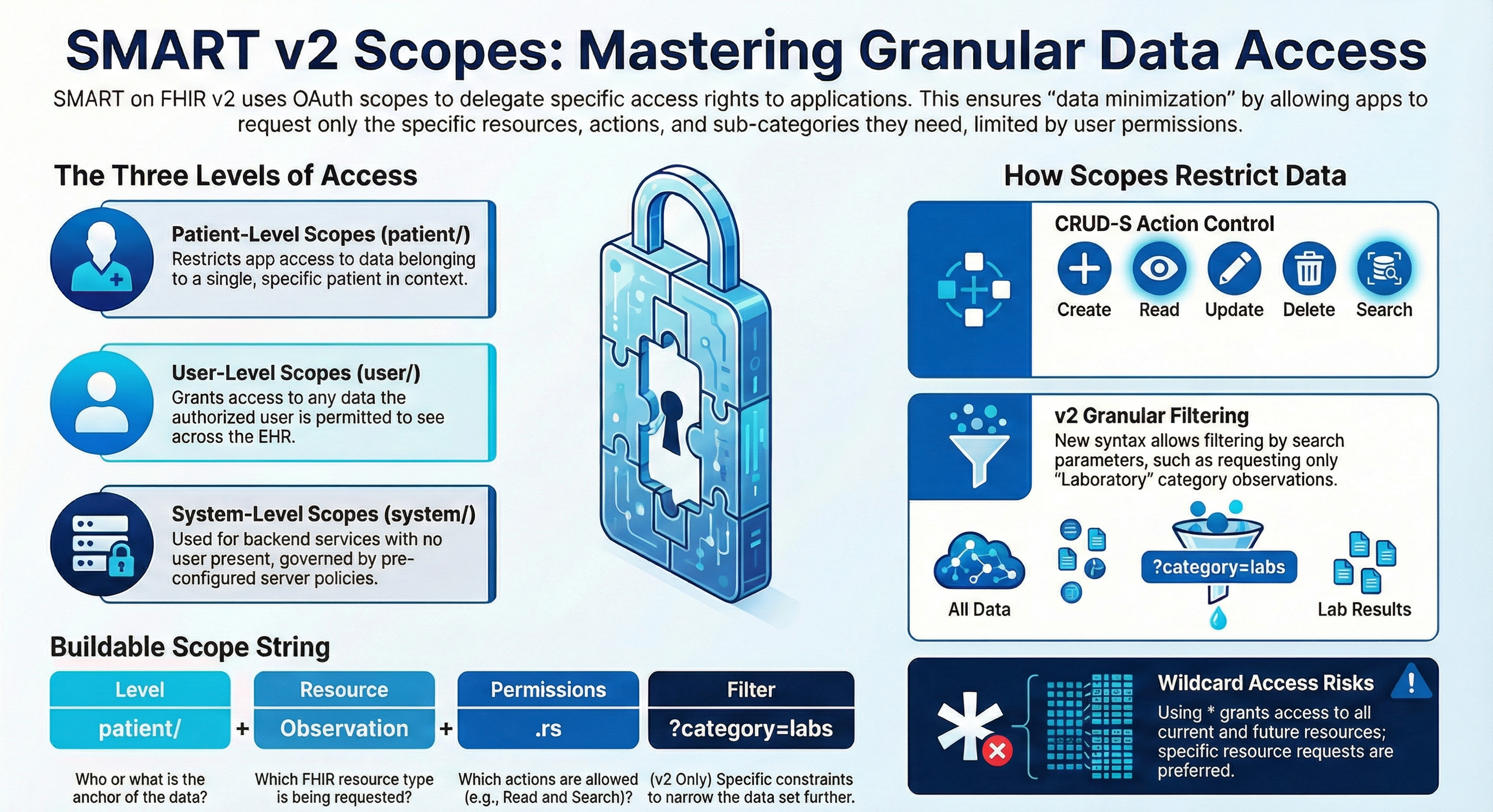
Input the scopes (here we input user/*.read and user/*.write, which is based on the scope support by


3
2 116
Article Ashok Kumar T · Feb 17, 2025 6m read

What is JWT?

JWT (JSON Web Token) is an open standard (RFC 7519) that offers a lightweight, compact, and self-contained method for securely transmitting information between two parties. It is commonly used in web applications for authentication, authorization, and information exchange.

A JWT is typically composed of three parts:

1. JOSE (JSON Object Signing and Encryption) Header
2. Payload
3. Signature

These parts are encoded in Base64Url format and concatenated with dots (.) separating them.

Structure of a JWT

Header

{ "alg": "HS256", "typ": "JWT"}

Payload

{"sub": "1234567890", "nam


4
9 602
Article Eduard Lebedyuk · Jan 5 4m read

If you want to generate JWT from x509 cert/key, any operation (including reading) on %SYS.X509Credentials requires U on %Admin_Secure resource.%Admin_Secure is required because %SYS.X509Credentials is persistent, and it's implemented this way to prevent all users from accessing private keys.

If %Admin_Secure resource is not available at runtime, you can use the following workaround.

Upon reviewing the code for JWT generation, I discovered that the JWT code utilizes %SYS.X509Credentials solely as a source of runtime data for PrivateKey, PrivateKeyPassword, and Certificate. As a workaround, yo

1
2 141
Article Kate Lau · Jan 1 4m read

Hi all, it's me again for sharing what I am studying recently.😓

Recently, I am studying how to setup OAuth2 authentication for the InterSystems FHIR repository. And I found the following articles are very good and easy to follow.😁

SMART on FHIR EHR Launch with IRIS for Health

Building an FHIR Repository + OAuth2 Authorization Server/Resource Server Configuration on IRIS for Health Part 2

For me, as a user who do not have much knowledge about OAuth2.0. I think it quite difficult to understand how to setup the whole OAuth2.0 environment before knowing how's it look like (what is it? wh


0
5 97
Question Scott Roth · Dec 29, 2025

I built a BP, that every time that a message is received from a BS, it executes 

set isAuth=##class(%SYS.OAuth2.AccessToken).IsAuthorized("EpicFHIRPOC",,,.accessToken,.idtoken,.responseProperties,.error)
 if 'isAuth {
        set tSC=##class(%SYS.OAuth2.Authorization).GetAccessTokenClient("EpicFHIRPOC", "*",, .error)        
         set isAuth=##class(%SYS.OAuth2.AccessToken).IsAuthorized("EpicFHIRPOC",,,.accessToken,.idtoken,.responseProperties,.error)
    }

To save time, I was thinking of just creating a BS that goes out and gets the Authorization Token every hour. However then how t

3
0 68
Article Piyush Adhikari · Dec 24, 2025 6m read

InterSystems API Manager (IAM) is a core component of the InterSystems IRIS Data Platform, offering centralized API management with a strong emphasis on security. IAM simplifies the entire API lifecycle, from creation to retirement, and provides a developer portal for easy API discovery and integration. Access control features allow administrators to define precise permissions, and IAM seamlessly integrates with the IRIS Data Platform, enhancing data management and integration capabilities.

Features of IAM include:

  • API Gateway: Centralized API management and security hub.
  • API Lifecycle Ma
0
0 75
Question Dmitrii Baranov · Dec 9, 2025

I need to connect IRIS to a third-party FHIR server which in turn is connected to Keycloak.

For machine-to-machine communications, client credentials grants should be used. I don't know why exactly but the FHIR server requires access tokens to contain the "openid" scope, otherwise it returns 401 (unauthorized).

If the access token returned by Keycloak contains that scope, IRIS complains about ""ERROR #8859: Unsupported response to access token request: OpenID Connect is not supported for password and client credentials grant type". The error is produced by the OAuth2.Response class, line 393

2
0 72
Question Colin Nagle · Oct 24, 2024

I have an API set up in IRIS which is secured using an IRIS authentication service, so there is a bearer token being passed down in the request header.

I've already set Parameter HandleCorsRequest = 1; on the spec class and All the endpoints I am have (a mix of GET, POST, PATCH and DELETE) are working from postman without issue, the problem is when consuming from the web front-end and the preflight checks the browser instigates. Most of the endpoints work in the browser, but some are triggering the preflight (OPTIONS) check causing the CORS issue.

This is what I am seeing in the browser:-


5
0 364
Question Ditmar Tybussek · Feb 21, 2025

Hi,

I do have the problem to send mails to outlook after getting the new OAUTH2 token. 

 I have no problem getting the token, but after I got the token I try to send the mail thru smtp but authorization failed , please see my try to send the token thru the %Net.Authenticator mechanism %Net.SASL.XOAUTH2

Is this ok?

Or is there an other method to authenticate using the needed bearer method instead of user/pwd with the authenticator? 

 ....code to get the token is working..

...   set s=##class(%Net.SMTP).%New()
    
    set m=##class(%Net.MailMessage).%New()
    
    set auth=##class(%Net.Au


1
0 149
Article David Hockenbroch · Apr 2, 2024 9m read

One of the most common kinds of integration we are asked to do is emailing. One of the most typical email services our customers use is Microsoft’s Office 365. After setting up the right configuration on the Microsoft side, we can email from IRIS with two HTTP requests. By the end of this article, we will be able to send an email with an attachment through our Microsoft 365 service!

Microsoft’s REST API, called Graph, allows you to do a lot of things within Microsoft’s various apps, and it is precisely what we will employ to send our email. We must start by registering our app in Entra locate

9
7 906
Question TAZ.R · Jul 16, 2025

Hello Community,

I’m working on an InterSystems IRIS production that needs to call an external API using OAuth client credentials (client_id and client_secret). For security reasons, I must pass these credentials via environment variables in my Docker container.

In the IRIS terminal, I can successfully retrieve these environment variables using $System.Util.GetEnviron("api-clientid") and $System.Util.GetEnviron("api-clientsecret"). However, inside my Business Operation class (OnMessage method), these environment variables return empty strings.

I verified that the variables are properly set

13
1 162
Article Vinicius Maranhao Ribeiro de Castro · Apr 2, 2020 4m read

In this 3-part series of articles, is shown how you can use IAM to simply add security, according to OAuth 2.0 standards, to a previously unauthenticated service deployed in IRIS.

In the first part, was provided some OAuth 2.0 background together with some IRIS and IAM initial definitions and configurations in order to facilitate the understanding of the whole process of securing your services.

This part will now discuss and show in detail the steps needed to configure IAM to validate the access token present in the incoming request and forward the request to the backend if the validation su


1
0 1190
Article Tani Frankel · Sep 22, 2024 1m read

Based on a great sample and workshop built by @Luis Angel Pérez Ramos (see related articles and related Open Exchange app), which included a local InterSystems IRIS for Health container (and desired setup), this sample presented here, adapted the workshop for using the InterSystems Cloud FHIR Server, and it's related setup.

3
1 470
Question Laura Blázquez García · Apr 7, 2025

We have an OAuth server configured as an identity provider, and we have an external application (from another provider) that connects correctly with OAuth.

Due to the needs of the project, what we want to do is the following:

  • If the user is not authenticated, show the OAuth login page, have them log in, and redirect them to the third-party app --> This part works
  • If the user is already authenticated (already logged in and already has a valid access_token), we create a cookie with the access_token generated at login, and when entering the third-party application URL, instead of showing the
1
0 116
Question Edmara Francisco · Feb 14, 2025

Hello, community!

I am working on implementing OAuth 2.0 authentication in InterSystems IRIS and need to correctly define a CSRF token that will be validated by OAuth.Response. However, I am having trouble finding a clear method to configure the CSRF token correctly.

So far, I have tried:

  • Setting the CSRF token in the request header.
  • Inserting the CSRF token via InsertCookie.

Despite these attempts, I haven’t been successful. On the OAuth.Response page, the CSRF token is empty, and I get the error message “Invalid CSRF token” because the csrfToken is empty.

If csrfToken '= state

1
0 188
Article Nicole Sun · Apr 17, 2025 6m read

Over the past couple of months, I have been working on the SMART on FHIR EHR Launch to test the capabilities of IRIS for Health using two open-source apps from CSIRO: SMART-EHR-Launcher and SMART Forms App. This journey has been incredibly interesting, and I’m truly grateful for the opportunity to work on this task and explore more of IRIS for Health’s potential.

After successfully demonstrating the seamless launch of multiple external SMART apps at the HL7 AU FHIR Connectathon, I’m excited to share what I’ve learned with the community. I hope my insights can help others get a faster start on

1
2 408
Announcement Andreas Dieckow · Apr 17, 2025

InterSystems IRIS 2025.2.0 introduces several features to improve the user experience of configuring OAuth2.

- OAuth2 is now a native authentication type and can be easily enabled for your services and web applications. Previously, OAuth2 was a type of delegated authentication.

- You can now create resource servers with the new OAuth2.ResourceServer class, which simplifies resource server configuration significantly. Previously, resource servers were instances of OAuth2.Client.

- The OAuth2.ResourceServer class and provides a sample authenticator for determining user permissions which, for

0
0 144
Article Sanjib Pandey · Apr 1, 2025 3m read

 JSON Web Token (JWT) Authentication

Hi Everyone,

I would like to share the code and step-by-step instructions/or guideline for generating a JWT (JSON Web Token) signature, as well as how to test it using Postman / HealthConnect.

JWT is an open standard (RFC 7519) that defines a compact, URL-safe method for securely transmitting information between parties in the form of a JSON object.

Structure of a JWT:

A JWT consists of three parts, separated by dots (.):

Header

.

Payload

.

Signature

  1. Header: The header contains about the token, specifying its type and

0
5 216
Question Jan K · Feb 10, 2025

We are trying to create a JWT in order to get oauth2 token from login.microsoftonline.com and then use that token to get key/secret from an Azure Key Vault.

It seemed like it would be quite straightforward by using the Create method of class %Net.JSON.JWT

But already trying to set the first header parameter alg PS256 as specified by https://learn.microsoft.com/en-us/entra/identity-platform/certificate-c… becomes a problem. Just to test, I do this:

set JOSE = {
 "alg""PS256"
}

and then using that and an arbitrary claims as parameters in Create method gives this

"Unsupported JOSE

1
0 191
Article Tani Frankel · Jan 19, 2025 1m read

In your Interoperability Production you could always have a Business Operation that is an HTTP client, that uses OAuth 2.0 for authentication, but you had to customize the Operation for this authentication methodology. Since v2024.3, which was lately released, there is a new capability, providing new settings, to handle this more easily.

0
0 185
Question Fabrizio Campari · Dec 24, 2024

Hi!   

I'm trying to set up a Clinical Viewer demo env with HealthShare 2024.2. 
I've done the standard installation following the doc : 

Everything works until I get to the point where I have to enable federated SSO (UCR demo - Federated SSO). Once it is activated, I can no longer access the instance through the portal, and the browser displays the following error:

Checking the messages.log, I see that every time I try to enable federated SSO and access the portal, I encounter the following error:

12/24/24-10:51:55:639 (98515) 2 [Utility.Event] Er

9
0 330
Article Oliver Wilms · Dec 15, 2024 3m read

I have started working on utilizing Epic on FHIR about a month ago.

Creating a Public Private Key Pair

mkdir /home/ec2-user/path_to_key
openssl genrsa -out ./path_to_key/privatekey.pem 2048

For backend apps, you can export the public key to a base64 encoded X.509 certificate named publickey509.pem using this command...

openssl req -new -x509 -key ./path_to_key/privatekey.pem -out ./path_to_key/publickey509.pem -subj '/CN=medbank'

where '/CN=medbank' is the subject name (for example the app name) the key pair is for. The subject name does not have a functional impact in this case but it is re

Screenshot
2
3 588
Question Oliver Wilms · Dec 15, 2024

I am trying to work with Epic on FHIR. Epic's documentation stated, your application makes a HTTP POST request to the authorization server's OAuth 2.0 token endpoint to obtain access token.

Set tSC = ##class(%SYS.OAuth2.Authorization).GetAccessTokenClient(pClient,pScopes,.prop,.err) returns

ERROR #9761: No key in provided JWKS for alg ES512 and kid  

I check this /csp/sys/oauth2/OAuth2.JWTServer.cls?client_name=medbank and I see this:

{
  "keys": [
    {
      "kty": "RSA",
      "n": "znrmjuKwUAI3eH6OiLANiNDkGP6EC8HoA5sr5sEJwAuc3U3IPSQ2SsNgFmNtaArAc7tpovz3_IRxYKOQNz_riq0mBWhtdwc9hp-PA
1
0 144
Question Gayle Congdon · Dec 5, 2024

I have created an OAuth Client and have created the credentials etc successfully.

I have tested using the curl command and have received the token back from the Server using the terminal.

I now need to create an Operation to use my client credentials to connect to the Server and receive the token back.

What adapter would I use as I am unable to link my client credentials and secret  - currently  I am using the EnsLib.HTTP.OutboundAdapter
 but I am not sure if this is the correct.

2
1 263
Question Mike Yackanich · May 27, 2021

Hi all,

I'm performing a migration of some services from one instance to another, and I noticed that the technique defined within the InterSystems Server Migration Guide does not include OAuth client configurations. The recommended technique is to use the ##class(Security.System).ExportAll() and ##class(Security.System).ImportAll() methods.

Is there a way to migrate OAuth client configurations, or do those have to be re-created manually?

5
0 538
Question Dmitrii Baranov · Nov 27, 2024

I want to integrate IRIS with Keycloak OAuth2 provider to use delegated authentication everywhere and to secure everything - sys*/Portal applications, REST services, FHIR server and so on. If an unathenticated user tries to access any IRIS URL - he or she should be redirected to Keycloak. After the user has successfully authenticated, i would like to access his requistes (username, email, roles, scopes) extracted from the JWT token, programmatically. What should be done to achieve that? I found this repo but it seems a bit tricky to implement a custom ZAUTHENTICATE function which has an access

1
0 307
Question Oliver Wilms · Nov 22, 2024

I finally figured out how to get JWT token using set x = ##class(%SYS.OAuth2.Authorization).GetAccessTokenClient("medbank","openid fhirUser",.prop,.err).

I also found iris-fhir-client app on Open Exchange. I registered Epic sandbox server, but I cannot list resources. I suspect I need to integrate authorization / authentication. How do I do this with irisfhirclient py?

1
0 158