6 Followers · 157 Posts

Java Database Connectivity (JDBC) is an application programming interface (API) for the programming language Java, which defines how a client may access a database.

Currently could be downloaded from here.

Article Benjamin De Boe · Nov 9, 2023 3m read

With the release of InterSystems IRIS Cloud SQL, we're getting more frequent questions about how to establish secure connections over JDBC and other driver technologies. While we have nice summary and detailed documentation on the driver technologies themselves, our documentation does not go as far to describe individual client tools, such as our personal favourite DBeaver. In this article, we'll describe the steps to create a secure connection from DBeaver to your Cloud SQL deployment.

22
2 2233
New
Question Enrico Parisi · Feb 19

I need to reproduce a table (in fact a view, but let's start with a simple table 😊) in IRIS as the currently used in Oracle.

I need to expose/project one column to JDBC as CLOB, in my class I have the corresponding property defined as:

Property GlobStream As %Stream.GlobalCharacter;

In JDBC this column is projected as LONGVARCHAR, this is compliant with the documentation but I need to project it as CLOB.

In addition, I'm no expert in JDBC but wit seems that LONGVARCHAR has a Maximum Length 32,700 characters in JDBC, not quite enough for an arbitrary stream.

Is it possible to project a %Stream to

8
0 87
Question Hour Abdellatif · Jan 27

Hello Community,

I am facing a JDBC connection issue after migrating from Caché 2016 to Caché 2018.1. When I attempt to connect using the following connection settings:

CACHE_DATASOURCE_URL=jdbc:Cache://localhost:1972/TEST

CACHE_DB_USERNAME=test

CACHE_DB_PASSWORD=test
 

I consistently receive the following error:

[Cache JDBC] Communication link failure: Access Denied

This configuration worked perfectly with Caché 2016. I have verified the following:

  1. The namespace (TEST) exists and is correctly specified in the connection URL.
  2. The credentials (username: test, password: test) are correct.
  3. The
7
1 89
Question Dmitrii Baranov · Dec 21, 2025

I have a business service that actively reads data from a remote Postgres database. OnProcessInput opens a XDBC (actually JDBC) connection, executes an SQL query, fetches several thousand rows, iterates the resultset, and closes the connection. On each iteration I also need to update each source row in the remote database using PreparedStatement.

In other words, in every OnProcessInput call I have a long running SELECT statement and several thousands small UPDATE statements.

The problems I'm facing are:

  1. I cannot execute an UPDATE statement via the same connection that was used before to select
11
0 136
Article Thomas Dyar · Dec 27, 2025 10m read

The Rut

Up until early this year, I haven't been not doing much coding at all -- I had gotten sick of it.

After many years as a hands-on software engineer and data scientist, I got burned out around 2015. I switched to business development roles focused on "external innovation," then joined InterSystems in 2019 as a product manager. I missed the creative aspects of coding, but not the tedium. The endless cycle of boilerplate, debugging, and context-switching had left me creatively depleted. Like Jim Carrey's character in Yes Man, I found myself saying "no" to new projects -- so much so that I

0
1 81
Article Kate Lau · Dec 12, 2025 3m read

Hi everyone. Long time no see. Again, I would like to share what I am studying recently Create Foreign Tables Using SQL via JDBC.

Since I am learning about the IRIS BI at the same time, so I started with this Sample-BI docker environment

https://github.com/intersystems/Samples-BI

After starting the environment, login to the management portal http://localhost:52773/csp/sys/UtilHome.csp  with the user Superuser.

Switch the namespace to IRISAPP.

😀 We will find out that all the sample data are stored in this namespace IRISAPP. Let's find a simple table for testing the Foreign Table feature 🤣

System

0
1 76
Article Iryna Mykhailova · Nov 30, 2025 4m read

In the previous article, we talked about ODBC and connecting from C#. And now, let's look at JDBC and Java. The InterSystems JDBC driver is the recommended, high-performance way to integrate your Java applications.

Here is a step-by-step guide to getting your Java application connected to an IRIS instance using the JDBC driver.

Step 1: Obtain and Include the InterSystems IRIS JDBC Driver

Unlike ODBC drivers, which are often installed system-wide, JDBC drivers are typically distributed as JAR files that must be included in your Java project's classpath.

If InterSystems IRIS is installed on your local machine or another you have access to, you can find the file in install-dir/dev/java/lib/ or similar, where install-dir is the installation directory for the instance. Conversely, you can download the jar file from Driver packages page.

Or as suggested by @Dmitry Maslennikov in the comments, use the maven central repository for Maven:

<dependency><groupId>com.intersystems</groupId><artifactId>intersystems-jdbc</artifactId><version>3.10.5</version></dependency>

or for Gradle:

implementation("com.intersystems:intersystems-jdbc:3.10.5")

Include the jar file in Project:

  • Maven/Gradle: If you use a build tool, the simplest method is to add the InterSystems JDBC driver as a dependency in your pom.xml or build.gradle file. This automatically downloads and manages the JAR.
  • Manual: For simple projects, you must place the JAR file in a project directory (e.g., /lib) and explicitly add it to your classpath when compiling and running.
2
0 154
Article Andreas Schneider · Apr 22, 2025 4m read

When using standard SQL or the object layer in InterSystems IRIS, metadata consistency is usually maintained through built-in validation and type enforcement. However, legacy systems that bypass these layers—directly accessing globals—can introduce subtle and serious inconsistencies.

Understanding how drivers behave in these edge cases is crucial for diagnosing legacy data issues and ensuring application reliability.
The DATATYPE_SAMPLE database is designed to help analyze error scenarios where column values do not conform to the data types or constraints defined in the metadata.

3
0 231
Question Attila Toth · Nov 10, 2025

Hello!

I'm trying to create some foreign tables to a PostgreSQL database. In some cases, columns with certain datatypes cannot be consumed by IRIS and the following error is thrown:

 [SQLCODE: <-237>:<Schema import for foreign table did not return column metadata>]

  [%msg: <Unkown data type returned by external database>]

For example: serial4 typed ID columns are typical examples. Is it possible, what's the best way of resolving these datatypes, which- seemingly- don't have proper JDBC metadata mappings?

Of course, explicitely defining columns and types as part of the CREATE FOREIGN TABLE

0
0 61
Article Davi Massaru Teixeira Muta · Oct 11, 2025 9m read

Technical Documentation — Quarkus IRIS Monitor System

1. Purpose and Scope

This module enables integration between Quarkus-based Java applications and InterSystems IRIS’s native performance monitoring capabilities.
It allows a developer to annotate methods with @PerfmonReport, which triggers IRIS’s ^PERFMON routines automatically around method execution, generating performance reports without manual intervention.


2. System Components

2.1 Annotation: @PerfmonReport

  • Defined as a CDI InterceptorBinding.
  • Can be applied to methods or classes.
  • Directs the framework to wrap method execution with IRIS
1
0 88
Article Guilherme Tonelotti · Sep 25, 2025 2m read

When we need to integrate Caché/IRIS with other relational databases, one common question arises: “How do I set up the JDBC connection?”.
The official documentation doesn’t always provide a straightforward step-by-step guide, which can be frustrating, especially for beginners.

In this article, I’ll walk you through the entire process of configuring a JDBC connection with MySQL, from downloading the connector to linking tables in Caché/IRIS.

Note: JDBC connections in Caché/IRIS have some limitations, especially regarding caching and the use of ResultSet. In many cases, you may need to adapt

1
0 122
Question Eugene.Forde · Aug 31, 2025

I’ve been exploring options for connecting Google Cloud Pub/Sub with InterSystems IRIS/HealthShare, but I noticed that IRIS doesn’t seem to ship with any native inbound/outbound adapters for Pub/Sub. Out of the box, IRIS offers adapters for technologies like Kafka, HTTP, FTP, and JDBC, which are great for many use cases, but Pub/Sub appears to be missing from the list.

Has anyone here implemented such an integration successfully?

For example:

  • Would it make sense to leverage IRIS’s Business Service + REST API adapter to connect to Google’s Pub/Sub REST endpoints?
  • Or perhaps use an intermediate
2
1 117
Article Dimitri Olchanyi · Apr 8, 2025 2m read

Due to MySQL's interpretation of SCHEMA differing from the common SQL understanding (as seen in IRIS/SQL Server/Oracle), our automated Linked Table Wizard may encounter errors when attempting to retrieve metadata information to build the Linked Table.

(This also applies to Linked Procedures and Views)

When attempting to create a Linked Table through the Wizard, you will encounter an error that looks something like this:

ERROR #5535: SQL Gateway catalog table error in 'SQLPrimaryKeys'.

6
1 269
Article Harry Tong · Jun 6, 2025 2m read

If you're migrating from Oracle to InterSystems IRIS—like many of my customers—you may run into Oracle-specific SQL patterns that need translation.

Take this example:

SELECT (TO_DATE('2023-05-12','YYYY-MM-DD') - LEVEL + 1) AS gap_date
FROM dual
CONNECT BY LEVEL <= (TO_DATE('2023-05-12','YYYY-MM-DD') - TO_DATE('2023-05-02','YYYY-MM-DD') + 1);

In Oracle:

  • LEVEL is a pseudo-column used in hierarchical queries (CONNECT BY). It starts at 1 and increments by 1.
  • CONNECT BY LEVEL <= (...) determines how many rows to generate.
  • The difference between the two dates plus one gives 11, so the query
1
0 212
Article Guillaume Rongier · Apr 9, 2019 3m read

IRIS and Ensemble are designed to act as an ESB/EAI. This mean they are build to process lots of small messages.

But some times, in real life we have to use them as ETL. The down side is not that they can't do so, but it can take a long time to process millions of row at once.

To improve performance, I have created a new SQLOutboundAdaptor who only works with JDBC.

BatchSqlOutboundAdapter

Extend EnsLib.SQL.OutboundAdapter to add batch batch and fetch support on JDBC connection.

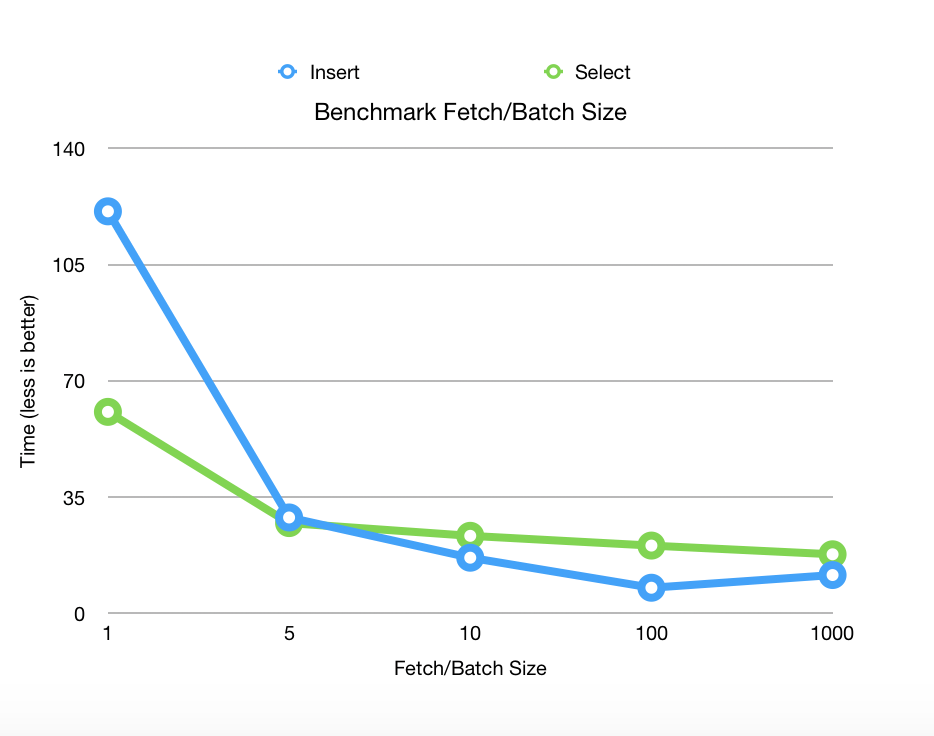
Benchmark

Benchmarks released on Postgres 11.2 with 1 000 000 rows fetched and 100 000 rows inserted on 2 columns.

alt text

Prerequis

10
3 1922
Question Kim Jiyong · May 15, 2025

Hello. Currently, we are developing using Cache 2018 version.
Our team is working on improving an existing legacy program so that it can also be used on the web.

Before asking my question, here is the development environment.

  • IDE: IntelliJ
  • Framework: Spring Boot, MyBatis
  • DB Connection: JDBC (using the library provided by InterSystems)

Currently, we are successfully mapping global data through the %PERSISTENT class and able to query it with SQL.However, the problem is that the retrieved "Korean" data is all broken.

8
0 276
Question Andrew Sklyarov · Mar 26, 2025

Here is my code:

Method getStocks(pRequest As Stock.Message.Req, Output pResponse As Ens.StreamContainer) As %Status
{
     s tSC = pRequest.NewResponse(.pResponse)
     q:$$$ISERR(tSC) tSC

     #dim pRS As EnsLib.SQL.GatewayResultSet

     s tSC = ..Adapter.ExecuteQuery(.pRS, "select jsonb_agg(s) #>> '{}' FROM prod.stocks s where s.""Warehouse"" = ?", pRequest.Warehouse)
     q:$$$ISERR(tSC) tSC

     s pResponse = ##class(Ens.StreamContainer).%New()
     s pResponse.Stream = ##class(%GlobalCharacterStream).%New()

     i pRS.Next() {
          d pResponse.Stream.CopyFrom(pRS.GetDataStream(1))
     else 

3
0 259
Question Igor Pak · Mar 7, 2025

Hello, dear colleagues.

I need to connect to a remote JavaGateway from an Ensemble service.

I am trying to use the EnsLib.JavaGateway.Service with a remote host where the JVM is running.

I can successfully ping the remote Java Gateway from EnsLib.JavaGateway.Service, and Ensemble reports that the service status is OK.

There are no network issues, and all necessary ports are accessible.

My requests work without any problems when I specify localhost in EnsLib.JavaGateway.Service. However, when I specify a remote JVM, I get the following error:

#5023: Error Java-gateway: Connection cannot be

1
0 170
Question Eduard Lebedyuk · May 18, 2016

In MySQL I have the following table:

CREATE TABLE `info` (
   `created` int(11)
);

And it is linked (via JDBC SQL Gateway) to Cache table mysql.info.  `created` field stores unix timestamp. So when I execute  this SQL in SMP:

SELECT created FROM mysql.info

I receive the following output (which is expected):

created
1435863691
1436300964

But I want to to display `created` field converted to ODBC timestamp format. To do that I call this SQL procedure

Class mysql.utils [ Abstract ]
{
/// Unix timestamp to ODBC
ClassMethod uto(unixstamp As %Integer) As %TimeStamp [ SqlName =
3
0 1034
Question Scott Roth · Jan 22, 2025

I am currently experiencing frustration with trying to Authenticate an Active Directory account through JDBC as the Hospital System moves from OnPrem SQL Server to using Azure SQL Server with Microsoft Entra Authentication.

Microsoft cannot give me a straight answer of what is required from a JDBC standpoint to authenticate from a Linux environment.

I am working with WRC, but we are both struggling to find the specific answer for JDBC.If I use my local desktop and JDBC to connect through DBeaver I don't have an issue.

2
0 151
Question Scott Roth · Jan 8, 2025

We connect to MS SQL Databases using the Microsoft JDBC Driver 12.2 using the following URL

jdbc:sqlserver://<server>:<port>;database=<database name>;trustServerCertificate=true;integratedSecurity=true;authenticationScheme=NTLM;domain=osumc;authentication=NotSpecified

They want to migrate the databases to the Azure Cloud and in doing so we need the Authentication to change to go through Microsoft Entra. I was given the following URL

jdbc:sqlserver://<server>:<port>;user=<user>;password=<password>;encrypt=true;trustServerCertificate=true;hostNameInCertificate=<certificate>;loginTimeout=30;Authenti

5
0 253
Article Scott Roth · Jan 24, 2025 3m read

Not sure there are many that connect to MS SQL to execute queries, stored procedures, etc, but our Healthsystem has many different MS SQL based databases we use within the Interoperability environment for various reasons.

With the push to moving from on-prem to the Cloud we ran into some difficulties with our SQL Gateway connections and knowing how to config them to use Microsoft Entra for Active Directory Authentication.

There are many articles out on the web, but there was not one that could give us the full answer to what we needed to do, and Microsoft wasn’t much help.
I figured I would

0
1 665
Article Andreas Schneider · Jan 12, 2025 1m read

Hi! I've extended my demo repository, andreas5588/demo-dbs-iris, to make it easy to test the FOREIGN SERVER and FOREIGN TABLE features in IRIS.

To achieve this, I created a namespace called FEDERATION. The idea is as follows:

  1. Set up JDBC connections for each namespace.
  2. Create a FOREIGN SERVER within the FEDERATION namespace for each connection.
  3. Define a FOREIGN TABLE a least for one table based on each foreign server.

The Script:  demo-dbs-iris/src/sql/02_create_foreign_server.sql

IRIS does not support executing SQL statements that combine tables from different namespaces.

3
1 289
Article Sylvain Guilbaud · Apr 30, 2024 3m read

Gitter

Production Configuration

This demo has an interoperability production with 16 items. 

Production Configuration HL7 + Kafka Producer

The first part of this demonstration consists of sending an HL7 SIU file which will be transmitted to the 2 other HL7 flows (HTTP and TCP), and transformed and transmitted to the Kafka server. HTTP and TCP flows will transform HL7 messages in the same way before sending them to Kafka as well.

  • 3 HL7 Business Services
  • 1 HL7 router
  • 2 HL7 Business Operations
  • one Business Operation sending the transformed messages to Kafka

Business Rule

The production has a business

3
4 524
Question Scott Roth · Nov 20, 2024

I am using a JDBC connection to MS SQL server to execute a stored procedure to select data and bring it into InterSystems as a EnsLib.SQL.Snapshot. I loop through the EnsLib.SQL.Snapshot using a while loop, but I also want to iterate through the Columns within that Row to do logic.

Is there a way to iterate through the Columns of the current Row of the EnsLib.SQL.Snapshot so I can apply logic/rules for further processing?

Thanks

Scott

4
0 169
Question Andreas Schneider · Sep 15, 2024

Has anyone successfully tested the new THROUGH command in IRIS 2024.2 with a FOREIGN SERVER?https://docs.intersystems.com/iris20242/csp/docbook/Doc.View.cls?KEY=RS…

I have connected from a Docker instance to a VM. I was able to successfully set up the JDBC connection through the UI.

I then configured a foreign server with this connection:

But I am unable to send a SQL 'THROUGH' to the DB. I always get a:

I've get the same message if i try it via Management Portal.
I've also tried this:

and this

Always with the same error.

11
0 403
Question Scott Roth · Oct 2, 2024

I have been trying to track down an issue we are seeing in our TEST environment with Memory usage.

We have Several BP's for years now that take a HL7 message, parse it apart, and make calls to a Custom EnsLib.SQL.OutboundAdapter to have it execute Insert/Select/Update/Delete stored procedures against a MS SQL Database via JDBC connection. We are using Microsoft's JDBC 12.2 driver to do this.

What we are seeing is that IRIS.WorkQueue globals are being defined for these calls but then the IRIS.WorkQueue is not being cleaned up and taking up large amounts of Memory.

I have tried ensuring the

5
0 177