Hey Developers!
We're pleased to announce the next competition of creating open-source solutions using InterSystems IRIS! Please welcome:
⚡️ InterSystems Full Stack Contest ⚡️
Duration: September 21 - October 11, 2020


InterSystems IRIS is a Complete Data Platform
InterSystems IRIS gives you everything you need to capture, share, understand, and act upon your organization’s most valuable asset – your data.
As a complete platform, InterSystems IRIS eliminates the need to integrate multiple development technologies. Applications require less code, fewer system resources, and less maintenance.
Hey Developers!
We're pleased to announce the next competition of creating open-source solutions using InterSystems IRIS! Please welcome:
⚡️ InterSystems Full Stack Contest ⚡️
Duration: September 21 - October 11, 2020
I'm not sure how to go about building this scenario:
Can steps 4.1 - 4.
Hi,
In Atelier I can click File --> New --> Class File, and File --> New --> Custom File etc to launch various wizards and templates to help me quickly create DeepSee KPI classes, %Installer manifests, Web Services and the like. Of course, all these are available through Studio as well. Is there anything similar in VSCode? If so where? I've looked at several videos and the documentation, but I haven't seen anything.
Thanks!
David
Hi Developers!
Please welcome the new video on InterSystems Developers YouTube:
Hi developers!
Want to discuss with you the case of %Status.
If you familiar with ObjectScript you know what is it. I'd love to hear the history of the case why it had appeared in ObjectScript but it turned out that almost every system/library classmethods return %Status and there is a whole set of tools to deal with it.
What is does it gives you the responsibility to check the value or %Status of every system method you call.
E.g. if you save the data of the persistent class, you should never call like this:
do obj.%Save()you need to call:
set sc=obj.%Save()

if $$$ISERR(sc) do // something or quit.Hi all, I am having problems trying to get Docker to run correctly on my Linux Mint machine.
I did the following:
1. Installed Docker.
docker --version
Docker version 19.03.6, build 369ce74a3c
docker-compose -v
docker-compose version 1.17.1, build unknown
2. Downloaded zip from https://github.com/intersystems-community/iris-fullstack-template/tree/42f9c174a9a4e63cb5eb3eb646abf3930a6e4d31
and unzipped it
3. Entered the following command:
docker-compose up -d
This generated the following error:
ERROR: Version in "./docker-compose.yml" is unsupported.
Hi Developers!
How do you handle errors with &sql a.k.a. embedded SQL?
I think I found a universal error-handling template which works in any situation:
&sql(SELECT * FROM Sample.Person)

if SQLCODE < 0 throw ##class(%Exception.SQL).CreateFromSQLCODE(SQLCODE,"Context description")
What is your choice?
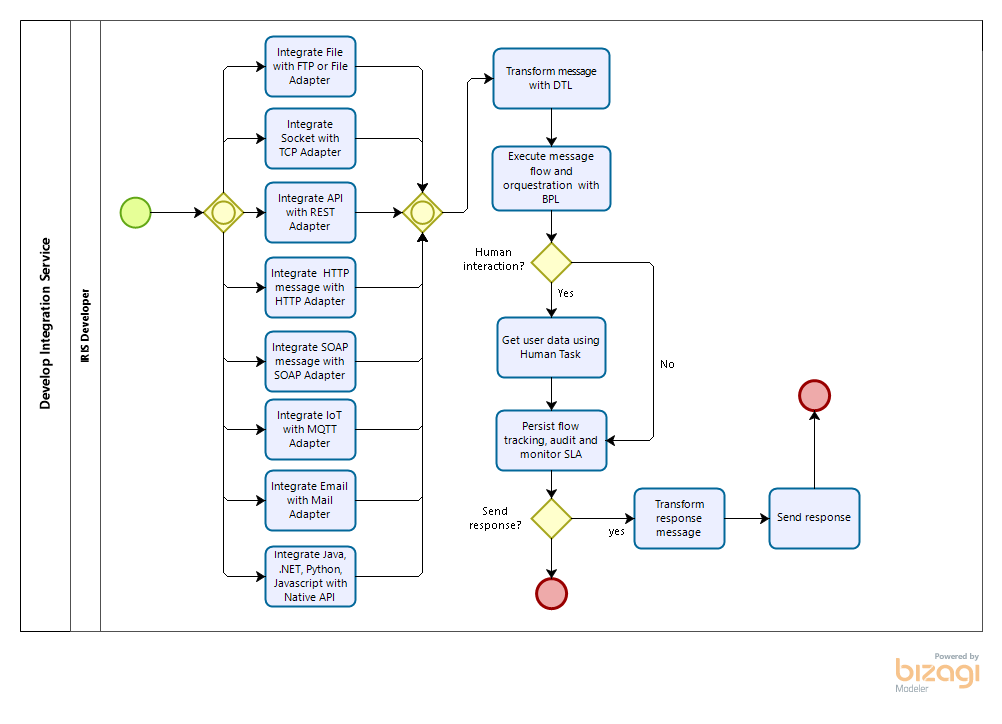
The InterSystems IRIS has an integration engine with these core elements:
1. Adapters: are inbound (data/message input/request) and outbound (data/message output/response) integration logic specialized in the type of data or message protocol (file, http, etc.). They are the interface to allows connect with source or target data repositories or systems.
2. DTL: is a component to mapping and transform data between two components in the flow orchestration.
3. BPL: is a component executing BPEL language to execute integration/orchestration flow.
4. Native API: is possible integrate with Java, .
Hey Developers,
New demo show by InterSystems Manager @Amir Samary is already on InterSystems Developers YouTube:
⏯ InterSystems IRIS: Kafka, Schema Normalization and Service Enablement
Hi Developers!
Recently we discussed the naming convention on packages we deploy and even made some choices.
Here I want to have a conversation on the naming convention for unit tests.
Of course, we wish every good library has unit tests. Here is the documentation and some good articles(one, two, three) regarding it on the Developer Community.
Let's decide on the naming of UnitTests packages?
The suggestion is that unit test classes will all start with the UnitTest package name.
E.g. if your library's class name is:
johndoe.lib.class
The related unit test class will be:
UnitTest.johndoe.lib.class
What about folders?
The suggestion is that unit test classes will live separately from source classes, e.g. in /tests directory.
Here is the example of a repository with unit tests that are named and placed according to the proposal.
What do you think?
Hello
Is there an example how to configure the webgateway on linux with kerberos in the dokumentation I found something but not realy in detail so far I understand I need two priniples one service prinple account with for example iris/at-mie-centos_iris.balmie.local@BALMIE.LOCAL-> there is my first problem with the dokumendation the @BALMIE.LOCAL is not dokumented but if you create a keytabfile with ktpass you can't create this without domain. For the secound user principle I am totaly lost how it should work must be both account in the keytabfile?
Hello developers!
Share the best practices: 1) saving frequently used code sections, 2) quickly finding it, and 3) quickly including it into the current program? There was a thought for 1,2 to use DC(this resource), but the search is not always convenient not only for me
The idea on the surface is to use the git repos wiki. Are there any other best practices?
There is a project github awesome.
Maybe we should include the awesome-objectscript sections in it?
And in the future for vscode to develop a plugin for awesome-objectscript ?
In Cache for Windows (x86-64) 2018.1.3 (Build 414U) I found something very useful
No reason apparently,
to many times executed :
[Database.SparseDBExpansion] Expanding capacity of sparse database /usr/irissys/mgr/iristemp/ by 1000 MB.
no details on audits, no traffic for that, no process to justify this, some ideas ?
IRIS for UNIX (Red Hat Enterprise Linux for x86-64) 2020.1 (Build 215U) Mon Mar 30 2020 20:23:13 EDT
Hi everyone,
I'm trying to build my project on a Linux machine using Docker.
In my development environment, I use Windows 10 Pro with Docker Desktop version 2.3.0.5. Everything works fine, and the docker-compose build runs flawlessly.
But, when I tried to run the same project in a Linux.
Ubuntu 18.04.5 LTS (GNU/Linux 5.4.0-1025-azure x86_64), docker --version
Docker version 19.03.6, build 369ce74a3c
I'm getting the following error:
ERROR: Service 'iris' failed to build: OCI runtime create failed: container_linux.go:349: starting container process caused "exec: \"/irissession.
Hi Community!
We are pleased to invite all the developers to the upcoming InterSystems Full Stack Contest Kick-off Webinar! The topic of this webinar is dedicated to the Full Stack Contest.
On this webinar, we’ll demo the IRIS Full Stack template and answer the questions on how to develop, build and deploy full stack applications in InterSystems IRIS.
Date & Time: Monday, September 21 — 11:00 AM EDT
Speakers:
🗣 @Evgeny Shvarov, InterSystems Developer Ecosystem Manager
🗣 @Raj Singh, InterSystems Product Manager - Developer Experience

In the WRC, we often see customers who have encountered a problem viewing their SOAP Catalog pages in a browser. This article will explain why the error is being encountered, as well as suggest a fix. This explanation is focused on the symptoms seen in InterSystems IRIS, but similar behavior can be seen in more recent versions of Caché.
The Problem:
You are trying to create new SOAP Web Services in InterSystems IRIS.
Dear Folks,
I am looking for a native approach to call a ClassMethod of an instance from another instance (Instances are running in different servers). I can still do this via API over Http or any other communication method but I believe it would be better if I communicate via IRIS native methods(If exists).
Thanks
Hi Community!
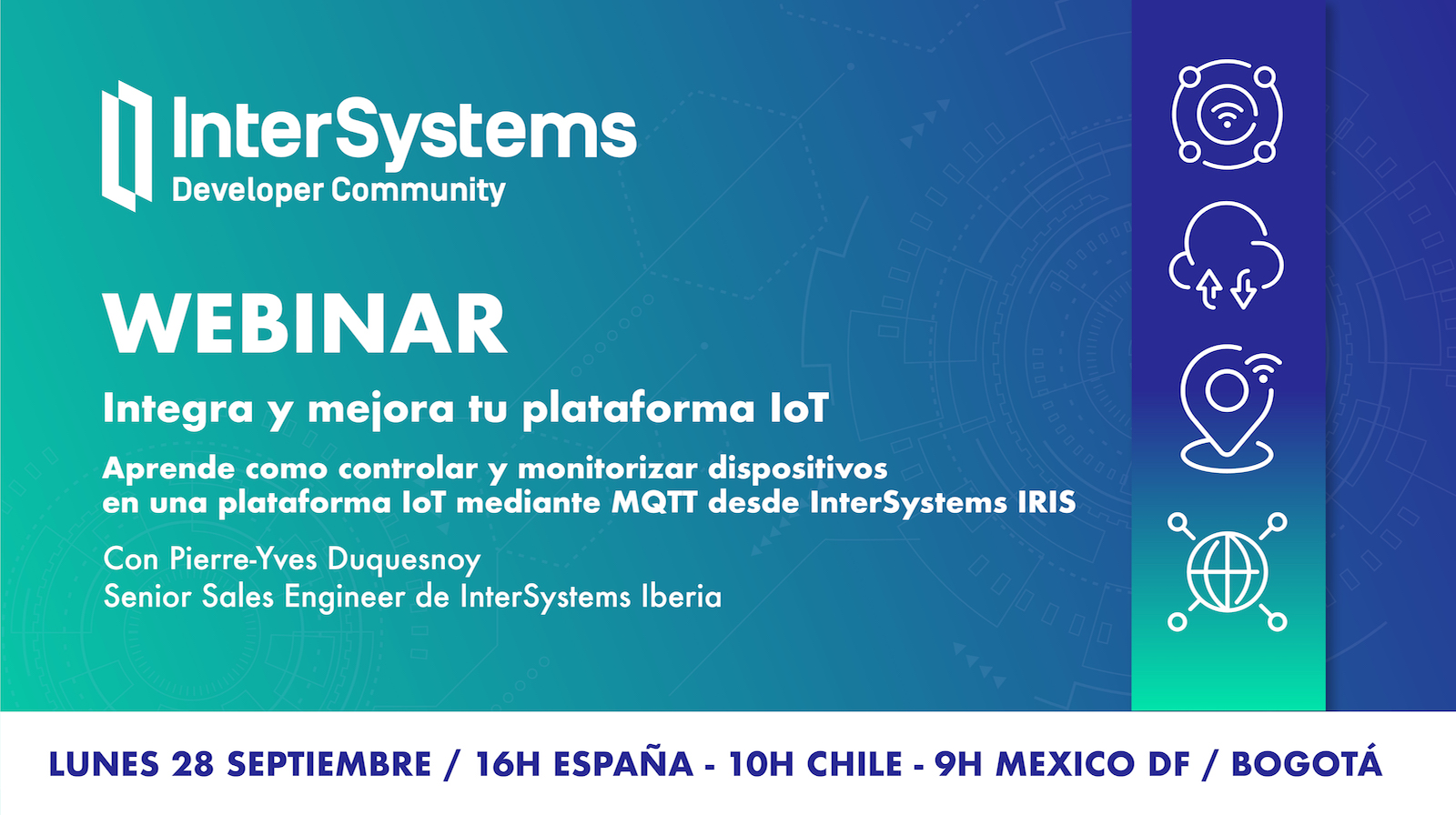
We are pleased to invite you to the upcoming webinar in Spanish: "Integrating and improving your IoT platform", on September 28 at 4:00 PM (CET)!
Hi Community!
Enjoy watching the new video on InterSystems Developers YouTube:
Hi Developers!
Here're the technology bonuses for the Full Stack Contest that will give you extra points in the voting:
See the details below.
Hi Community!
Please welcome the new video on InterSystems Developers YouTube:
⏯ Get InterSystems IRIS from the Docker Store
Hi Community!
Join us for another InterSystems Brazil virtual event, this time in partnership with Shift. The topic of discussion led by Marcelo Lorencin on September 16 will be: "InterSystems IRIS for notification of Covid-19's test results for the Ministry of Health".
Please register now with the link below, vacancies are limited:
✅ InterSystems IRIS for notification of Covid-19's test results for the Ministry of Health
Date & Time: September 16 – 11:00 BRT
Note: The language of the webcast is Portuguese.
Join us!
Hello Developer Community!
I’m pleased to announce the 0.9 release of the ObjectScript extension for Visual Studio Code. Earlier this year I announced that InterSystems would be joining the community in evolving this already popular tool. Since then, we have been hard at work solidifying the code base and building a slew of new features.
Before I get into the details, I’d like to take a moment to thank @Dmitry Maslennikov, @John.
Hi Community,
Enjoy watching the new Global Summit 2019 video on InterSystems Developers YouTube Channel:
⏯ Building Data-Driven Web Apps
Hi,
Does anyone have a simple code snippet to encode and upload a raw text to Azure Blob?
InterSystems has corrected a defect that can cause a build-up of orphaned processes consuming system resources. In extreme cases, this can cause a system to become unresponsive.
This defect affects the following versions:
No other InterSystems product versions are affected by this issue. Specifically, earlier versions of Caché and Ensemble, Health Connect 2019.1 and 2019.1.
I am currently working with docker for the first time the last month. I created a project with these 2 images:
My docker-compose.yml looks like this:
    version: '2'
    services:
        frontend:
            container_name: frontend
            build:
                context: ./container/frontend
dockerfile: Dockerfile.You might have encountered this and not known how to prevent it, or perhaps not even noticed it...
Keywords: IRIS, IntegratedML, Flask, FastAPI, Tensorflow Serving, HAProxy, Docker, Covid-19
We touched on some quick demos of deep learning and machine learning over the past few months, including a simple Covid-19 X-Ray image classifier and a Covid-19 lab result classifier for possible ICU admissions. We also touched on an IntegratedML demo implementation of the ICU classifier.