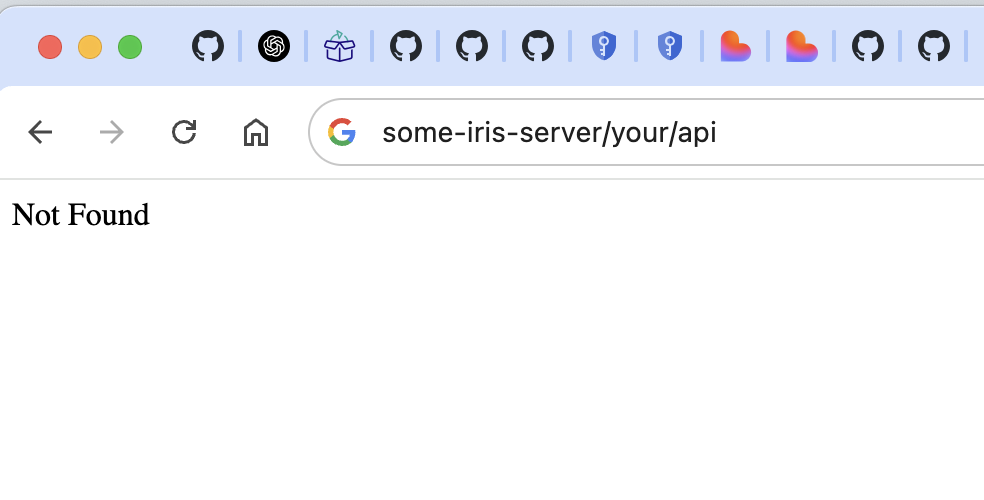
There are numerous excellent tools available for testing your REST APIs, especially when they are live. Postman, various web browser extensions, and even custom ObjectScript written with %Net.HttpRequest objects can get the job done. However, it is often difficult to test just the REST API without inadvertently involving the authentication scheme, the web application configuration, or even network connectivity. Those are a lot of hoops to jump through just to test the code within your dispatch class. The good news is that if we take our time to understand the inner workings of the %CSP.REST class, we will find an alternative option suited for testing only the contents of the dispatch class. We can set up the request and response objects to invoke the methods directly.

7 5
5 151

You probably know this situation:
Some time ago, you found a very special $ZU function for a very specific type of problem. Some kind of mystical formula. It became popular and was used by many developers throughout your code and across all your installations.

Several versions and updates later, you are informed by ISC that your mystical $ZU is deprecated and no longer supported. You are advised to replace it with a new $something().

3 2
0 79

Sometimes it is more convenient, more efficient, and more secure, to limit FHIR Searches per pre-defined "Lists" of Resources.

Since v2025.1 we support several List-related features in our FHIR Server.

I will highlight these here, and provide some samples.

5 2
0 54

Embeddedpy-bridge: A Toolkit for Embedded Python

Overview

Embedded Python is a game-changer for InterSystems IRIS, offering access to the vast Python ecosystem directly within the database. However, bridging the gap between ObjectScript and Python can sometimes feel like translating between two different worlds.

2 1
2 57
Article
· Dec 24, 2025 1m read
Using IRIS as a vector database

InterSystems IRIS embedded vector search capabilities lets us search unstructured and semi-structured data. Data is converted to vectors (also called ‘embeddings’) and then stored and indexed in InterSystems IRIS for semantic search, retrieval-augmented generation (RAG), text analysis, recommendation engines, and other use cases.

This is a simple demo of IRIS being used as a vector database and similarity search on IRIS.

Prerequisites:

2 0
1 76
Article
· Dec 24, 2025 2m read
"The Hidden HTTP Errors" (Behind IIS)

You send an HTTP request and get back an HTTP error but with an HTML error page which you didn't expect... what's happening?... 🤔

Specifically for example, perhaps you tried to READ a FHIR Resource (e.g. /Patient/123) and you get back a 404 error page, even though with other Patient IDs, you get back the Resource payload, so "the page" definitely does exist... why should you be getting a 404 error page? 🙄

6 0
0 68

When working with InterSystems Interoperability (Iris / Health Connect / Ensemble), configuration data is often spread across many production items: services, processes, operations, adapters, and their settings.

A common operational or security need is to answer questions like:

9 0
2 65

Looking at my database I see I have a very big ^rINDEXSQL global? Why is that? 😬

In the Management Portal SQL page, under "SQL Statements" I see a 'Clean stale' button - what does this do? 🤔

In the list of Statements some have a 'Location' value and some don't? How is that? 🤨

4 0
1 60

InterSystems IRIS is built on an architecture that separates the logical organization of data (namespaces) from its physical storage location (databases). Understanding this separation and the distinction between Namespaces and Databases is crucial for effective data management, security, and especially, high-performance data sharing.

In this article, I will discuss these foundational components and provide a practical guide on leveraging global mappings to share native data structures (globals) across different logical environments.

Databases: Physical Reality

A database represents the physical reality of where the data is stored on the disk. First and foremost, it’s a file in a file system called IRIS.dat (e.g., <Install folder>\mgr\user\IRIS.DAT). The maximum size of this file is 32TB. It is the container for all the actual data and the code. Databases are managed by the IRIS kernel, which handles caching, journaling, and transaction logging at the physical file level.

When you install InterSystems IRIS DBMS, the following databases are installed automatically:

4 0
2 51