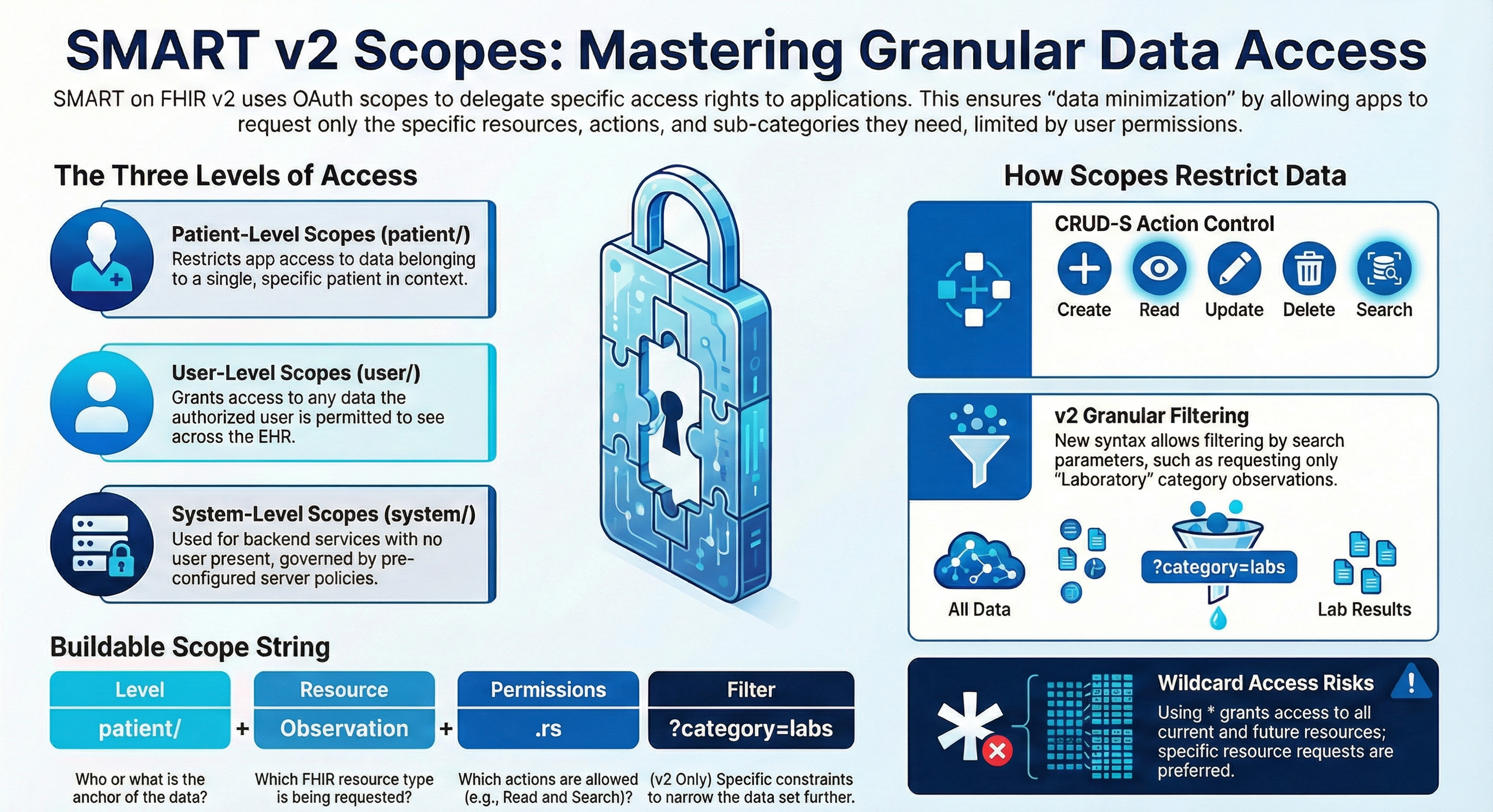
In v2026.1 we introduced support for a more robust and real-life secure authorization for your FHIR endpoints.
This is achieved by using SMART on FHIR v2 fine-grained scopes.

Fast Healthcare Interoperability Resources (FHIR, pronounced "fire") is a draft standard describing data formats and elements (known as "resources") and an application programming interface (API) for exchanging electronic health records
In v2026.1 we introduced support for a more robust and real-life secure authorization for your FHIR endpoints.
This is achieved by using SMART on FHIR v2 fine-grained scopes.

#North American Demo Showcase entry.
>> Answer the question below to be entered in the raffle!
⏯️ Message Operational Data Store
Create an operational data store using the data flowing through your production. Create user-defined analytics tables based on fields and paths to their data from incoming documents with varying standards (FHIR, CDA, HL7v2, etc.).
Presenters:
🗣 @Kwabena Ayim-Aboagye, Sales Engineer at InterSystems
🗣 @Christopher Carmichael, Sales Engineer at InterSystems
🗣 @Jeff Semmens, Senior Sales Engineer at InterSystems
#North American Demo Showcase entry.
>> Answer the question below to be entered in the raffle!
⏯️ Health Galaxy: AI-Enabling Healthcare Applications
Health Galaxy creates an AI access point on top of any FHIR server, bringing healthcare into the AI future that has become a reality for many other industries.
🗣 Presenter: @Zelong Wang, Sales Engineer at InterSystems
#North American Demo Showcase entry.
>> Answer the question below to be entered in the raffle!
⏯️ AI Assistants for the Unified Care Record Powered by Gemini
In this demo, you will see how Gemini works directly with FHIR data, and how it leverages the harmonized dataset provided by InterSystems Unified Care Record. It also showcases multiple AI assistants helping multiple groups of users, e.g. clinicians, patients.
🗣 Presenter: @Simon Sha, Sales Architect at InterSystems
Hi Developers,
We are happy to announce the new InterSystems online programming contest:
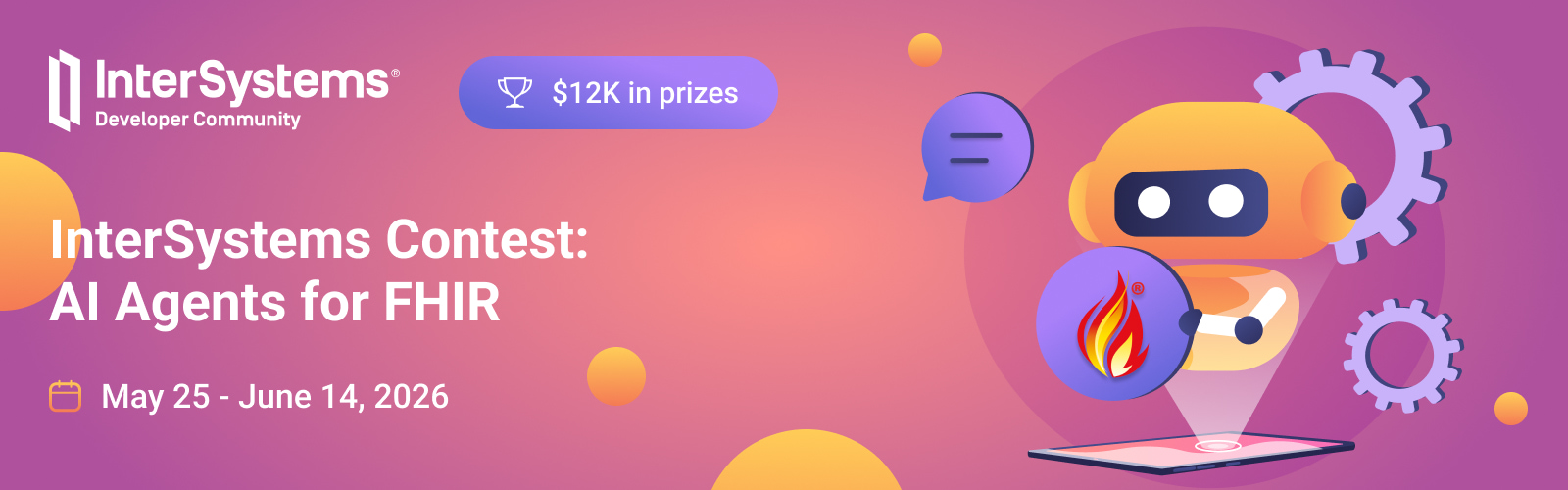
🏆 InterSystems Programming Contest: AI Agents for FHIR🏆
Duration: May 25 - June 14, 2026
Prize pool: $12,000

Hi,
I'm pretty sure I'm not the first one to encounter this, so please share your solution
I'm trying to load a package with 2 dependencies, one of them has 5 dependencies..
is there a better tool / script / wizard for that?
I am working on setting up OAUTH with FHIR and Microsoft Entra. I have configured the Client and configured it in the FHIR Server successfully. However, I get 401 when authenticating with a token. Looking at ^ISCLOG I see:
^ISCLOG("Data",9,0)="accessToken=<jwt token>, scope=, aud="
^ISCLOG("Data",10)=$lb(3,"OAuth2","[OAuth2.ServerDefinition:ValidateJWT]","171430","%SYS","2026-04-28 17:41:25.305549397","OAuth2.ServerDefinition.1","","zwKKakZZZx2")
^ISCLOG("Data",10,0)="JWT valid? sc=1"
^ISCLOG("Data",11)=$lb(3,"HSFHIRServer","[HS.FHIRServer.
In v2026.2 (currently available as a Developer Preview), we are adding a feature that can help in a FHIR Endpoint SMART/OAuth authorization - more out-of-the-box flexibility in audience value validation.
Hi, Community!
Are you gathering data for clinical research? See how InterSystems OMOP can help streamline your data preparation:
A very important feature for HL7 FHIR has been introduced with the release of v2026.1 - the support for SMART on FHIR v2 fine-grained granular Scopes.
This enables you to be much stricter and more accurate in the access you provide to the data in your FHIR repository.
Part of this new support is to refuse requests that don't match the scopes, but an even more interesting ability is to filter the results according to the provided scopes.
The 2026.1 release of InterSystems IRIS® data platform, InterSystems IRIS® for Health, and InterSystems Health Connect™ is now Generally Available (GA). This is an Extended Maintenance (EM) release.
|
Advisory ID |
Product & Versions Affected |
Risk Category & Score |
Explicit Requirements |
|
IF-9396 |
InterSystems IRIS® for Health InterSystems Health Connect™ versions |
System Stability Concern: 3 |
Deployments with non-default path-prefixes will not serve FHIR Server UIs. |
Hi, Community!
Need help setting up OAuth on the FHIR Server? We'll guide you through the workflow:
Hi Community,
An error occurs during the analysis process in the FHIR SQL Builder. How can I identify the exact cause of the error?
I'm using this service to create a FHIR facade.
I want to return OperationOutcome to the calling application when I detect an error.
My code at present is :
set##class%NewIf I change the response code to 422, the calling app doesn't get the OperationOutcome. Instead I get
The custom error module does not recognize this error.
Do I need to implement a custom error?
FHIR (Fast Healthcare Interoperability Resources) is the modern standard for storing and exchanging clinical data. But once your data is in a FHIR server, how do you actually explore it? FHIR data is stored as JSON — powerful, but not practical to read directly. I wanted a tool where you could click on a patient, see their conditions, medications, lab results, and more — in a clean, readable format. So I built the FHIR Patient Viewer.
The app runs entirely in Docker and connects directly to an InterSystems IRIS for Health FHIR server.
I thought I knew how to return a Response from a Business Process back to the Source Config Name, but I guess not.
I am working on a Proof of Concept, that the Request Message Class would determine a "Route" within a Business Process to make a FHIR call (search, read) to our External FHIR repository, and return back the HS.FHIR.DTL.vR4.Model.Resource.xxxxxxx as a Response to the Source Config Name.
I have the FHIR part working, however now that I have the data in the form of HS.FHIR.DTL.vR4.Model.Resource.
Earlier this year, I set about creating kit to introduce young techy folk at a Health Tech hackathon to using InterSystems IRIS for health, particularly focusing on using FHIR and vector search.
I wanted to publish this to the developer community because the tutorials included in the kit make a great introduction to using FHIR and to building a basic RAG system in IRIS.
Hey Developers,
Watch this video to learn about automating the provisioning and management of FHIR services:
⏯ Automating Provisioning and Management of FHIR Services @ Ready 2025
Hey Community!
We're happy to share a new video from our InterSystems Developers YouTube:
🌐Explore the world of HL7® FHIR® at your own pace with a curated YouTube playlist from Learning Services.
Emergency Medical Services (EMS) teams often arrive at the emergency department with patients whose demographics are incomplete or unknown—no medical record number (MRN), no confirmed name, and sometimes no date of birth. Yet EMS transportation notes still need to land in the correct chart.
To support safe and reliable documentation, EMS agencies, third-party integration services, and hospital integration teams build secure interfaces that exchange identifiers and clinical messages.
Hello everyone,
I am André from MedVertical. We are exploring InterSystems-native ways to operationalize continuous FHIR conformance: repeatable regression runs, baseline/delta comparisons, and evidence-style reporting to detect drift after releases and IG changes.
In many FHIR implementations, validation is done “point-in-time” in pre-prod, but conformance degrades in production due to IG/profile updates, terminology changes, mapping evolution, upstream releases, and configuration drift.
JSON
JSON (JavaScript Object Notation) is a lightweight, text-based format designed for structured data interchange. It represents data objects consisting of key–value pairs and arrays, and it is entirely language-independent.
Hello Community,
We are excited to announce that registration is now open for the second cohort of the course:
🧑💻 Developing FHIR Applications Using Python 🧑💻
This hands-on program is designed for developers who want to build real-world FHIR applications using Python and InterSystems IRIS for Health.
👉 Watch 5-minute course overview
📅 Second cohort starts March 29, 2026
In the modern healthcare landscape, finding clinically similar patients often feels like looking for a needle in a haystack. Traditional keyword searches often fail because medical language is highly nuanced; a search for "Heart Failure" might miss a record containing "Congestive Cardiac Failure."
I am excited to share iris-medmatch, an AI-powered patient matching engine built on InterSystems IRIS for Health. By leveraging Vector Search, this tool understands clinical intent rather than just matching literal strings.
Hi Community!
We’re excited to announce the launch of a new, hands-on training program:
🧑💻 Developing FHIR Applications Using Python 🧑💻

This cohort-based course takes developers from FHIR fundamentals to advanced, real-world healthcare interoperability solutions, with deeper, more practical coverage than typical industry offerings and a strong focus on production-ready skills using InterSystems technology.

You’ve seen how tools like Lovable are shaking up web development. People are spinning up entire apps just by talking to an AI, almost like pair‑programming on steroids.
Now imagine bringing that same “vibe coding” experience into healthcare. know, it sounds crazy. Healthcare is complex, full of regulations, and usually gives us a headache just thinking about the interoperability rules.
That’s exactly the space where withLove lives: an AI‑Native, Low‑Code platform built entirely on InterSystems IRIS for Health.
Hi, Community!
👩⚕️If you need to access clinical data at scale, the InterSystems Bulk FHIR Coordinator can help!
Using the InterSystems Bulk FHIR Coordinator to Extract Clinical Data
Hi,
I need to create a bundle of synthetic data in order to populate FHIR servers (not mine).
Can I use a predefined ids, or is it possible the one of the servers will not allow using my IDs and replace them with it's automatic numbering?